Tag Archives: Louis Armstrong

A Stan King Playlist

Photo Care of @onlyapaprmoon

Photo from Timeless CD CBC 1-090 courtesy of @onlyapaprmoon

Like most early jazz drummers, Stan King was not well served by technology. He first appeared on hundreds of sessions with the California Ramblers, including the band’s numerous offshoots for different labels, starting in the early twenties. Acoustic recording techniques at that time limited the equipment that drummers could use, and the technology wasn’t kind to what remained of the kit. King does manage to burst out of the Five Birmingham Babies (a.k.a. the California Ramblers) on “Arkansas” and bang out some springy drum rudiments on Ray Kitchingham’s banjo:

Unfortunately, outbursts like this one were rare. King didn’t use the standard acoustically sanctioned percussion (like cymbals and blocks) as much as his contemporaries Zutty Singleton, Baby Dodds, and Chauncey Morehouse. So despite all the records, it’s hard to hear what or how King was playing early on his career. Either way, it got him plenty of work! He must have been doing something worth hearing.

Based on slightly later recordings, it involved plenty of snare drum. Jazz drumming now often tends to emphasize metal as the primary beat maker. Yet as “Broken Idol” with the Ramblers shows, King could move a band with “just” drum skins. It’s a pity he was so skilled with what amounted to kryptonite for most recording engineers of the twenties:

Aside from a few cymbal crashes, the “exotic” blocks, and tom-toms, King’s main rhythmic medium here is his snare and bass drum. He keeps up a simple but buoyant bounce alongside Tommy Felline’s banjo and then steps out behind Pete Pumiglio’s red hot alto sax solo. The brushes are pure momentum, more than compensating for Ward Lay’s slightly ponderous tuba. There’s none of the military-style heft that so many historians associate with prewar, snare-centric jazz drumming.

King’s work with Frank Trumbauer’s orchestra demonstrates his light but propulsive touch on drum heads while never drawing too much attention to the wheels moving the band. “Futuristic Rhythm” includes a head-bobbing rhythm in the first chorus and percolating accompaniment to the leader’s vocal and cymbals behind Bix Beiderbecke:

King’s airtight press rolls and last chorus backbeat on “I Like That” (a.k.a. “Loved One“) are simple, impeccably timed, and very effective:

Listening to King nearly 60 years later, renowned drummer Mel Lewis pointed to King’s “clean” style with definite praise. A crisp, precise, and utterly unobtrusive approach defines King’s style more than any part of the drum set. He was above all an ensemble player who rarely soloed but always made sure that the band was “well fed” (to paraphrase bass sage Walter Page describing the role of the rhythm section).

With the Charleston Chasers, King leaves most of the rhythmic heavy lifting on “Loveable and Sweet” and “Red Hair and Freckles” (what were these guys thinking about on this session?) to pianist Arthur Schutt and bassist Joe Tarto:

Dancers and jazz aficionados may not be listening for King’s sizzling brushes and tapping rims or how his drums click in with Tarto’s bass to produce a deliciously buzzy sonority or for his simple but firm beat. Listening to those touches reveals how subtly King could color and catalyze a band. It also points to an attention to detail and a knack for musical nuance that might not be heard could be felt. For example, while many drummers use press rolls, and King relied on them throughout his career, the way that he loosens his press rolls up behind Tommy Dorsey’s trumpet solo on “Hot Heels” with Eddie Lang makes a difference:

Audio wizard, historian, and trombonist David Sager recalls an “old-time drummer” he met at a gig in California “who nearly shouted when he said, ‘Stan King had the best press roll in the business!’” King’s press rolls with none other than Louis Armstrong on Seger Ellis’ “S’Posin” might not impress on their own, but Armstrong scholar Ricky Riccardi explains that “Armstrong liked loud, emphatic drumming, and he obviously dug what King was putting down.”

[Listen to “S’Posin” via Riccardi’s outstanding blog here, and subscribe while you’re at it.]

According to Richard Sudhalter, King didn’t read music. His “natural drive and quick ear” were enough to make him one of the most in-demand drummers in New York during the twenties and thirties, performing with Paul Whiteman, Jean Goldkette, the Boswell Sisters, Ben Selvin, the Dorsey Brothers, and Benny Goodman among others. A session directed by bass saxophonist Adrian Rollini finds King with the cream of the New York jazz crop at that time on standards such as” Sugar” and  “Davenport Blues”:

On “Somebody Loves Me,” King lays out behind George Van Eps’s solo, which allows the guitar to get heard and changes up the ensemble texture, but digs in behind Goodman’s clarinet and Arthur Rollini’s tenor saxophone while easing back behind trumpeter Mannie Klein and trombonist Jack Teagarden. It’s a model of sensitive, rhythmic jazz drumming (or “dance band” drumming, depending on one’s preferred pigeonhole):

King could also turn up the heat on his own. On “The Man From The South” with Rube Bloom, he locks in with Adrian Rollini, tossing out fast snappy fills and bearing down just a little harder behind Goodman before making room for Rollini’s solo:

On “Here Comes Emily Brown”—again with the Charleston Chasers but without Joe Tarto’s booming slap bass—King add a sizzle to his shuffle behind Tommy Dorsey’s trombone while his cowbell accents practically kick Benny Goodman from behind. Fills and backbeat on the out chorus also boot the ensemble:

King even gets some spotlight in a call and response episode with the ensemble on “Freeze and Melt” with Lang:

Occasionally, King would get away from a steady beat and toss out unexpected accents and syncopations, for example early on his career behind Bobby Davis’ alto solo on “That Certain Party” with the Goofus Five (a.k.a. the California Ramblers):

or his offbeat rim “bombs” behind Jimmy Dorsey’s alto on “You’re Lucky To Me”:

Yet it’s all within the context of the band. Record after record shows King to be a clean, precise, utterly musical drummer. His preferred instrumentation may have limited his recorded legacy, and his unflashy style may have hindered his historical one. Singer Helen Ward, speaking about King’s tenure with Benny Goodman’s band, said “we called him strictly a society type of musician. Everything he played was ‘boom-cha, boom-cha.’ There was no fire there.” Goodman described King as “merely adequate.”

The entry for King in the Encyclopedia of Popular Music describes “an exceptionally good dance band drummer with meticulous time [whose] jazz work always left something to be desired. Listening to, for example, Goodman’s recordings in late 1934 will reveal how King’s playing never lifts the band in the way Gene Krupa did when he took over as drummer…” John Chilton describes Louis Armstrong’s “I’m Putting All My Eggs In One Basket” as a “typical example of [King’s] somewhat foursquare playing:

King isn’t Krupa, Dodds, Sid Catlett (or for that matter Elvin Jones), but it’s easy to imagine any of those players taking the same approach that King does given the thin material, flimsy arrangement, and the fact that this is really Armstrong’s show. Riccardi astutely points out King’s “tasty” accents during Armstrong’s opening trumpet chorus and the fact that “relaxation is the key” here. There’s a difference between playing stiffly and playing appropriately, a difference King was more than experienced enough to understand.

In the stylistic wake of louder, better-recorded, and busier drummers, it is easy to overlook someone like King, who performed an essential role seamlessly and without drawing attention to his work. What some overlook, others celebrated. Drummer Chauncey Morehouse would praise King for his solid time years after his colleague’s death. When Morehouse led his own date playing his patented N’Goma drums, he chose King to handle traps duty.  Fud Livingston thought King was “the world’s greatest drummer!” Saxophonist and historian Loren Schoenberg noted how King continued to get work despite his well-known status as a “fall-down drunk.” It didn’t seem to matter: King got the job done.

Jazz historian Scott Yanow, who credited King for his “fresh” sound, explains that King’s alcoholism finally did get the best of him. King eventually took a low-key job with former California Ramblers sideman Chauncey Grey before fading from attention and passing away in 1949. King made his last recordings ten year earlier, with pianist (and fellow victim of alcoholism) Bob Zurke. “I’ve Found A New Baby” wasn’t the last thing King recorded but it provides explosive closure:

Fud Livingston’s arrangement gives King and the rest of the band plenty of room. King is a force of nature, crisp and light as always but distinctly forward in the mix, perhaps the influence of what Krupa and Chick Webb were bringing to the table at the time. King still remains his own man, with press rolls in first chorus and rim shots and backbeats egging on Zurke’s contrapuntal flurries and Sterling Bose’s trumpet. At a time when most drummers were emphasizing cymbals and a steady horizontal flow, King stuck to skins and a charging but tight vertical feel. He had something unique to contribute and put the needs of the band first. That certainly sounds like a jazz drummer, or maybe a just a good band drummer, but definitely a drummer worth hiring and hearing.

Tagged , , , , , , , , , , , , , , , , , , , , , , , , , , , , , , , , , , , , , , , , , , , , , , , , , , , , , , , , , , , , , , , , , , , , , , , , , , , , , , , , , , , , , , , , , , , , , , , , , , ,

My Favorite “Ain’t Misbehavin'”

Tom Lord’s Jazz Discography lists over one thousand recordings of “Ain’t Misbehavin’.” Pretty good for a song that Ted Gioia explains is ”not quite as important a part of the jazz repertoire nowadays as it once was.”

It is true that beboppers, post-boppers, free-jazzers, fusionites and other modernists never really cozied up to the Fats Waller standard. That still leaves a who’s-who of prewar and prewar-influenced jazz musicians to give it a shot. Yet even with Louis Armstrong’s magisterial interpretations, the composer’s own performances and pianists from Jelly Roll Morton and Art Tatum through Dick Hyman and Jeff Barnhart to choose from, I keep coming back to the Charleston Chasers’ “Ain’t Misbehavin’.”

In fact the the Original Memphis Five working under an alias that Columbia records used for several bands, the Charleston Chasers waxed their version at the height of the song’s popularity. Waller had written “Ain’t Misbehavin’” for the revue Hot Chocolates, where it soon became a feature for Louis Armstrong and eventually the most famous part of the show. The Chasers recorded the tune about a year later, and just a few weeks before Armstrong made his own recording (skip ahead to 0:48 in the following clip to hear the music):

This arrangement never entirely settles, and that’s what makes it so interesting. The Chasers’ two-beat amble has its own magnetic energy, but their rhythm is a little overly delineated. Phil Napoleon’s trumpet is typically crisp yet slightly tense: his high notes during the introduction sound forced while the turnaround notes in the first chorus are hesitant. There’s a carefulness to the Chasers’ playing, the sound of a band feeling their way through a brand new composition.

NapoleonThey’re also figuring out what to “do” with this new song,  adding some highly original touches to make it their own. The Chasers feature a standard front line of trumpet, trombone and clarinet, but clarinetist Jimmy Dorsey lays low during the ensembles to let Napoleon and his frequent OM5 partner Miff Mole fashion brass duets. Napoleon and Mole were already seasoned jazz musicians, developing in tandem with the music from its earliest roots in ragtime. The pair displays a refreshingly harder-edged sound and play busier, punchier lines than most of their New Orleans colleagues. Napoleon and Mole even switch roles following the vocal, with muted trumpet decorating the trombone’s burry lead.  Eva Taylor’s vocal is charming but Arthur Schutt’s elegant accompaniment behind her is the real find.  His classical allusions also turn the minor chords of the bridge into miniature Rachmaninoff preludes. Joe Tarto’s bass keeps snapping throughout while Dorsey’s whinnies add a humorous symmetry to the whole thing.

This performance is a departure from the jamming and stride theatrics now typically associated with “Ain’t Misbehavin’.” It’s also far removed from the weight of history and sense of familiarity attached to even the most relaxed renditions of this song. This was only the fourth recording in the history of Waller’s iconic tune. If it shows its age, that age offers a completely unique experience.

Tagged , , , , , , , , , , , , , , , , , , , , , , , , ,

Finding Bill Moore

Bill Moore. The name seems like a pun on itself, a homophone inviting literally “more” to be said about it while resisting that urge through its own frequency. The number of birth certificates, census records, coroners’ reports, and gravestones for “William Moore” or “Bill Moore” makes it a daunting prospect when it comes to research. I’m interested in the trumpeter Bill Moore, but there are several players with that name, playing different instruments and kicking up more hay around my desired needle.

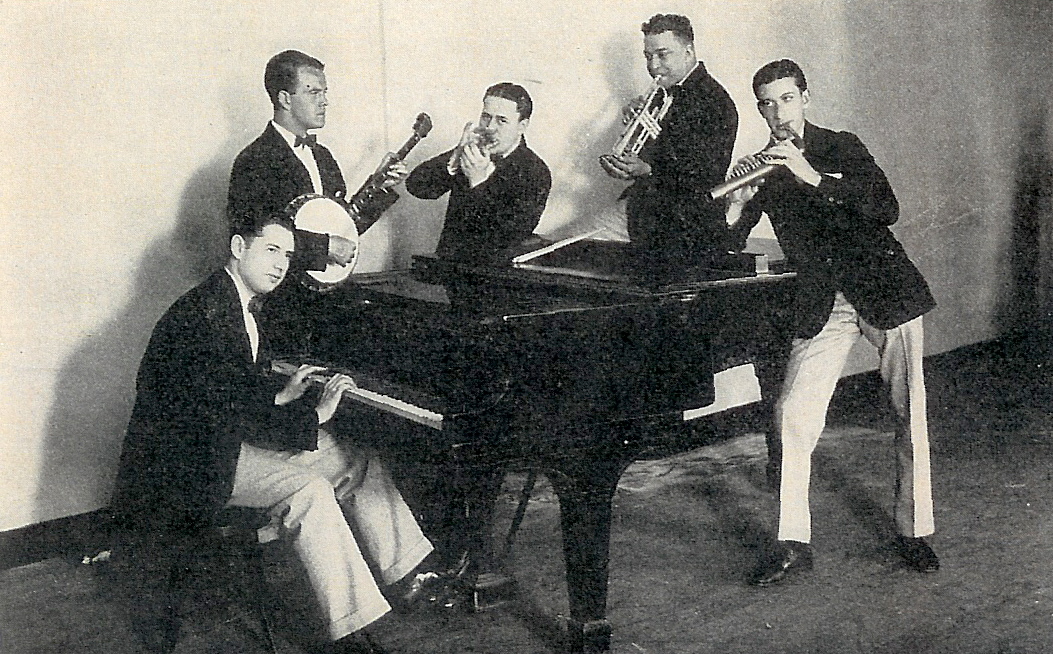
Irving Brodsky - Piano  Left to Right: Ray Kitchingham, Stan King, Bill Moore and Adrian Rollini
Irving Brodsky – Piano
Left to Right: Ray Kitchingham, Stan King, Bill Moore and Adrian Rollini

What I’ve found (so far, based on admittedly perfunctory research) says little and repeats it often: that Moore worked with the California Ramblers in all of their pseudonymous forms as well as with Ben Bernie, Jack Pettis, and many other bandleaders. His unique position as a Black musician playing in white bands also comes up frequently. Howard Rye, quoting Albert McCarthy’s The Dance Band Era in Names and Numbers magazine, explains that “One of the regular personnel [of the California Ramblers] in the mid-20s was trumpeter Bill Moore, a light-skinned Black who ‘passed.'” Discographies confirm that he played with a variety of bands through the Swing Era, with a 1950 Billboard review praising his “Armstrong-inspired” trumpet. There’s not much more to learn about the man, even less when it comes to the musician. Bill Moore is very hard to find.

The sound of Moore’s trumpet during the twenties takes us past the realm of historical ciphers and gigging sidemen. At that time, Moore was a distinctly pre-Armstrong player. His tone is far removed from the rich, brassy sound now virtually synonymous with “jazz trumpet.” It’s narrower and more piercing, like a needle rather than a sword, well suited to tying an ensemble together rather than cutting its own path.

Even through the haze of acoustic records, Moore’s trumpet has a buzzy edge to it, different than the cool quality of his contemporary Red Nichols, the broad, warm tone of Paul Mares or Johnny Dunn’s crisp flourishes.

Moore also frequent played with a mute. Brass players often point out how mutes can be used to hide intonation problems (with King Oliver a favorite example) but the possibility of expressive choice is worth considering in Moore’s case. Moore’s pinched sound was put to good use on a series of sessions throughout the late twenties.

Moore also chatters rather than blasts, maybe to hide an uneven tone, maybe to show off fast fingers. Either way, he lets this brash instrument—seemingly designed for sweeping bursts—speak in tight, concentrated patterns.

Armstrong experimented with what Brian Harker called a clarinet-like approach early on in his career. Nichols used clever, clipped lines throughout his long career. Jabbo Smith and Roy Eldridge frequently employed double-time with the boppers later adding their own phrasing and harmonic ideas.

Moore’s chattering is based on a pre-Armstrong aesthetic that emphasized contrast and variety over continuity and flow. It’s also more of an ornament, as Moore sticks closer to the melody than many modern jazz musicians care to—while Moore knows how to have fun with even the silliest tune, rather than simply throw it out. The emphasis on contrast, paraphrase, and mutes indicates that Moore might have been listening to “novelty” trumpeter Louis Panico.

Listening to Moore reveals more than session dates and personnel listings. It points to influences, musical choices, textures, and his own stylistic vocabulary. In other words, there’s a distinct musical voice at work. Neither a genius granted immortality nor a hack deserving complete neglect, after generations of brash, brassy trumpeters in the Armstrong mode, Moore’s style might seem like a wholly new experience (even if it originated decades before most readers were born).

from The Reading Eagle, November 7, 1929

Jazz purists might dismiss Moore based on his different sense of swing, comparatively restrained improvisational approach, or some other interesting but ultimately illogical bit of teleology. Given his post-ragtime, pre-Armstrong soundscape, criticizing Moore (and his contemporaries) for not sounding like later players is like chastising Renaissance paintings for having too many religious references. Rather than admiring the work in its historical context or apart from the critic’s context, everything is measured against one stylistic endpoint with all “great” works leading up to or issuing from it.

Not that many even take the time to dismiss Moore based on his playing.  As is often the case with the earliest chapters of music history, discussion beyond the session cards and matrix numbers and right to the sound of the music appears infrequently. Maybe reacting to the music itself seems too subjective. Maybe now that Moore and his colleagues are no longer around, maybe the only thing left to do is ensure an accurate record of the past. Hopefully, when the record is complete, we’ll remember why it was assembled in the first place.

Tagged , , , , , , , , , , , , , , , , , , , , , , , , , , , , , , ,

A Contender for John Coltrane’s Favorite Tuba Player

Released in 1963, and even with its rhythm section and harmonic sensibility soaked in modern jazz, John Coltrane’s album Ballads may be one of the best examples of the prewar jazz aesthetic:

Coltrane’s reliance on pure tone and straightforward lyricism speaks to a style of jazz that can paraphrase melodies (even fast ones) as well as deconstruct them.  The “tune proper” isn’t thrown out after the first chorus, but partnered with throughout the performance, channeled to make something recognizable but personal.

Do yourself a favor and click on the following hyperlinks.  You will not be sorry.

Coltrane, the symbol of boundary-pushing, technically advanced modern jazz, keeps company with Louis Armstrong and Bix Beiderbecke, as well as Phil Napoleon, Manny Klein and Joe Smith. Trumpeters were usually the ones playing lead in the twenties, thirties and forties, but saxophonist Frank Trumbauer and his way of paring down a melody to its essentials also comes to mind, as does trombonist Kid Ory.  Don Murray, with a gorgeously burry sound and distinct personality on baritone sax, also understood that the expressive potential of straight melody.  Even Guy Lombardo’s sax section, hated by jazz scholars and beloved by Armstrong for their clean melody statements, might have appreciated Coltrane’s approach on Ballads.

Coltrane’s glistening tenor sax even brings to mind tuba player Clinton Walker on “Frankie and Johnny” with King Oliver:

Walker provides a rich lead for the leader’s punctuations, and while he doesn’t get all of his notes out, its an admirable solo.  Modern ears may hear it as a novelty, but the tone, the attempt to control the sound and the refusal to harrumph reveal a player giving both the melody and his own voice their due.  Differences of chops, decades and octaves notwithstanding, these musicians were all about the tune.

Wonder If He Ever Heard Alberto Socarras?

Wonder If He Listened to Alberto Socarras?

Tagged , , , , , , , , , , , , , , , , , , , , , , , , , , ,

Five Letters That Feel Like Four

Fire That Press Agent, Eddie

I’ve hated the word “Dixieland” since I first gathered a few friends from my high school band to play the music of Jelly Roll Morton, the Bobcats and other prewar jazz musicians. No matter how much I insisted that we were playing “traditional jazz,” the label “Dixieland” stuck with teachers, parents and other (unfortunate) listeners.

My distaste for that word had nothing to do with any cultural or chronological connotations.  Ironically, as a kid who had spent his whole life in Brooklyn with occasional travel as far as City Island, I had no idea that “Dixie” signified the South, especially some (ridiculous) vision of an idyllic antebellum South. If “Dixie” meant “archaic,” my teenaged reverse conformism just thought, “the older, the better!” No, I hated that five-letter word because it reminded me of an earlier childhood treat that had neither the longevity or nutritional value of jazz.

I had only heard “Dixie” in reference to the circular bricks of processed ice cream that elementary school teachers deposited on my desk as a sign of celebration (read, pacification), food that didn’t merit a spoon but just included a small, dull, wooden plank, a utensil that correctional officers might like because inmates couldn’t carve it into a shank. “Dixieland” reminded me of Dixie Cups, and that was an outrage.

“‘Cause Ice Cream Scoops Are Bourgey!”

Sure, the word “Dixie” could have seemed like a bite of nostalgia, almost the way it did for the lyricists of tunes such as “Anything Is Nice If It Comes From Dixieland” or “There Ain’t No Land Like Dixieland,” anthems to a kinder, simpler time (that was never kind or simple).  “Dixieland” bands did reference the early days of jazz through choice of repertoire, collectively improvised ensembles and their preference for blue thirds over flatted fifths. Some Dixielanders paid obvious (sometimes gratuitous) homage to the original artists.

Phil Napoleon Never Played Dixieland.

Yet those artists’ music had to deserve a better label than that of a tiny, soggy, syrupy sweet confection aimed at underdeveloped palettes. By extension, the thin horns and bloodless rhythm sections I heard from many so-called “Dixieland” groups was a far cry from Bix Beiderbecke’s popping ensembles, King Oliver’s dense, earthy polyphony or even the Original Dixieland Jazz Band’s almost frighteningly frantic attack. The music of the “Chicagoans and the best contemporary “trad” players listened back but resounded in the here and now. By contrast “Dixieland” seemed like sugarcoated revision rather than sincere reflection.

Of course the distinction between good music, bad music and bad labels gets clearer as I get older (while straw hats and red suspenders will always be just plain awful): like ice cream or a host of other delights, everyone knows what’s good or bad when they hear it.  “Dixie” remains something that’s tolerable in small doses but will eventually make me sick.

Tagged , , , , , , , , , , , , , , , , , , , , , , , , , , , , , , , , , , , , , , , , ,

RIP Joe Muranyi

Joe Muranyi, courtesy of Henning Janos

Joe Muranyi passed away last Friday.  A bad Internet connection and a busy weekend kept the news from me until Monday, and uncertainty about what to say kept me from commenting until today.

Muranyi was best known as the last clarinetist to play with Louis Armstrong, as well as a good friend of Armstrong’s, a prodigious jazz writer and a fine musician in his own right.  Muranyi was a link to a seminal force in music.  He was also the person who taught me how to give Louis Armstrong the benefit of the doubt.

As a younger listener,  I was one of those Louis Armstrong fans who just assumed that the great trumpeter’s career as a jazz artist ended some time around 1928, when big bands, vocals and Tin Pan Alley made him into a (mere) “popular entertainer.”  Joe Muranyi’s liner notes for the 1989 BMG/Bluebird CD Laughing Louie taught me better.  Knowing the man and his music well, he pointed out that Armstrong wasn’t holding back, he was playing just the notes he needed for maximum impact.  He wasn’t selling out by leaving jazz tunes behind, he was flexing his imagination and chops by looking ahead to new material.  Most of all, he was reaching more listeners.  Armstrong was all about reaching people.

Muranyi’s commentary moved like great sports casting.  It was also optimistic, open-minded and above all insightful, treating these 1932 and 1933 studio sessions not as popular concessions or the product of opportunistic management, but as the sincere work of a pensive yet joyful artist.  In short, Muranyi heard music, and from then on so did I.

And that’s all I have to say about him.  I’ll leave the rest to some other writers who help me to hear more and understand better:

Goodbye, Josephus” from Michael Steinman at Jazz Lives.

In Loving Memory of Joe Muranyi” by Ricky Riccardi at The Wonderful World of Louis Armstrong.

Tagged , , , , , , , , , , , , , , ,

Phil Napoleon: To Jazz Or…

Swing, blues and a completely fresh improvisation at every performance: three common (for some essential) descriptors of “jazz” that were only beginning to take root at the height of Phil Napoleon’s career. Sounds from New Orleans and the Midwest territories were not as widespread when Napoleon was blowing trumpet for the Original Memphis Five. Louis Armstrong’ rhythmic and solo innovations were still to come, and jazz remained a collective experience with strong influences from ragtime. Yet even beyond his musical and historical surroundings, Napoleon always had other priorities.

Those priorities included a brilliant yet inviting tone, given to clipped articulation and rhythmically tense phrasing. That tone usually supported a powerful, balanced lead, but could also supply spare, neatly organized “hot” patterns. “How Come You Do Me Like You Do” features Napoleon’s direct ensemble lead as well as his witty muted obbligato behind Jimmy Lytell’s clarinet:

Richard M. Sudhalter explained, “The Memphis Five appear to have ‘routined’ their arrangements in advance and in detail…A routine on one number doesn’t change from take to take.” This stick-with-what-works ethic makes sense the more one hears (and feels) Napoleon’s overriding concern for balance and blend. If Napoleon knows exactly what he’s going to play next on “He May Be Your Man,” and if the rhythm is more sway than swing, he still conveys spontaneity alongside restraint. He even adds subtle sardonic color to Lem Fowler’s naughty little tune [just follow the arrow to listen]:

He May Be Your Man

The chamber intimacy of these recordings combined with Napoleon’s clean, resilient sound betrays his background as a classically trained player. Even at his most unbuttoned, for example on a later date with Miff Mole, his “Dixieland” sound is perfectly centered, and he executes a tortuous muted passage (in tight harmony with Mole’s trombone!) neatly and convincingly:

Throughout his career, Napoleon never completely absorbed the loose rhythms and bluesy rhetoric of Louis Armstrong, or the coaxing warmth and harmonic palette of Bix Beiderbecke. It’s probably one reason why Napoleon has had a modest presence in most “jazz” histories. Here he is leading a group of other Jazz Age stars, instantly recognizable and dependable as always. Napoleon remained his own man, something even Armstrong and Beiderbecke could have related to:

Tagged , , , , , , , , , , , , , , , , , , ,

The Consequences of Freddie Keppard

Freddie Keppard’s entire discography fits on one compact disc. It’s an ironically modest recorded legacy, especially for someone who was known for everything but modesty in their lifetime.

By most accounts Keppard was proud to the point of arrogance. He came up through the ranks of New Orleans cornetists, drew crowds on the vaudeville circuit of both coasts and was more than willing to proclaim and demonstrate his musical prowess. A photograph of the cornetist, dressed smart but tough in double-breasted suit, wide brimmed Boss of the Plains Stetson and ornate lapel medal, looking out intently with a touch of haughtiness, provides a visual allegory of the musician that no less than Jelly Roll Morton and Sidney Bechet would praise years after his passing.

Keppard’s few recordings provide teasing glimpses of his huge sound and dominating style on cornet. In Keppard’s time jazz was still transitioning from collective ingredient to solo expression. The cornet was intended to provide a solid lead, with power and color supporting an ensemble. Extended solo outings, decorous lines and multi-chorus explorations wouldn’t come into play until one of Keppard’s younger New Orleans colleagues arrived on the scene.

In addition, most of Keppard’s recordings were cut with Doc Cooke‘s large dance orchestra, in which Keppard actually played the second horn part, not lead. Keppard’s role was to heat things up during an out chorus, or contribute intense but short breaks to Cooke’s written arrangements. Many of Keppard’s sides also suffer from the worst indignities of twenties audio technology. It’s a miracle anyone still cares about this loud-mouthed ensemble player.

True to reputation, Keppard demands attention. The Cooke band’s sides on Columbia Records’ certainly help: a pristine electric recording process and the diffuse acoustics of an empty hotel ballroom capture the Cooke band cutting loose on some of their hottest charts. Keppard’s brash interjection on the aptly named “High Fever” [at 0:23 in the following clip] doesn’t have anything to prove; though brief, its cocky stride tells the listener Keppard knows exactly “who he is”:

Following the piano solo, Keppard’s blasting riffs behind lead cornet Elwood Graham [at 1:07] might not provide the best instruction in providing accompaniment. Yet Keppard wasn’t there to teach or blend or simply be heard; his presence was meant to be felt. By the time the closing “dog fight” arrives [at 2:15], whatever name was written on the lead part becomes moot. This is Keppard’s tune, with driving phrases and an infectiously “funky” break [at 2:26] bringing it to a close.

Keppard isn’t doing much technically, but his impact on the Cooke band is immense. A few months later, he brings an equally gripping effect to the clean, almost concert band-like reading of the opening theme on “Sidewalk Blues,” an interpretation that he seems to self-parody and then detonate for the ride out [starting at 2:12 in this clip]:

Keppard’s hair-trigger change is the type of “sweet to hot” juxtaposition that twenties bandleaders loved to include in even their most straight-laced material. Yet Keppard’s changeover also reminds us of the brash, occasionally volatile personality he was known for. Perhaps his most powerful maneuver was turning down an offer from Victor Records to record in 1916. The reasons for Keppard’s refusal are now legend, ranging from a concern that listeners could “steal his stuff” to balking at having to record a test pressing without pay (standard operating procedure for record labels at the time).

Whatever his motivations, they point to a man who refused anything short of what he wanted. They also point towards the Original Dixieland Jazz Band’s session of February 26, 1917, considered to be the first “jazz” recording ever made, courtesy of a group of “non-improvising White musicians” and an event still debated (and despised) on both musical and cultural grounds.

Whatever else might be said of Freddie Keppard’s music or his personality, even his smallest gestures had huge consequences.  He wouldn’t have had it any other way.

Tagged , , , , , , , , , , , , , , , , , , , , , , , , , ,

Satch on Screen, Underwater and Beyond Words

A few weeks ago, I mentioned a touching film from the underwater film festival in the beautiful town of Kas, Turkey.  I didn’t mention that I was fortunate enough to meet the film’s producer/director following the screening.

In addition to his talents as a filmmaker, Ozgur Gedikoglu also plays trumpet and loves jazz.  That artistic background makes his short film about a diver’s final voyage that much more personal, while still managing to reach out to his audience regardless of their musical tastes or native tongue:

Ozgur tells me he hopes to have an English translation of the film available as soon as possible.  Thanks to the Armstrong touch and his own visual narrative, he doesn’t need to rush.

By the way, I ran into Ozgur not far from the screening, where I also met the film’s star, Suat, at his jewelry shop.  Between dives and shoots, Suat designs some lovely Murano glass jewelry.  So that makes a hat trick of Renaissance men in this film.  Ne harika bir dünya, indeed.

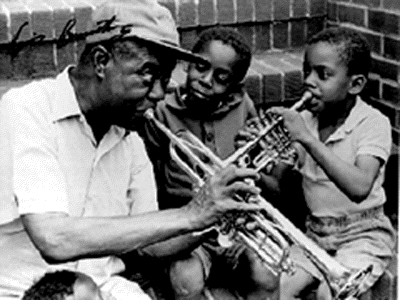
Louis Armstong Conducts an Impromptu Master Class in Corona, Queens

Tagged , , , , , , , , ,