Here’s part three of an insightful documentary on YouTube about Bill Rank and his performances in Holland. Rank is best known as a sideman with Bix Beiderbecke, but “Santopec” comments on a confident, unique trombonist who continued to grow long after Beiderbecke’s Goethe-esque early passing:
The incredible technique is still there after “all those years,” even more well integrated into a highly personal (though clearly indebted to Miff Mole) style based off of wide intervals and suspended harmonies. The difference is a surer, more rounded sound and suppler sense of construction, which allows those leaps and notes to color Rank’s inventions rather than anchor them (as they occasionally do on earlier records). Hearing Rank’s music on its own terms, without any legendary colleagues surrounding it, is the real find.
As for the “modest and captivating” person playing these solos, he confesses to embarrassment at the privileged treatment by his Dutch fans, and he still pronounces the name of an admired colleague with a Midwestern clip (“Adrian Roll-IN-e“). Not much to do with the music, but sometimes the brain and heart behind the notes matter. Who’d have thought?
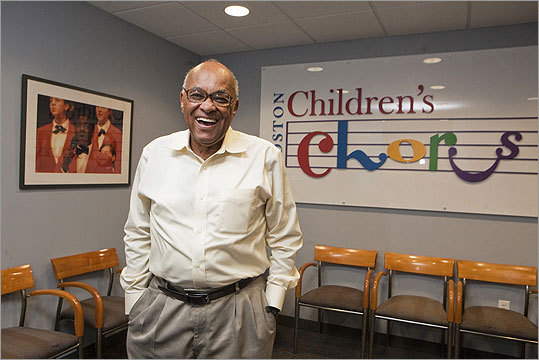
Saturday night the Boston Landmarks Orchestraopened their summer season at Harvard’s Sanders Theatre, featuring special guests the Boston Children’s Chorus and Latin ensemble Alex Y Amigos, with honors for the BCC’s founder, civic leader Dr. Hubie Jones. Geoffrey Wieting provides excellent coverage of the music on The Boston Musical Intelligencer. This blogger (who attended through the generosity of his employer) couldn’t stop talking, and reflecting, about everything the kids brought to that music.
Whatever their nascent spiritual leanings, the young performers looked and sounded uplifted by Aaron Copland’s exhortation to shout during “Zion’s Walls.” Chorus and audience alike were flush with enjoyment at the animal onomatopoeia of “I Bought Me A Cat,” with Copland’s sophisticated harmonies just a means to underline a lot of meows, quacks and giggles. If these compositions were “modernist,” “old” or “esoteric” it was news to this ensemble. They dug into the percussive syllables and jabbering ensemble improvisations of Alberto Grau’s “Pata Pa’ca” with the same excitement.
Seeing a few dozen adolescents singing, swaying and smiling through choral works is a great answer to all the doom and gloom surrounding the fate of classical, jazz and anything else that doesn’t make it to the Billboard Top 100. “Art music” music kept these children riveted, without any drums, auto-tuners or scandalous backstories.
They might not pursue musical careers, they may never perform again, but they’ll always remember how they felt singing to the rafters. It’s not an end in itself but it’s certainly not the end of this music. Just ask the six year old boy dancing in the front row.
Thank You, Boston Children’s Chorus and Dr. Jones (Photo Courtesy of The Boston Globe)
In case any producers were wondering, “The Complete Sudie Reynaud” would fit on one compact disc.
A whole CD devoted to an obscure Jazz Age bassist might require some snappy marketing, and many collectors already own this collection via reissues under Reynaud’s more well-known collaborators. Sudie Reynaud will undoubtedly, and thankfully, remain unknown in every sense of the word.
“Maybe Brass Bass, or Bass Sax, On My Next Album…”
His discography lists him as playing both string bass and tuba, which evidences a basic, and therefore all the more impressive, skill needed to gig in Reynaud’s time. “Bass” meant both “string” and “brass” varieties during this transitional period in jazz and American pop, so “bass player” meant someone who could double both instruments. Steve Brown did so reluctantly, preferring his bull fiddle and the chance to unleash a signature slap technique. Cyrus St. Clair on the other hand preferred to puff rather than pluck: he stuck to brass bass well into the forties, developing jazz tuba into an art decades before Howard Johnson or Bill Lowe. John Kirby split the difference through clean, fast and clever bass lines on both instruments. Chink Martin doubled without drawing too much attention to himself on either instrument, yet his foundation and lift can be heard on dozens of recordings.
Reynaud cut just sixteen sides in his life, recorded sporadically between 1926 and 1933 in Chicago. Like Martin, he serves a functional but spurring role (except for two barely audible sessions on tuba with Fess Williams that can be heard here). On “High Fever” with Doc Cook’s band, Reynaud catches all the ensemble hits and resonates under the band without overwhelming it, even through a stomping final chorus:
While Freddie Keppard‘s ranging cornet dominates this side as well as “Sidewalk Blues,” Reynaud’s part is simple and well-defined: provide ground rhythm and outline the harmonic skeleton (while doing so musically, as Tom Smith’s comment below explains). That role doesn’t allow any insight into Reynaud’s influences, his style, or his personality. All that’s left is pure music, which makes the strutting atmosphere on Jelly Roll Morton‘s tune possible:
If Reynaud were known for nothing other than contributing to “Here Comes The Hot Tamale Man” he’d have an enviable legacy. It remains one of the most rhythmic, confident examples of “hot” artistry from this or any other era, and it’s hard to imagine without those roots and fifth punching away underneath:
Five years later Reynaud was back in the studio under the direction of trumpeter and would-be Louis Armstrong rival Reuben Reeves. The antiphonal lines of reedman Franz Jackson‘s arrangements and the loose, declaratory, Armstrong-inspired language of the soloists illustrate the evolution from hot jazz to nascent big band swing, as do the four steady beats of Reynaud’s string bass, which never steals the show but does make it possible.
He’s felt rather than heard through the swirling darkness of “Zuddan.” He nourishes the stream of solos on “Mazie” and “Screws, Nuts and Bolts” (which includes the simply dirtiest growl imaginable, courtesy of Reeves). Only on “Yellow Five” does Reynaud peek out from the curtain, with thwacking strings and a strong four beat slap towards the end of the side:
There’s no way now to understand him as an artist, no recorded innovations or theatrics to shed some light on him as a human being as well as a sideman (for this listener, his tone isn’t even as distinct as that of Country Washburne, Pete Briggs or John Lindsay). There aren’t any memoirs, interviews or even biographical entries pertaining to Reynaud, either because no researchers have bothered to look or he died without leaving any to find. Whoever Sudie Reynaud was, he did his job. In other words, “Sudie Reynaud,” historical enigma, biographical cipher and musical everyman, is now pure music. There are far worse fates.
Perennially hip, cynically postmodern ears may hear Franz Jackson’s music as outdated. Others will listen and be grateful for an eighty-year career spent playing exactly the notes the clarinetist, saxophonist, vocalist and arranger wanted (which is pretty much the definition of “hip”).
For Jackson artistic liberty was expressed through swing, a clear melody and the blues, not to mention such important musical fundamentals as a distinctly warm tone and a sense of humor. Jackson’s role as one of the last surviving voices of jazz’s pre-swing era only added to his musical toolkit, without miring that voice in nostalgia. For example, “reed popping” was in some ways out of fashion by the late twenties, but Jackson uses it for some percolating counterpoint behind John Thomas’ trombone lead on “Mack the Knife” in 1961. Jackson’s sandy, rhythmically liberated vocal and clarinet (with some delicious chalumeau trills) evidence a player who had been listening and absorbing but also remembering and reshaping ideas for decades:
That sense of knowing exactly what he wants to say (mixed with an underlying sense of joy at being alive to say it), similarly colors Jackson’s playing on the Jimmie Noone warhorse “Sweet Lorraine.” Here it’s clothed in a subtle small group swing arrangement, with Jackson in turn using Coleman Hawkins-esque heft to clothe his own coy approach on tenor sax:
Jackson’s clarinet on “Battle Hymn of the Republic” pays uncanny tribute to George Lewis’ ensemble arpeggios (albeit with surer tone and intonation), while his loping solo grooves and arches even at double the tempo. Here and elsewhere Jackson surrounds himself with other clear, direct communicators:
All of the above videos are posted by Jackson’s daughter, Michelle Jackson Jewell, who also maintains a loving tribute to her father at an informative, comprehensive and tune-filled website. She’s also organizing a campaign to fund the release of Jackson’s 95th birthday celebration, his swinging, star-studded last concert in 2008, which she hopes to issue as a double disc set. You can find out more about her father, this project and how to donate here:
As the clip on that page will show, Jackson could make a chorus of “Happy Birthday” a party unto itself! He once said, “it’s no good tune if it don’t have a story,” and hopefully the right support can keep Jackson’s story going much longer.
Downbeatmagazine has posted Dave Dexter Jr.’s “classic” interview with Billie Holiday from 1939. Among (perhaps apocryphal) anecdotes about Artie Shaw‘s relentlessly serious self-image and some honesty concerning her first recording, Holiday speaks frankly about troubles on the road, looking forward to an “unglamorous and unprofitable” future and her hatred of “straight singing.” Probably worth rereading even if you’ve been there and done that article, and definitely worth getting the electronic word out.
As for that first record she cut, this writer has always enjoyed the singer as well as the sidemen:
yet his favorite Holiday record, based on further subjective, uncritical criterion, remains “I’ve Got My Love to Keep Me Warm“:
It turns out Holiday had an enviable future, she just wasn’t around to see it.
Cool jazz is usually assumed to have been a reaction to bebop that first appeared in the late forties, with opponents popping up soon after. It’s no secret that Bix Beiderbecke and Frank Trumbauer were experimenting with “cooler” sounds in the twenties. Yet the lineage of the cool, as well as its its haters, is just as strong in the music of Ernest Loring “Red” Nichols. Both Red’s jazz and cool jazz share a sense of exploration and reflection, along with critics who were unable to listen past their own fiery, immediate preconceptions.
For Nichols’ kindest adversaries, he was merely a Bix Beiderbecke imitator, while words like “cold” and “mechanical” have logged a lot of mileage courtesy of his other detractors. Such attacks may or may not have to do with the unromantic truth that Nichols was a disciplined, shrewd player and businessman who was able to pay his bills. Geographically, chronologically and musically, he was also his own musician, . During a period when “jazz” meant earthy and “hot,” Nichols had the imagination and gall to work with lighter textures, nuanced arrangements and subdued, cerebral energy. A lucrative studio career has resulted in a nearly insurmountable discography, but Nichols’ take on Hoagy Carmichael’s “Washboard Blues” best illustrates his singular cornet and style:
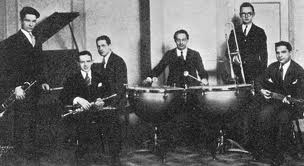
Nichols’ way with a front line speaks volumes from the start. Instead of the three-way polyphony heard in hundreds of combos at the time, cornet and clarinet lay down a bone-dry lead (similar to the brass and reed front lines of most post-war groups). The attention to detail for just two horns is also revealing, first answering Eddie Lang‘s guitar in unison for the introduction, then switching to tight, coy harmony for the melody, with Vic Berton‘s timpani offering its own abstract commentary. When collective improvisation does materialize, it’s with the same balance and intimacy heard earlier. Even the timbres are telling: Nichols’ clean, lithe, slightly clipped cornet, Jimmy Dorsey whistling polished, cutting phrases on clarinet.
The false fingerings and ghosted notes of Nichols’ solo illustrate why “clever” doesn’t have to be an epithet. Dorsey’s arpeggios and phrase entrances come across as more acrobatic but equally measured. Pianist Arthur “The Baron” Schutt shows off his classical studies with busy, two-fisted rubato, while Lang’s strings resemble a steely, pensive harpsichord. The players cherry-pick their notes as though in the midst of some detailed internal calculus, insistently (and for that time, bravely) refusing to throw everything in until they know what’s possible. Many critics hear careful reserve. Other listeners just notice technique, curiosity and patience.
Responding to an earlier post about the loss of Joe Muranyi, a commenter recalled Muranyi trying out his own “metal Conn clarinet, a horn a more self-conscious player would recoil from.” The open-minded Muranyi in turn “played the living heck out of it.” Apparently for some musicians, the instrument is always a catalyst and never a compromise. For Lester Young, a metal clarinet was a choice, maybe even a necessity.
Gunther Schullernotes that when Young put down his tenor, the influential jazz artist and part-time tragic hero “played a cheap metal clarinet that he picked up somewhere on his travels, but whose tone he loved dearly.” Young kept the signature lightness of his sax on the smaller horn, and at fast tempos would use the same triplets and encircling, never inundating lines for the “little stories” he had to tell. At slower tempos and in more reflective settings, he’d come up with a story like the one in “Blues with Helen,” from the 1939 Spirituals to Swingconcert organized by impresario John Hammond [starting at 1:47 in the clip below]:
Hammond introduces Young as “switching over to clarinet,” but there is no sense of “switch” or adaptation here: Young is simply playing clarinet. The tone could be called “thin,” but more like a leaf rather than paper, something likely to tear given the right force but able to support storms and sunlight on its own terms. Sustained notes let the audience absorb that sound while always unfolding a narrative, never halting the action or merely displaying beauty for the sake of itself. If anything is different, it’s that the clarinet’s brighter, at times childlike timbre brings out the fragility of the clarinetist.
Benny Goodman mentions purchasing a Selmer (wood) clarinet for Young while in Europe, an instrument fewer clarinetists might recoil from. While it’s endearing to imagine Young gratefully accepting the gift and sticking to his cheap little instrument, the truth is that it doesn’t matter what kind of clarinet Lester Young played, only that he played clarinet.
Political correctness advises that age should have nothing to do with how we evaluate the playing of eighty-year old “Wild Bill” Davison and eighty-three year old Newell “Spiegle” Wilcox. Apparently both musicians, as well as lifelong jazz aficionado, drummer and Tonight Show host Johnny Carson thought otherwise:
A few things stand out here. Of course there’s the music, including a beautifully cohesive clarinet solo and an upbeat rhythm section. The walking bass and drum accents underneath the “Dixieland” front line point to musicians playing dynamically but sincerely, rather than faithfully recreating some earlier era or obsessively keeping up with the stylistic Joneses. In other words, this is jazz, on The Tonight Show.
As for the headliners, it’s remarkable to hear them for reasons besides their ability to receive a senior citizen’s discount at the cinema. Wilcox was an important but under-recorded part of Jean Goldkette‘s seminal records, and only started to gain more attention (and a lot more solos) much later on in his life. It may have been due to the trombonist’s longevity, or perhaps it was simply the right time to hear what he had to say.
Davison himself explains that he had been “Wild Bill” for several decades already, and while he seems to hold back slightly for The Tonight Show audience, his crackling tone and driving lead are still a force of nature. He started his career in the twenties, and is perhaps best known for his work with various Eddie Condon and Commodore groups during the thirties and forties. It’s easy to think of artists frozen in time at some supposed peak, but Davison was also a gigging musician who lived and played until 1989. Based on the sound of that horn, he doesn’t seem like the type to rely upon social security for income.
Finally, they’re on The Tonight Show, with Johnny Carson, in their eighties (and yes, in the eighties), not only playing jazz but playing “jazz” as defined by two octogenarians, laughing it up with the host and at one point even discussing embouchures. It’s hard to imagine a similar scenario on any current late night talk show. That’s worse than a value judgment, that’s a simple observation.
Though known for his humbleness, Domenico Cimarosa was probably proud to never accomplish the same feats as his contemporary Wolfgang Amadeus Mozart.
Cimarosa didn’t compose a variety of complex, emotionally probing works. He wasn’t misunderstood or criticized for his music. He didn’t even inspire passionate stories about dying sick, young and penniless. Instead, Cimarosa’s comic operas made him immensely rich and popular, and were still well-known after he passed away ten years later and seventeen years older than Mozart.
Cimarosa’s Il Matrimonio Segretoactually received the most famous encore in operatic history, when Leopold II requested the whole work be repeated directly after its premier. Tuneful, catchy and a little bawdy (even without the risqué stage direction below), no wonder His Majesty couldn’t get enough:
In addition to a Holy Roman Emperor and the Austrian wunderkind himself, Cimarosa’s other fans included Haydn, who staged several of Cimarosa’s operas for his own patron, French realist writer Stendahl, who actually preferred Cimarosa’s music to that of you-know-who and Rossini, who apparently couldn’t stop whistling the Cimarosa arias he heard as a boy. Yet aside from Il Matrimonio Segreto, most of Cimarosa’s works are rarely if ever performed. At some point in history Cimarosa’s modest goals and immense success came to be classified as shortcomings.
While the current critical script is that even second-rate Mozart is preferable to the best efforts of a composer like Cimarosa, fresh listening is never a bad idea. For starters, it’s helpful to hear Cimarosa as Cimarosa, rather than “not Mozart” or some other composer i.e. as a musician who enjoyed straightforward harmonies, rounded melodies and bright textures, with a lot of woodwinds thrown in for added color. Atene Edificata doesn’t offer any intricacies in terms of music or story: the “characters” (really just allegorical mouthpieces for Cimarosa’s onetime employer Catherine the Great) praise god and country in lyrical phrases [just click “Play” below to listen]:
and runs that fall easily on the ear, with good momentum and without chromatic surprises [skip ahead to 2:40 in the following clip]:
Cimarosa was best known for his comedies, but tense drama and psychological insight were never really priorities in any of his works, nor were they as important to his contemporary listeners as they are for current operagoers. Cimarosa’s opera seria graft his bright style onto the vocal acrobatics and highfalutin stories eighteenth century audiences craved. “Superbo Di Me Stesso,” from Cimarosa’s setting of Metastasio‘s warhorse L’Olimpiade does provide a novel musical treatment for this well-worn text [starting at 0:39 in the following clip]:
The minor chords and wide intervals proclaiming “Superbo di me stesso, andrò portando in fronte” (“I’ll proudly go, bearing in front”) and the sweeter curlicues for “quel caro nome impresso, come mi sta nel cor” (“that beloved name, as it’s written in my heart”) convey how seriously this speaker takes the task of competing under a friend’s name to earn that friend a prize, and how dear that friend’s name is to the character. The skipping variation on “quel caro nome impresso” just reinforces his sentiments. Not a bad bit of character painting, especially for a libretto that had been set dozens of times previously and a composer now known for his “short, bubbly, and easily digestible” music.
On the other hand many of L’Olimpiade‘s arias are pure vocal exhibition. “Mi sento, O Dio, Nel Core” (“I feel, oh gods, in this heart”) for soprano with obbligato oboe is a magnificent traffic jam of an aria [which starts at 1:38 in the clip below], with an overly long, tacked on introduction, an impossibly high tessitura (even for a pro like Patrizia Ciofi) and gratuitous (even for eighteenth century audiences) coloratura. It also seems to go on forever, but makes for a hell of a show. In Cimarosa’s time, even serious opera was rarely “drama,” and “high art” only well after the final curtain: it was was vocal showpiece, spectacle, an athletic event and even a competition, a night of ” can they make it?”
As for that “short, bubbly, and easily digestible” sound, YouTube user Thrax1982 (who posted the above videos and whose dedication to lesser known operas is invaluable) offers the best analysis of Cimarosa’s music as “often (not [always]) seem[ing] like it’s put together of Lego blocks.” While that description might imply simplicity, sameness and a lack of emotion, it also suggests the use of familiar materials to create vivid, recognizable structures. Cimarosa’s compositional process is pretty transparent; no advanced theories or formal curveballs lurking under all those glistening surfaces. That might just be artistic choice on the composer’s part. Besides, Legos are fun, and they can make some pretty impressive stuff.
Gli Orazi e I Curiazi, a tale of political duty, romantic love and familial loyalty set in ancient Rome, leaves lots of room for big choruses, lush eroticism and deadly serious situations. Cimarosa flexes his theatrical chops at several key moments (including an unusually grim ending) and the second act’s oracle scene is as far removed from Cimarosa’s comedies as possible [Thrax’s commentary in the following clip is especially informative]:
Yet Cimarosa’s musical instincts for a sheerly beautiful effect enhance even stock scenes. Three-part harmony between the heroine, her Roman brother and an enemy of Rome that she just happens to be in love with depicts a brief truce as a moment of peace and celebration between siblings, lovers and nations [skip ahead to 3:44 below]:
It’s not dramatic verisimilitude or advanced music theory, but it does make for some great music. Shortly after, the brief duet between the couple, “Ti giura il labbro e il core amore e fedeltà” (“My lips and heart swear love and fidelity to you”), is so pure it brings the narrative to a halt:
Taken on its own terms, this simple, perhaps “superficial” writing works for Gli Orazi, due in part to Cimarosa’s knack for a distinct melodic hook. The lovers’ quarrel that opens Act II features some particularly juicy strings in the accompanied recitative, expressing this scene’s intensity in a highly stylized but effective manner:
The violins behind the ensuing duet “Se Torni Vincitor” (If You Return Victorious,” starting four minutes into the above clip) are touching, memorable and in musical terms, just plain gorgeous. Occasionally “beautiful” is enough, as is building with blocks rather than marble or watercolors. Cimarosa, as well as other musicians stuck on the historical unemployment line, remind us that it might be time for some prepositional reversal to the old adage “good, but not Mozart.”
Joe Muranyi passed away last Friday. A bad Internet connection and a busy weekend kept the news from me until Monday, and uncertainty about what to say kept me from commenting until today.
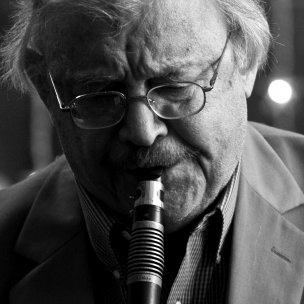
Muranyi was best known as the last clarinetist to play with Louis Armstrong, as well as a good friend of Armstrong’s, a prodigious jazz writer and a fine musician in his own right. Muranyi was a link to a seminal force in music. He was also the person who taught me how to give Louis Armstrong the benefit of the doubt.
As a younger listener, I was one of those Louis Armstrong fans who just assumed that the great trumpeter’s career as a jazz artist ended some time around 1928, when big bands, vocals and Tin Pan Alley made him into a (mere) “popular entertainer.” Joe Muranyi’s liner notes for the 1989 BMG/Bluebird CD Laughing Louie taught me better. Knowing the man and his music well, he pointed out that Armstrong wasn’t holding back, he was playing just the notes he needed for maximum impact. He wasn’t selling out by leaving jazz tunes behind, he was flexing his imagination and chops by looking ahead to new material. Most of all, he was reaching more listeners. Armstrong was all about reaching people.
Muranyi’s commentary moved like great sports casting. It was also optimistic, open-minded and above all insightful, treating these 1932 and 1933 studio sessions not as popular concessions or the product of opportunistic management, but as the sincere work of a pensive yet joyful artist. In short, Muranyi heard music, and from then on so did I.
And that’s all I have to say about him. I’ll leave the rest to some other writers who help me to hear more and understand better: