Tag Archives: saxophone

Nathan Glantz and the Saxophone in Late Nineteenth-century Russia

On November 13, 1904, a 26-year-old Ukrainian musician stepped off a ship at Ellis Island with plans that probably confused more pragmatic immigrants. A career in music already posed unique challenges. But this gentleman wanted to play the saxophone for a living.

The instrument’s patent was less than 60 years old. Its inventor had passed away a mere decade ago. Adolphe Sax’s invention was still years away from achieving its iconic status in this young musician’s new home. Back in Russia, depending on who you spoke to, it was either a curiosity, a waste of time, or a meaningless word; most imperial subjects had probably never heard the instrument, let alone its name.

Yet life in the empire enabled this musician to develop a professional-level ability on the instrument. He left home intent on making the saxophone his livelihood. At least, that’s what Nathan Glantz told an interviewer for Metronome 25 years later. By that point, playing the saxophone allowed him to pay the bills and then some. Glantz became one of the most successful radio and recording artists of the twenties. None of the new arrivals that Sunday, including him, probably saw that coming.

In that profile of Glantz from the May 1929 issue of Metronome, he only mentions studying the saxophone in Russia in passing. He says he had “learned to master the saxophone in Russia and had hoped to earn a livelihood with it in America,” and moves on to his disappointment once he got there. Historians have documented the saxophone’s journey from novelty to star status in the U.S. But the fact that Glantz got there ready to work as a saxophonist raises some interesting questions about his life in Russia.

Assuming it wasn’t a shoddy recollection or a PR fabrication, Glantz’s story meant he came to the United States from Russia as a trained saxophonist. What was his path from saxophone student under the tsar to budding professional saxophonist? Glantz’s quote piqued my curiosity, and I wanted to share some preliminary research.

To put it simply, where did you learn to play the saxophone in late nineteenth-century Russia?
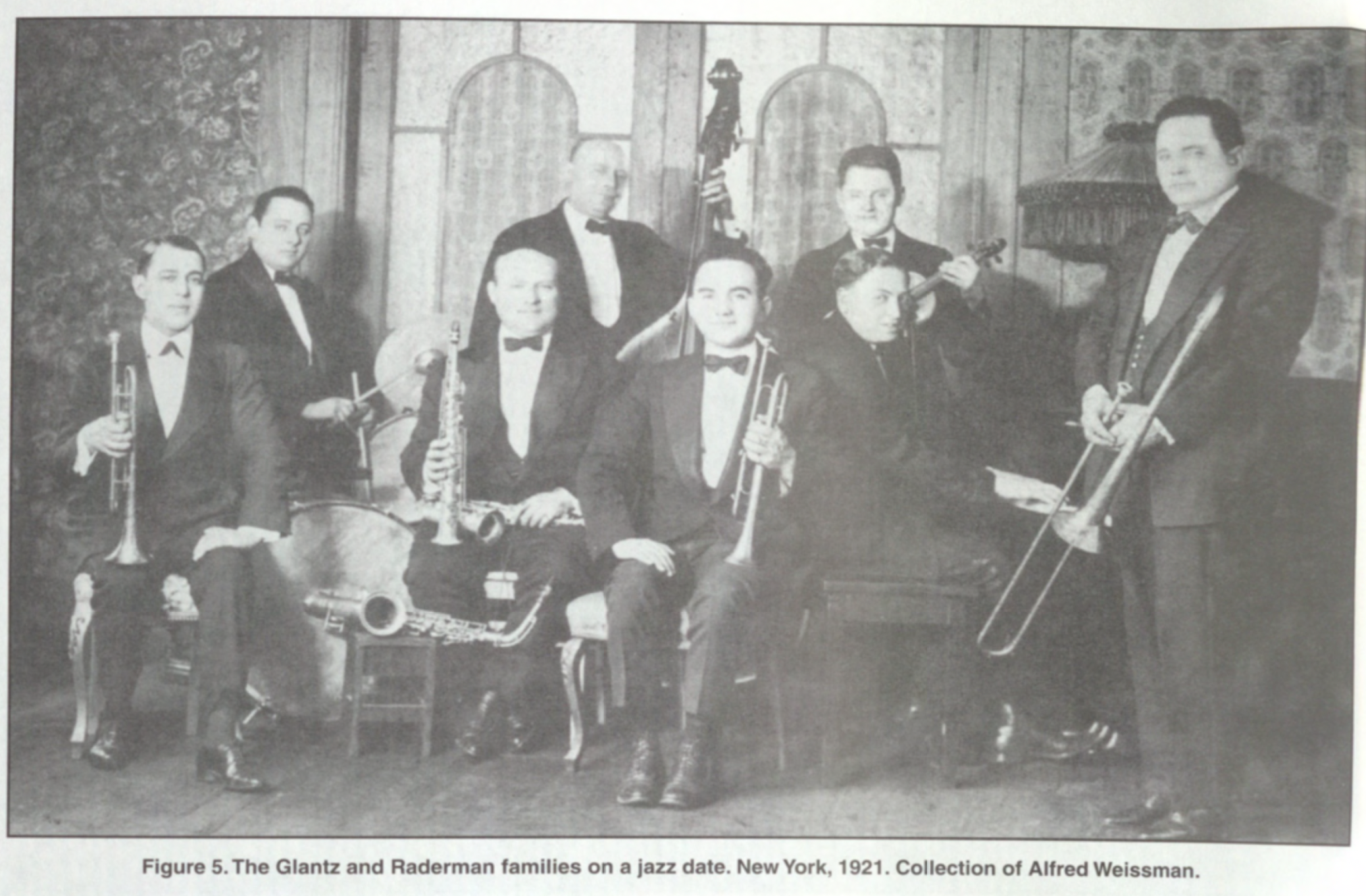
From André M. Smith, “A Centennial Tribute to Harry Glantz” in International Trumpet Guild Journal, vol 20, issue 1 (Feb. 1996). Glantz is seated third from the left, holding the saxophone.

Play That Саксофон

If you were looking to hear or play the saxophone in many European countries at the time, you might join the army. Europe’s regimental bands were the earliest and, especially during the 1860s, the most widespread adopters of the instrument.

Russian musical society was more conservative. Brass instruments dominated the tsar’s military bands. Traditionalists suspicious of “westernization” probably didn’t welcome an instrument invented by a Belgian and widely used in the French army. A Russian military brass ensemble that included saxophones had won acclaim at the 1867 Paris Exposition. But only two standing Russian army regiments included saxophones in their bands. The instrument was also briefly part of a maritime unit, which may have been its downfall.

Naval band inspector and respected composer Nikolai Rimsky-Korsakov was not confident in the saxophone. In a report to naval officials, he echoed common criticisms at the time. Supposedly, Sax’s invention was poorly designed, limited in its expressive capabilities, and suffered from poor intonation in the cold (maybe the most damning allegation for pragmatic Russians). The accuracy of these claims was probably less important than their alignment with conservative tastes. Less than a year after its introduction to the navy, Rimsky-Korsakov ordered the removal of the instrument and recommended the same for army bands. When it came to the Russian military, the saxophone was out of the picture for the next few decades.

Even after the Russian military expunged the saxophone, it continued to appear in court ensembles. The tsar’s brass band, responsible for providing music at state ceremonies and palace events, included saxophones. There were as many as six of them in the orchestra at the court of Prince Felix Yusupov (famous for his role in planning Rasputin’s death). This aristocratic presence might have led to the instrument’s slow resurgence. By the turn of the century, the instrument began to appear again in military bands. One nobleman’s influential bandmaster even called for a saxophone school in Russia—an idea that wouldn’t fully materialize until well into the twentieth century.

Chances are, the least likely place to learn the saxophone would have been the conservatory or other institutions of formal music training. These schools taught Western European instruments and repertoire. The instrument might have encountered even greater difficulty in Russian schools than in the German schools they were modeled on. In Russia, conservatory training with recognized diploma credentials was about the same age as the saxophone; the St. Petersburg Conservatory, the first such institution in Russia, was only founded in 1862.

It doesn’t eliminate the possibility of saxophone teachers at these schools—an instructor at the St. Petersburg Naval music school kept teaching the instrument through 1922—but both Moscow and St. Petersburg, the two largest and most prestigious conservatories in the empire, were far from young Nathan Glantz in many ways.
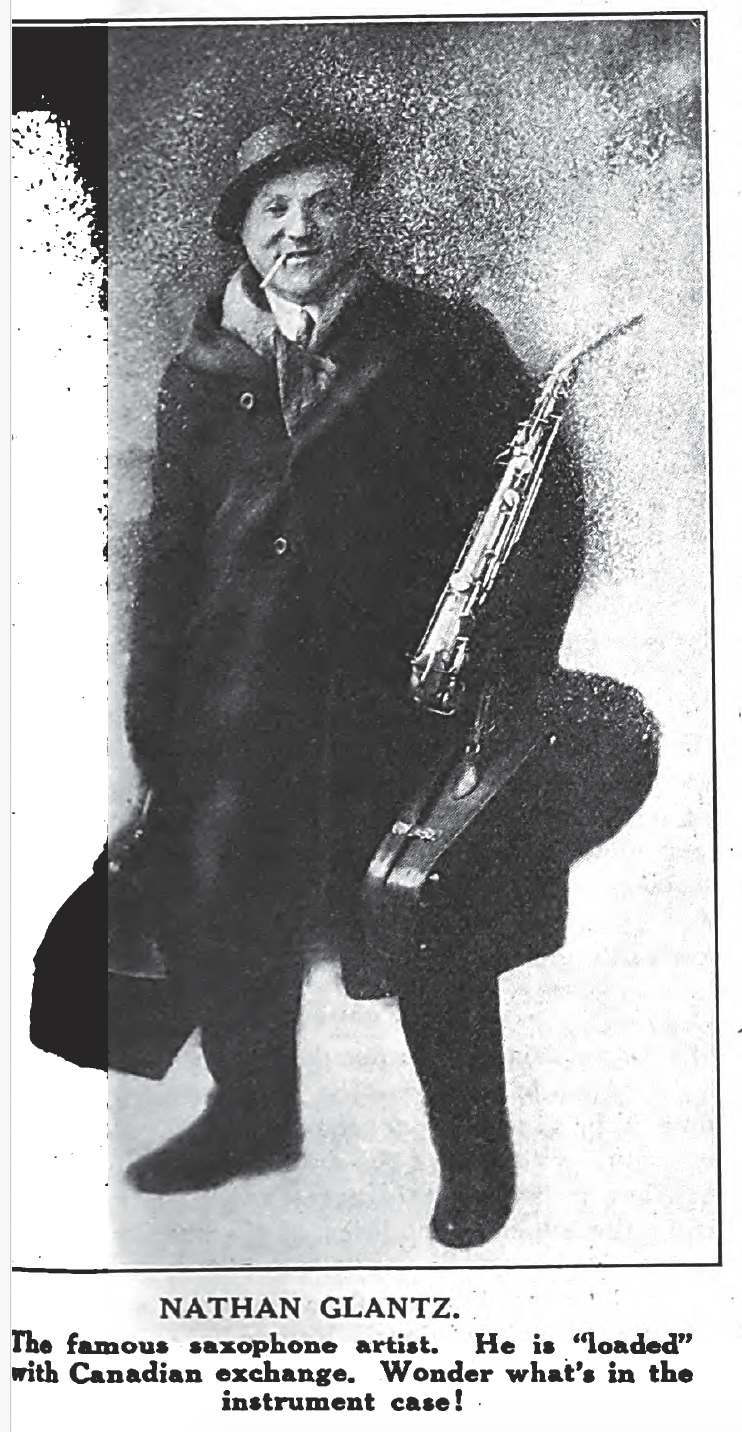
From “The History of the Laughing Saxophone and the Man Who is Responsible” in The Dominant, January 1921

A Saxophonist Despite the Odds

Glantz lived during an interesting time for the saxophone, even by its already unique standing in Russia. While you might have found the saxophone in military and court bands, you probably wouldn’t have seen Glantz.

He was born in 1878. Rimsky-Korsakov ordered the removal of the saxophone in 1874 and served as naval band inspector until 1884, while also exerting considerable influence over army bands. By the time Glantz might have started learning the saxophone, the Russian military would have likely purged most, if not all, of its instruments. Aside from saxophones used in regular service, Russian military schools that taught music and other trades might have had their own stock.

Even assuming a generous number of saxophones made it to resellers and other hands, it’s hard to tell how far these leftover instruments were dispersed within the empire’s vast borders. That’s without accounting for the state repurposing these materials. The military and other government agencies could probably find other uses for melted brass. By the early 1920s, even in a big city like Moscow, saxophones were still incredibly rare. Moscovite Mikhail Lantsman recalled that as late as 1931, when he wanted to learn to play, he needed to travel all the way to Kyiv and pay a lot of money to buy a saxophone from a retired royal guardsman.

Glantz was born and raised in the small town of Proskurov (now Khmelnytskyi in the historic Podolia region of modern-day Ukraine), about 250 miles southwest of Kyiv and 100 miles north of the province’s capital, Kamenetz-Podolska. Metropolises like St. Petersburg, where the saxophone and even American ragtime were beginning to catch on, were well over a thousand miles away and in a whole other social stratum.

Proskurov was inside the Pale of Settlement, the region where Jews were restricted to live until its abolishment after the revolution. Segregation, pogroms, random acts of violence, racist official policies, and discriminatory cultural practices all contributed to the vast scope of antisemitism in Russia at the time. For a young Jewish musician, geography was just one barrier to Russia’s major cultural centers.

These factors, plus a rigid class code, would’ve made affiliation with one of the court ensembles unlikely, too. Unlike large cities like Kyiv, and unlike their private countryside residences, the Russian nobility did not frequent remote provincial towns. Proskurov was one of the smallest towns in the empire (a population of just over 20,000 in 1897). It doesn’t seem to have been especially well known to any local musical institutions. In fact, the town is unfortunately now infamous as the site of one of the bloodiest pogroms on record.

Music Education Pre-sax

Glantz may have jumped on the saxophone bandwagon just as the instrument began resurfacing in military bands at the turn of the century. That would mean he “mastered” it just a couple of years before setting sail for the U.S. It would have been fortuitous timing: he’d have come in at a good time to learn the instrument and to leave the service (with or without approval).

Unfortunately, a researcher hired to look through records in Glantz’s hometown didn’t find any record of his service or his life there. Pre-Soviet military records are primarily located on-site at Moscow’s Russian State Military Historical Archive, and research there is challenging at this time. For now, it’s uncertain if Glantz was ever in the Russian military, though his brother and fellow musician Pincus did serve for five years.

Ultimately, I’m uncertain where Glantz learned the saxophone in Russia. He died in 1937, having retired a few years earlier, at the age of 59. Other than some marketing-oriented profiles like the Metronome one, there don’t seem to be any extensive interviews. Piecing together his early days seems more a matter of educated hypothesis, process of elimination and speculation.

Researching this topic raised the broader question of where he might have studied music more generally as a Ukrainian kid, which suggested more about where he was coming from, musically and as a person. The “inventor of the laughing sax” came from difficult, often tragic circumstances. His story continues to interest me, and I look forward to sharing more here.

Appreciation

Thanks so much to Aaron Keebaugh and Michael Steinman for their early feedback and ample patience on an earlier “kitchen-sink” draft of this post.

Sources

Abbreviated citation style for length and visual clarity.

  • “20 Years Ago the Saxophone Was Considered a Joke” in Metronome, May 1929
  • Fedorik, L.N. “The Saxophone in the Tsarist Army, The Red Army, and the Russian Army” presented at the International Center for Scientific Partnership’s International Research Competition on May 11, 2020 [translated from Russian]
  • Frost, Edgar L. “The Impact of Russians and Eastern Europeans on American Society” in Russian Language Journal, no. 162/164 (1995)
  • Gershon, Swet. “Russian Jews in Music” chapter in Russian Jewry, 1860–1917
  • Kendall, Bryan. In Search of the Saxophone: Its Origins and Functions
  • Lindemeyer, Paul. Celebrating the Saxophone
  • Mannherz, Julia. “Nationalism, Imperialism, and Cosmopolitanism in Russian Nineteenth-Century Provincial Amateur Music-Making” in The Slavonic and East European Review, 95, no. 2 (2017)
  • Maugans, Stacy. “The History of Saxophone in St. Petersburg” in Music Faculty Publications from Valparaiso University (2001, 1)
  • Ohren, Dana. “All the Tsar’s Men: Minorities and Military Conscription in Imperial Russia, 1874–1905,” PhD dissertation at Indiana University, January 2006
  • Petrovsky-Shtern, Yohanan. “Military Service in Russia” entry of YIVO Encyclopedia of Jews in Eastern Europe
  • Sanborn, Josh. “Military Reform, Moral Reform, and the End of the Old Regime” chapter of The Military and Society in Russia
  • Sapoznik, Henry. Klezmer: Jewish Music from Old World to Our World
  • Sargeant, Lynn. “A New Class of People: The Conservatoire and Musical Professionalization in Russia, 1861-1917” in Music & Letters 85, no. 1 (2004)
  • Smith, Andre M. “A Centennial Tribute to Harry Glantz” in International Trumpet Guild Journal, vol 20, issue 1 (Feb. 1996)
  • Starr, S. Frederick. Red and Hot: the Fate of Jazz in the Soviet Union, 1917–1980
  • Veidlinger, Jeffrey, “Musical Education and Musical Societies” entry in YIVO Encyclopedia of Jews in Eastern Europe
  • Yugan, I.I. “History of the Establishment of Military Orchestras and Their Role in the State of Russia “ in History of Pedagogy and Education, Professional Journal of the Association, (2, 30, 2019) [translated from Russian]
  • New York Passenger Arrival Lists (Ellis Island), 1892-1925
  • Miscellaneous New York census records via ancestry.com
  • Miscellaneous official records translated from Russian and located onsite and affiliated with state and local archives for Khmelnytskyi, Ukraine
Tagged , , , , , , ,

Notes On Lucien S.

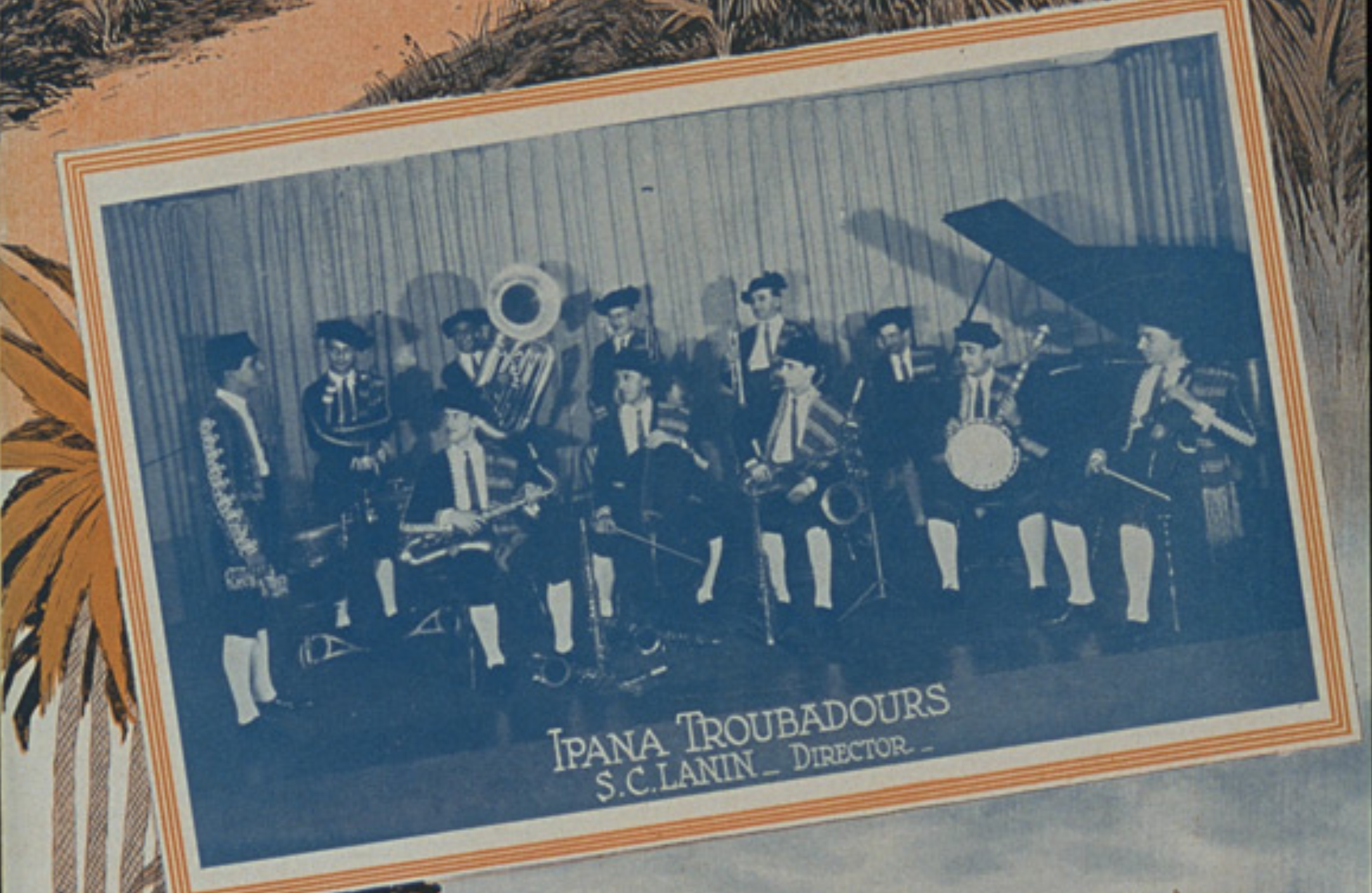
A profile of the Ipana Troubadours in Radio Broadcast magazine singles out just one sideman in the band. Even among musicians that leader Sam Lanin “picked from the country’s best dance and symphony orchestras,” he receives special attention:

Lucien Schmit, for instance, virtuoso cellist, was Walter Damrosch‘s first cellist for five seasons and is also an accomplished pianist and saxophone player. Schmit is a representative member of the group.

A photo of the Troubadours shows an unidentified player holding a cello with a saxophone at his feet. Section mates on either side of him hold their saxophones. But the cellist’s sax doesn’t even get a stand; it rests directly on the floor. If the reader didn’t know any better, they might assume that sax was just an occasional double.

From Radio Broadcast of September 1926 via worldradiohistory.com.

Of course, “Lucien Schmit” sounds like “Lucien Smith,” a name record collectors and hot dance aficionados likely recognize as one of the saxophonists on several recordings by Lanin and other bandleaders. It’s found next to more well-known names like Bennie Krueger, Miff Mole, Red Nichols, Harry Reser, and the Dorsey brothers in many discographies.

A 1931 radio listing makes the connection more explicit, but even the copywriter faces an identity problem with his subject:

Many performers know how to double in brass, but Lucien Smith will demonstrate the talent which permits him to triple in brass and strings. He will appear as soloist on piano, cello, and saxophone. Best known as a master of the cello, Mr. Schmit has won the praise of music critics for years…it was [conductor Eugene] Ormandy‘s idea to present him in the three phases of his artistic accomplishment.

Mistaking the saxophone as a member of the brass instrument family may be mere carelessness. But the switch between “Smith” and “Schmit” suggests which artistic phases are more or less important. Smith may play many instruments, but Schmit is the cello master earning critical praise.

In contemporary reports, saxophonist “Lucien Smith” didn’t get much attention. With just a couple of exceptions, that name is limited to discographies. For the sake of argument (and according to far more knowledgeable researchers than this writer), it’s safe to assume they were the same musician. And some cursory research shows he enjoyed a long and varied musical career spanning different instruments, repertoires, and artists.

Prodigy

Government records indicate that Lucien Alexander Schmit was born in Belgium on January 6 of either 1898 or 1899 (depending on which draft card). A New York Times obituary from July 22, 1976, fills in the blanks and notes early talent:

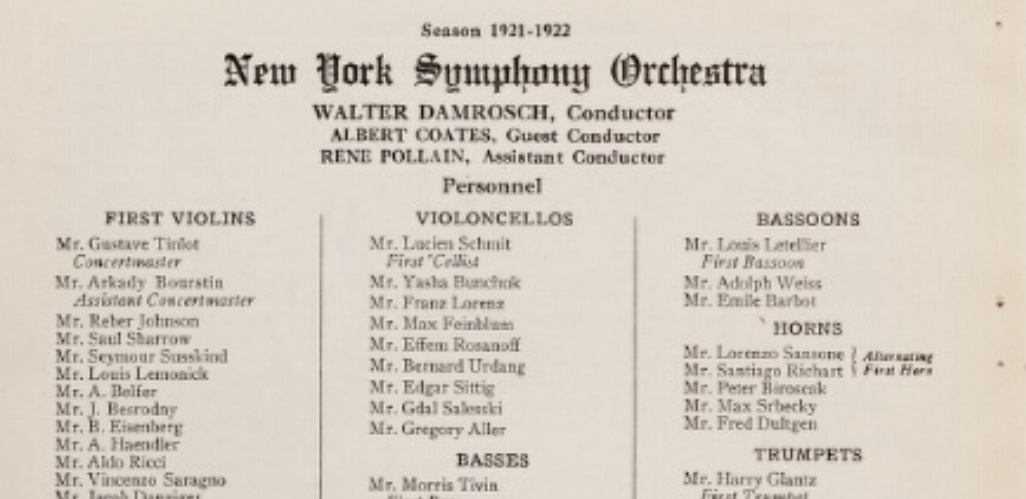
Lucien S. Schmit, a cellist who first performed publicly at the age of seven in Paris and who became a member of the St. Louis Symphony Orchestra at 13…came to this country in 1909. He became first cellist in the New York Symphony Orchestra in 1921 under Walter Damrosch.

Still, there’s a big issue here. And it’s not just the middle initial, which was reprinted as “S” elsewhere. The obituary omits the subject’s many recordings as a reed player with several bands. It even ignores his extensive work as a cellist on recordings with everyone from Quincy Jones to David Sanborn.

This obituary doesn’t mention any ability—let alone talent—for playing saxophone. “Lucien Smith” got left out of the obituary for “Lucien Schmit.”

Symphony Cellist

Across multiple discographies, newspaper articles, radio listings, promotional materials, and other documents, the division between names and roles is surprisingly consistent. “Lucien Smith” plays reed instruments, mainly sax, and “Lucien Schmit” is a cellist. And, based on the amount of historical documentation, the cellist received a lot more press and promotion.

Conductor Walter Damrosch’s pick for principal cello was bound to get plenty of attention. Audiences and critics respected Damrosch for his musical direction, premiering new works, and educational efforts. Damrosch’s New York Symphony was a respected institution later incorporated to form the New York Philharmonic. He remains a well-known name to this day.

This writer cannot remember the source for this image.

Aside from brand recognition, a principal cellist would probably have handled most (if not all) of the solo parts for the orchestra. Several reviews talk about “Lucien Schmit” featured in works such as Saint-Saëns’s Cello Concerto in A Minor and cello pieces by Bach and Boccherini. One New York Times critic praised Schmit as a “graceful and fluent player” in a program of contemporary classical pieces. A writer for Etude magazine, years after hearing Schmit with the Lutèce Trio, recalled that an audience of about 5,000 people “thought him the star performer” despite playing on a mediocre instrument.

Schmit played under Damrosch for five seasons. Half a decade playing to critical acclaim with a renowned orchestra under an esteemed conductor casts a large shadow. At this time, many listeners were more likely to turn their noses up (in public, anyway) to jazz and popular music. Among self-identified “respectable” circles, European art music was the accepted social currency. It was bound to get more press in mainstream publications. It also seems like Lucien Smith, the saxophonist, was rarely featured as a soloist. In short, his dance band legacy might have suffered based on cultural associations and sheer audibility.


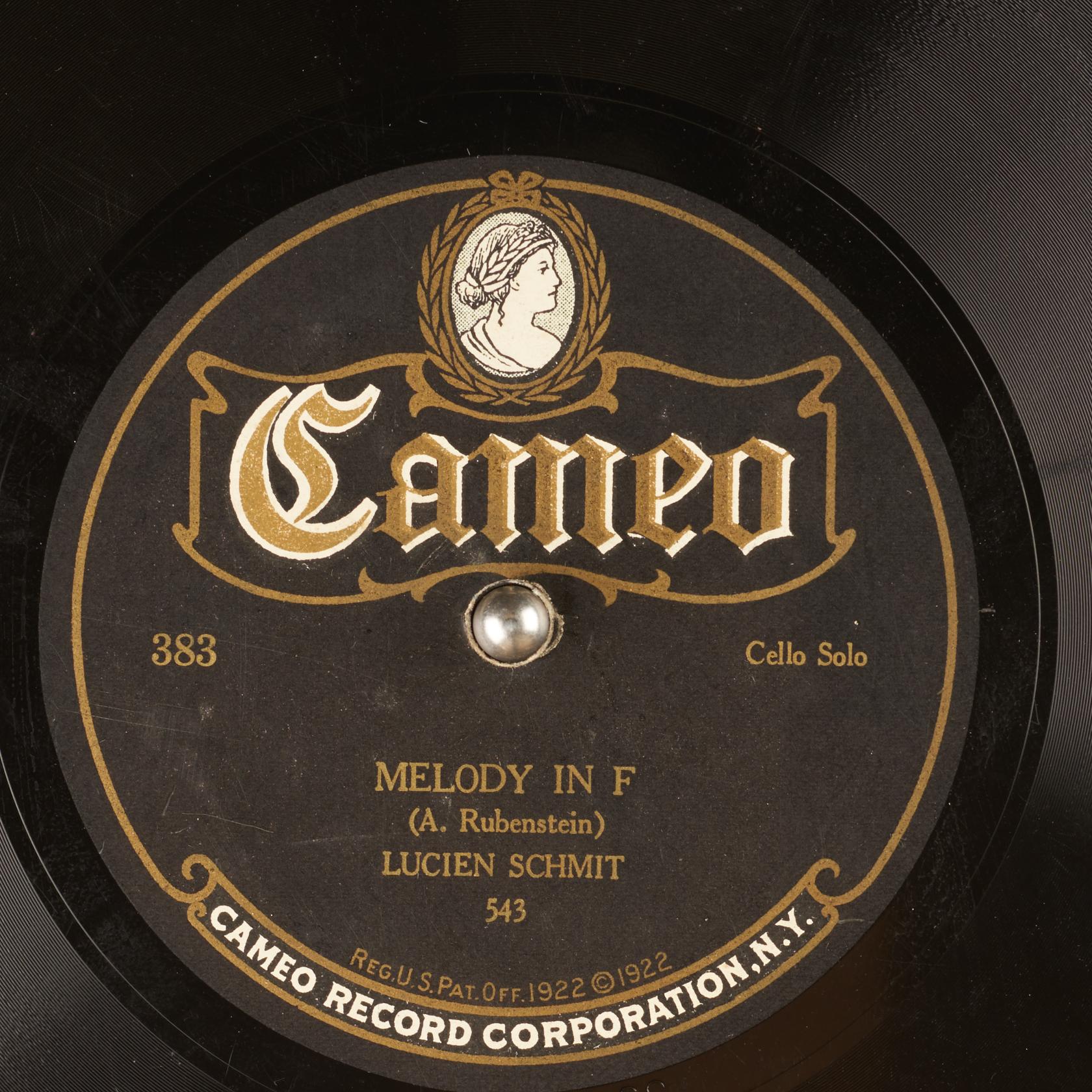
On June 30, 1923, Lucien Schmit, cellist, recorded Rubenstein’s Melody in F (mx. 0543) and “The Swans” from Saint-Saëns Carnival of Animals (matrix number 0544). Audio of each side follows. Images and audio from Internet Archive.

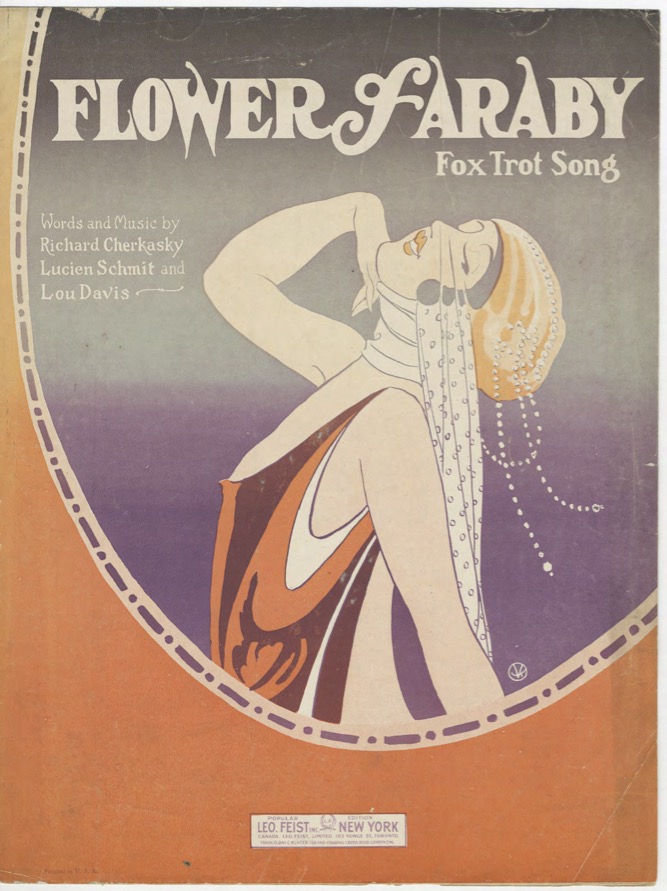
Published in 1922, “Flower of Araby” was recorded by several bands but it’s unclear if Schmit himself recorded the song. Image from IMSLP.

Saxophonist

It’s unclear when he began playing saxophone with dance bands. The earliest discographical entry (that the writer could find) for “Lucien Smith,” the reed player with Lanin and others, is a February 1922 session with Bailey’s Lucky Seven for the Gennett label. Smith is listed as playing tenor sax in the probable personnel. Yet at the time, he was still the principal cello under Damrosch. It’s also hard (for this writer) to single out a distinct tenor sax voice on “My Mammy Knows” or to identify the tenor lead “On the ‘Gin, ‘Gin, ‘Ginny Shore.”

His reasons for deciding to play saxophone professionally are beyond this writer’s research or qualifications. He may have wanted to try something new. Maybe the popularity of dance bands seemed financially promising or musically challenging. It was likely some combination of practical and personal reasons. Whatever the cause, saxophonist Lucien Smith doesn’t appear on another dance band date until August 1924.

From that point, he’s on plenty of great hot dance and jazz records! Discography entries that include “Lucien Smith” read like a who’s who of hot dance/jazz bands: Nathan Glantz, Dave Kaplan, Krueger, Lanin, and Ben Selvin are just a few of the names. Tom Lord’s online jazz discography lists Schmit on 85 sessions between 1922 and 1931—and that’s just what made it into the discography as “jazz.” He likely doubled multiple saxophones and clarinet as a working dance band musician. His substantial presence with these bands indicates significant skill, versatility, and reliability.

Despite the obvious talent, the last session listing Lucien Smith on reeds appears to be August 7, 1931, with violinist Billy Artz’s band. Artz and Lucien both played in B.A. Rolfe‘s famous orchestra, where Lucien is listed as doubling clarinet, tenor sax, and cello. The two likely forged a connection there. He may also be the hot tenor sax on “There’s A Time and Place for Everything.” But at this point, maybe regularly playing tenor was unneeded or less lucrative during the Great Depression.

Radio Cellist and More

Instead, cellist “Lucien Schmit”—who happened to also play saxophone and piano—resurfaces in the press and discographies. The New York Times obituary states that “During the 1930s, he was active in radio musical programs…musical director of ‘The Royal Typewriter Hour’ and for 20 years was featured on such programs as ‘The Telephone Hour,’ the Firestone Show, the Longines Symphonette program and ‘The Prudential Family Hour.'” But that obituary is entirely framed around his work as a cellist.

Some contemporary reports of “Lucien Schmit” reference work as a saxophonist and pianist, like this April 24, 1930 radio listing in the Hartford Courant:

Lucien Schmitt [sic], the violincellist of the Melody Moments orchestra and other concert orchestras on the networks, will demonstrate his ability to triple in brass and strings…He will contribute piano, cello, and saxophone solos to the concert.

In directories for the New York American Federation of Musicians, Local 802 (generously provided by Vince Giordano), there’s only “Lucien A. Schmit” listed in the “Cello” section. Whatever else he may have played on the radio, Schmit’s primary role was always as a cellist.

Over the next few decades, in addition to radio work, his cello as well as his violin and viola are listed in studio recordings with Kenny Burrell, Perry Como, Johnny Griffin, Coleman Hawkins, Artie Shaw, and Wes Montgomery, among others. Almost inevitably, it’s “Lucien Schmit” in the string section. Grammy-wining bandleader and hot music historian Vince Giordano explains that pianist Dick Hyman recalls “Lucien” coming to sessions carrying both reed instruments and his cello.

Along the way, he and his wife raised their only child (who went on to a respected career in engineering). Lucien passed away following a stroke on July 20, 1976, in a hospital near his Manhasset, Long Island home.

Musician

Depending on the area of his considerable experience, you might end up reading two different narratives. Almost all the discographies and press clippings that mention the cellist reference Schmidt, Schmit, or Schmitt. Except for very few contemporary articles, Lucien Smith, a saxophonist, is only found in discographies (though the prolific and knowledgeable discographer Javier Soria Laso gets a lot of credit for covering all the bases by referring to “Lucien Smith/Schmitt/Schmidt”).

There may be a better or more straightforward explanation for using different names. And wider research may show that the associations between the names weren’t as cut and dried. Maybe “Smith” was a deliberate alias or just a propagated typo. But just looking at (some) writings, you might think Lucien Smith’s saxophone was a temporary side hustle compared to Lucien Schmit’s cello.

That probably says more about audiences’ and reporters’ perceptions of “serious” and “popular” music during Lucien’s lifetime. His musical career makes for a single interesting story. You’d just better know who to look for.

From the sheet music for “Tamiami Trail,” published in 1927 by Jerome H. Remick & Co. Image retrieved online from Florida International University libraries.

Sources

  • American Federation of Musicians, directories from 1937, 1943, and 1958
  • American Dance Bands on Record and Film by Johnson and Shirley
  • ARSC Journal, vol. 24, no. 1: “Georges Barrere” by Susan Nelson
  • Brunswick Records: A Discography of Recordings, 1916-1931 by Ross Laird
  • Buffalo Times on January 16, 1930
  • Daily News [New York] on April 7, 1932
  • Etude magazine on April 1922
  • Florida International University libraries
  • Hartford Courant on April 24, 1930
  • International Music Score Library Project (IMSLP)/Petrucci Music Library
  • Journal of the National Medical Association, Vol. 17, No. 4, December 8, 1925
  • Tom Lord’s Jazz Discography online
  • Music News on December 28, 1923
  • The Musical Blue Book of America for 1922
  • Nassau Daily Review on August 26, 1931
  • Nathan Glantz’ Orchestra as the Tennessee Happy Boys by Javier Soria Laso
  • National Academy of Engineering Memorials: “Lucien A. Schmit Jr., 1928-2018”
  • New York Philharmonic website
  • New York Times articles
  • Pittsburgh Press on January 22, 1928
  • Portland Press Herald on April 24, 1930
  • Radio Broadcast, September 1926
  • Recordings of Bennie Krueger’s orchestra for Brunswick and Vocalion by Javier Soria Laso
  • Rhythm on Record by Hilton R. Schleman
  • Times-Union [Albany] on April 24, 1930
  • U.S. census records
  • U.S. draft records

Appreciation

Many thanks to Vince Giordano for sharing his recollections, relevant newspaper articles, and 802 directories. Thanks also to Javier Soria Laso for his insights into the subject and meticulous discographies that first connected the names for me. Thank you, Aaron K., for your fine edits. And thanks to “P.C.” on Facebook.

Tagged , , , , , , , , , , , ,

(Keep) Franz Jackson, Always Telling Stories

Courtesy of FranzJackson.com

Perennially hip, cynically postmodern ears may hear Franz Jackson’s music as outdated.  Others will listen and be grateful for an eighty-year career spent playing exactly the notes the clarinetist, saxophonist, vocalist and arranger wanted (which is pretty much the definition of “hip”).

For Jackson artistic liberty was expressed through swing, a clear melody and the blues, not to mention such important musical fundamentals as a distinctly warm tone and a sense of humor. Jackson’s role as one of the last surviving voices of jazz’s pre-swing era only added to his musical toolkit, without miring that voice in nostalgia.  For example, “reed popping” was in some ways out of fashion by the late twenties, but Jackson uses it for some percolating counterpoint behind John Thomas’ trombone lead on “Mack the Knife” in 1961.  Jackson’s sandy, rhythmically liberated vocal and clarinet (with some delicious chalumeau trills) evidence a player who had been listening and absorbing but also remembering and reshaping ideas for decades:

That sense of knowing exactly what he wants to say (mixed with an underlying sense of joy at being alive to say it), similarly colors Jackson’s playing on the Jimmie Noone warhorse “Sweet Lorraine.”  Here it’s clothed in a subtle small group swing arrangement, with Jackson in turn using Coleman Hawkins-esque heft to clothe his own coy approach on tenor sax:

Jackson’s clarinet on “Battle Hymn of the Republic” pays uncanny tribute to George Lewis’ ensemble arpeggios (albeit with surer tone and intonation), while his loping solo grooves and arches even at double the tempo. Here and elsewhere Jackson surrounds himself with other clear, direct communicators:

All of the above videos are posted by Jackson’s daughter, Michelle Jackson Jewell, who also maintains a loving tribute to her father at an informative, comprehensive and tune-filled website. She’s also organizing a campaign to fund the release of Jackson’s 95th birthday celebration, his swinging, star-studded last concert in 2008, which she hopes to issue as a double disc set. You can find out more about her father, this project and how to donate here:

“Franz Jackson: Milestone” (A Historic CD Project)

As the clip on that page will show, Jackson could make a chorus of “Happy Birthday” a party unto itself!  He once said, “it’s no good tune if it don’t have a story,” and hopefully the right support can keep Jackson’s story going much longer.

Tagged , , , , , , , , , , , , , , , , , , , , , , , , , , , , , , , ,