On November 13, 1904, a 26-year-old Ukrainian musician stepped off a ship at Ellis Island with plans that probably confused more pragmatic immigrants. A career in music already posed unique challenges. But this gentleman wanted to play the saxophone for a living.
The instrument’s patent was less than 60 years old. Its inventor had passed away a mere decade ago. Adolphe Sax’s invention was still years away from achieving its iconic status in this young musician’s new home. Back in Russia, depending on who you spoke to, it was either a curiosity, a waste of time, or a meaningless word; most imperial subjects had probably never heard the instrument, let alone its name.
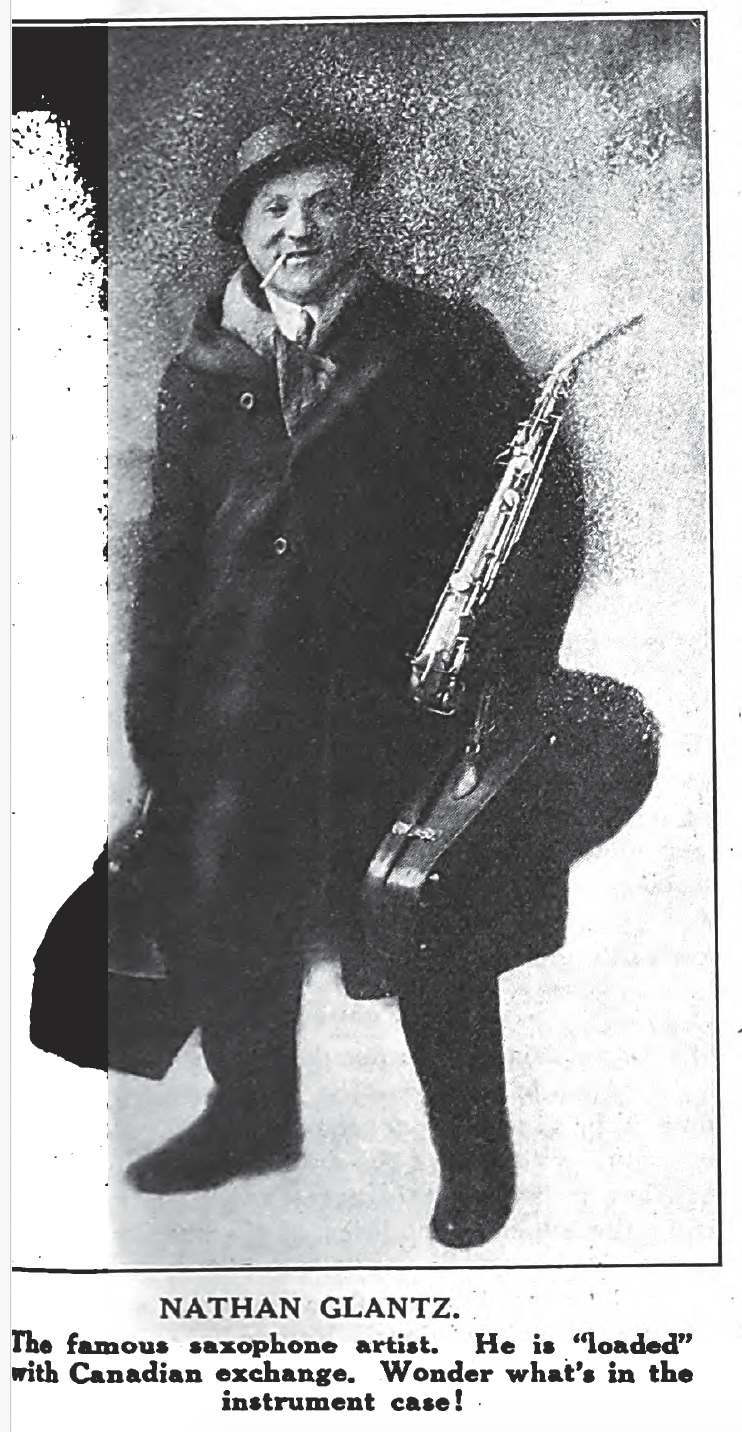
Yet life in the empire enabled this musician to develop a professional-level ability on the instrument. He left home intent on making the saxophone his livelihood. At least, that’s what Nathan Glantz told an interviewer for Metronome 25 years later. By that point, playing the saxophone allowed him to pay the bills and then some. Glantz became one of the most successful radio and recording artists of the twenties. None of the new arrivals that Sunday, including him, probably saw that coming.
In that profile of Glantz from the May 1929 issue of Metronome, he only mentions studying the saxophone in Russia in passing. He says he had “learned to master the saxophone in Russia and had hoped to earn a livelihood with it in America,” and moves on to his disappointment once he got there. Historians have documented the saxophone’s journey from novelty to star status in the U.S. But the fact that Glantz got there ready to work as a saxophonist raises some interesting questions about his life in Russia.
Assuming it wasn’t a shoddy recollection or a PR fabrication, Glantz’s story meant he came to the United States from Russia as a trained saxophonist. What was his path from saxophone student under the tsar to budding professional saxophonist? Glantz’s quote piqued my curiosity, and I wanted to share some preliminary research.
To put it simply, where did you learn to play the saxophone in late nineteenth-century Russia?
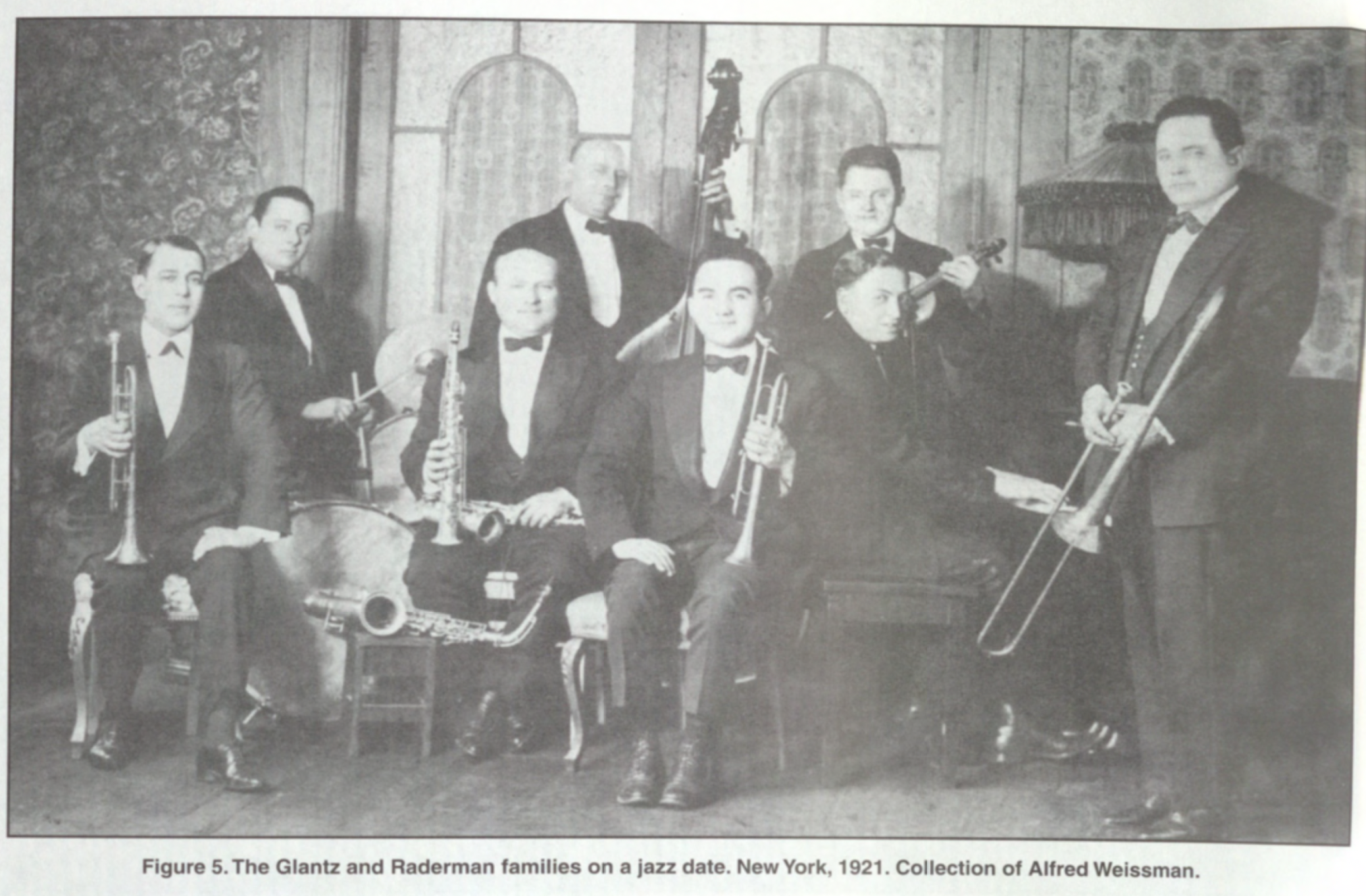
Play That Саксофон
If you were looking to hear or play the saxophone in many European countries at the time, you might join the army. Europe’s regimental bands were the earliest and, especially during the 1860s, the most widespread adopters of the instrument.
Russian musical society was more conservative. Brass instruments dominated the tsar’s military bands. Traditionalists suspicious of “westernization” probably didn’t welcome an instrument invented by a Belgian and widely used in the French army. A Russian military brass ensemble that included saxophones had won acclaim at the 1867 Paris Exposition. But only two standing Russian army regiments included saxophones in their bands. The instrument was also briefly part of a maritime unit, which may have been its downfall.
Naval band inspector and respected composer Nikolai Rimsky-Korsakov was not confident in the saxophone. In a report to naval officials, he echoed common criticisms at the time. Supposedly, Sax’s invention was poorly designed, limited in its expressive capabilities, and suffered from poor intonation in the cold (maybe the most damning allegation for pragmatic Russians). The accuracy of these claims was probably less important than their alignment with conservative tastes. Less than a year after its introduction to the navy, Rimsky-Korsakov ordered the removal of the instrument and recommended the same for army bands. When it came to the Russian military, the saxophone was out of the picture for the next few decades.
Even after the Russian military expunged the saxophone, it continued to appear in court ensembles. The tsar’s brass band, responsible for providing music at state ceremonies and palace events, included saxophones. There were as many as six of them in the orchestra at the court of Prince Felix Yusupov (famous for his role in planning Rasputin’s death). This aristocratic presence might have led to the instrument’s slow resurgence. By the turn of the century, the instrument began to appear again in military bands. One nobleman’s influential bandmaster even called for a saxophone school in Russia—an idea that wouldn’t fully materialize until well into the twentieth century.
Chances are, the least likely place to learn the saxophone would have been the conservatory or other institutions of formal music training. These schools taught Western European instruments and repertoire. The instrument might have encountered even greater difficulty in Russian schools than in the German schools they were modeled on. In Russia, conservatory training with recognized diploma credentials was about the same age as the saxophone; the St. Petersburg Conservatory, the first such institution in Russia, was only founded in 1862.
It doesn’t eliminate the possibility of saxophone teachers at these schools—an instructor at the St. Petersburg Naval music school kept teaching the instrument through 1922—but both Moscow and St. Petersburg, the two largest and most prestigious conservatories in the empire, were far from young Nathan Glantz in many ways.
A Saxophonist Despite the Odds
Glantz lived during an interesting time for the saxophone, even by its already unique standing in Russia. While you might have found the saxophone in military and court bands, you probably wouldn’t have seen Glantz.
He was born in 1878. Rimsky-Korsakov ordered the removal of the saxophone in 1874 and served as naval band inspector until 1884, while also exerting considerable influence over army bands. By the time Glantz might have started learning the saxophone, the Russian military would have likely purged most, if not all, of its instruments. Aside from saxophones used in regular service, Russian military schools that taught music and other trades might have had their own stock.
Even assuming a generous number of saxophones made it to resellers and other hands, it’s hard to tell how far these leftover instruments were dispersed within the empire’s vast borders. That’s without accounting for the state repurposing these materials. The military and other government agencies could probably find other uses for melted brass. By the early 1920s, even in a big city like Moscow, saxophones were still incredibly rare. Moscovite Mikhail Lantsman recalled that as late as 1931, when he wanted to learn to play, he needed to travel all the way to Kyiv and pay a lot of money to buy a saxophone from a retired royal guardsman.
Glantz was born and raised in the small town of Proskurov (now Khmelnytskyi in the historic Podolia region of modern-day Ukraine), about 250 miles southwest of Kyiv and 100 miles north of the province’s capital, Kamenetz-Podolska. Metropolises like St. Petersburg, where the saxophone and even American ragtime were beginning to catch on, were well over a thousand miles away and in a whole other social stratum.
Proskurov was inside the Pale of Settlement, the region where Jews were restricted to live until its abolishment after the revolution. Segregation, pogroms, random acts of violence, racist official policies, and discriminatory cultural practices all contributed to the vast scope of antisemitism in Russia at the time. For a young Jewish musician, geography was just one barrier to Russia’s major cultural centers.
These factors, plus a rigid class code, would’ve made affiliation with one of the court ensembles unlikely, too. Unlike large cities like Kyiv, and unlike their private countryside residences, the Russian nobility did not frequent remote provincial towns. Proskurov was one of the smallest towns in the empire (a population of just over 20,000 in 1897). It doesn’t seem to have been especially well known to any local musical institutions. In fact, the town is unfortunately now infamous as the site of one of the bloodiest pogroms on record.
Music Education Pre-sax
Glantz may have jumped on the saxophone bandwagon just as the instrument began resurfacing in military bands at the turn of the century. That would mean he “mastered” it just a couple of years before setting sail for the U.S. It would have been fortuitous timing: he’d have come in at a good time to learn the instrument and to leave the service (with or without approval).
Unfortunately, a researcher hired to look through records in Glantz’s hometown didn’t find any record of his service or his life there. Pre-Soviet military records are primarily located on-site at Moscow’s Russian State Military Historical Archive, and research there is challenging at this time. For now, it’s uncertain if Glantz was ever in the Russian military, though his brother and fellow musician Pincus did serve for five years.
Ultimately, I’m uncertain where Glantz learned the saxophone in Russia. He died in 1937, having retired a few years earlier, at the age of 59. Other than some marketing-oriented profiles like the Metronome one, there don’t seem to be any extensive interviews. Piecing together his early days seems more a matter of educated hypothesis, process of elimination and speculation.
Researching this topic raised the broader question of where he might have studied music more generally as a Ukrainian kid, which suggested more about where he was coming from, musically and as a person. The “inventor of the laughing sax” came from difficult, often tragic circumstances. His story continues to interest me, and I look forward to sharing more here.
Appreciation
Thanks so much to Aaron Keebaugh and Michael Steinman for their early feedback and ample patience on an earlier “kitchen-sink” draft of this post.
Sources
Abbreviated citation style for length and visual clarity.
- “20 Years Ago the Saxophone Was Considered a Joke” in Metronome, May 1929
- Fedorik, L.N. “The Saxophone in the Tsarist Army, The Red Army, and the Russian Army” presented at the International Center for Scientific Partnership’s International Research Competition on May 11, 2020 [translated from Russian]
- Frost, Edgar L. “The Impact of Russians and Eastern Europeans on American Society” in Russian Language Journal, no. 162/164 (1995)
- Gershon, Swet. “Russian Jews in Music” chapter in Russian Jewry, 1860–1917
- Kendall, Bryan. In Search of the Saxophone: Its Origins and Functions
- Lindemeyer, Paul. Celebrating the Saxophone
- Mannherz, Julia. “Nationalism, Imperialism, and Cosmopolitanism in Russian Nineteenth-Century Provincial Amateur Music-Making” in The Slavonic and East European Review, 95, no. 2 (2017)
- Maugans, Stacy. “The History of Saxophone in St. Petersburg” in Music Faculty Publications from Valparaiso University (2001, 1)
- Ohren, Dana. “All the Tsar’s Men: Minorities and Military Conscription in Imperial Russia, 1874–1905,” PhD dissertation at Indiana University, January 2006
- Petrovsky-Shtern, Yohanan. “Military Service in Russia” entry of YIVO Encyclopedia of Jews in Eastern Europe
- Sanborn, Josh. “Military Reform, Moral Reform, and the End of the Old Regime” chapter of The Military and Society in Russia
- Sapoznik, Henry. Klezmer: Jewish Music from Old World to Our World
- Sargeant, Lynn. “A New Class of People: The Conservatoire and Musical Professionalization in Russia, 1861-1917” in Music & Letters 85, no. 1 (2004)
- Smith, Andre M. “A Centennial Tribute to Harry Glantz” in International Trumpet Guild Journal, vol 20, issue 1 (Feb. 1996)
- Starr, S. Frederick. Red and Hot: the Fate of Jazz in the Soviet Union, 1917–1980
- Veidlinger, Jeffrey, “Musical Education and Musical Societies” entry in YIVO Encyclopedia of Jews in Eastern Europe
- Yugan, I.I. “History of the Establishment of Military Orchestras and Their Role in the State of Russia “ in History of Pedagogy and Education, Professional Journal of the Association, (2, 30, 2019) [translated from Russian]
- New York Passenger Arrival Lists (Ellis Island), 1892-1925
- Miscellaneous New York census records via ancestry.com
- Miscellaneous official records translated from Russian and located onsite and affiliated with state and local archives for Khmelnytskyi, Ukraine

