Category Archives: Uncategorized

Beauty, Rhythm and Paychecks with Ben Pollack’s Boys

Here’s a case for all the popular music that jazz musicians had to record just to make ends meet during the prewar era.

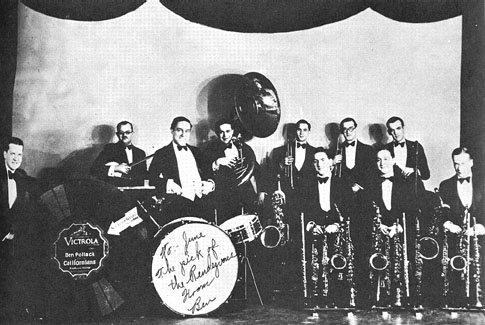
The following session includes some of the best players in New York at that time, regulars in Ben Pollack‘s band and performing here in one of the many studio groups organized by impresario Irving Mills. Young Benny Goodman sticks to reading alto saxophone parts, and Jack Teagarden’s trombone is barely audible, yet it’s not just commercial dross:

Scholars and purists will probably fast-forward to Jimmy McPartland’s cornet solo. Some might even mention criminally underrated saxophonist Larry Binyon. Yet McPartland is as rich, penetrating and warm on straight lead as he is in his Beiderbecke-inspired improvisation.  A typical prewar sax section (two altos and a tenor) has a bright, buttery sound that’s a refreshing change of pace from more modern reeds. Even the unknown, operetta-inspired crooner sounds more than bearable with Dick McPartland’s banjo, Harry Goodman’s tuba and Ray Bauduc‘s drums guarding the beat behind him.

Despite the simple tune and small space given to improvisation, a group of talented musicians makes it beautiful as well as rhythmic.  There’s no way to tell if heroes are happy, but these professionals certainly sound good.

Tagged , , , , , , , , , , , , , , , , , ,

A Long Time Ago In A Record Store

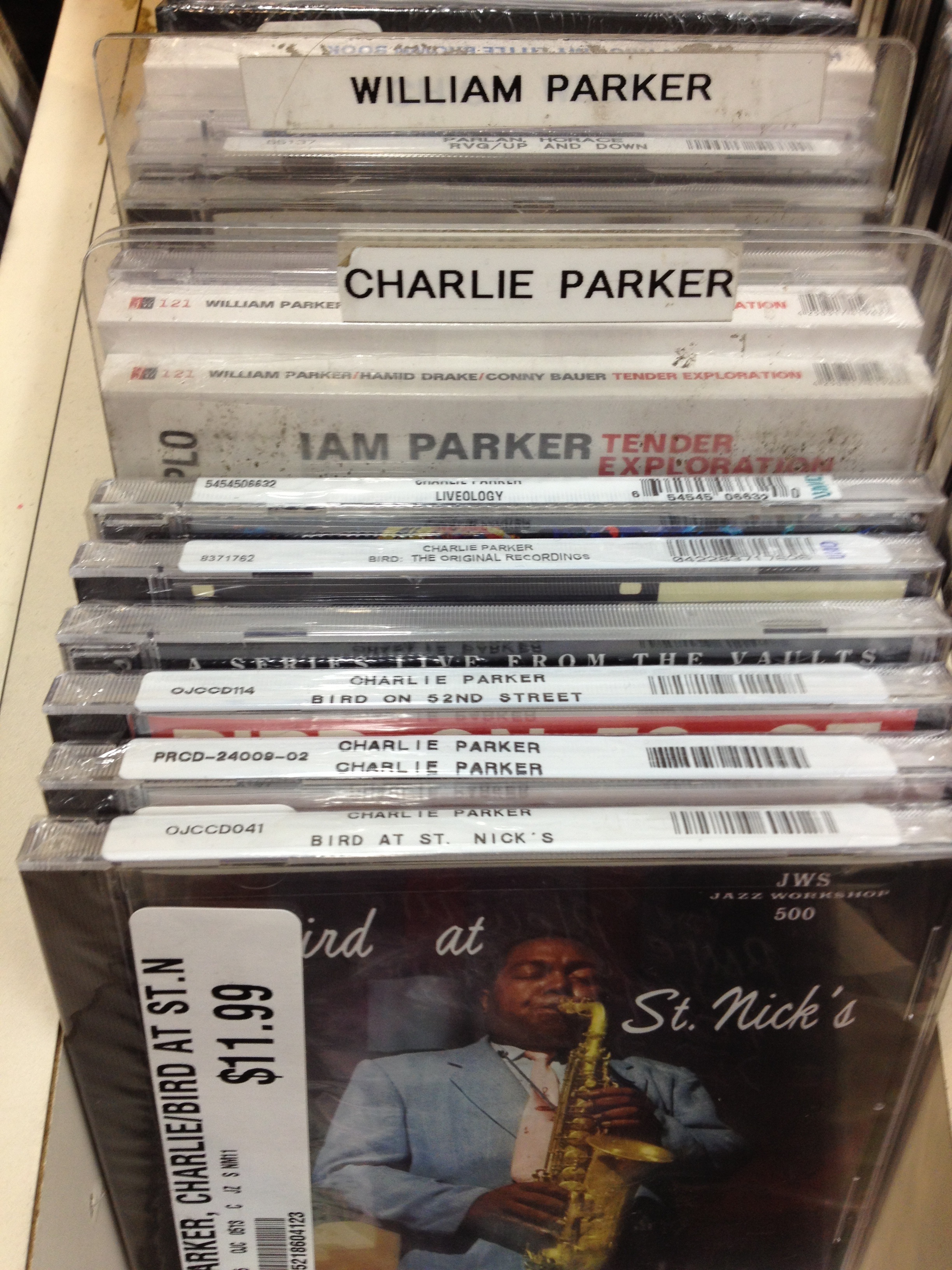
CDTime was that recorded music needed to be stored on some type of circular object (with rectangular objects briefly, and in hindsight laughably, substituted at a few points). If a listener wanted to hear their favorite band, they could insert one of these circles into a machine specifically designed to spark music from out of the circle. Over the years the circles changed in appearance, size, material, sound quality and how much music they stored. As the circles grew more sophisticated, so did their packaging: they might include the names of the musicians providing music for the circle, insight into the music beyond what its promoters had to say or some image that listeners would forever associate with that circle and its music. The principle always remained the same: a physical object that made music possible.

220px-EdisongoldmouldedTo keep hearing recorded music, a listener had to purchase more circles. Entire stores were devoted to selling circles, with aisles of them organized according to labels that weren’t perfect but still gave a general sense of where to look for a particular artist. The circles usually cost money but most listeners didn’t seem to mind; the right circle could provide joy, intellectual stimulation, inspiration, reminiscence or something else that made any price seem like a steal.

Many circle-buyers had a favorite store, a place where they found the circles they wanted or discovered new circles, sometimes a circle that changed their life. It might be some essential building block of a collection (for example The Hot Fives or The Well-Tempered Clavier), something recommended by friends (such as the Luis Russell band or Teresa Berganza singing Rossini) or something completely new to them (maybe Fats Waller playing the organ, perhaps Handel’s violin sonatas). Circle shops combined commerce, personal choice, education, hope, and the thrill of the hunt, with every flip of a cardboard cover or click of plastic cases bridging whole aesthetic universes.

J&R Music World was my favorite source for circles. Its sheer variety for even most esoteric musical tastes and its constantly growing store of music awaiting discovery will never be surpassed. Yet if pressed to explain why J&R really stood out, it would have to be for the train ride home following a shopping spree. The distance between lower Manhattan and southeast Brooklyn isn’t substantial in terms of geography, but the subway warps time in unusual ways. Waiting to switch from the R to the Q at DeKalb Avenue alone could seem like a Chaucerian journey. Yet the anticipation of getting home to hear those circles, packed tightly inside one of J&R’s signature light blue bags, made the wait blissfully unbearable.

2011-06-14-JR_panel

After moving out of New York City, trips to J&R became more sporadic but my appreciation for the experience grew. Aside from nostalgia, going to J&R was a chance to bump into something new rather than simply ordering what I already knew I wanted. Rather than reading a list of new releases cherry-picked by some editor at a magazine, I discovered them on my own, thumbing through them on the rack, browsing covers and often hearing them over the store’s speakers. And of course there was still that ride back home, which changed locations over the years and grew further from J&R, but which always seemed more rewarding after another good haul.

Recorded music slowly began to need circles less and less, and my favorite circle outlet began to change. On my first trip back after starting college, I was surprised that the jazz section was no longer surrounded by car horns and chatter coming from the street on the first floor, but was moved up to the second floor.  Yet the change allowed me to hear the new releases and employee selections over the store speakers that much better, as well as the staff’s answers to my questions and their suggestions based on my inquires. Regardless of what floor housed the circles, there was still ample ground to cover. Poring through the jazz section alone could easily take a few hours.

Over the years the few hours needed to cover the stacks started to diminish. The classical and opera rooms in the back became two parts of the same section, awkwardly squeezed next to other sections (Vivaldi’s vicinity to the karaoke section may not have inspired the same degree of outrage for all consumers). I also began to notice fewer and fewer circles in the overstock cabinets underneath.

IMG_0853On my last trip to J&R, I learned that their entire row of stores (including their electronics, appliance, computer, photography and other divisions) have now been condensed into one building. A sign outside the former spot of the music department directed me to the new omnibus location, where music now occupies two floors. The space is much smaller but things don’t seem very tight. Based purely upon the thumb and pluck method of stock analysis and an overwhelming sense of “is that it?” it seemed like there were fewer circles than ever. I haven’t researched J&R’s sales or plans for the future, and no one sends them more well-wishes than I do, but if the writing isn’t on the wall, it’s only because the download has to finish.

Progress has liberated music from its physical trappings. It has also ensured that future generations will never feel artistic possibilities gliding on their fingertips, or learn music history from a deluge of album covers while a former drug connection for Miles Davis and a retired Metropolitan Opera coach discuss their favorite albums across the aisle. In lieu of circles, music is now this weightless, formless, costless thing, as easy to find and forget as the air we breathe. One person missing his circles might be sad (in several senses of the word), but an entire generation never enjoying those circles seems unfortunate.

IMG_0297

Tagged , , , , ,

Finding Bill Moore

Bill Moore. The name seems like a pun on itself, a homophone inviting literally “more” to be said about it while resisting that urge through its own frequency. The number of birth certificates, census records, coroners’ reports, and gravestones for “William Moore” or “Bill Moore” makes it a daunting prospect when it comes to research. I’m interested in the trumpeter Bill Moore, but there are several players with that name, playing different instruments and kicking up more hay around my desired needle.

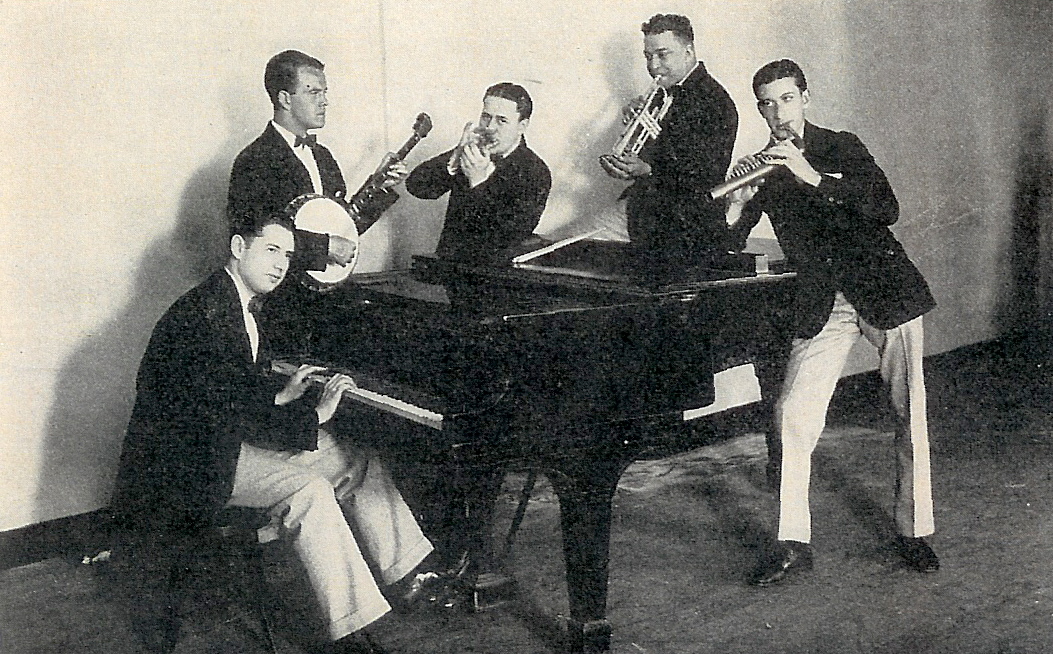
Irving Brodsky - Piano  Left to Right: Ray Kitchingham, Stan King, Bill Moore and Adrian Rollini
Irving Brodsky – Piano
Left to Right: Ray Kitchingham, Stan King, Bill Moore and Adrian Rollini

What I’ve found (so far, based on admittedly perfunctory research) says little and repeats it often: that Moore worked with the California Ramblers in all of their pseudonymous forms as well as with Ben Bernie, Jack Pettis, and many other bandleaders. His unique position as a Black musician playing in white bands also comes up frequently. Howard Rye, quoting Albert McCarthy’s The Dance Band Era in Names and Numbers magazine, explains that “One of the regular personnel [of the California Ramblers] in the mid-20s was trumpeter Bill Moore, a light-skinned Black who ‘passed.'” Discographies confirm that he played with a variety of bands through the Swing Era, with a 1950 Billboard review praising his “Armstrong-inspired” trumpet. There’s not much more to learn about the man, even less when it comes to the musician. Bill Moore is very hard to find.

The sound of Moore’s trumpet during the twenties takes us past the realm of historical ciphers and gigging sidemen. At that time, Moore was a distinctly pre-Armstrong player. His tone is far removed from the rich, brassy sound now virtually synonymous with “jazz trumpet.” It’s narrower and more piercing, like a needle rather than a sword, well suited to tying an ensemble together rather than cutting its own path.

Even through the haze of acoustic records, Moore’s trumpet has a buzzy edge to it, different than the cool quality of his contemporary Red Nichols, the broad, warm tone of Paul Mares or Johnny Dunn’s crisp flourishes.

Moore also frequent played with a mute. Brass players often point out how mutes can be used to hide intonation problems (with King Oliver a favorite example) but the possibility of expressive choice is worth considering in Moore’s case. Moore’s pinched sound was put to good use on a series of sessions throughout the late twenties.

Moore also chatters rather than blasts, maybe to hide an uneven tone, maybe to show off fast fingers. Either way, he lets this brash instrument—seemingly designed for sweeping bursts—speak in tight, concentrated patterns.

Armstrong experimented with what Brian Harker called a clarinet-like approach early on in his career. Nichols used clever, clipped lines throughout his long career. Jabbo Smith and Roy Eldridge frequently employed double-time with the boppers later adding their own phrasing and harmonic ideas.

Moore’s chattering is based on a pre-Armstrong aesthetic that emphasized contrast and variety over continuity and flow. It’s also more of an ornament, as Moore sticks closer to the melody than many modern jazz musicians care to—while Moore knows how to have fun with even the silliest tune, rather than simply throw it out. The emphasis on contrast, paraphrase, and mutes indicates that Moore might have been listening to “novelty” trumpeter Louis Panico.

Listening to Moore reveals more than session dates and personnel listings. It points to influences, musical choices, textures, and his own stylistic vocabulary. In other words, there’s a distinct musical voice at work. Neither a genius granted immortality nor a hack deserving complete neglect, after generations of brash, brassy trumpeters in the Armstrong mode, Moore’s style might seem like a wholly new experience (even if it originated decades before most readers were born).

from The Reading Eagle, November 7, 1929

Jazz purists might dismiss Moore based on his different sense of swing, comparatively restrained improvisational approach, or some other interesting but ultimately illogical bit of teleology. Given his post-ragtime, pre-Armstrong soundscape, criticizing Moore (and his contemporaries) for not sounding like later players is like chastising Renaissance paintings for having too many religious references. Rather than admiring the work in its historical context or apart from the critic’s context, everything is measured against one stylistic endpoint with all “great” works leading up to or issuing from it.

Not that many even take the time to dismiss Moore based on his playing.  As is often the case with the earliest chapters of music history, discussion beyond the session cards and matrix numbers and right to the sound of the music appears infrequently. Maybe reacting to the music itself seems too subjective. Maybe now that Moore and his colleagues are no longer around, maybe the only thing left to do is ensure an accurate record of the past. Hopefully, when the record is complete, we’ll remember why it was assembled in the first place.

Tagged , , , , , , , , , , , , , , , , , , , , , , , , , , , , , , ,

A Very Brief History of Jazz via “Tiger Rag”

everynote.comThis list is more stylistic than chronological, and certainly less than comprehensive, but hopefully it still provides a fair overview of the music’s development.  At the very least it shows that good musicians never play “the same old tune.”

Screen Shot 2014-08-14 at 10.07.30 AM


Unfortunately, YouTube removed a great clip of Barry Ulanov’s All Stars, featuring Ray Brown, Dizzy Gillespie, Charlie Parker, Max Roach and Lennie Tristano playing “Tiger Rag.


Readers are encouraged to share examples  of “Tiger Fusion, Tiger Latin, Tiger Atonal, Tiger Hip Hop” or their own favorite exploration of this perennial favorite.

Tagged , , , , , , , , , , , , , , , , , , , ,

Jacobs on Pergolesi’s Stabat Mater: “What Are There, Like A Million Recordings Of It Already?”

z01839ns2cbRene Jacobs said he is thrilled to start recording modern premiers of several operas by Pergolesi once he finishes work on “another fucking version of the Stabat Mater.

Jacobs also praised Pergolesi’s vocal writing and sensitive style. “Pergolesi became incredibly popular despite such a short life. He left behind just a handful of works but they show so many sides of him. Too bad record labels keep sitting on the same finger and rotating.”

When asked if he thought audiences were ready to hear more from this composer, the esteemed conductor and scholar shrugged and noted, “Who the hell knows? Asking what classical audiences enjoy is like asking where a cat will pee: they could go anywhere, but god forbid you move the same litter box they’ve been using their whole lives.” Currently he is also finishing up the one millionth recording of Vivaldi’s Four Seasons.

denisesisko.com

Tagged , , , , , , , , ,

All About Jazz Is All About Buster Bailey (Today, Kinda’)

Buster BaileyThrilled to see my review of Buster Bailey‘s All About Memphis on All About Jazz. It’s great to see my name on an article, but I’m even prouder of the fact that this underrated clarinetist cut an album as a leader and that he’s getting some attention today, right next to some musicians who just happen to be alive.

Incidentally, the album is available as a (cheap) download on Amazon. Perhaps with the right attention, the only thing that will be a footnote about Bailey will be his death.

Thanks for reading, and keep listening.

Tagged , , , , , , , , , , , , , , , , , , , , , , , ,

Jazz On Record Turns 96…

…maybe it does, maybe it doesn’t.  Just for today, let’s put aside the debates, give the Original Dixieland Jass Band credit for getting jazz its earliest attention and enjoy their music in all its raucous, onomatopoeic glory:

Happy birthday to recorded jazz (whenever that may be).

www.thejazzman.com.au

Tagged , , , , ,

Tom Smith Remembers Donald Byrd

Donald Byrd (Photo Michael Ochs Archive/Getty Images via Billboard)

Donald Byrd (Photo Michael Ochs Archive/Getty Images via Billboard)

The jazz world and music community as a whole were saddened by the passing of Dr. Donald Byrd earlier this month. The trumpeter was known as a mainstay of Blue Note’s classic period and for his work in various soul, funk and pop settings. The numerous obituaries and remembrances for Byrd also speak to his role as an influential educator and mentor to many artists.

One of those mentees, Tom Smith, currently serves as professor and Director of Jazz Studies at Ningbo University in China. In the following piece (appearing in English courtesy of the Romanian website Jazz Compass with photos and hyperlinks added by me), Smith provides a heartfelt recollection of Byrd, especially his prescience regarding the global scope of jazz. Smith’s position as an international jazz educator with his “boots on the ground” as well as someone close to Byrd is worthy of several reprints and translations.

Recalling a Mentor
by Tom Smith

This past week, a great and influential jazz musician named “Donald Byrd” died. He was one of my earliest mentors, and as colorful a man as ever known. I first met him in early 1981 following a terrible six-month road gig that began optimistically in Minneapolis before self-destructing in Central Mexico. I was twenty-three and already burned out, having decided a homebound strategy until alternate plans could be discerned and evaluated. Then by accident, I learned of Byrd’s professorship at North Carolina Central [University], and signed on for an ambiguous term of graduate studies, never planning to finish…only to hang and play with the great trumpeter whenever possible.

I met Byrd (the name we all called him) face to face when two days into enrollment, he bolted into my practice room. “I haven’t heard a straight horn tone since I got here,” he said. Then he introduced himself, followed by my cursory, albeit “hamfisted while trying to be cool.” admirer confession. I think that really threw him off, considering a recent unexplained anonymity, perplexing in light of numerous albums and freshly recalled affiliation with a Blackbyrds’ hit called “Walking in Rhythm.” Then, he took me into his office and we jammed for an hour or so. After that I had Byrd pretty much to myself for any amount of arbitrary brain picking, and with him being the big talker that he was, such exercises were a joy to pursue.

I think Byrd saw me as this enigma who was looking for something he couldn’t find. So, within that context, he tolerated our daily banter, while some of my favorite interims included solitary evenings where he passed along Art Blakey gossip, while sharing Frank Zappa recordings. He was especially fond of the Lather set, and outright stole my copy of Studio Tan.

Donald Byrd and Tom Smith (photo courtesy of Tom Smith)

Donald Byrd and Tom Smith (photo courtesy of Tom Smith)

Still, those discussions were never entirely perfect. Truth be known, we fought tooth and nail about any number of things, especially jazz. Back then, I was an unforgiving hard core, which made it easy to sense my loathing for his newer “get some money” approach. Subsequently, he made it abundantly clear that lectures from overreaching kids were beneath his pay grade. In the process, I acquired numerous scars, including his being mad enough to withdraw a prior touring commitment. But that’s the way Byrd was: hot, cold, turn on a dime.

Not surprisingly, he was up on current affairs, while intrigued with Eastern Bloc nations. Byrd was in fact the first musician to tell me about the Romanian curiosity for jazz. He even periodically enlisted diplomats to get him there, an aspiration never realized but always on his radar. His intuitive knowledge of Iron Curtain behaviors always fascinated, and as the years passed those places assumed a greater importance for me. Sometimes, Byrd’s assumptions were downright prophetic.

“Watch what happens when Russia leaves,” he said. “Those people will hook up with the money countries and musicians will get their asses out of there.”

http://romanianjazz.blogspot.com/2008/07/johnny-rducanu-jazz-made-in-romania.html“But what then, Byrd?” I asked. “That’s going to be up to them,” he replied. “But we’ll be deep in the middle of it, you can bet on that. Then later, musicians will return to their cultures, because it’s just too hard to walk away from what you are.” Then he looked me square in the eye and shared another deeply furrowed insight. “The older ones will stay right there, insisting on taking money they will think belonged to them as young men,” a tacit attack on my misdirected indictment of his more human inclinations. After all, I could never in a million years imagine how many different ways Black musicians were robbed in Byrd’s time, any more than I could understand the plight of older Romanians deprived of their own paydays. Still, while most of the past decade unfolded, I diligently fought for contrasting outcomes, while knowing in my heart of hearts that Donald Byrd’s all-encompassing prophecy had indeed come to fruition.

Back in 2004, I wrote a magazine article describing the future exodus of Romanian artists. I called it, “The Reverse Migration,” and was astonished by how some reacted, as if to imply I had manifested something Romanians already knew to be gospel. But nine years ago, with [European Union] ascension just over the horizon, popular wisdom asserted that most, if not all Romanian artists would scurry across Western borders faster than you could say “Ceausescu.” It was further assumed that Romania’s small but massively talented family of jazz musicians would be among those most severely affected, if not irreparably damaged. Romania and Bucharest in particular, was blessed with a good quantity of talented jazz performers, who undertook numerous important tasks, including participation in any number of worthwhile endeavors, while simultaneously creating most of the jazz everyone there took for granted.

Alex Simu with Srdjan Ivanovic's Quartet at the Dutch Jazz Competition, 2008 (Photo courtesy of Simu)

Alex Simu with Srdjan Ivanovic’s Quartet at the Dutch Jazz Competition, 2008 (Photo courtesy of Alex Simu)

As a Fulbright Professor at the National University of Music, I had the good fortune of teaching Romania’s best young jazz musicians. But in all candor, I was largely disappointed by their diminished sense of artistic nationalism, and perennially dismayed by their unhealthy infatuation for Western art. “Just show us how to play in your manner,” they would say. “If you want to help, show us how to secure Western residencies,” the hook to any admission that preceded a desire to leave Romania. Then just as Byrd had predicted, a Western migration of young jazz musicians did indeed occur. It started six months into my first residency when a young saxophonist named Alex Simu bolted for Holland. After that, the floodgates opened, and few of my class remained, leaving a handful of persistent loyalists, young works in progress, and a core group of older musicians in their stead, with some harboring no desire but to see all work go into their pockets alone.

Due to unforeseen circumstances, the yang of my theory was proved unfounded. Westerners never came to take those jobs abandoned by emigration, seeing as how there were none to take. A great 2008 recession had seen to that.

Following a brief return in 2009, I was very concerned about Bucharest while harboring guarded optimism for the rest of the country. Timisoara was certainly a bright spot, the result of a failed but legacy successful jazz school that rejuvenated Western Romania’s happily optimistic Banat infrastructure. Then Cluj profited from six months with Dave Brubeck’s oldest son Darius, while old Fulbright loyalist Rick Condit reinforced his efforts in Iasi. Soon, I realized that what remained could most likely survive as a non-stagnant national product, deemphasizing Bucharest to some extent, but in turn holding dear old legacies for as long as required, before Romania’s young prodigal sons (now older, more seasoned men) returned single file through Bucharest’s Arc De Triumph. Still, this essential reshuffling could not deter those enterprising and creative souls, both young and old (such as Mihai Iordache, Raul Kusak, Irina Sarbu, Michael Acker, etc.) who have kept Bucharest’s jazz scene alive despite any number of obstacles.

In the meantime, the Alex Simus, Lucian Bans, Catalin Mileas, Petru Popas, Arthur Baloghs and George Dumitrius continue to expand their expat influences, while growing exponentially as savvy, marketable performers, all quality driven and ethical to a fault.

I have also taken note of the current inclination for Romanians to sing jazz in their own language, not because they have to, but because they want to. This in turn seems intertwined with those Romanian folk melodies I currently hear in the motivic expressions of young performers: musicians who see their jazz not so much in terms of Americanized cloning, but as the melding of a relevant and viable name brand that says “We’re from this place and this is our way.” It’s also nice to hear them share how they’re interested in what Alex, Catalin, Lucian or George are doing even if it isn’t in Romania, because like all great diasporas, jazz culture can most certainly achieve highest enlightenment when on the move.

http://www.theage.com.au/national/obituaries/hard-bop-luminary-who-weathered-crossover-controversy-and-inspired-leading-hiphop-artists-20130214-2eg8u.htmlWhile reflecting on the teachings of my old mentor Donald Byrd, I can easily imagine his looking down just long enough to shake his head and say “I told you so.”

[Jazz Compass Editor’s Note] From 2002 to 2008, Tom Smith was a six-time Fulbright Professor of Jazz in Bucharest and Timisoara. He is currently a Professor of Music at Ningbo University, in Zhejiang Province, China.

Tagged , , , , , , , , , , , , , , , , , , , , , , , , , , , , , , , , , , , , , , ,

Bom Chicka Wah Wah, Circa 1727

Even if The Borgias, The Tudors, and Boardwalk Empire have established that people have been getting “nasty” for centuries, Vivaldi’s “Sol Da Te” from Orlando Furiso had to have steamed a few collars and corsets in eighteenth century Venice.

The aria takes place right after the knight Ruggiero swallows a love potion and instantly fixates on the sorceress Alcina. Nothing too racy there, so Vivaldi leaves it up to the music to scandalize his audience:

It’s that dark minor key, combined with a tense, palpitating but teasingly slow momentum, that makes the listener feel like they’re in on a very intimate moment. Flute over muted strings now seems like something for the Easy Listening set, but here the flute alternates between Vivaldi’s seductive melody and rapid bursts, as thought it’s having trouble concentrating. The Italian poetry, sung in cultivated operatic tones (originally written for a castrato!), only seems more “romantic” than “sexy;” don’t treat these lyrics too literally:

Sol da te, mio dolce amore,
Questo core
Avra pace, avra conforto.
Le tue vaghe luci belle
Son le stelle,
Onde amor mi guida in porto.

(In loose English translation:
Only from you, my sweet love,
Does this heart
Find peace and comfort.
The beautiful lights of your eyes,
Are the stars,
That guides my love to harbor.)

It’s beautiful, but it doesn’t take a dirty twenty-first century mind to read into all that talk about “comfort, peace” and being “guided” into the harbor. Barry White wasn’t the first one to use “love” as a code word for a variety of feelings and actions. There’s a long history of guys using the right lines and music to get what they want. So get to happy hour tonight, keep the music of a dead Italian priest in mind and have a happy Valentine’s Day!

Give Him a Powdered Wig and a Harpsichord, Then He Can Sit In

Get That Man a Powdered Wig and Electric Harpsichord!

Tagged , , , , , , , , ,

Fess Williams and Eric Dolphy Playing Their Saxophones

What do Fess Williams and Eric Dolphy have in common? For starters, both played for none other than Charles Mingus.

Dolphy, prophet of the jazz avant-garde, deeply admired by Mingus and considered one of the most galvanizing forces to ever play with the bassist/composer, and Williams, an incredibly popular bandleader during the twenties, now mostly remembered for his gas pipe clarinet that even diehard collectors merely tolerate: both appeared at Mingus’ (in)famous Town Hall Concert of 1962. Dolphy performed most of the show, but Mingus brought Williams, a.k.a. his Uncle Stanley, onstage briefly to show off some circular breathing.

Even more important than a boss or an uncle, Williams and Dolphy share an ear for the humorous and disturbing, a penchant for making their instruments squeak, honk and pop, throwing in plenty of gangly dissonances and other sounds that most musicians leave behind alongside soft reeds and method books.

Compare Williams’ jagged breaks at the beginning of “Playing My Saxophone”:

with Dolphy’s entrance on his groundbreaking “Out To Lunch”:

and it’s easy to hear that both reedmen simply love sound: the more jarring, the better. It’s fun to imagine Dolphy and Williams backstage at Town Hall, not saying a word but merely trading squawks and fractured themes.

Both Williams and Dolphy also snub their noses at the clean lines and cultivated timbres no doubt enforced at the conservatories they trained in. That makes them both rebels, and jazz loves a good rebel! Yet given Williams’ period of activity and the large audiences he played to, his rejection of classical instruction seems more commercial, and therefore more suspect.  Most jazz histories (when they mention Williams at all) relegate him to “novelty.” Williams was out to make a buck, Dolphy sought to change ears and minds. Dolphy is the artist, Williams was merely an entertainer.

It’s a neat little distinction, but it speaks more to cultural interpretation than sheer sound. Dolphy does often display much quicker fingers and harmonic variety, yet that’s as much of a stylistic choice as Williams’ reliance on a percussive sound and bumpy phrases.  Even when the sounds aren’t so similar, both players’ sense of taking the listener to a different, even weirder place is clear. Simply listening to Dolphy’s blurting, burry bass clarinet on “Booker’s Waltz”:

back-to-back with Williams’ ambling slap tongue solo on “Dixie Stomp” illustrates two musicians who liked to play in every sense of that word:

Yet even assuming that Williams was just goofing off to make a buck and that Dolphy was in fact the serious artist pushing boundaries, all the listener is left with is the sound. The sound is out there to be heard.  Trying asking it about its motives, or whether it’s a novelty or work of art.

While We're At It, Rahsaan Roland Kirk (Left) Stole Wilbur Sweatman's Act!

While We’re At It, Rahsaan Roland Kirk (Right) Stole Wilbur Sweatman’s Act!

Tagged , , , , , , , , , , , , , , , , ,