Tag Archives: Sam Lanin

Alfie Evans: Everything in a Day’s Work

Alfie Evans appears in personnel listings with popular dance bands and next to several jazz legends. He didn’t change the course of music, but a little research shows he enjoyed a long musical career while earning kudos from colleagues and collecting some fascinating anecdotes. I hope you enjoy reading about him as much as I enjoyed learning about him.

Musical Roots

Alfred Lewis Evans was born on June 20, 1904, in the Pennsylvania borough of Olyphant. That middle name came from his Welsh-born father, who named his son after a late brother who had died in the Scranton mines.

Music was likely an important part of young Alfred’s life from the start. His father was the pianist for Olyphant Baptist Church and Scranton’s Strand Theatre. After moving to White Plains, New York, later in his life, the elder Evans continued playing with radio orchestras until his death at the age of 80.

Evans’s father also played trumpet while leading his own bands. As a Bucknell University student, arranger Bill Challis recalls Alfred playing “hot violin” with his father’s group as early as 1922. He was already going by “Alfie.” At some point, Evans met fellow Pennsylvanian and future swing star Jimmy Dorsey. He likely also met Jimmy’s trombonist younger brother, Tommy.

A childhood friend of the Dorseys remembered Alfie as a “violinist who switched to sax and clarinet after just three weeks of training with [Jimmy].” That was more than enough training. By the start of 1923, Evans was playing saxophone with the Saxons Society Orchestra. This elitely-named band also played hot dance numbers like “Chicago,” “Lovin’ Sam,” and “Toot Toot Tootsie.” By the start of the following year, Evans seems to have relocated to New York City. He may have moved there with his family; his marriage certificate indicates his parents were living in the city by 1926.
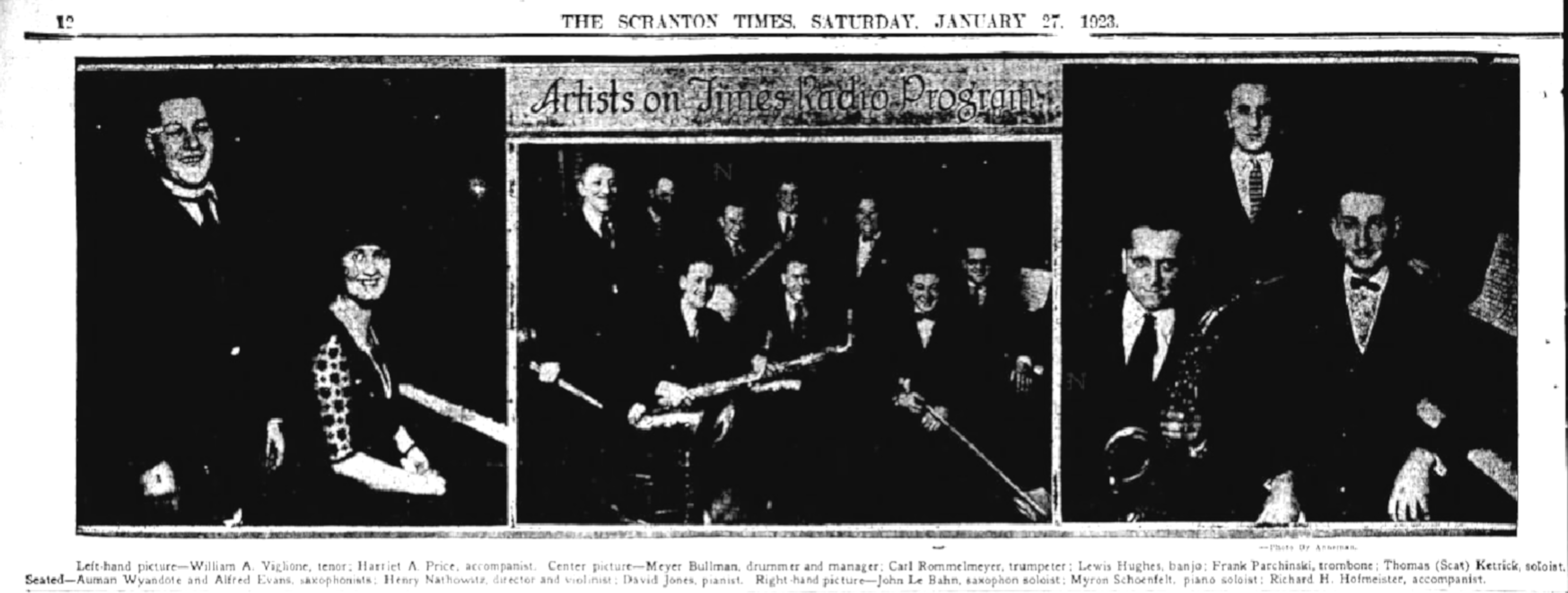
The Scranton Times on January 27, 1923. The center panel shows the Saxons Society Orchestra with Alfie Evans seated second (?) from the left.

A photo from this period shows Evans with the Scranton Sirens when Billy Lustig led the group as “Billy Lustig and His Sirens Orchestra.” In an informative piece about guitarist Eddie Lang, researcher and audio engineer Nick Dellow notes that this “local band through which many dance band and jazz luminaries passed” played the Beaux Arts Café Atlantic City, New Jersey, for two weeks starting on New Year’s Day of 1924. Banjoist Jack Bland recalled Evans, both Dorsey brothers, Lang, and Morgan with the Sirens at that venue. Alfie was barely older than 20 and already keeping impressive musical company!
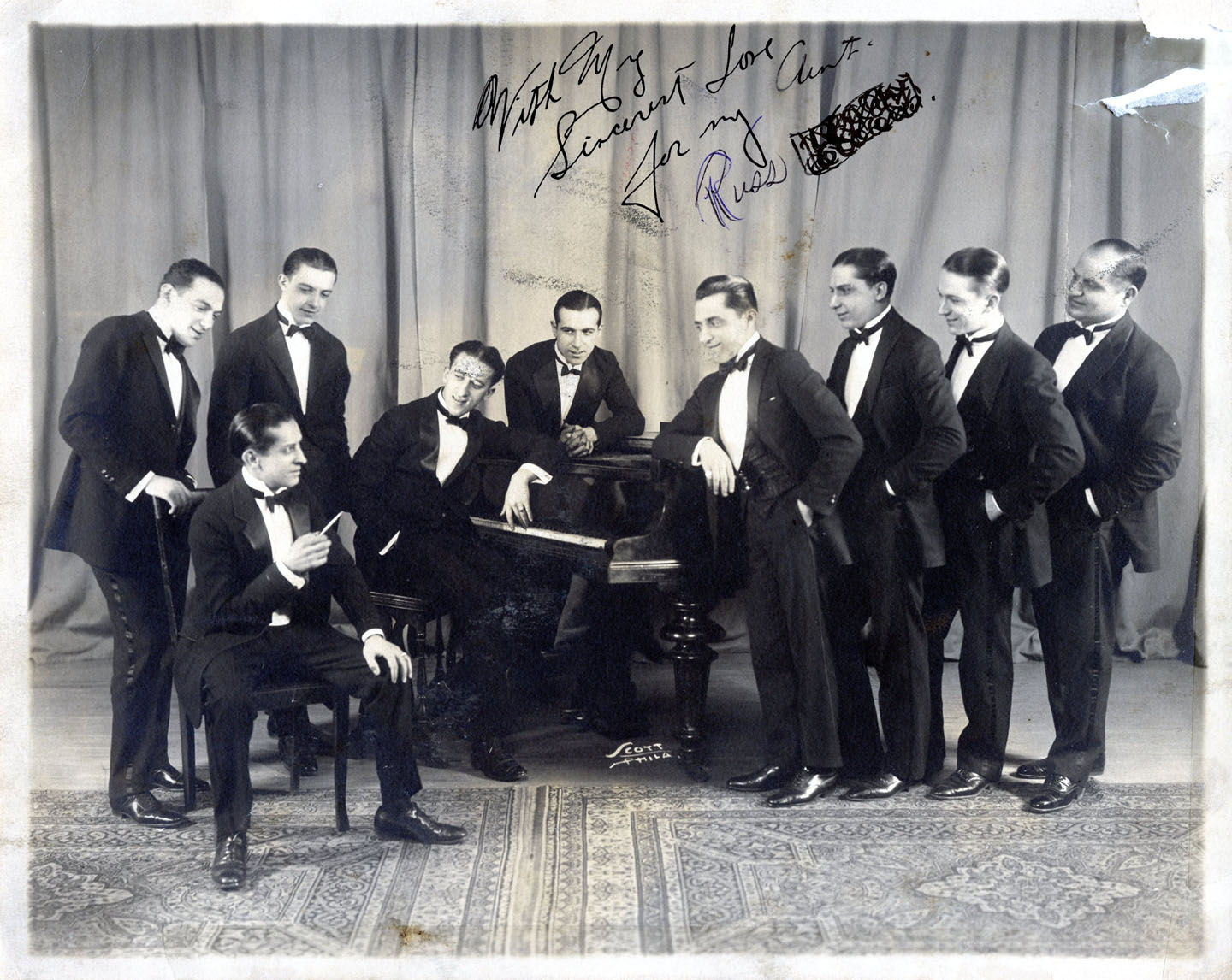
Billy Lustig and His [Scranton] Sirens Orchestra. Alfie Evans is second from the right. Photo from Russ Morgan’s collection and shared by Josh Duffee on The Bixography Discussion Group.

After the Beaux Arts gig, the Sirens embarked on a series of one-nighters, but it’s unclear whether Evans went on the road with them or stayed in the area. He joined Dinty Moore’s orchestra at the Hunter Island Inn in Pelham, New York, around May 1924. Variety reported this band playing “regulation jass [sic] stuff and selections from comic operas…[and] a cycle of Victor Herbert works.” Moore featured all his band members—“especially” Evans—as soloists. The magazine also mentioned Evans having played under Herbert, an esteemed conductor and composer.

Dance Bands

In a letter to historian Stephen Hester, tuba player Joe Tarto said Evans played clarinet and alto sax with Sam Lanin at the Roseland Ballroom in 1924. Biographies of Bix Beiderbecke also mention that Evans and cornetist Red Nichols were living in a hotel while playing with Lanin. Beiderbecke soon moved in when the Wolverines band came to New York.

Evans shared some unique views about his roommates in a letter to Beiderbecke biographer Phil Evans (no relation):

Red had all of the Bix recordings that were available, and he would play them over and over and again over. So, I knew Bix’s work very well before I met him…Red played most of Bix’s choruses on RCA Victor with George Olsen’s band…I found that Bix had ideas that were six years ahead of his ability to play them. He had a range of maybe a tenth, not much tone, but he could do wonderful things with his limited technique…[Bix] and I would sit up until the wee hours trying to wear out my new recording of Petrushka. Bix would sit there and drool over some of Stravinsky’s chords.

“Not much tone” will likely surprise many Beiderbecke fans (and the writer doesn’t know George Olsen’s records well enough to say who’s playing what on them). Evans sure had definite tastes and expectations in music!

But when did he join Lanin in 1924? A Billboard article from May 10, 1924, lists Lanin’s reed section as Larry Abbott, Maurice Dickson, and Merle Johnston. By October, Variety was reporting that “Lanin’s sax section—Clarence Heidke, Al Evans, and George Slater—are a crack trio for harmonies and rhythms.” That’s the same section listed in Tarto’s letter.

Johnson and Shirley’s American Dance Bands on Record and Film (ABDRF) lists Evans on a December 26, 1924, session with a Lanin group recording as Bailey’s Lucky Seven. That seems to be Evans’s first recording date, inaugurating a lengthy recording career. Tom Lord’s online Jazz Discography lists “Alfie Evans” and “Alfred Evans” on nearly 200 sessions. ABDRF shows 40 index entries, with many spanning multiple pages. That doesn’t count recordings outside the sometimes arbitrary labels of “jazz” and “dance music.”

Ironically, despite Evans’s extensive discography, it’s difficult to identify him as a soloist or in ensembles for most of his career (at least for this writer’s ears). Part of the issue is pinning down Evans’s “voice” on any of the instruments that multiple discographies assign him through all those personnel listings. Following that period’s sax section conventions, Evans often appears alongside at least two other reed players. Those players often doubled various permutations of reeds: clarinet and sometimes bass clarinet; soprano, alto, and/or baritone saxophones; and a decent amount of flute, oboe, and other orchestral reeds.

Doubling may be expected of professional musicians. Just being able to meet that expectation is impressive. Evans seems to have exceeded that professional standard for decades. His skill and versatility allowed him to not just survive but thrive for his entire career.

That still doesn’t help locate him on records. Discographies show Evans as the sole reed on two sessions with The Red Heads waxed for Pathe Actuelle on February 4 and April 7, 1926. Discographies are not perfect. Their sources aren’t always clear. Evans might not be on these sessions, but they might be the best opportunities to isolate his sound.

In the ensemble on “Poor Papa,” the clarinetist plays in syncopated accents between the cornet’s lead and the trombone’s counterpoint. It’s a different approach than the tumbling arpeggios and heavily inflected lines of some other players. In solos, the clarinet has a medium-bright tone with a slight sandiness in the mild register.

On alto for “‘Taint Cold” and “Hi-Diddle-Diddle,” the player crafts lines in stepwise phrases and short intervals. He displays a neutral tone and light vibrato that (to the writer) sound different from the lead/solo alto(s) on Lanin’s recordings at the time.

Evans continued to record with Lanin throughout the twenties. But his regular day job shifted. He moved between multiple groups filled with top musicians who had the skill and versatility to play hot dance music, complex arrangements, and the range of material required to be a successful working band—yet another indicator of Evans’s talent and hustle.

After joining Ray Miller’s band at the Arcadia Ballroom for the 1924 winter season, Evans may have spent time with Roger Wolfe Kahn in 1925 before officially joining him the following year. George Van Eps remembered Evans as part of the Kahn band—along with Vic Berton, Lang, and Joe Venuti—at Manhattan’s Pennsylvania Hotel during an instrument makers’ expo. By the summer of 1925, Evans was with Ross Gorman’s pit orchestra for Earl Carroll’s Vanities show as well as broadcasts on the radio and records made for Columbia. In addition to their multi-reed virtuoso leader, Gorman’s sidemen also included Tony Colucci, Miff Mole, and Nichols. Evans was still with Gorman through at least November.

Ross Gorman’s Vanities Orchestra. Image from Record Research 34, April 1961, and retrieved from archive.org.

Beside legitimate nightclubs and ballrooms, Evans also played the circuit of after-hours mob-run speakeasies. For many musicians of the time, working with organized crime figures was just part of the job. Evans seemed to enjoy a courteous, professional relationship with these gangster businessmen. He shared one story with his son and grandson highlighting this curious dynamic and Evans’s shrewdness in tough situations.

Over dinner with one venue’s management, Evans happened to admire a Cadillac driving by outside. Two days later, that Cadillac was parked on the lawn at his Long Island home. It wasn’t just the same model; it was (somehow) the exact same car. Evans thanked his employers but politely explained that he could not accept such a gift. He knew that accepting it would mean being indebted to the wrong people. Evans was extra cautious after hearing about a singer who ended up with maimed vocal cords after quitting a venue. He had to play for some dangerous people to make a living but diplomatically avoided any involvement outside professional music.

Evans recalled mostly playing alto sax at these jobs, which could last into the earliest hours of the morning. Unlike some of his fellow musicians, he skipped any alcohol-fueled carousing after the gigs. Evans’s son remembers his childhood home as a popular dinner spot for musicians and an occasional stopover when they were exhausted or hungover. One morning, as a little boy, he walked down the stairs to find Tommy Dorsey snoring on the family couch and sleeping off the night’s festivities!

By the start of 1926, Evans had replaced Dick Johnson in Roger Wolfe Kahn’s band at the leader’s Peroquet de Paris club on West 57th Street. The Kahn band was another group of all-stars that included Vic Berton, Arnold Brilhart, Tony Colucci, Tommy Gott, Lang, Leo McConville, Arthur Schutt, and Venuti.
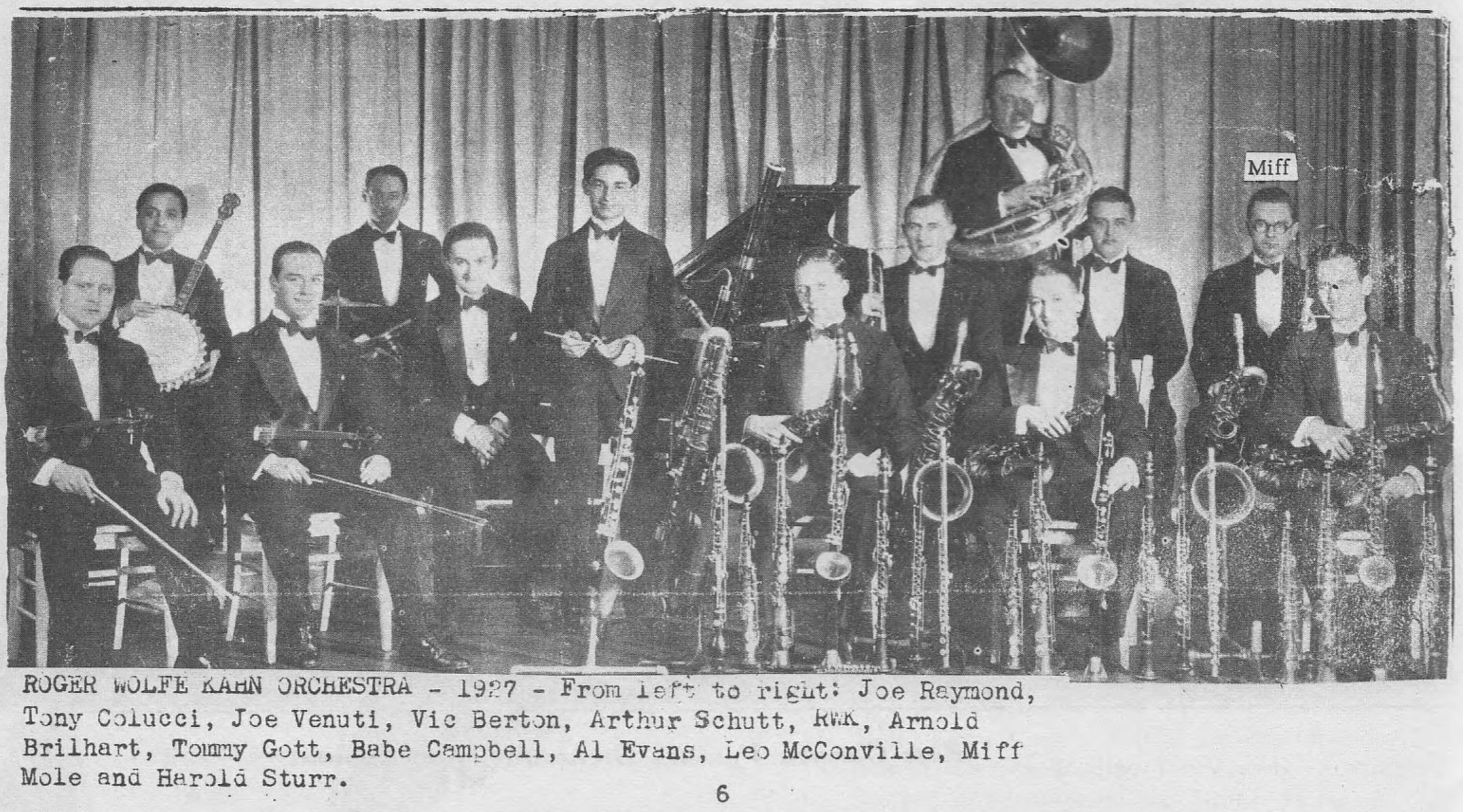
Roger Wolfe Kahn’s band. Photo from Record Research 34, April 1961, and retrieved from archive.org.

He also accompanied his friend Rudy Wiedoeft in a saxophone ensemble concert at Aeolian Hall on April 17, 1926. Evans said that Wiedoeft saw working as a sideman as beneath him—which Evans thought was for the best because he considered Wiedoeft a poor section player!
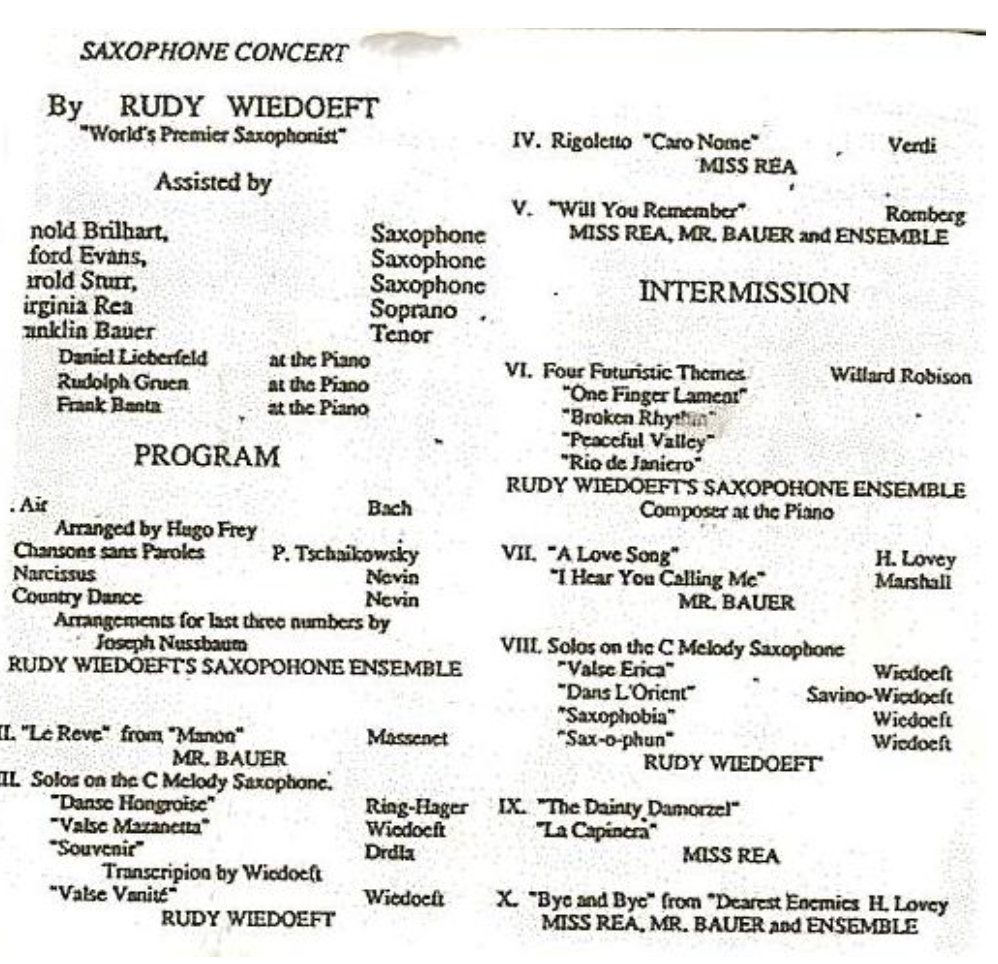
From the program of Rudy Wiedoeft’s Saxophone Ensemble concert at Aeolian Hall on April 17, 1926. Evans is listed with the first name “Alford” (that is partially cut off above). Image from Saxophones in Early Jazz by Karl Koenig.

 A few weeks later, on June 7, 1926, Evans married his high school sweetheart, Myrtle Sullivan. They would have two children together: Alfred Jr., who went on to become a successful attorney, and Marjorie, a devoted worker in John F. Kennedy’s presidential campaign.

Evans continued recording with Kahn and recording with Lanin groups like the Broadway Bellhops and Ipana Troubadours through 1928. Red Nichols told Record Research writer John Steinert that Evans played alto in the ensemble on the cornetist’s dates for Edison as Red and Miff’s Stompers, but there are no solo, obbligato, or lead choruses to identify him. Evans may also be on records by Frank Farrell’s augmented recording band. After that, he recorded with the Dorsey Brothers, large orchestral bands led by Red Nichols on Brunswick, and some of Joe Venuti’s hot big band sessions as “The New Yorkers.”

Radio Career

Evans had plenty of work. Yet the birth of his first child in August of 1928 may have inspired him to seek more regular hours, company benefits, and other advantages of full-time employment while still doing what he loved.

At the time, the growth of radio networks opened up huge opportunities for musicians even as it hurt record sales and, to some extent, live performance. A radio gave listeners unlimited access to a variety of music without having to spend money on a 78 or a cover charge. Radio even managed to grow after the stock market crashed. Evans must have observed these trends and watched fellow musicians make the transition. With his ability, experience, and connections, it would have been easy for the new “Alfred Evans Sr.” to find work as a radio staff musician at a major network.

It’s unclear exactly when Evans started work as an NBC radio staff musician. He seems to have been in place by early October 1929 (if not sooner). If that was the case, his timing was impeccable. The stock market crash on October 24 signaled the end of the roaring twenties and the start of the Great Depression.

An article in the Jersey Journal dated October 11, 1929, paints a picture of Evans right at home in the NBC studio a few weeks before the financial collapse:

[Evans] works in a chromatic run that’s a ‘wow…’ Alfie Evans is the ‘sweet alto sax.’ But he too is wandering all over the studio tooting a clarinet into corners, through an old hat, anything to make it sound different. ‘Hey! Philly [i.e., Phil Napoleon] ’ yells Miff [Mole]. ‘Front and center! Let’s try this over with Alfie…’ Alfie warbles furiously on the clarinet, making it talk bass.

Evans could play sweet or hot as the occasion demanded. But jazz was just one element of the job description for a staff musician. Louis Reid reported on the day-to-day for these players: 

The staff musicians of the broadcasters, craftsmen trained to play with a symphony orchestra one hour and with a jazz band the next, don’t get their names in the papers often nor are their names familiar to ear cuppers. Yet they occupy an important position in the radio scheme of things. Without them, the day’s run of programs would be a bleak affair. Approximately 1,000 musicians play every month in the studios of [NBC]. The staff musicians, however, are a smaller group. At present [around September of 1930], there are 75 men who report every day and who are the company’s musical backbone…These men must be versatile. They must be able to respond to the dynamic urge of Cesare Sodero when he is conducting opera, to the rhythmic baton of Hugo Mariani when the tangos of the Argentine are punctuating the ether, and to the feverish beats of William Daley when a jazz program is on the air…New conductors never worry them. Nor do new music scores. Whether Berlin or Beethoven stares at them from their music racks, it is all in a day’s work.

For Evans, the day’s work often put him front and center. Frank Kelly mentioned Evans as the “principal lead alto sax” on the NBC staff—a prominent role and crucial element in shaping an ensemble’s sound. He also played under the legendary conductor Arturo Toscanini in the NBC Symphony Orchestra (likely on clarinet, oboe, or other orchestral reeds); with esteemed violinist David Rubinoff for the popular Chase and Sanborn Hour; and with Murray Kellner on the Let’s Dance show in 1935.

The “Kel Murray” society orchestra and Xavier Cugat’s Latin group alternated with Benny Goodman’s increasingly popular swing band. Kellner likely provided the more sedate musical offerings on Let’s Dance. But he led an army of generals with the likes of Arnold Brilhart, Hymie Farberman, Manny Klein, Sammy Lewis, Charlie Margulis, Arthur Schutt, and concertmaster Louis Raderman. Evans was also a featured soloist playing saxophone compositions by Wiedoeft and Andy Sannella and a marquee accompanist for singers such as Chick Bullock, The Bonnie Laddies, and Smalley and Robertson.

Radio work could pay far more than union scale. Even during the leanest years of the Great Depression, Evans did quite well for himself. He provided for a growing family in his home on Long Island Sound. He picked up sailing after purchasing a boat. And he supported several relatives outside his immediate family amidst the country’s economic hardships.

Evans watched several musicians in his circle move from sideman to star soloist to bandleader. But he was happy in his role. Evans’s grandson recalls his grandfather mentioning a professional “fork in the road” he simply didn’t want to take. Maybe he saw some of his colleagues’ sacrifices to become “really big.” Perhaps the work/life balance was just right for him as is.

With a newborn in the house and during a depression, the regular paycheck and steady hours were probably blessings. And set hours suited Evans’s demeanor. Alfred Jr. remembers his father as a homebody and family man. He loved his job as a musician but also enjoyed coming home to spend time with his wife and their children.

In that regard, Evans resembled one of his musical idols: Frank Trumbauer, another saxophonist who preferred being home with his family to partying after the gig. Ruth Shaffner Sweeney, Bix Beiderbecke’s girlfriend, said Trumbauer “never cared much about going out after hours. When Bix, Pee Wee [Russell], and the other members of the [Jean Goldkette] band went out with my sisters and me, Frank would always go home. He had an adorable wife and little son, and he was a homebody type.” Swap out a few names, and this may be an accurate description of Evans.

In a letter to Beiderbecke biographer Phil Evans (no relation), Alfie Evans expressed earnest admiration for Trumbauer:

I fell in love with his work long before I ever met him. Sax men, in the early days, spent much time and effort trying to develop a tone that didn’t sound like a buzz saw going through a pine knot…along came ‘Tram,’ with his easy, flowing way of playing a tune full of interesting little turns, etc. without destroying the tune.

Even among the incredibly talented but often anonymous pool of studio musicians, Evans collected his own admirers. When listing radio musicians who exemplified the skills he described, Louis Reid put Evans at the top of his list. In a 1930 retrospective of Ross Gorman and his alumni, columnist Graham McNamee mentioned Evans as “one of the best radio saxophonists” at the time. In his Tune Time magazine column, violinist Jack Harris described Evans as “one of the most valuable men in the dance world today. He plays a hot fiddle almost as well as Venuti, and his clarinet and saxophone work is simply astounding.”

Orchestral saxophonist and teacher Larry Teal called Evans, Arnold Brilhart, and Merle Johnston “the top section in New York.” An ad for Conrad reeds lists Evans as one of the “prominent reed players” endorsing their products along with Arnold Brilhart, Chester Hazlett, and Artie Shaw. In 1940, among the likes of Louis Armstrong, Harry James, Ziggy Elman, Jack Teagarden, Miff Mole, and Mannie Klein, Evans also contributed his expertise to a volume on The Answer to Wind-Instrument Playing Problems published by M. Grupp Studios.

Evans also acquired some celebrity status among his son’s schoolmates. On a class field trip to Manhattan to watch the NBC orchestra, Evans greeted his son after the performance. A dumbfounded Junior watched his classmates gather around his father for an autograph!

Some of Junior’s school friends may have recognized his dad from the big screen. As a member of Henry Levine’s band on NBC’s Chamber Music Society of Lower Basin Street program, Evans was audible and visible in numerous “Soundies.” In addition to these short music videos played on jukebox screens and movie theaters during the forties, the group broadcast nationwide and made records for Victor.

Music critic Scott Yanow describes the show as “a satire of classical music broadcasts where the announcer could often be stuffy, excessively high-brow, and a little too intellectual for his own good…the show had all of the musicians being introduced as either Professor, Dr., or Maestro [and] mixed together humorous commentary and occasional comedy acts with excellent music.”

The Lower Basin Street band exudes an easygoing swing and bright dynamic with obvious warmth and humor. Nick Dellow interviewed its leader, Henry “Hot Lips” Levine, and summarizes the trumpeter’s legacy and ability:

Levine was a veteran jazz and dance band musician who had briefly played with the Original Dixieland Jazz Band in the early 1920s, subsequently becoming established as a reliable sideman who could turn out respectable hot solos when required. He was part of the close-knit coterie of studio dance band musicians in New York, often “subbing” for Red Nichols when Red was too busy to fulfill studio dates. Evans undoubtedly knew Levine in the 1920s.

Chamber Music Society broadcasts often featured a famous guest musician like Sidney Bechet, Benny Carter, or Jelly Roll Morton. Evans was just one of the crack musicians in the group playing with these greats. He also played reeds in Paul Laval’s jazz-oriented woodwind ensembles on NBC.

Paul Laval and His Woodwindy Ten in 1941. Photo by NBCU Photo Bank/NBCUniversal via Getty Images. Evans is second from the left.

The four horns of Levine’s octet often combined for “orchestrated Dixieland,” trombonist and historian David Sager’s term for a voicing with “the first available harmony line [usually taken by the trombone] below the cornet lead, while the clarinet [takes] the first available harmony above the lead.” Rudolph Adler’s tenor sax added a fourth voice to the typical front line of trumpet, trombone, and clarinet, which added body to this exceptionally bright harmonic stack. Playing as a harmonized section also provided textural contrast to solos and collectively-improvised ensembles.

Picking out solos in this ensemble-based style is an anachronistic approach. But these are the best recordings to hear Evans. Highlights include him having a ball playing obbligato behind Linda Keene’s vocal on “When My Sugar Walks Down the Street” and his long lines in “Ja-Da.” “Georgia On My Mind” is just Evans and piano god Art Tatum over the rhythm section.

Retirement

It’s unclear exactly when Evans left radio work and, seemingly, full-time professional performance. He was still working in that capacity by 1950 but was running a music store by 1960. The NBC Symphony Orchestra stopped broadcasting after 1954, so perhaps that was his cue. After leaving NBC, he taught lessons at his White Plains store and a studio on 44th Street between Sixth and Seventh Avenues.

An advertisement in Woodwind magazine humbly states, “Alfie Evans, radio and recording artist now accepting students on saxophone and clarinet.” He didn’t need to say much more than that. Saxophonist Ray Beckenstein explained that, when he was seeking a teacher after joining Bobby Sherwood’s band, “The saxophone teachers in New York [around the early forties] were Merle Johnson, Alfie Evans, Henry Lindeman, and Joe Allard. Those were the people that everybody went to, to study saxophone.”

By 1970, Evans had retired and moved to Florida. His grandson remembers visiting him in an age-restricted community in Deerfield Beach, near Boca Raton. He never saw his grandfather pick up an instrument, but he recalls a keen interest in photography and plenty of high-end equipment. When a representative from the Polaroid company demonstrated their product to potential investors, Evans declined because he thought the photos were of inferior quality. He looked at the photos as a connoisseur (not a consumer) and was just as discerning of photography as music. Evans was also an amateur meteorologist. “Grandpa” kept huge maps with multicolored pins plotting hurricane trajectories. Golf was another favorite pastime.

Evans’s activities in his senior years, and their apparent distance from anything musical, point to someone who had truly retired from music. He might have viewed music as a job he loved, but a job nonetheless, and one he was ready to move on from. He may have wanted to use his time to explore other interests. Maybe he still played music on his own terms, without an audience, and purely as a form of expression and a craft all to himself. Following complications from a fall, he passed away in 1991 at the age of 87. His wife of over 65 years died soon after.

More Than Jazz

“Sidemen, section players, studio guys”: whatever else we call these incredible talents, discographies are full of musicians who doubled multiple instruments but rarely soloed on them. Their contributions are now often viewed through a jazz lens. Nowadays, that usually means a laser focus on soloists, improvisation, and contemporary ideas about what counts as “Jazz.”

Widening the lens, Evans becomes more than a guy in a section or a name in a discography. He remains someone who, by working hard at his musical craft, played a unique role in American music. Sustaining a lifelong career by expertly playing several instruments well enough to perform with the company Evans kept is remarkable. That would be the case if he never improvised a single note. May we all be fortunate enough to have such talent and passion (that can also pay our bills).

Appreciation

Many thanks to Alfie Evans’s grandson for graciously speaking to the writer and sharing information about his grandfather and his father. Thanks also to Nick Dellow for reading through this article and providing suggestions.

Sources

In addition to the articles and books below, ancestry.com provided several census, death, marriage, and military records as well as ship passenger lists and other documents. Many sources were retrieved online through archive.org, The Bixography Discussion Group, and newspapers.com.

  • “200 at Clique Club Dance in North Jamaica” in The Daily Star of Long Island City, Queens, on December 13, 1932
  • “A Thumbnail Sketch of Frank Farrell’s Career” by Woody Backensto in Record Research 65
  • “As I Knew Eddie Lang” by Jack Bland in The Jazz Record
  • “Band and Orchestra Reviews” in Variety on August 27, 1924, and October 8, 1924
  • “Bill Challis” in Jazz Gentry by Warren Vache
  • “Concert Bureau to Present All-Star Program Tonight” in Elmira Star-Gazette on December 7, 1928
  • “Eddie Lang: The Formative Years, 1902–1925” by Nick Dellow in VJM 167
  • “I Remember…” by Jack Harris in Tune Times of January 1934
  • “Lewis Evans, Musician, Dies” in The Tribune of Scranton on July 19, 1960
  • “On the Radio Last Night” in Brooklyn Daily Eagle of March 20, 1928
  • “Psychology Not of Jazz But of Jazz Musicians” in Jersey Journal of Jersey City on October 11, 1929, via Ralph Wondrascheck on The Bixography Discussion Group
  • “Ray Beckenstein” by David J. Gibson in Saxophone Journal, volume 12 (1987).
  • “Saxophone Sense” by Frank G. Chase in International Musician of March 1942
  • “Symphony and Swing Can Be Mixed” in Down Beat of December 1937
  • “The Voice of the Anthracite is Heard in Splendid Concert” in The Times-Tribune of Scranton on January 27, 1923
  • “Two of a Kind” in International Musician of September 1940
  • “Variety Of Music And Church Services Are Weekend Air Features” in Rochester Times-Union on May 26, 1928
  • “Washington’s Birthday to Be Commemorated on Radio Today” in Rochester Democrat and Chronicle of February 22, 1929
  • “Where Are They Now” in Frank Kelly’s “Reminiscing in Tempo” column from Record Research 109, February 1971
  • Ad for Conrad reeds in The International Musician of November 1938
  • Ad in Variety on November 4, 1925
  • American Dance Bands on Record and Film by Johnson and Shirley
  • Announcement in Orchestra World of January 1926 cited by Albert Haim on Bixography forum
  • Article about staff musicians in Louis Reid’s “The Loud Speaker” column in Syracuse Journal of September 13, 1930, cited by Albert Haim on The Bixography Discussion Group and available on Tom Tryniski’s Old Fulton NY Post Cards website
  • Billboard on May 10, 1924, cited in ABDRF
  • Bix: The Leon Bix Beiderbecke Story by Phil Evans cited by Albert Haim in The Bixography Discussion Group
  • Buffalo Evening News of July 3, 1930
  • Evans in “More About Fud” by Richard DuPage in Record Research 25
  • George Van Eps quoted in Lost Chords by Richard Sudhalter
  • Internet message with Nick Dellow
  • Jazz and Ragtime Records, 6th, ed., by Brian Rust
  • Jimmy Dorsey: A Study in Contrasts by Robert L. Stockdale
  • Letter from Evans to Phil Evans from the Richardson-Sloane Special Collections Center of the Davenport Public Library
  • Liner notes to The Complete Wolverines 1924–1928 (Archeophone (RCH OTR-03) by David Sager
  • Alfred Evans Jr.’s obituary in The Atlanta Journal-Constitution on May 2, 2009
  • Phone conversation with Alfred Evans III
  • Profile of James Crossan as a teacher in an ad for the Lopez Music House in Allentown Morning Call on April 22, 1937,
  • Profile of Ross Gorman in “Graham McNamee Speaking” column in The Sunday Star of Washington, DC, on November 2, 1930
  • Radio listings in Hartford Courant of April 25, 1930
  • Richard DuPage’s article “Miff Mole: First Trailblazer of Modern Jazz Trombone” in Record Research 34 of April 1961.
  • Rochester Times-Union of May 7, 1928
  • Rubinoff’s Chase-Sanborn Orchestra recording of “The Betty Boop Song” per Marc F. on Facebook.
  • Saxophones in Early Jazz by Karl Koenig
  • The American Dance Band Discography, 1917–1942 by Brian Rust
  • The Jazz Discography online, ed. Tom Lord
  • The World-News of March 8, 1929
  • Interview with Larry Teal on July 30, 1983, cited by Harry R. Gee in Saxophone Soloists and Their Music: An Annotated Bibliography
  • Tram: The Frank Trumbauer Story by Phil Evans
  • Variety of July 22, 1925, as cited in Richard DuPage’s article “Miff Mole: First Trailblazer of Modern Jazz Trombone” in Record Research of April 1961
Tagged , , , ,

Notes On Lucien S.

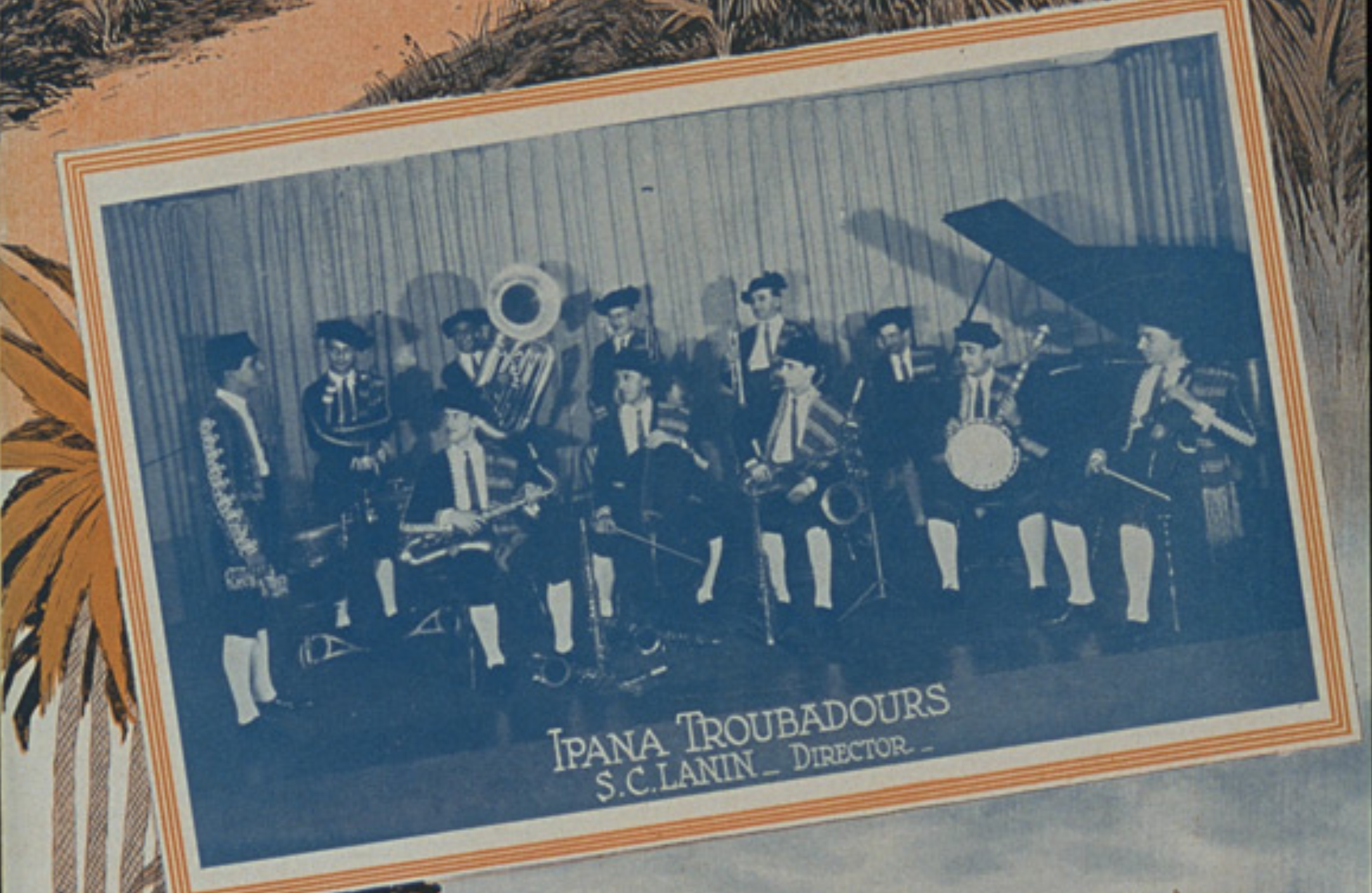
A profile of the Ipana Troubadours in Radio Broadcast magazine singles out just one sideman in the band. Even among musicians that leader Sam Lanin “picked from the country’s best dance and symphony orchestras,” he receives special attention:

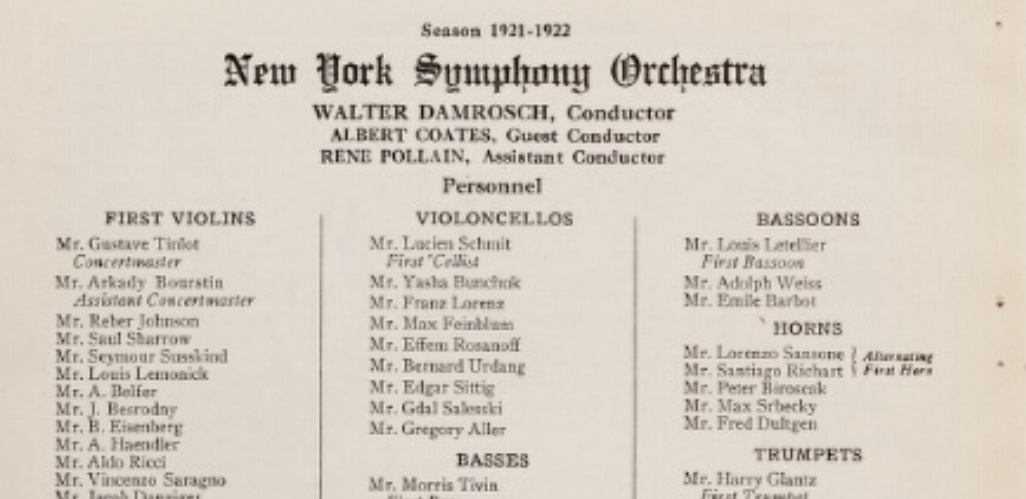
Lucien Schmit, for instance, virtuoso cellist, was Walter Damrosch‘s first cellist for five seasons and is also an accomplished pianist and saxophone player. Schmit is a representative member of the group.

A photo of the Troubadours shows an unidentified player holding a cello with a saxophone at his feet. Section mates on either side of him hold their saxophones. But the cellist’s sax doesn’t even get a stand; it rests directly on the floor. If the reader didn’t know any better, they might assume that sax was just an occasional double.

From Radio Broadcast of September 1926 via worldradiohistory.com.

Of course, “Lucien Schmit” sounds like “Lucien Smith,” a name record collectors and hot dance aficionados likely recognize as one of the saxophonists on several recordings by Lanin and other bandleaders. It’s found next to more well-known names like Bennie Krueger, Miff Mole, Red Nichols, Harry Reser, and the Dorsey brothers in many discographies.

A 1931 radio listing makes the connection more explicit, but even the copywriter faces an identity problem with his subject:

Many performers know how to double in brass, but Lucien Smith will demonstrate the talent which permits him to triple in brass and strings. He will appear as soloist on piano, cello, and saxophone. Best known as a master of the cello, Mr. Schmit has won the praise of music critics for years…it was [conductor Eugene] Ormandy‘s idea to present him in the three phases of his artistic accomplishment.

Mistaking the saxophone as a member of the brass instrument family may be mere carelessness. But the switch between “Smith” and “Schmit” suggests which artistic phases are more or less important. Smith may play many instruments, but Schmit is the cello master earning critical praise.

In contemporary reports, saxophonist “Lucien Smith” didn’t get much attention. With just a couple of exceptions, that name is limited to discographies. For the sake of argument (and according to far more knowledgeable researchers than this writer), it’s safe to assume they were the same musician. And some cursory research shows he enjoyed a long and varied musical career spanning different instruments, repertoires, and artists.

Prodigy

Government records indicate that Lucien Alexander Schmit was born in Belgium on January 6 of either 1898 or 1899 (depending on which draft card). A New York Times obituary from July 22, 1976, fills in the blanks and notes early talent:

Lucien S. Schmit, a cellist who first performed publicly at the age of seven in Paris and who became a member of the St. Louis Symphony Orchestra at 13…came to this country in 1909. He became first cellist in the New York Symphony Orchestra in 1921 under Walter Damrosch.

Still, there’s a big issue here. And it’s not just the middle initial, which was reprinted as “S” elsewhere. The obituary omits the subject’s many recordings as a reed player with several bands. It even ignores his extensive work as a cellist on recordings with everyone from Quincy Jones to David Sanborn.

This obituary doesn’t mention any ability—let alone talent—for playing saxophone. “Lucien Smith” got left out of the obituary for “Lucien Schmit.”

Symphony Cellist

Across multiple discographies, newspaper articles, radio listings, promotional materials, and other documents, the division between names and roles is surprisingly consistent. “Lucien Smith” plays reed instruments, mainly sax, and “Lucien Schmit” is a cellist. And, based on the amount of historical documentation, the cellist received a lot more press and promotion.

Conductor Walter Damrosch’s pick for principal cello was bound to get plenty of attention. Audiences and critics respected Damrosch for his musical direction, premiering new works, and educational efforts. Damrosch’s New York Symphony was a respected institution later incorporated to form the New York Philharmonic. He remains a well-known name to this day.

This writer cannot remember the source for this image.

Aside from brand recognition, a principal cellist would probably have handled most (if not all) of the solo parts for the orchestra. Several reviews talk about “Lucien Schmit” featured in works such as Saint-Saëns’s Cello Concerto in A Minor and cello pieces by Bach and Boccherini. One New York Times critic praised Schmit as a “graceful and fluent player” in a program of contemporary classical pieces. A writer for Etude magazine, years after hearing Schmit with the Lutèce Trio, recalled that an audience of about 5,000 people “thought him the star performer” despite playing on a mediocre instrument.

Schmit played under Damrosch for five seasons. Half a decade playing to critical acclaim with a renowned orchestra under an esteemed conductor casts a large shadow. At this time, many listeners were more likely to turn their noses up (in public, anyway) to jazz and popular music. Among self-identified “respectable” circles, European art music was the accepted social currency. It was bound to get more press in mainstream publications. It also seems like Lucien Smith, the saxophonist, was rarely featured as a soloist. In short, his dance band legacy might have suffered based on cultural associations and sheer audibility.


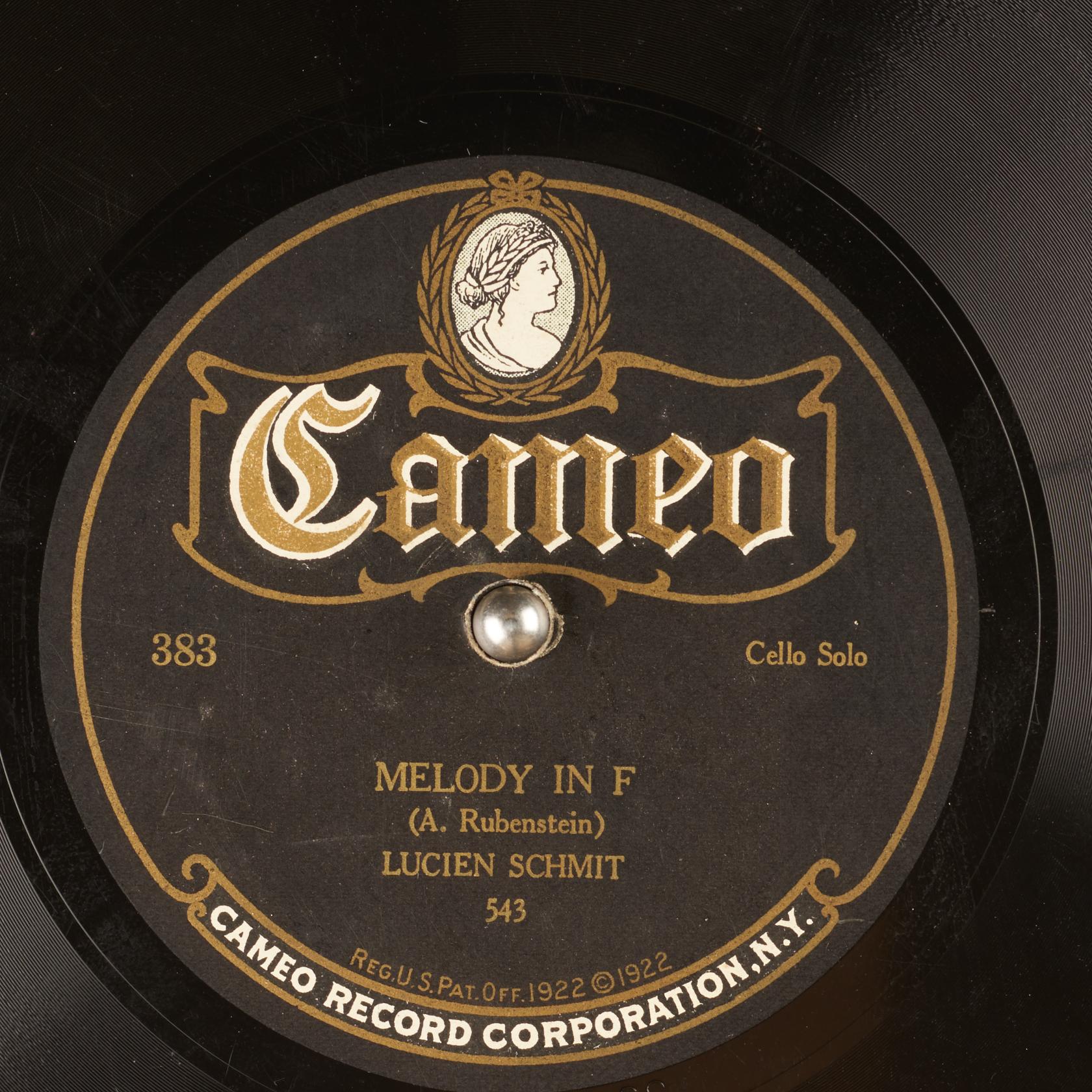
On June 30, 1923, Lucien Schmit, cellist, recorded Rubenstein’s Melody in F (mx. 0543) and “The Swans” from Saint-Saëns Carnival of Animals (matrix number 0544). Audio of each side follows. Images and audio from Internet Archive.
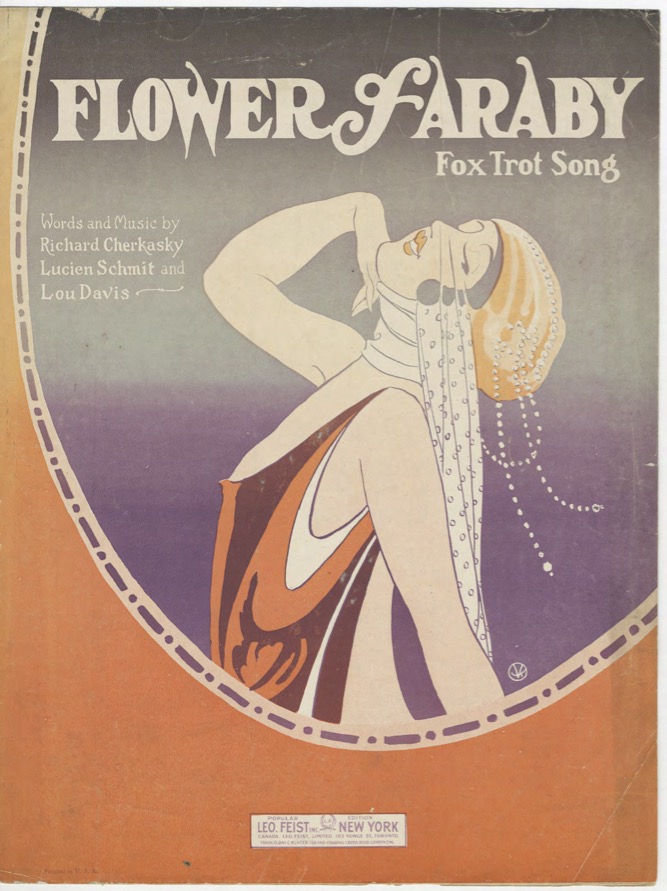
Published in 1922, “Flower of Araby” was recorded by several bands but it’s unclear if Schmit himself recorded the song. Image from IMSLP.

Saxophonist

It’s unclear when he began playing saxophone with dance bands. The earliest discographical entry (that the writer could find) for “Lucien Smith,” the reed player with Lanin and others, is a February 1922 session with Bailey’s Lucky Seven for the Gennett label. Smith is listed as playing tenor sax in the probable personnel. Yet at the time, he was still the principal cello under Damrosch. It’s also hard (for this writer) to single out a distinct tenor sax voice on “My Mammy Knows” or to identify the tenor lead “On the ‘Gin, ‘Gin, ‘Ginny Shore.”

His reasons for deciding to play saxophone professionally are beyond this writer’s research or qualifications. He may have wanted to try something new. Maybe the popularity of dance bands seemed financially promising or musically challenging. It was likely some combination of practical and personal reasons. Whatever the cause, saxophonist Lucien Smith doesn’t appear on another dance band date until August 1924.

From that point, he’s on plenty of great hot dance and jazz records! Discography entries that include “Lucien Smith” read like a who’s who of hot dance/jazz bands: Nathan Glantz, Dave Kaplan, Krueger, Lanin, and Ben Selvin are just a few of the names. Tom Lord’s online jazz discography lists Schmit on 85 sessions between 1922 and 1931—and that’s just what made it into the discography as “jazz.” He likely doubled multiple saxophones and clarinet as a working dance band musician. His substantial presence with these bands indicates significant skill, versatility, and reliability.

Despite the obvious talent, the last session listing Lucien Smith on reeds appears to be August 7, 1931, with violinist Billy Artz’s band. Artz and Lucien both played in B.A. Rolfe‘s famous orchestra, where Lucien is listed as doubling clarinet, tenor sax, and cello. The two likely forged a connection there. He may also be the hot tenor sax on “There’s A Time and Place for Everything.” But at this point, maybe regularly playing tenor was unneeded or less lucrative during the Great Depression.

Radio Cellist and More

Instead, cellist “Lucien Schmit”—who happened to also play saxophone and piano—resurfaces in the press and discographies. The New York Times obituary states that “During the 1930s, he was active in radio musical programs…musical director of ‘The Royal Typewriter Hour’ and for 20 years was featured on such programs as ‘The Telephone Hour,’ the Firestone Show, the Longines Symphonette program and ‘The Prudential Family Hour.'” But that obituary is entirely framed around his work as a cellist.

Some contemporary reports of “Lucien Schmit” reference work as a saxophonist and pianist, like this April 24, 1930 radio listing in the Hartford Courant:

Lucien Schmitt [sic], the violincellist of the Melody Moments orchestra and other concert orchestras on the networks, will demonstrate his ability to triple in brass and strings…He will contribute piano, cello, and saxophone solos to the concert.

In directories for the New York American Federation of Musicians, Local 802 (generously provided by Vince Giordano), there’s only “Lucien A. Schmit” listed in the “Cello” section. Whatever else he may have played on the radio, Schmit’s primary role was always as a cellist.

Over the next few decades, in addition to radio work, his cello as well as his violin and viola are listed in studio recordings with Kenny Burrell, Perry Como, Johnny Griffin, Coleman Hawkins, Artie Shaw, and Wes Montgomery, among others. Almost inevitably, it’s “Lucien Schmit” in the string section. Grammy-wining bandleader and hot music historian Vince Giordano explains that pianist Dick Hyman recalls “Lucien” coming to sessions carrying both reed instruments and his cello.

Along the way, he and his wife raised their only child (who went on to a respected career in engineering). Lucien passed away following a stroke on July 20, 1976, in a hospital near his Manhasset, Long Island home.

Musician

Depending on the area of his considerable experience, you might end up reading two different narratives. Almost all the discographies and press clippings that mention the cellist reference Schmidt, Schmit, or Schmitt. Except for very few contemporary articles, Lucien Smith, a saxophonist, is only found in discographies (though the prolific and knowledgeable discographer Javier Soria Laso gets a lot of credit for covering all the bases by referring to “Lucien Smith/Schmitt/Schmidt”).

There may be a better or more straightforward explanation for using different names. And wider research may show that the associations between the names weren’t as cut and dried. Maybe “Smith” was a deliberate alias or just a propagated typo. But just looking at (some) writings, you might think Lucien Smith’s saxophone was a temporary side hustle compared to Lucien Schmit’s cello.

That probably says more about audiences’ and reporters’ perceptions of “serious” and “popular” music during Lucien’s lifetime. His musical career makes for a single interesting story. You’d just better know who to look for.

From the sheet music for “Tamiami Trail,” published in 1927 by Jerome H. Remick & Co. Image retrieved online from Florida International University libraries.

Sources

  • American Federation of Musicians, directories from 1937, 1943, and 1958
  • American Dance Bands on Record and Film by Johnson and Shirley
  • ARSC Journal, vol. 24, no. 1: “Georges Barrere” by Susan Nelson
  • Brunswick Records: A Discography of Recordings, 1916-1931 by Ross Laird
  • Buffalo Times on January 16, 1930
  • Daily News [New York] on April 7, 1932
  • Etude magazine on April 1922
  • Florida International University libraries
  • Hartford Courant on April 24, 1930
  • International Music Score Library Project (IMSLP)/Petrucci Music Library
  • Journal of the National Medical Association, Vol. 17, No. 4, December 8, 1925
  • Tom Lord’s Jazz Discography online
  • Music News on December 28, 1923
  • The Musical Blue Book of America for 1922
  • Nassau Daily Review on August 26, 1931
  • Nathan Glantz’ Orchestra as the Tennessee Happy Boys by Javier Soria Laso
  • National Academy of Engineering Memorials: “Lucien A. Schmit Jr., 1928-2018”
  • New York Philharmonic website
  • New York Times articles
  • Pittsburgh Press on January 22, 1928
  • Portland Press Herald on April 24, 1930
  • Radio Broadcast, September 1926
  • Recordings of Bennie Krueger’s orchestra for Brunswick and Vocalion by Javier Soria Laso
  • Rhythm on Record by Hilton R. Schleman
  • Times-Union [Albany] on April 24, 1930
  • U.S. census records
  • U.S. draft records

Appreciation

Many thanks to Vince Giordano for sharing his recollections, relevant newspaper articles, and 802 directories. Thanks also to Javier Soria Laso for his insights into the subject and meticulous discographies that first connected the names for me. Thank you, Aaron K., for your fine edits. And thanks to “P.C.” on Facebook.

Tagged , , , , , , , , , , , ,

Sweet And/Or Hot With The Broadway Bellhops

The Broadway Bellhops were far from the hottest act of the twenties. One of many recording bands in New York City, bandleader Sam Lanin gathered the leading jazz players of the time to diligently read arrangements of the latest popular songs. This music set out to deliver a tune rather than showcase musicians.

Those musicians, however, performed with assembly line efficiency and concert virtuoso polish. Improvisation and rhythmic intensity were cleverly stitched into a larger musical whole. The trombone chorus starting “I Don’t Believe You” sticks to the melody but is far from faceless: melodic, masculine, not “swinging” but still rhythmically sharp, it’s like an actor giving life to their lines:
[The music is hyperlinked above but please share a video if you have one!]
In the last chorus, a three-part, collectively improvised frontline opens a hot concerto grosso, the trombonist returns for the final bridge and sweet collides with hot as a clarinet pipes over the big theatrical finale.

Somehow, though, the piano accompaniment behind Charles Hart’s vocal is the most interesting part, due to its subtlety. The accompaniment is halfway between song-plugger style and rag-a-jazz, ever so slightly at odds with Hart’s approach. There’s a tension at work that even fans used to these juxtapositions would have noticed, though not balked over.

Time has not been kind to Hart, Irving Kaufman, Scrappy Lambert and others singing with the Bellhops. Their sound now inspires a wide variety of judgments. Depending on one’s opinion, the instrumental obbligatos behind their vocals are either novel contrasts or pure subterfuge. The clarinetist on “Away Down South In Heaven” pushes and pulls at Kaufman’s downbeat while still harmonizing with the lead and never distracting from the vocal. These were professionals. They may not have been making art but they never sounded sloppy or unconvincing.

Two takes of “Get Out And Get Under The Moon” show the thought behind these products, first trying a restrained piano behind Lambert and then well-timed, charming saxophone licks:

Ensemble effects such as the upper-register clarinet with muted trumpet on “Don’t Take That Black Bottom Away” and “I’d Rather Cry Over You” recall the orchestrated Dixieland sound described by David Sager in his liner notes for Off The Record’s reissue of The Wolverines:


That voicing resembles Sager’s description of “the first available harmony line below the cornet lead, while the clarinet took the first available harmony above the lead.” This was a “standard voicing” of the time, so it was likely a well-known device for enhancing stock arrangements. Similar ideas pop up on “Mary Ann” under Lanin’s name or Lanin d.b.a. Billy Hays on “I’d Rather Cry Over You.”


This band-within-a-band sound and allusion to small group jazz in an arranged setting exemplify the style-splitting popular music of that time. That context is sometimes lost when fast-forwarding to the solos.

Solos like those of Tommy Gott on “Our Bungalow of Dreams,” Red Nichols on “Collette” or Bix, Tram and Don on the Bellhops’ most well-known session are worthy of attention. They defamiliarize the hot/sweet dichotomy and an extra eight bars would have been welcome:


Yet there is much to admire on these sides even without improvisation. Who else could pull off a soprano-sax led soli like the one on “There’s Everything Nice About You” not to mention the tight brass section of just three players sounding like six?

“She’s A Great, Great Girl” features brilliant lead playing by Larry Abbott on lead alto and Gott on first trumpet. Abbott does cover up the rest of the section, effectively making this his moment. He plays with an unabashedly syrupy tone and varied phrasing, digging in at times, creamy at others:

His lead is more transparent after the vocal, another contrast as well as an indication of deliberate design. The side ends with a half-chorus of piano and soft-shoeing cymbals, adding still more structural, dynamic and textural flavor. Details like these are why this music still resounds as flesh and blood performances, rather than disposable pop artifacts or nostalgia.

If you have your own favorite finds from the Broadway Bellhops, please share them in the comments!

Tagged , , , , , , , , , , , , , , , , , , , , ,

Don Murray Goes Commercial

Longtime readers of this blog (both of them) have probably noticed the wealth of fan nonfiction devoted to clarinetist Don Murray. Dead by the age of twenty-sixfour, often overshadowed by his friend and fellow young talent cut tragically short Bix Beiderbecke and with a modestly-sized discography to his name, Murray is both a personal favorite and nowhere near overexposure in the history books.

Murray’s legacy is also complicated by a lot of commercial sessions that probably paid his rent but often didn’t leave room for improvisation. Everyone (or at least the 0.5% of the planet who enjoy hot jazz) knows that it is Murray cascading out of the opening stop chord on “Sorry” under Bix Beiderbecke’s leadership. It takes some patience to find his solo on “What A Wonderful Wedding That Will Be”:

Of course, it’s worth digging if you just like Murray, but his music is worth the effort. The repetition of the first eight bars after the bridge means he was either bored with the tune or simply liked those phrases. Either way, Murray’s clarinet (as well as Red Nichols’s squeezing and pecking on trumpet) adds rhythmic and technical interest to this affair. Murray did not get to stretch out nearly as much on commercial sides but they provide some of his most elusive and rewarding work.

It’s a pity the obbligato saxophone behind the vocal isn’t better recorded; it also gets some things done musically and it might well be Murray. Murray’s tenor on “Marvelous” is much easier to hear and the title might as well refer to Murray:
https://youtu.be/3Ssh5B6GXjU
The rhythmic intensity of this side immediately skyrockets upon his entrance, with Murray’s triplets and hill-and-dale phrases injecting some hot virtuosity into a peppy but otherwise straightforward performance. Murray’s gauzy tone on tenor (heard here as well as on “Blue River” with Jean Goldkette) is similar to his light-toned baritone, while he kept a bright, open sound on both clarinet and alto saxophone.

It is likely Murray’s alto saxophone on the first chorus bridge of “Feelin’ Good” and possibly his clarinet on the eight-bar improvised bridge of the last chorus. The opening squeal is uncharacteristic but the tumbling arpeggios are pure Murray:

That alto’s rhythmic phrasing, especially of eighth notes, and tone are similar to the alto on “Just Like A Melody Out Of The Sky”:

Murray seems to have made a specialty out of these rhythmic paraphrases of non-refrain sections, such as the final bridge on “I’m Ridin’ To Glory” or his gorgeous texture and rhythmic recasting of the verse on baritone for ‘”Tain’t So, Honey, Tain’t So”:


The two records with Joe Venuti’s band are much jazzier charts that still don’t give Murray much spotlight. It’s easy to lament the infrequency or brevity of Murray’s solos (especially after, for example, you might have isolated the 240 or so records that Murray appears on and listened and re-listened to every solo, obbligato, ensemble descant and straight lead he ever waxed). Yet these records also demonstrate a musician working within constraints, responding to and enhancing a musical environment much different from out-and-out jazz settings. “Somebody Lied About Me” barely gives Murray ten seconds of audible space on clarinet and he still manages to make it his own:


“Commercial” is a dirty term in some jazz circles but it simply means the popular music of the time: melodic, danceable, often slickly executed, at times novel, other times trite and above all focused on different musical priorities than other genres, including jazz. So it’s impressive that Murray got away with the impromptu ornaments behind the band and awesome double-time decoration here. Maybe the business-savvy Sam Lanin was also a fan. Whatever the explanation, the sound of Murray’s clarinet piercing through Lanin’s spongy reeds is a very powerful example of musicianship and personality (even if it won’t gain admissions into any jazz anthologies).

“Maybe, Who Knows?” is practically a feature for Murray. He plays clarinet around the ensemble on the first chorus, switches to baritone for a swinging lead on the bridge, answers Ted Lewis’s vocals back on his clarinet and then improvises on the last bridge:

Not just any section man could pull it all off with the same tone, technique, style or those tasteful, spurring ornaments at end of the band’s phrases. I’m still hopeful that someone will unearth recordings of Don Murray playing in a trio a la Jimmy Lytell but, in the meantime, these records do very well on their own terms. There may not be much jazz in them, and some of it may not even be classified as “jazz,” but it is creative, confident and individual music.

DonMurrayInParis1928CroppedFromMarkBerresfordPhotoViaBixographyWebsite

Tagged , , ,

A (The?) Larry Binyon Story

The following post first appeared in multiple parts on this blog, and I was asked to consolidate it into one single entry (and more than happy to oblige). Larry Binyon has been a personal favorite since I first started listening to jazz. Hopefully, this post will shed some light on his life and work, and perhaps inspire someone with better resources to research that life, and more importantly Binyon’s music, further. Either way, please enjoy!

Larry BinyonReality television notwithstanding, ubiquity and fame are two very different accomplishments. Just ask Larry Binyon. More practically, Google him: he appears on dozens of record dates (150 jazz sessions alone according to Tom Lord), usually listed alongside some legendary names. Yet that’s all most historians and musicologists have to say about him. Larry Binyon is all over jazz history but not a well-known part of it.

He must have been an impressive musician to get work so consistently, especially with the likes of Benny Goodman, Fats Waller, Red Nichols, the Boswell Sisters, the Dorsey Brothers, and other famous names. He also doubled several instruments, mostly playing tenor saxophone but contributing on flute when it was rarely heard in a jazz context. Binyon could also improvise in addition to read and double. Given the company he kept, he got to read and double far more often than he got to take a solo.

Years later and with very few solos on record, sidemen like Binyon can seem like historical packaging material. They surround the names we know best, provide musical as well as personnel background but otherwise end up padding the “real” artistic goods. After all, isn’t jazz “really” about improvisation? Weren’t there “better” improvisers around? Didn’t other musicians double? Couldn’t “anyone” have read the chart, as Binyon did?

Perhaps, but only from the luxury of listening decades later. To musicians, someone who could do all three (and maybe even show up on time and in uniform) would be a precious resource. There must have been a reason why Larry Binyon got to play so often. He also recorded quite a bit, even some of those improvised solos that jazz purists like to hunt down between all the written stuff, which Binyon also made possible. That sounds like far more than filler, and it definitely sounds like an important part of the music.

Chicago And Back Again: The Early Years

Lawrence “Larry” Fiffe Binyon was born in Illinois on September 16, 1908, the younger of Claude and Josephine Armstrong Binyon’s two children (their first child Hugh was born in 1905). Census records show the Binyon family renting one unit of a two-family home in Chicago’s twenty-seventh ward in 1910, with Claude Binyon listed as an unemployed funeral director and somehow still employing a live-in servant. By 1920 the family was renting a single home in the city of Urbana, about 150 miles south of Chicago. Claude now worked as a secretary for an oil company. Josephine was now also employed as a music teacher working out of the Binyon home, now servant-less.

Urbana was a much less densely populated city, and census records show more white-collar jobs among the Binyons’ neighbors in Urbana than those in Chicago. Perhaps the quality of life was a factor in their move. Maybe Urbana was simply where Claude could find another steady paycheck, albeit now supplemented with a second income. If there was financial hardship, it could have influenced Larry’s understanding of the value of a dollar. Claude’s death in 1924, when Larry was just sixteen years old, certainly would have put a financial strain on the family. Larry might have developed his later well-documented work ethic at an early age.

It’s unclear how early Larry Binyon started playing music, but safe to assume that his mother shared at least some of her musical knowledge. By age eighteen, Binyon was at the University of Illinois at Urbana-Champaign, listed on E flat (soprano) flute in the school’s concert band as well as (standard) flute and piccolo in its first regimental band during the 1926-27 school year.

Binyon would only spend one year at college. By 1927 he was already playing professionally in Chicago as part of Beasley Smith’s band, which also included drummer Ray McKinley and clarinetist Matty Matlock. Drummer and future swing era star Gene Krupa was playing across the street from Beasley in Joe Kayser’s band, and Binyon would have encountered an even wider pool of talent in the jazz mecca. Flute may have been Binyon’s first instrument, or at least his primary one at school, but tenor sax would have by now become his main horn for dance bands.

Later on that year, drummer, bandleader, and talent incubator Ben Pollack came back to Chicago after an unsuccessful gig at the Venice Ballroom in California. His third saxophonist and arranger Fud Livingston had left the band earlier that year (to work with conductor Nat Shilkret in New York City). It’s unclear exactly when or how Binyon hooked up with Pollack, but he was with the Pollack band on December 12, 1927, when it returned to the Victor’s Chicago studio after a five-month hiatus. He even got to solo!

On the final bridge of “Waitin’ For Katie,” Binyon stays pretty close to the melody on the first take and loosens up slightly for the second one. Both takes find Binyon jumping in on a break and ripping into the upper register (here is the issued first take):

Like many jazz musicians from this period, Binyon “routines” his solo but still has something unique to offer. His reedy tone and declaratory, trumpet-like phrasing are very different from Coleman Hawkins’s metal and rapid-fire arpeggios. Binyon has been compared to Bud Freeman, but Freeman generally played in a more agitated style at this time. Binyon sounds more relaxed even at faster tempos. Stated bluntly, he just played fewer notes than those guys.

Apparently, Pollack liked Binyon’s notes; his tenor saxophone gets another solo on the session’s other issued side, “Memphis Blues,” where Binyon once again varies things just slightly between two takes (the issued first take follows):

He sounds tentative playing counterpoint in the introduction, and his brief solo might not seem like a model of construction. Yet he doesn’t get much room to stretch out on the W.C. Handy standard. Fud Livingston’s arrangement inserts some snappy chord substitutions from the band into the middle of Binyon’s chorus, which Binyon leaps into with a beautiful, well-executed lick. His preceding improvisation/routine is closer to an earlier, pre-Armstrong tradition that emphasized variety over contiguity. It’s also the work of a nineteen-year-old cutting his first record. Better things were still to come but this was an admirable start.

Pollack’s band was filled with young talent, including eighteen-year-old Benny Goodman and twenty-year-old Jimmy McPartland. They usually got more solos, and have certainly received more ink since this session, but Binyon got to play alongside them and make the Pollack band possible. He must have been doing something worth talking about.

pollackband1929careofredhotjazzdotcom

Making It Work: The Pollack Years

Much to Ben Pollack’s short-term benefit, his band and Larry Binyon parted ways following their December 7, 1927 recording session. Variety’s issue of January 25, 1928, reported that the band had already started a residency at the Club Bagdad in Chicago’s Pershing Hotel. By February 25 it had closed at the Bagdad and was onto New York City. Binyon might have played with the Pollack band during its remaining time in Chicago, but Pollack apparently had another saxophonist in mind for its next move.

Bud Freeman explains that Pollack first heard him play at a late-night jam session in Chicago, and was so impressed by the saxophonist’s solos with McKenzie and Condon’s Chicagoans that he asked Freeman to join the Pollack band in New York. These now-famous recordings are widely considered the birth of the “Chicago style.” Yet it’s hard to believe their loose format was a decisive factor in Pollack’s decision. Pollack was running a jazz-infused dance orchestra, not a jam-oriented jazz band. He needed musicians with the ability and discipline to read written arrangements as well as improvise solos. Freeman never hid his distaste for dance band work and didn’t like New York. Pollack fired Freeman after three months for clowning around on the bandstand and then rehired him for an Atlantic City engagement in July, only to have Freeman quit at the end of the month.

Pollack Reed Section c. 1927: Benny Goodman, Fud Livingston and Gil Rodin

Pollack Reed Section c. 1927: Benny Goodman, Fud Livingston and Gil Rodin

After some traveling gigs and a brief dry spell, the Pollack band began a long-term engagement at the prestigious Park Central Hotel on September 28. Pollack already had Jimmy McPartland, Benny Goodman and Jack Teagarden (who had joined in June) to contribute hot solos. By this point, he was probably willing to sacrifice some improvisational fire for a third saxophonist who could, and would, do the job. That included doubling the numerous other reed instruments that Pollack, apparently inspired by bands such as Roger Wolfe Kahn’s, wanted to show off.

Binyon probably continued to work with Beasley Smith’s band or one of several bands in Chicago while Pollack was in New York. It’s uncertain when Binyon got to New York, whether Pollack sent for him or if he just happened to be one of the many musicians starting to move to the musical epicenter, but by October 1, 1928, Binyon was back on record with the Pollack band in New York.

With three powerful soloists and the band’s tendency to rely on written arrangements, Binyon didn’t get many solos on record with Pollack. With Benny Goodman frequently doubling alto and baritone saxes, he wasn’t even the only saxophone soloist. Pollack instead capitalized on Binyon’s strength as an ensemble player.

A lush waltz like “Forever” or the muted trumpets, violins, and (most likely Binyon’s) flute on “Let’s Sit And Talk About You” might not interest jazz listeners but the records work on strictly musical terms. Attention to dynamics, ensemble balance, and lyricism are fairly consistent through even the Pollack band’s most commercial dates. Its sax section of Binyon, Goodman, and lead alto Gil Rodin play with a bright, creamy blend, for example answering the full band on the Victor recording of “Futuristic Rhythm”:

or “From Now On,” on which they achieve an especially transparent sound, right down to Binyon’s purring tenor:

Talented musicians, a steady gig at a famous venue and sheer hustle helped the Pollack band grow incredibly popular, allowing them to move onto radio work, Broadway, various touring appearances, and a few short films. The band is featured exclusively on a Vitaphone film shot on July 29, 1929. Binyon is seen in the middle of the sax section, soprano sax, clarinet, and flute impressively displayed in front of him while he plays tenor throughout:

Pollack obviously liked Binyon; he appears on every title cut under Pollack’s name (save for one small group session by “Ben’s Bad Boys” in January 1929). Yet a dependable player from a well-known band who could read, double and improvise was bound to get additional offers. Based on his discography, Larry Binyon was more than happy to work on the side.

A Sideman Soloing On The Side

Larry Binyon was talented (and fortunate enough) to have joined the Ben Pollack band just in time for its peak of popularity. He appeared on nearly every title cut under Pollack’s name, but side dates with studio pickup groups let the tenor saxophonist stretch out as more than a section player. He gets to join in with Pollack’s favored soloists on “Whoopee Stomp” under Irving Mills’s leadership, kicking off a string of solos featuring Benny Goodman, Jack Teagarden, and Jimmy McPartland:

It’s tempting to compare Binyon with these now-marquee names in terms of relaxed phrasing, catchy licks, and bluesy inflection, but Binyon’s style works on different priorities. It doesn’t display the same technical confidence but remains driving and tense. Binyon rarely stays in one place, wriggling up and down phrases, emphasizing variety over linear continuity. Binyon played hot solos: no frills, high on energy and contrast yet very personal. Binyon pushes the beat but without the agitation and gritty tone of fellow tenor player Bud Freeman or his cohorts Eddie Miller and Babe Russin. Binyon’s approach is also far removed from the dense arpeggios and metallic tone of the Coleman Hawkins school.

Binyon’s tone—husky, reedy, and distinct—could be an asset unto itself. On “Wont’cha” with Pollack, Binyon gets a paraphrase (one of his few solos of any kind with Pollack) after the vocal that shows off his warm, centered sound:

It’s not an improvised solo but it is an effective orchestral voice, probably appreciated in a dance band setting. Twenties bandleaders would occasionally use a light-toned baritone sax in a melodic role, but it sounds like Binyon’s tenor providing the broad, cello-like lead on the transition to the last chorus of “A Japanese Dream” with Mills:

“Blue Little You” includes a similar voicing in its introduction and right after the vocal. Contrasted with the standard alto lead that immediately follows, it makes an especially colorful effect on what might otherwise be dismissed as a straight dance chart:

Binyon also tosses out an improvised bridge before the ensemble conclusion. His jagged lines come across as flip commentary on the vocalist’s elongated, slightly nasal delivery. Brief solo spots like this one allow Binyon a concentrated burst to say just enough in a few measures. He snaps into the final bridge of “Little Rose Covered Shack,” once again on McPartland’s heels, this time with snaking, clarinet-like lines along with his usual rich tone and tendency to begin phrases in the upper register:

He really cuts loose on one of the few mixed dates of the Jazz Age, a freewheeling session with no less than Fats Waller. With Waller as well as Teagarden, Red Allen, Albert Nicholas, Eddie Condon, and Gene Krupa on hand, it’s no surprise that Binyon sounds like he’s having fun. He wails and moans (showing he also listened to Hawkins) through both the introduction and one chorus of “Ridin’ But Walkin’”:

On “Won’t You Get Off It Please?” Binyon sticks to declaratory, at times trumpet-like exclamations, popping out high notes and plunging into the lower register for the release:

Binyon also seems to enjoy himself on “Shirt Tail Stomp,” one of the novelty tunes that “the Pollack band without Pollack” recorded to satisfy popular demand. His big tone stays intact through all of the mooing and whinnying:

Benny Goodman “created” this number after a recording engineer overheard his band mocking a cornball jazz act. Binyon has the perhaps dubious honor of appearing on three of its five versions on record. In addition to reading, doubling, and improvising, he was apparently also a capable musical clown.

careofsaxophonedotorgBinyon could obviously fit into a variety of musical settings, from Pollack’s snappy dance band setting to looser blowing sessions and everything between; trumpeter and band organizer Red Nichols had even started hiring him on orchestral pop dates modeled after Paul Whiteman (though mostly doubling oboe and flute as well as tenor sax, with Babe Russin handling solos). He was nothing if not versatile, and a versatile musician was usually a busy one.

By the summer of 1929, Goodman and McPartland had left the Pollack band. They were more than capably replaced by Charlie Teagarden and Matty Matlock. Jack Teagarden would stay on for another three years. Yet Binyon may have seen Goodman and McPartland’s departure as a sign that the Pollack band had peaked. He might have been smarting under the same conditions that drove them out of the band; Pollack had fired two of his top soloists for showing up to work with scuffed shoes! A good reputation as a multitalented player in New York would have enabled Binyon to forego the life of a touring musician. It also would have provided more opportunities to perform in different settings.

Something convinced Binyon to leave his first regular employer and a still widely respected band. Binyon’s last session with Pollack was in January 1930. As usual, he didn’t get any solos. One of the two tunes recorded at that session, “I’m Following You” featured yet another one of the leader’s comically earnest vocals. Larry Binyon might have simply been ready for something different.


A Heavy Gig Bag And Phonebook: The Thirties

U.S. Census records state that in April 1930, Larry Binyon was renting a room in his hometown of Urbana, Illinois. Jazz discography shows that by this time, said “saxophonist” working in the industry of “orchestra” (a federal category, or Binyon’s own prestigious description?) was firmly settled in New York City.

Red Nichols Photo care of Stephen Hester

Red Nichols (care of Stephen Hester)

Binyon had stopped recording with popular bandleader Ben Pollack by mid-January 1930, but his big sound is clearly audible in the sax section of Sam Lanin’s band on several dates from March through May of that year. A careless census taker may have counted Binyon while he was in town for his mother’s wedding to her second husband. It’s also possible that the twenty-two-year-old sideman simply neglected to change his address. He was certainly busy enough: his post-Pollack resume reads like a directory of the most popular names in jazz and popular music of the time. He was also working alongside the cream of New York’s musical crop. With Lanin alone, Binyon got to record with Tommy Dorsey, Miff Mole, Manny Klein, Leo McConville, and Al Duffy.

He was also part of the veritable all-star band that Red Nichols assembled for the Broadway musical “Girl Crazy.” Binyon had already worked with the trumpeter and booker on a few sessions, including large, symphonic jazz sessions where he doubled flute, oboe, and clarinet. Composer George Gershwin wanted a jazz band for “Girl Crazy.” Nichols assembled Pollack alumni Benny Goodman, Glenn Miller, Charlie and Jack Teagarden, and drummer Gene Krupa among others. Binyon isn’t usually mentioned as being part of the group, but neither are several other players needed to fill out the band. Binyon’s familiarity with the other players as well as his ability to read and double would have made him a welcome addition to this (or any other) pit.

“Girl Crazy” opened on October 14, 1930. Nine days later Nichols recorded two tunes from the show with several members of the band, including Binyon. Binyon doesn’t get to solo on “I Got Rhythm,” and “Embraceable You” doesn’t leave much room to distinguish any of the musicians. It’s unclear whether Binyon would have preferred more solo opportunities, but he must have been more than used to an ensemble role by this point.

Binyon continued recording with Nichols and Lanin as well as Benny Goodman on some of the clarinetist and future swing powerhouse’s earliest sessions leading a big band in 1931. Goodman assigns Binyon straight, almost dutiful melodic statements on both “I Don’t Know Why” and “Slow But Sure.” He also gets a flowery flute lead on “What Am I Gonna’ Do For Lovin’?” switching to tenor sax as well as a darker tone and more swinging approach for a duet with Goodman on the last chorus:

Given Goodman’s disagreements with Pollack while in his band, it may seem ironic that both bandleaders took a similar approach to Binyon’s role. Yet by the time Goodman began leading bands, that role may not have necessarily reflected Binyon’s abilities as a soloist. Solo space on jazz and dance records grew increasingly limited during the early thirties. Depression-era listeners preferred more sedate pop arrangements to driving hot jazz numbers. Even with the most exciting soloists on hand (Goodman’s 1931 bands included the likes of Bunny Berigan and Eddie Lang), many studio dates from this period stay fairly tame. Binyon may have had a varied toolkit, but his bosses may have needed one specific device.

The joy in listening to a sideman like Binyon is not just listening for when he pops up but what he gets to do. When a band did get to cut loose, for example Roger Wolfe Kahn’s orchestra performing “Shine On Your Shoes,” Binyon could throw down a hot solo on tenor sax:

or use his brawny sound to heat up even straight melodies like “Sweet And Hot” with Nichols:

Binyon’s flute could add the requisite touch of sweetness and refinement as needed. It could also bring an unusual color to up-tempo numbers like “Walkin’ My Baby Back Home” with the Charleston Chasers:

The combination of the Binyon’s flute with ensemble syncopations and Krupa’s drums points to more than just a sweet context. Musicologist and historian Gunther Schuller mentions Binyon’s flute as well as Glenn Miller’s arrangement as examples of a sound “well beyond the normal dividing lines between commercial dance music and late twenties jazz.”

Along with Albert Socarras (who had soloed on flute as early as 1929 on “Have You Ever Felt That Way?” with Clarence Williams) and Wayman Carver, Binyon was one of the first to bring the flute into a jazz context. His smoky introduction to the Boswell Sisters’ “Sentimental Gentleman From Georgia” must have made musicians and bandleaders reconsider the possibilities of this instrument in a jazz setting:

In addition to the Boswells, Binyon accompanied vocalists Grace Johnston, Phil Danenberg, Dick Robertson, Chick Bullock, Mildred Bailey, and Ethel Waters during the early thirties. He was usually backing these singers alongside members of the same circle of top-notch New York musician that he would have known very well by this point. He impressed Tommy and Jimmy Dorsey enough to land work with their band. At this point the Dorsey Brothers Orchestra was a smaller studio band, allowing Binyon room to solo on instrumentals such as “Mood Hollywood”:

and “Old Man Harlem”:

It’s unclear exactly what type of work Binyon landed outside of the studios during the early thirties. Arranger Don Walker recalls Binyon playing in the band for Hit Parade of 1933 as well as “first (legitimate) flute” in the 1935 musical Maywine. Walker and his copyist Romo Falk excitedly noted Binyon’s presence (expressing similar accolades for Binyon’s section mate, Artie Shaw).

Binyon played with Paul Whiteman’s orchestra for one month in 1936 before moving onto radio work, including jobs under Red Nichols’ direction, as well as other work outside of an expressly jazz context. It was around this time that Binyon also married his first wife, Polly. Seven years younger than Larry, she was born in Puerto Rico and living in Syracuse by 1935, before marrying Larry at some time before 1940. The steadier work and more regular hours of radio may have eased his transition to married life, or vice-versa. Binyon even had time for a trip to Bermuda (though it is unclear whether it was for work, honeymoon or one last bachelor outing).

Binyon also did sax section work on jazz dates with Frank Trumbauer, Joe Venuti, Bob Zurke, and Dick McDonough during the mid to late thirties. McDonough was an experienced, well-connected guitarist who had his pick of sidemen for the few sessions he ever directed during 1936 and 1937. Binyon was on hand for two of McDonough’s dates, getting in some paraphrases as well as a quick-fingered, slightly more modern solo on “He Ain’t Got Rhythm”:

At this stage, Binyon had the reputation as well as the chops to work in a variety of settings alongside some of the best players in New York. He even found the time to change his address: by 1940, one Larry Binyon, now a “musician” in the “orchestra” industry, was officially living in New York City.

1940 US Census per AncestryDotCom

Talent, Opportunity And Choice: Final Years and Legacy

The All Music Guide states that Larry Binyon “needed someone to hold the door open for him when he arrived at a recording studio or radio broadcast date.” It’s an unsubstantiated anecdote but an accurate image. By the early thirties, Binyon was, in violinist Harry Hoffman’s words, one of New York’s “first-call” studio musicians who could “play anything.” With his move to full-time radio work in 1936, Binyon would have been playing his tenor sax, flute and oboe, probably clarinet (and possibly the “few fiddle credits” mentioned by AMG writer Eugene Chadbourne) in any number of musical settings.

From The Big Band Almanac by Leo Walker

While trombonist Larry Alpeter adds, “most of these [first-call] guys had fine jazz skills,” Binyon’s appearances on jazz records and already sparse solo spots dried up by the mid-forties. He is one of two tenors on Billie Holiday’s 1944 Decca sessions with Toots Camarata’s orchestra, but it’s unclear whether Binyon or Paul Ricci handle the few brief solos on these recordings. Binyon is strictly an ensemble player on his final jazz session, with Jess Stacy’s big band in June 1945.

After close to twenty years of having his hands literally and figuratively full in New York City, Binyon moved to Los Angeles in 1946. Binyon worked once again with Nichols in California, this time in Bobby Dolan’s orchestra on The Ford Show (starring Dinah Shore) from September 18, 1946, through June 11, 1947. Yet Binyon had also relocated to work as a recording contractor for the American Federation of Musicians.

If Binyon was looking to segue into a “behind-the-scenes” role, the paucity of documents from this period indicates that he got his wish. Drummer Johnny Blowers does recall a February 8, 1950 session with Phil Harris organized by Binyon, but Binyon’s activities as an organizer are otherwise largely unrecorded. A new home, warmer climate, and slower pace on the West Coast were probably a welcome change for him. It also would have allowed him more time with his son Claude (born in 1940 and named after Larry’s father). Blowers actually secured the Harris date when he ran into Binyon in New York, who was on a vacation of all things.

Blowers also notes that Binyon was still playing with West Coast bands, though it must have been less hectic than the New York scene. Binyon frequently worked with Phil Harris in Los Angeles, previously co-writing “Bump On The Head Brown” for the entertainer along with Chauncey Morehouse and Frank Signorelli (now that would have been a trio!).

Binyon worked the 1952 and 1953 seasons of the Phil Harris and Alice Faye radio show alongside Nichols in Walter Scharf and Skippy Martin’s bands, recorded five numbers with Harris on December 27, 1953, for RCA Victor, packed his gig bag(s) for a tour of Asia in the early fifties and booked sessions for fellow players: it all must have been a breeze for this seasoned musician.

for Phil Harris care of discogsdotcomHe seems to have stopped playing completely by 1955. Based on Binyon’s track record, that must have been by choice rather than necessity. His story fades even further after that decision: marriage to a second wife in Nevada in 1962 and then a third wife in California in 1966, followed by a divorce two years later. Larry Binyon passed away on February 10, 1974 (followed by his brother Hugh in 1978 and then son Claude in 1999, both of whom died childless).

Other than personnel listings and occasional mention by his contemporaries, most of whom are now also gone, Larry Binyon has faded into the background behind more famous names. It’s easy to make a comparison between his legacy and his work, but that would dismiss the talent that earned Binyon such fast company in the first place. How else does one get to play with everyone from Tommy Dorsey to Benny Goodman to Billie Holiday and Fats Waller?

Binyon’s versatility and sheer ubiquity may have actually helped force him into the background. Had he stuck to one or even two instruments, it might have been easier for bandleaders and listeners to remember him. Yet jumping between dozens of dance bands, jazz groups, studio ensembles, and radio orchestras while covering a multiplicity of parts as the schedule demanded and always being on hand to make every arranger’s whim seem like an easy task, it was easy to see that Binyon was capable of anything but probably harder to associate him with one thing.

There are enough accolades to show that he wasn’t just any sideman, yet not enough solos to determine what kind of a jazz musician he was (in a world where “jazz” is synonymous with “soloist,” anyway). Depending on how one hears his music, Binyon either lacked the ability or opportunity to inspire followers (though musician and writer Digby Fairweather detects Binyon’s influence in Georgie Auld’s earliest performances). In the end, it’s hard to depict him as a “jazz artist” and inaccurate to dismiss him as some studio drone.

Depending on how one reads his story, Larry Binyon is either a neglected musician or a person who made a life’s work doing something he was very good at and presumably enjoyed very much. Whatever the interpretation, his ability as well as his impact on jazz and/or/a.k.a. American popular music is undeniable. He was right there next to some of music’s greatest names, as much by his choice as theirs. Maybe Larry Binyon was simply exactly where he wanted to be.

LarryBinyonCareOfDiscogsDotCom

Tagged , , , , , , , , , , , , , , , , , , , , , , , , , , , , , , , , , , , , , , , , , , , , , , , , , , , , , , , , , , , , , , , , , , , , , , , , , , , , , , , , , , , , , , , , , , , , , , , , , , , , , , , , , , , , , , , , , , , , , , , , , , , , , , , , , , , , , , , , , , , , , , , , , , , , , , , , , , , , , , , , , , , , , , ,

A Heavy Gig Bag And A Thick Phone Book: Larry Binyon In The Thirties

This post is another installment of my continuing series on the music and life of Larry Binyon. Feel free to read previous posts about why I’m covering Binyon, how he started out, his first records with Ben Pollack or the greater solo space he received away from Pollack, or just read on…

U.S. Census records state that in April 1930, Larry Binyon was renting a room in his hometown of Urbana, Illinois. Jazz discography shows that by this time, said “saxophonist” working in the industry of “orchestra” (a federal category, or Binyon’s own prestigious description?) was firmly settled in New York City.

Red Nichols Photo care of Stephen Hester

Red Nichols (care of Stephen Hester)

Binyon had stopped recording with popular bandleader Ben Pollack by mid January 1930, but his big sound is clearly audible in the sax section of Sam Lanin’s band on several dates from March through May of that year. A careless census taker may have counted Binyon while he was in town for his mother’s wedding to her second husband. It’s also possible that the twenty-two year old sideman simply neglected to change his address. He was certainly busy enough: his post-Pollack resume reads like a directory of the most popular names in jazz and popular music of the time. He was also working alongside the cream of New York’s musical crop. With Lanin alone, Binyon got to record with Tommy Dorsey, Miff Mole, Manny Klein, Leo McConville and Al Duffy.

He was also part of the veritable all-star band that Red Nichols assembled for the Broadway musical “Girl Crazy.” Binyon had already worked with the trumpeter and booker on a few sessions, including large, symphonic jazz sessions where he doubled flute, oboe and clarinet. Composer George Gershwin wanted a jazz band for “Girl Crazy.” Nichols assembled Pollack alumni Benny Goodman, Glenn Miller, Charlie and Jack Teagarden as well as drummer Gene Krupa among others. Binyon isn’t usually mentioned as being part of the group, but neither are several other players needed to fill out the band. Binyon’s familiarity with the other players as well as his ability to read and double would have made him a welcome addition to this (or any other) pit.

“Girl Crazy” opened on October 14, 1930. Nine days later Nichols recorded two tunes from the show with several members of the band, including Binyon. Binyon doesn’t get to solo on “I Got Rhythm,” and “Embraceable You” doesn’t leave much room to distinguish any of the musicians. It’s unclear whether Binyon would have preferred more solo opportunities, but he must have been more than used to an ensemble role by this point.

Binyon continued recording with Nichols and Lanin as well as Benny Goodman on some of the clarinetist and future swing powerhouse’s earliest sessions leading a big band in 1931. Goodman assigns Binyon straight, almost dutiful melodic statements on both “I Don’t Know Why” and “Slow But Sure.” He also gets a flowery flute lead on “What Am I Gonna’ Do For Lovin’?” switching to tenor sax as well as a darker tone and more swinging approach for a duet with Goodman on the last chorus:

Given Goodman’s disagreements with Pollack while in his band, it may seem ironic that both bandleaders took a similar approach to Binyon’s role. Yet by the time Goodman began leading bands, that role may not have necessarily reflected Binyon’s abilities as a soloist. Solo space on jazz and dance records grew increasingly limited during the early thirties. Depression-era listeners preferred more sedate pop arrangements to driving hot jazz numbers. Even with the most exciting soloists on hand (Goodman’s 1931 bands included the likes of Bunny Berigan and Eddie Lang), many studio dates from this period stay fairly tame. Binyon may have had a varied toolkit, but his bosses may have needed one specific device.

The joy in listening to a sideman like Binyon is not just listening for when he pops up but what he gets to do. When a band did get to cut loose, for example Roger Wolfe Kahn’s orchestra performing “Shine On Your Shoes,” Binyon could throw down a hot solo on tenor sax:

or use his brawny sound to heat up even straight melodies like “Sweet And Hot” with Nichols:

Binyon’s flute could add the requisite touch of sweetness and refinement as needed. It could also bring an unusual color to up-tempo numbers like “Walkin’ My Baby Back Home” with the Charleston Chasers:

The combination of the Binyon’ flute with ensemble syncopations and Krupa’s drums points to more than just a sweet context. Musicologist and historian Gunther Schuller mentions Binyon’s flute as well as Glenn Miller’s arrangement as examples of a sound “well beyond the normal dividing lines between commercial dance music and late twenties jazz.”

Along with Albert Socarras (who had soloed on flute as early as 1929 on “Have You Ever Felt That Way?” with Clarence Williams) and Wayman Carver, Binyon was one of the first to bring the flute into a jazz context. His smoky introduction to the Boswell Sisters’ “Sentimental Gentleman From Georgia” must have made musicians and bandleaders reconsider the possibilities of this instrument in a jazz setting:

In addition to the Boswells, Binyon accompanied vocalists Grace Johnston, Phil Danenberg, Dick Robertson, Chick Bullock, Mildred Bailey and Ethel Waters during the early thirties. He was usually backing these singers alongside member of the same circle of top-notch New York musician that he would have known very well by this point. He impressed Tommy and Jimmy Dorsey enough to land work with their band.  At this point the Dorsey Brothers Orchestra was a smaller studio band, allowing Binyon room to solo on instrumentals such as “Mood Hollywood”:

and “Old Man Harlem”:

It’s unclear exactly what type of work Binyon landed outside of the studios during the early thirties. Arranger Don Walker recalls Binyon playing in the band for Hit Parade of 1933 as well as “first (legitimate) flute” in the 1935 musical Maywine. Walker and his copyist Romo Falk excitedly noted Binyon’s presence (expressing similar accolades for Binyon’s section mate, Artie Shaw).

Binyon played with Paul Whiteman’s orchestra for one month in 1936 before moving onto radio work, including jobs under Red Nichols’ direction, as well as other work outside of an expressly jazz context. It was around this time that Binyon also married his first wife, Polly. Seven years younger than Larry, she was born in Puerto Rico and living in Syracuse by 1935, before marrying Larry some time before 1940. The steadier work and more regular hours of radio may have eased his transition to married life, or vice-versa. Binyon even had time for a trip to Bermuda (though it is unclear whether it was for work, honeymoon or one last bachelor outing).

Binyon also did sax section work on jazz dates with Frank Trumbauer, Joe Venuti, Bob Zurke and Dick McDonough during the mid to late thirties. McDonough was an experienced, well-connected guitarist who had his pick of sidemen for the few sessions he ever directed during 1936 and 1937. Binyon was on hand for two of McDonough’s dates, getting in some paraphrases as well as a quick-fingered, slightly more modern solo on “He Ain’t Got Rhythm”:

At this stage Binyon had the reputation as well as the chops to work in a variety of settings alongside some of the best players in New York. He even found the time to change his address: by 1940, one Larry Binyon, now a “musician” in the “orchestra” industry, was officially living in New York City.

1940 US Census per AncestryDotCom

I have hyperlinked to all sources but also wanted to personally thank the Red Nichols historian, Mr. Stephen Hester. His generosity of knowledge and time filled in many blanks when it came to Binyon’s work with Nichols. The next Larry Binyon post will focus on Binyon’s move to a behind-the-scenes role in music as well as his final years and legacy.

Tagged , , , , , , , , , , , , , , , , , , , , , , , , , , , , , , , , , , , , , , , , , , , , , , , , , , , , , , , , , , , , , , , , , , , , , , , , , , , , , , , , ,