Tag Archives: Paul Whiteman

Rediscovering Frank Quartell by Colin Hancock

Quartell’s band in Cuba. Image from The Miami Herald, February 23, 1935.

This blog is thrilled to welcome a guest post from Colin Hancock: a bandleader, multi-instrumentalist, researcher, and sound preservationist who has built his musical career around playing, recording, and documenting early jazz, blues, ragtime, and old-time music.

Colin Hancock has worked as a producer, curator, and researcher on several historical albums, including Grammy-nominated compilations.In 2023, Hancock and Mark Berresford wrote the liner notes for The Moaniest Moan of Them All: The Jazz Saxophone of Loren McMurray (Archeophone, 2023),  which received a Grammy nomination for Best Historical Album that year. Hancock’s liner notes for The Missing Link: How Gus Haenschen Got Us from Joplin to Jazz and Shaped the Music Business (Archeophone, 2020) received a Grammy nomination in 2020. In addition to his ongoing research projects, he writes the “Discographical Ramblings” column of Vintage Jazz Mart magazine, the world’s oldest magazine for collectors of vintage jazz and blues records.

Colin Hancock regularly plays with and leads bands nationwide at various venues and events. While studying at Cornell University, he founded the Original Cornell Syncopators—a 12-piece dance orchestra that toured the United States, headlined the San Diego Jazz Festival, and recorded an album for Rivermont—Colin also operates the Semper Phonograph Company, one of the few operations in the world specializing in acoustical cylinder and disc recording.

Please enjoy this typically insightful and vivid piece of scholarship and the accompanying playlist from Colin!

The first time I heard the trumpet playing of Frankie Quartell (1901–1984), I was confused. While perusing the titles of a reissue of Okeh dance band oddities, I heard the 1924 rendition of Elmer Schoebel’s “Prince of Wails” by Quartell’s band, and it wasn’t much like any other rendition of the tune I was familiar with. His sound was not conventional: shaky, almost quavering at times, yet powerful and directional—he knew how to lead a band and shape every phrase. It seemed old-fashioned in some ways, harkening back to Ray Lopez and Louis Panico’s vibrato and subdivision of notes. But it also seemed abstract: those guys often played hot solos and offered the occasional or orchestrated lead. Quartell led in an almost folksy manner, sort of like a pastor or cantor leading a congregation. My confusion eventually turned to intrigue.

Over time, I have accumulated much information on Quartell with the help of many great jazz scholars and friends. Jazz legend Vince Giordano pointed me in the direction of an interview from the University of Texas at El Paso conducted in 1977, which set up a framework to start digging. I compiled a list of bands he played with—Ben Pollack, Isham Jones, Paul Biese, Art Kahn, Nick Lucas, Arnold Johnson, Dan Russo and Ted Fiorito—practically a laundry list of Chicago’s most popular dance band leaders. I heard tales from Kevin Coffey of Quartell’s own tours in Texas, Louisiana, and even Mexico, only adding to my intrigue. A closer look at some of the non-Chicago acts he worked with (like Paul Whiteman, Marion Harris, Paul Specht, and even a Wisconsin territory band) demonstrated that he was not afraid to put down roots in multiple groups. This is a side of musicians far too overlooked by scholars who often vilify musicians’ need to afford a bite to eat. Quartell is a perfect example of how this is woefully unjust and was as much a part of a working musician’s life then as it is now.

So, why does it all matter, and why is Quartell virtually unknown today? I think a lot of people don’t know about Quartell because he is hard to pinpoint. After all, describing him as a “jobbing, ragged, second-generation, Chicago-meets-territory trumpeter-bandleader” is an understatement! He doesn’t just exist as a dichotomy but as a representative of so many things happening in jazz, Chicago, and the world in those days. I think this is where his real value is: his career is like rings on a tree, with each event demonstrative of a milestone in the music and the world of the first half of the twentieth century while still indicative of the unique environment that created him. From confusion to intrigue, my approach to Quartell had finally developed into appreciation. I hope your opinion will follow a similar trajectory.

The Outer Ring: The Quaratiellos

Frankie Quartell’s early years begin like so many Chicago jazz musicians, with a story of immigrants overcoming the near-inconceivable obstacles of moving across the world in that era. His parents, Vincenzo (1864–1944) and Crestina (1868–1941) Quaratiello, were both Italian, moving from the southern Italian hill town of Ruvo del Monte in the province of Potenza to Chicago in the 1880s. The Quaratiello family settled in the city’s 19th Ward on the “Near West Side,” described at the time as the “most desolate part of the city,” notorious as the neighborhood where the treacherous 1871 Chicago fire began. It was a rough part of town, and Vincenzo did what he could as a day laborer to help the family put down roots.

As the years went on, the Quaratiellos welcomed their first child, Anthony, into the world in 1887, followed by another boy, Dan, in 1889. That same year, Vincenzo’s mother Carmela joined the family from Italy, and things seemed to be looking up. A daughter, Carmela Jr., was born in 1893, but tragedy struck the family when she died after only one month. Possibly, two more attempts at bearing children in the 1890s may have had a similar fate.[i] Fortunately, a new century brought new luck to the family. On October 6, 1901, they welcomed their third child, Francesco “Frank” Quaratiello, into the world. The family went on to have at least five other children:  Molly (1904–1988), Emily (ca.1905–1987), Joe (1906–1974), Anna (ca.1908–1987), and Ernie (1911–1995).

With eight kids and three generations living in the Quaratiello household, the large family was strapped for resources in a city and country that was usually very unforgiving toward Italian immigrants. Fortunately, the 19th Ward was home to the “Hull House,” a famous Chicago settlement house for all nationalities. Founded by humanitarians Jane Addams and Ellen Gates Starr, it focused on socializing and community growth as well as the sharing of knowledge and the arts. It boasted a strong music program, and many young boys like Frankie and even Benny Goodman got their musical starts in Hull House bands. In 1911, Quartell picked up the clarinet but soon switched to the cornet. He took lessons from fellow resident James Sylvester, and one of Quartells’s older brothers eventually helped him purchase his first cornet, a silver-plated Lyon and Healey horn, for $25.

While Quartell was discovering music, the city of Chicago was experiencing a musical revolution through an explosion of a new form of syncopated dance music taking the city by storm. Though hot music had existed there since at least the 1893 World’s Columbian Exposition, in the first 15 years of the twentieth century, out-of-towners like Wilbur Sweatman, the Original Creole Orchestra, Tom Brown’s Band from Dixieland, Jelly Roll Morton, Johnny Stein, and countless others made their mark on the city by introducing a new way of playing it (it’s entertaining to think that the same year Wilbur Sweatman published “Down Home Rag” in Chicago, Quartell played his first notes!) Indeed, some argue Chicago is where the term “jazz music” was coined. It certainly was in use there as early as 1915, when Bert Kelly’s legendary band began using it to signal potential patrons that his brand of music possessed a certain kind of “pep” that set it aside from regular social dance music. What’s not debatable is that a lot was going on musically and that generations of musicians would be swayed by all the goings on. With the “discovery” of another out-of-town band, the Original Dixieland Jass Band, in 1916 by another out-of-town act, Al Jolson, the city’s fate as a center of jazz music was sealed.

Quartell was instantly bitten by the jazz bug, though whether he heard any of those bands early on is unknown. Ray Lopez did sing Quartell’s praises in later years due to his work with the Oriole Terrace Orchestra but didn’t mention anything earlier.[ii] What we do know is that he started a small five-piece band that played for high school dances starting around 1915. Due to Quartell’s October 1901 birthday, he barely missed the 1917 Selective Service Act’s 1917–18 drafts and instead focused on his music and working as a chauffeur.[iii] By 1919, he was officially a card-carrying union musician (by way of the Alma, Michigan union) and briefly joined a small band called the “Kentucky Five” that went to St. Louis, where he played his first major professional show.[iv] The show was a success, and it’s not a stretch to imagine Quartell must have seen something more promising in the stage lights of St. Louis than on the streets of the 19th Ward. Trumpeter Louis Armstrong, who came from a similarly tough background and similarly discovered St. Louis in this era, described the feeling of seeing the city for the first time:

“There was nothing like that in my hometown, and I could not imagine what they were all for. I wanted to ask someone badly, but I was afraid I would be kidded for being so dumb. Finally, when we were going back to our hotel, I got up enough courage to question [bandleader] Fate Marable. ‘What are all those tall buildings? Colleges?’” [v]

At that time, St. Louis boasted some fascinating music, such as the aforementioned Marable band with Armstrong and the earliest version of Charlie Creath’s famed group. That Quartell heard bands like these during this time and incorporated their styles into his own music is certainly a possibility. Quartell appears to have stayed for an indefinite amount of time in St. Louis before returning to Chicago in the mid-spring of 1921, when he deposited his musician’s union card there for the first time.[vi] Incidentally, the guitarist and banjo player Nick Lucas deposited and removed his union card at the same time, in March of 1921. Could this have also been the beginning of his relationship with Quartell?[vii]

The Second Ring: “Dangerous Blues”
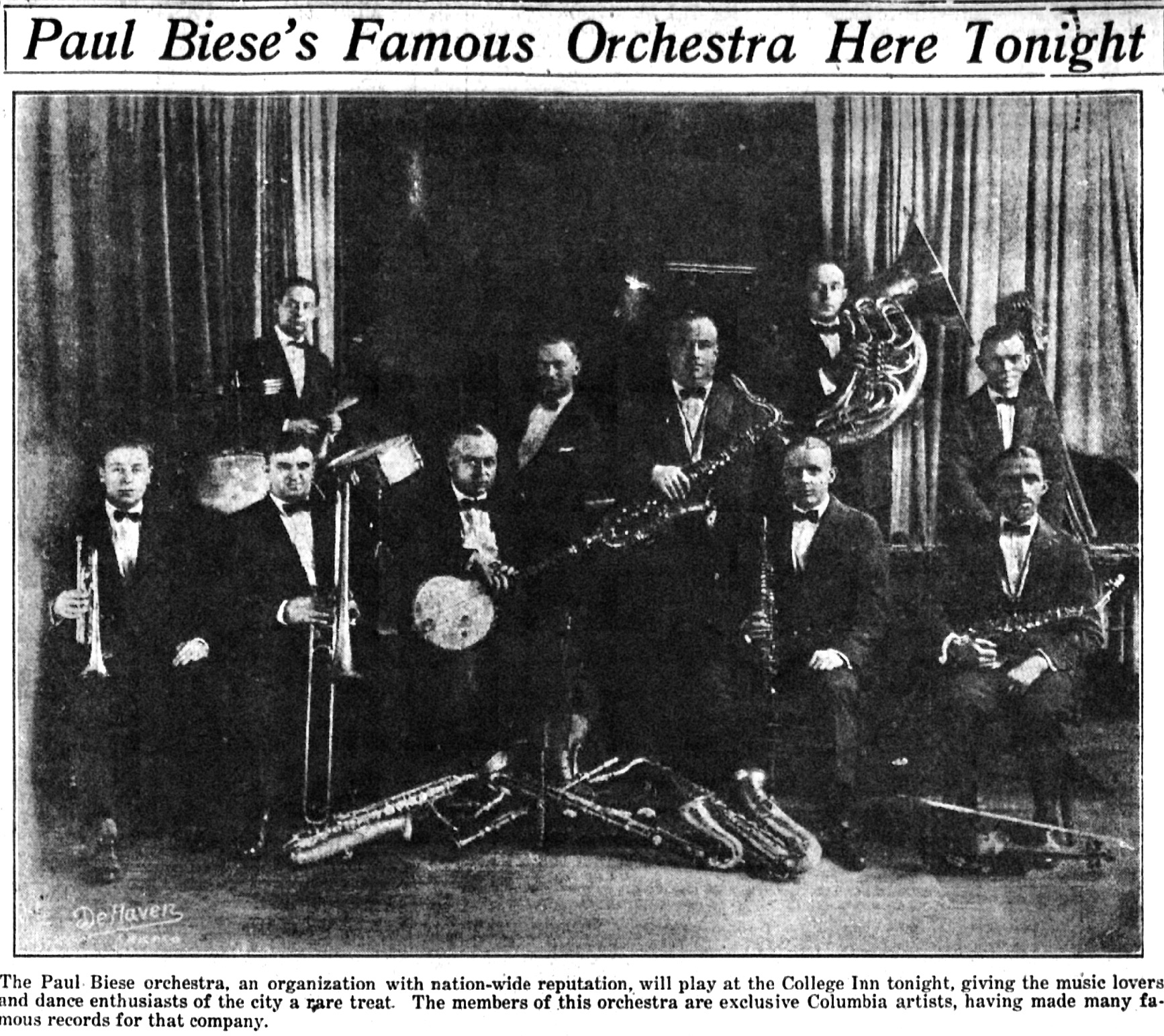
Image from The Fort Wayne Journal Gazette, November 28, 1921.

Sometime around March or April of 1921, Quartell was approached by the tenor saxophonist, bandleader, and Columbia Records recording star Paul Biese. Known for his husky presence and even huskier sound, Biese was instrumental in putting the post-ODJB Chicago jazz scene on the map and attracting the attention of several phonograph companies. While leading a successful band at the city’s College Inn, Biese decided he wanted a new lead trumpeter to replace Henry “Rags” Vrooman and likely hired Quartell sometime in April of 1921.

It was with Biese that Quartell, now going by that Americanized version of his last name instead of “Quaratiello,” probably made his first records, likely traveling with the band to New York City in May.[viii] Among these recordings are three beautiful selections backing Marion Harris where what sounds like Quartell’s distinctively raspy and quavering tone can be heard. However, he is featured very little otherwise. The band’s instrumental sides aren’t much better, though it certainly sounds like he is leading the band on their June recording of “Crooning.” To me, the most obvious candidates are the several sides cut with Biese’s trio, where an unnamed cornetist possessing the same tone and a knack for mutes contributes many fine obbligatos and even a gorgeous open horn solo of the melody of “Sweet Love” interpolated into the Biese recording of “Dangerous Blues.” This four-piece “trio” also backed singer Frank Crumit on some great sides, including a particularly bluesy rendition of “Frankie and Johnny” (incidentally a St. Louis tune.)

In later years, Quartell recalled staying with the band for about six months, substantiated by a clipping in the July 1926 issue of Radio Digest. Given that he is photographed and mentioned as being with the band as late as November of 1921, by the end of the year, his tenure with the band appears to have been complete.

The Third Ring: “Oriole Blues”

In May of 1922, Quartell boarded a train from Chicago headed to New York City. He had been hand-picked by the proprietors of the brand-new Oriole Terrace Ballroom in Detroit and by Gus Haenschen, head A&R man of Brunswick Records, to play hot cornet in a new ensemble that the ballroom and company were putting together: the Oriole Terrace Orchestra. Touted as the “greatest orchestral combination in America,” being “composed of jazz experts from the levees and Chicago,” and “12 jazz mad musicians from the nifty home of jazz,” the band’s personnel was indeed a mix of musicians from cities such as Chicago, New Orleans, and Kansas City­, all major influences on the development of jazz. The dozen-piece unit possessed a dreamy sound, with such talents as pianist Ted Fiorito, violinist Dan Russo, lead trumpeter Marty Campbell, New Orleans-born trombonist Roy Maxon, ex-Kansas City accordionist Frank Papilla, saxophonist Clayton Nassett, and later on Nick Lucas, who may have begun recording with the band as early as September of 1922 before joining them full time the following year. In between beautiful sonorities from the reeds, accordion, and strings, the sound was punctuated by hot muted breaks and choruses from Quartell and Maxon, such as on their recordings of “Oriole Blues” and the phenomenal “Serenade Blues.” The whole thing was supported by a steady and sweeping rhythm section. The band’s first gig appears not to have been a gig at all but their first recording session![ix]

Advertisement for the first Oriole Orchestra show. Image from Detroit Free Press, May 26, 1922 (edited by Colin Hancock).

After several days of rehearsals and recording, the band played their first show at the Detroit Arcadia Ballroom on May 30, 1922.[x] Their records became instantly popular, and they quickly secured a contract for a summer engagement at Chicago’s Edgewater Beach hotel, which really became their home base for the next several years despite the Oriole name (they would eventually drop “terrace”). They continued routine trips back to New York to record for Brunswick as well, cutting many fantastic features for Quartell, including “Toot Toot Tootsie,” “Bee’s Knees,” and “Carolina in the Morning,” which Quartell falsely recalled as the first record to feature a “wah-wah” mute sound.

(Author’s note: David Sager and I have concluded that this was likely done by another Chicagoan, Louis Panico, on “Wabash Blues” with Isham Jones’s Orchestra in 1921, also for Brunswick. Of course, the “wah-wah” effect had existed in jazz going back to Buddy Bolden, but that’s a conversation for another time.)

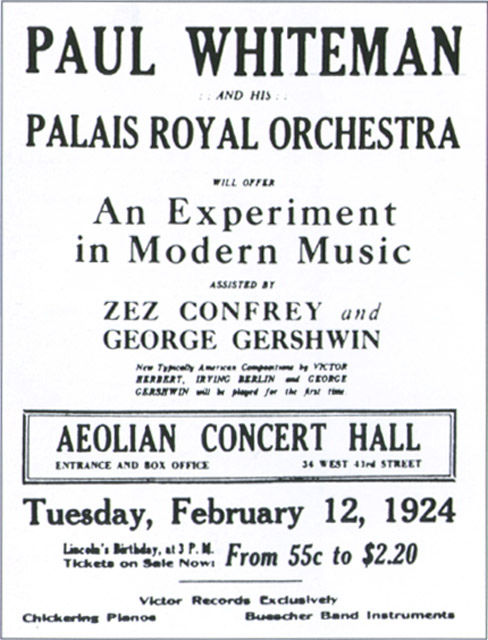
All of the positive attention earned the band a great reputation that slowly worked its way all the way up to the nation’s top bandleaders, including Paul Whiteman. In January of 1923, the band had its first public appearance in New York City at the B. F. Keith Palace. It was a huge success, and Whiteman, who was in attendance, was floored.

Over the next few months, Quartell’s relationship with the Oriole Orchestra seems to have started fizzling. The Oriole Orchestra played a long engagement in St. Louis that spring, during which he and Frank Papilla also moonlighted with the Maxwell Goldman Orchestra. This was followed by a three-month stay in Cleveland, during which Quartell also joined up with the Vernon-Owens Hotel Winton Orchestra. Though he is present on the recordings the Oriole band made in May, it seems that by that summer, Quartell had left the band, at least on stage.[xi]

The Fourth Ring: “You Should Have Told Me”

Around August of 1923, Quartell and Maxon were both offered positions in Paul Whiteman’s band, which Quartell recounted:

“Now, I had an offer from Paul Whiteman in [1923]. I went to New York, I made a recording with him, but he didn’t offer me enough money to stay with his band. Mr. Gus [Haenschen], recording manager for Brunswick Records, asked me if I would like to go back to the Edgewater Beach Hotel with Bennie Krueger for more money, and I did. I didn’t accept Mr. Whiteman’s offer. I came into Chicago with Bennie Krueger, I made several recordings for Brunswick, and I came to the Edgewater Beach Hotel.”

It seems that this recording must have been either the September 20 or 26, 1923 session, given that Maxon’s first confirmed appearance was September 20. The most likely candidate for this recording is “Cut Yourself a Piece of Cake” from that date, which features two cornets in a muted “wah-wah” chorus, presumably Quartell and the orchestra’s regular lead trumpeter, Henry Busse, who is prominent on the other recording from that day, “I Love You.” However, it is quite difficult to tell whether or not Quartell is truly present. Whatever the case, by October of 1923, Quartell was back in Chicago with Krueger at the Edgewater Beach Hotel, likely thanks to Haenschen and Brunswick’s relationship with both the band and the venue.

In early 1924, Quartell traveled again, this time for a brief stint with bandleader Arnold Johnson in Miami alongside fellow Chicagoan Vic Berton. He also began working with the pianist Art Kahn around this time, possibly thanks to his relationship with Berton (a member of Kahn’s Columbia recording orchestra) that went back to the Paul Biese days. It’s not known if Quartell recorded with them at this time (it may be him contributing the hot derby muted solo on “Bahama”), but he would certainly record with them later in 1924 and on the band’s January 1925 sessions. He is particularly well-featured on “You Should Have Told Me” and “Insufficient Sweetie,” the former a fast-paced romp featuring his “dicty” straight lead style and hot improvisations and the latter a low-down affair.

In between Johnson and Kahn, Quartell found his way back to New York again to play with bandleader Paul Specht. Replacing Italian-born trumpet player Frank Guarente, Quartell spent much of the summer with Specht, recording many great sides for Columbia, including a lovely blues waltz entitled “Come Back to Me,” his most beautiful performance on record to date. At the end of this engagement, he took a brief vacation to Wisconsin, where he played with Frank Doyle’s Orchestra in Green Bay.[xii]

The Fifth Ring: The Melody Boys, Isham Jones, and the Mid-20s

The mid-1920s were good to Quartell. Returning to Chicago in the fall of 1924, he began fronting his own band for the first time since joining Paul Biese. Likely road-weary and ready to take a break from being a sideman, he organized “Frankie Quartell and His Melody Boys.” Before long, the band was quickly engaged at the city’s Montmartre Café, the revamped Green Mill Gardens, where the Chicago Cellar Boys and many other groups still hold court to this day. Although his usual reedmen were Al Hyatt, Dave Sholden, and Maurice Morris (how’s that for a name!?), around this time, Quartell also briefly employed Benny Goodman, though the venue made him fire the young clarinetist for his “unconventional” style. I guess they weren’t ready for the sounds coming out of Hull House.

The Melody Boys recorded two sides for the General Phonograph Corporation’s Okeh Records in December of 1924: “Prince of Wails” (which this article begins with) and the even stranger “Heart Broken Strain.” Both feature Quartell’s lead and distinctive mute work, very much up-to-date for late 1924. The rest of the band isn’t quite as tight, although the final chorus of “Prince of Wails” is fantastic, particularly thanks to Morris’ slap tongue saxophone work. Hyatt’s sour clarinet work leaves much to be desired, though some phrases are hip.

In early 1925, Quartell was once again compelled to work as a sideman when he received an offer from Isham Jones to replace Louis Panico as the hot cornetist in his band. Three years Panico’s junior, Quartell was quite similar in style and approach to Panico and was a logical choice. Further, his skills as a veteran recording artist only made him more attractive to the business-minded Jones. Quartell contributed many fine solos to the band’s mid-1920s Brunswick records and even traveled with them to the United Kingdom in 1925 to play the Kit Kat Club, replacing Ted Lewis and Vincent Lopez before that.[xiii] His playing on the band’s “River Boat Shuffle,” “Danger,” “Sweet Man,” and “The Original Charleston” are among the cornetist’s finest recordings.

(Author’s note: One of the more entertaining stories (to me at least…) relating to this era of Quartell’s life was a mix-up I made between Quartell and Frank Cotterell (1903–1940), who Wolverines authority Chris Barry helped explain was another Chicago trumpeter and reedman who preceded Bix Beiderbecke in the Wolverines, and probably is the guy present on the Dudley Mecum’s Wolverines tests for Paramount in fall of 1925, as opposed Quartell, who was either about to leave for Europe with Isham Jones or was already en route!)

After his tenure with Jones, Quartell briefly returned to the Edgewater Beach Hotel in 1926, where he performed with the new Edgewater Beach Hotel Orchestra fronted by violinist Joe Gallicio and directed by pianist Roy Bargy. During this stint, he traveled with the band to play a Kentucky Derby overnight excursion train, which pulled over in French Lick, Indiana, to let patrons use the town’s gambling establishments. During the trip, Quartell had a most interesting conversation with Mr. S. G. Gonzalez of El Paso, Texas, who was a passenger on the train. During the discussion, Quartell recounted that:

“Mr. Gonzalez said, ‘If you ever decide to come to El Paso, I own the Central Cafe in Judrez, Old Mexico, and would like to have you work for me as my orchestra leader.’”[xiv]

Though he did not initially take up Gonzalez, this exchange would change Quartell’s life in later years.

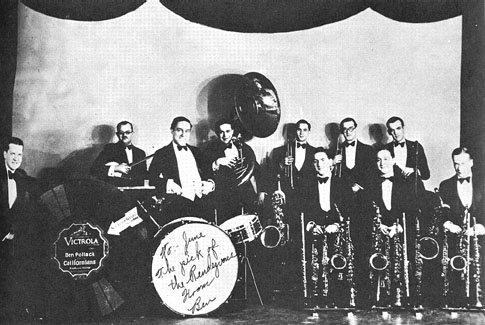
Returning to Chicago, Quartell briefly rejoined his fellow Hull House alum Benny Goodman, this time as a member of Ben Pollack’s famed band, where he contributed some second cornet work to such jazz classics as “Waitin’ for Katie.” Sadly, Quartell is virtually indistinguishable on this lauded recording, but his presence only adds to the magic.

The Sixth Ring: “Way Out West in Texas” and “Way Down ‘Yonder in New Orleans”
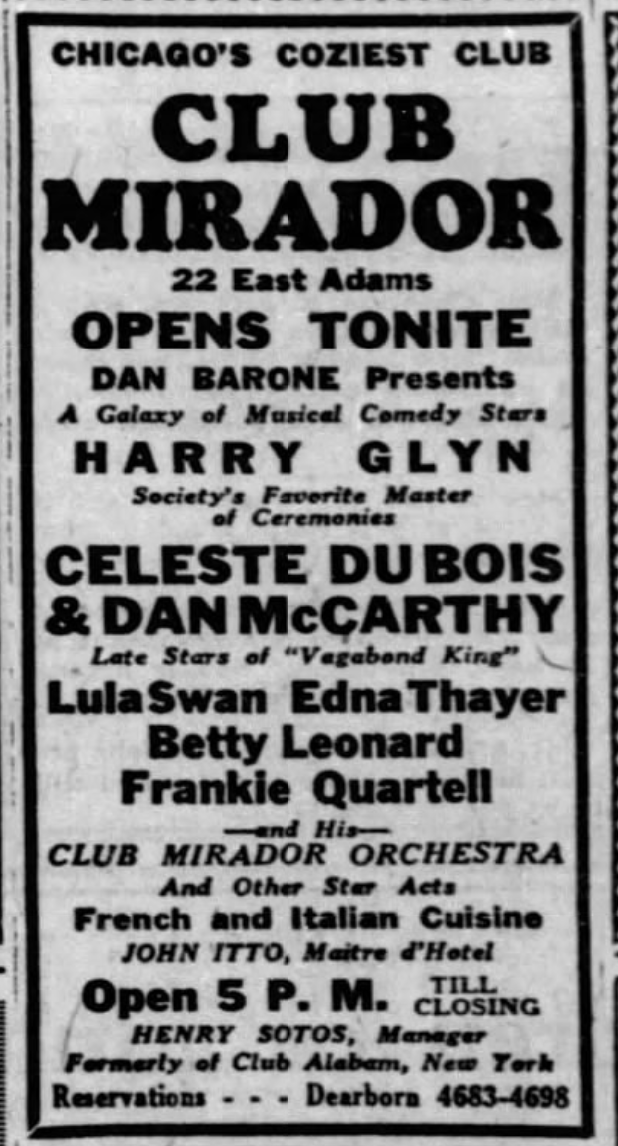
Image from Chicago Tribune, September 20, 1927.

In 1927, Quartell founded a new band at the Club Mirador in Chicago that achieved some success. However, it seems Quartell fell in with the wrong crowd at this time as he picked up a bad habit of gambling that eventually led to a nasty separation from his wife, Arvilla.[xv] In the wake of all of this drama, Quartell wanted to get away, and that opportunity soon arrived at the behest of Texas gangster Sam Maceo, who offered Quartell a chance to play a season at the Grotto in Galveston, Texas, a well-known nightclub and gambling casino in that gulf-side city.[xvi] Maceo was an interesting character who rented a suite of rooms in the palatial Hotel Galvez and traveled annually to New York to buy the latest white suits specially tailored for him.

Hiring a band that included Quartell’s brother Joe on trombone, this group was quite popular and generally a good experience for Quartell. He fondly recalled hanging around Galveston Island’s speakeasies and red-light districts as well as at the Hotel Galvez, where he also took up temporary residence and where bandleader Dandy Wellington now leads Jazz Age-style bands at an annual summer soiree.

Following the Grotto engagement, Quartell played a short stint at the Little Club in New Orleans, Louisiana. While there, his band recorded two sides for Brunswick Records, who were on a field trip through the American South to record local talent for local markets. “Sweet Baby” and “Pining,” the two recordings the Quartell Little Club Orchestra waxed, are stylistically quite different from his 1924 recordings, focusing more on rhythmic heat than oddball arrangements. What is consistent, however, is Quartell’s raspy and driving lead tone that shines through on both sides. Unfortunately, the Little Club engagement ended early due to unsatisfied management, resulting in an early departure from New Orleans and a lawsuit from Quartell.[xvii]

Traveling back to Chicago in early 1929, Quartell found work at the Beaumont Club and recorded a couple of sides with Nick Lucas, including the Spikes Brothers’ latest “Someday Sweetheart” knockoff, “Some Rainy Day.” He longed for the road again and booked his band for engagements in Cleveland, Los Angeles, New York, and a six-week engagement at the El Tivoli nightclub in Dallas. During this gig, he began to recall his run-in with Mr. Gonzalez during the Kentucky Derby excursion three years earlier and figured he’d see for himself if it was true. Further, he had recently discovered that his wife had contracted tuberculosis, which a dry climate would help cull. Boarding a Texas and Pacific train, he headed for the border town of El Paso with little more than Gonzalez’s name and address.

The Seventh Ring: “The Voice of the Rio Grande”

Despite its remote location, in the 1920s and 30s, El Paso boasted many fine bands and jazz musicians like the Doc Ross orchestra with Wingy Manone and Jack Teagarden and Dallas trombonist Bert Johnson’s Sharps and Flats, which included a young Don Byas and Milt Hinton as well as Ida Cox on vocals. Its location across the border from Mexico also meant that it was in close proximity to vices that were still illegal in the United States, including alcohol. As such, clubs across the river in Juarez offered steady work for musicians without the competition of larger scenes. Given that Quartell had been working professionally for over a decade and with the nation’s top bandleaders for eight years, it makes perfect sense that El Paso was an attractive option to the trumpeter from a work standpoint.

After locating Mr. Gonzalez, Quartell set up an international band of American and Mexican musicians at the Central Café in Juarez. A trio from the larger band (likely Quartell and the group’s two other American musicians) began broadcasting from the radio station WDAH, “The Voice of the Rio Grande,” on the roof of the El Paso Del Norte Hotel that still stands.[xviii] Quartell recalled that the amateur station only paid the band a weekly salary of $15.00 (only about $285 in today’s money) for daily half-hour shows six days a week![xix] Quartell functioned as emcee, bandleader, soloist, and vocalist, singing his theme, “The Bouncing Baby.” Through these broadcasts and performances, Quartell became the most popular musician in the city and achieved a decent amount of wealth. By the fall of 1929, he was even able to open “Frankie Quartell’s Music Shop” that sold Brunswick records, radios, and instruments.
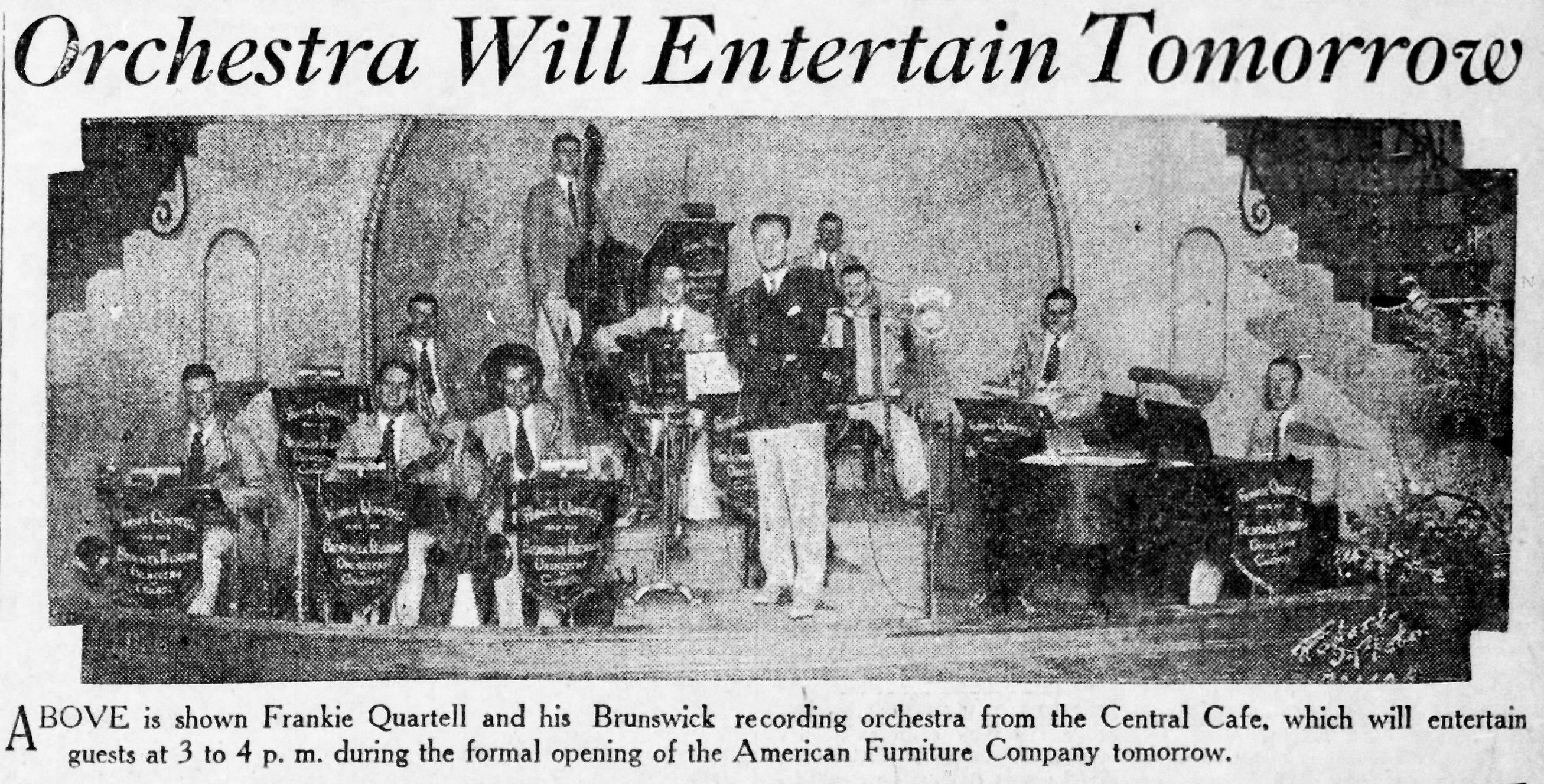
Quartell’s band ca. 1928. Image from El Paso Herald, October 21, 1929.

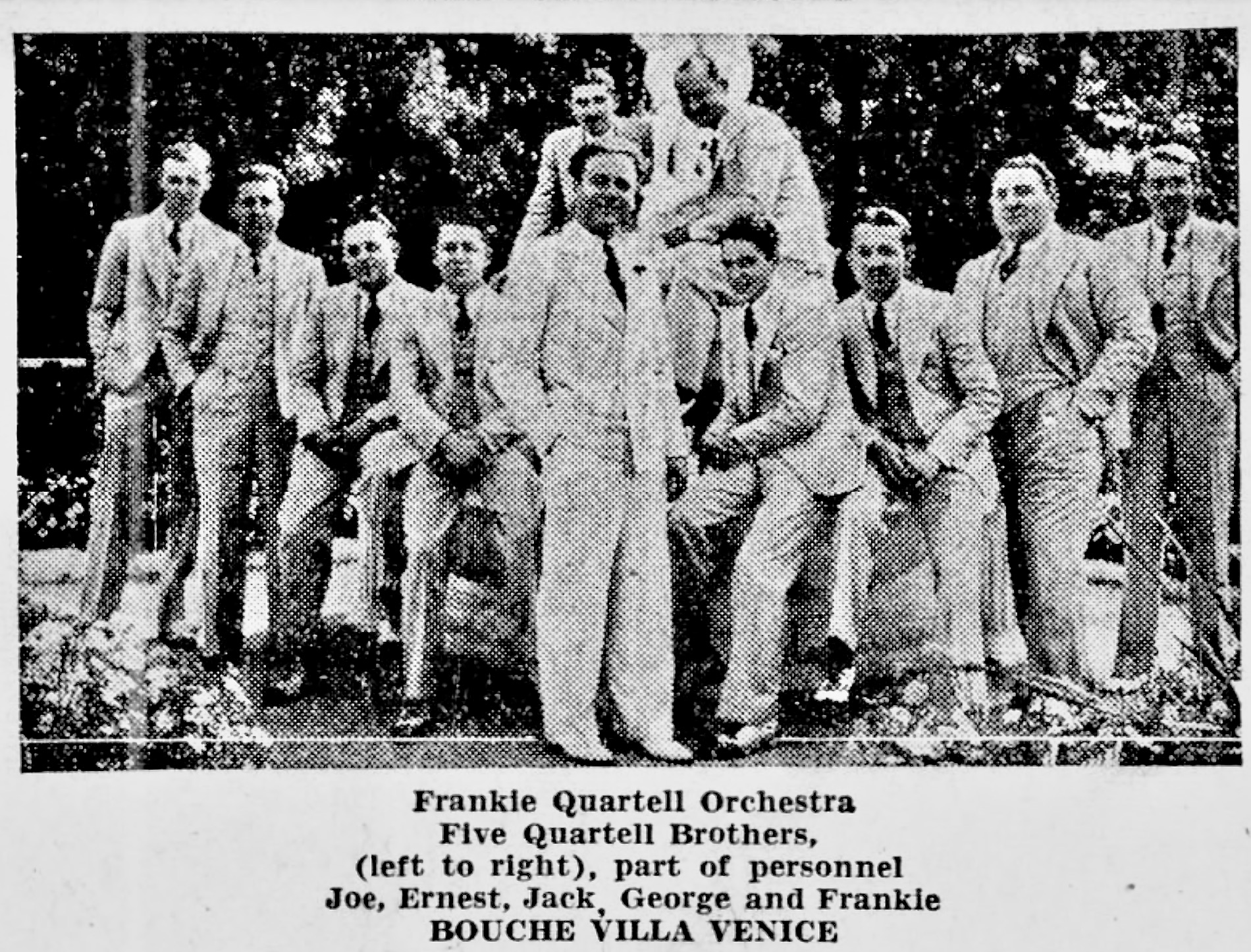
Despite the difficulties of the stock market crash, Quartell hustled even more to find steady work through much of the 1930s. Leaving El Paso and his shop due to the Depression, he ended up back in Chicago leading a band called the “Playmates” at the Edgewater Beach Hotel back in Chicago before relocating to the city’s Villa Venice.[xx] He continued playing around Chicago but routinely brought bands back to Texas, including shows in Galveston and Corpus Christi in 1932.[xxi] In 1934, the band traveled to Miami to play New Year’s Eve at the city’s own Bouche Villa Venice. The band also featured his brothers Joe, Ernest, Jack, and George, billed as the “Five Quartell Brothers,” a hot band within the band.[xxii] This, combined with the venue’s other acts, turned into a steady review that was so popular that the band was brought down to Cuba to play the Teatro Nacional in Habana, one of Quartell’s proudest moments and one of the farthest excursions music would take him on..[xxiii]

The Eighth Ring: Later Years and Epilogue

As the Great Depression wore on, Quartell began struggling to find work. He became a sideman again when, in 1936, he reconnected with his old Oriole Orchestra pal Nick Lucas to play a brief stint at New York’s Hollywood Dinner Club and (briefly) marrying 19-year-old Virginia Lee Chew. Relocating to Chicago once more, he led another band that played throughout the Midwest and was based at Colosimo’s café. This band had a steady engagement for a few years and was one of the longest tenures Quartell had in one place. It seemed that years on the road had finally caught up with him.

In 1942, just as World War II began for the United States, Quartell enlisted in the U.S. Air Force. Like so many other musicians who served, he was involved in music leadership, conducting the Air Force Training Command band at the Stevens Hotel in his hometown of Chicago. In between this, he also managed to manage the city’s Morocco Theatre Café until the war ended. In classic Quartell fashion, he was ready to move once again, this time to Los Angeles, where he became manager of the city’s Stowaway Room. Evidently, this didn’t last long. By the early 1950s, he moved back first to Chicago, where he married his last wife, Lois Zuber, and then to Florida, where he managed the Colonnade Hotel auditorium in Riviera Beach. But something in him once again called him back to El Paso, where he eventually retired for good, convincing much of his family to move there in the process. He spent the last two and a half decades of his life there, enjoying the sunshine and fond memories of the days when he was the city’s musical kingpin. It was there that he would eventually pass away on August 22, 1984.

Frankie Quartell’s life story is unique. Like a pinball, he bounced around the country and, indeed, the world during some of the most economically challenging times in American history. Raised from almost nothing, he worked his way into the national spotlight and made an impact nearly everywhere he went. But, like the music he loved, he faded into obscurity with the changing of the tide, and so too did much of his legacy. But thanks to a few scratchy old records, some faded newspaper clippings, and the tireless love of jazz fans from around the world, we can rediscover and revive the legend of Frankie Quartell and the music that captured audiences from the Hull House to Havana one side (or tree ring) at a time.

From Colin Hancock and Dave Bock’s collections.

Acknowledgments

Special thanks to Dave Bock, Kevin Coffey, Ate Van Delden, Vince Giordano, Javier Soria Laso, David Sager, Andrew J. Sammut, and Dustin Wittman for their help in preparing this article and providing precious source materials including recordings, clippings, and photographs.

Thanks to Kevin Coffey and Andrew J. Sammut for their careful edits to this piece. Thanks also to Coffey for his help with establishing an accurate timeline of the Oriole Orchestra. Thanks to Sammut for inclusion of this piece on his Pop of Yestercentury blog.

Thanks to Dustin Wittman for his restorations of “Prince of Wails,” “Sweet Baby,” and “Pining.”

Personnel and discographical information taken from Brian Rust’s Jazz and Ragtime Records, 1897–1942 and The American Dance Band Discography, 1917–1942; Richard J. Johnson and Bernard H. Shirley’s American Dance Bands on Records and Film, 1915–1942; and the Discography of American Historical Recordings with edits, additions, and revisions by Kevin Coffey, Javier Soria Laso, and Colin Hancock.

Endnotes

[i] A birth certificate for Maria Carmela, born July 4, 1894, to Vincenzo and Crestina, exists in the Cook County records but no records appear to exist after that besides an 1896 New York State death certificate that lists Maria Carmela to have been born in 1895 yet is unconfirmed as to whether or not the parents are Vincenzo and Crestina. Another Carmela, aged one and born in 1898, is listed in the 1900 census as a daughter living at the Quaratiello household beneath her grandmother, Carmela Sr. Could this one-year-old be the same as the ca. 1894 Carmela? Could she have been yet another premature death in the family. So far, we do not know.

[ii] Dick Holbrook: “Mr. Jazz Himself: Interview with Ray Lopez, Part II,” Storyville no. 69 (1977)

[iii] In his 1977 interview, Quartell claimed to join the Kentucky Five in 1918. Though there is a Kentucky Five performing in St. Louis in 1918 with the Zeigler Sisters, Kevin Coffey pointed out that it’s unlikely that Quartell would have traveled this early before being a card-carrying union musician. Quartell also misremembered his dates by about two years in the interview (stating, for instance, that he joined the Oriole Orchestra in 1920 rather than the actual date of 1922), which would place his tenure with the Kentucky Five closer to 1920–21.

[iv] 1977 UTEP interview; research by Kevin Coffey.

[v] Kennedy, William Howard: Jazz on the River, chapter 3: Louis Armstrong and Riverboat Culture.” University of Chicago Press, 2005, p. 66.

[vi] Research by Kevin Coffey.

[vii] Id.

[viii] Contemporary advertisements for the band specified that each musician was a “exclusive Columbia recording artist.” Judging by the frequency that Biese recorded at this time, aural evidence on the recordings, and photo evidence, Quartell’s presence is almost without question.

[ix] “Fine Dance Hall is to Displace Theatre,” Detroit Free Press, May 7, 1922, p. 45; The Brooklyn Daily Times, Jan 7, 1923, p.16; Brooklyn Eagle, Jan 7, 1923, p.36.

[x] “Arcadia Closes Tonight with Wonder Orchestra,” Detroit Free Press, May 30, 1922, p.1.

[xi] Research by Kevin Coffey. Though Quartell claimed to have been in the band “a year and a half,” Kevin Coffey points out that contemporary press for the Oriole Orchestra stop mentioning Quartell (but keep mentioning Papilla, Lucas, etc.) around June of 1923. Could Quartell have just stayed on for the recording sessions after the Cleveland engagement? It is also worth noting that though the Vernon-Owens band did make records for Gennett that year, their recordings were made in February, and therefore Quartell’s presence is doubtful

[xii] Research by Kevin Coffey.

[xiii]Id.

[xiv] 1977 UTEP interview.

[xv] “Stinting Wife to Play Poker Wrong Court Says,” The St. Louis Star and Times, Feb. 28, 1927, p.3.

[xvi] 1977 UTEP interview.

[xvii] Research by Kevin Coffey.

[xviii] Id.

[xix] Id.

[xx] Brooklyn Eagle, Feb. 14, 1930, p.2; 1977 UTEP interview.

[xxi] “Noted Dance Band to Play Here Friday!” Corpus Christi Times, May 23, 1932, p.3.

[xxii] “Appearing at Metropolitan Miami Supper Clubs,” The Miami Herald, Feb. 23, 1935, p.12.

[xxiii] “Villa Venice Open Until End of the Month,” The Miami Herald, Mar. 23, 1935, p.28.

[Thanks so much to Colin for sharing his post here!—AJS]

Tagged , , , , , , , , , , , , ,

In Search Of Rag-A-Jazz

MamieSmithJazzHoundsCareOfRedhotjazzDotCom

Another Corner Of The Hothouse

Jazz loves hybrids, though some blends get more sunlight than others. A web search for “raga jazz” turns up pages of results showing the cross-pollination between jazz and Indian classical music. Yet a search for the union of ragtime and jazz known as “rag-a-jazz” just generates more results for raga jazz. Google won’t even ask if you meant rag-a-jazz.

So, what are web crawlers missing out on? One example is a watershed moment in American pop and a million seller for Paul Whiteman, his recording of “Wang Wang Blues”:

It keeps the syncopation and staccato attack of ragtime but has its own popping sense of tension and release, as well as a humor that is not just ragged but downright raucous; just listen to Buster Johnson’s trombone or how clarinetist Gus Mueller slices and slurs into each chorus. How do we describe this music, teasingly similar yet ultimately unlike ragtime or most of the jazz discussed in history books and played in swanky clubs? How would we find other examples of this sound?

Unsurprisingly, musicians, historians and open-eared listeners prove far more illuminating than search engines. Reed player and contemporary rag-a-jazz performer Dan Levinson defines rag-a-jazz as “a hybrid style of dance music that existed briefly from the mid teens through the early twenties, while ragtime was evolving into jazz” and which “still held onto many characteristics of ragtime in terms of syncopation, song forms and even the way eighth notes were played.”

The OM5, Left to Right: Phil Napoleon on trumpet, Frank Signorelli on piano, Jimmy Lytell on clarinet, Miff Mole on trombone (with Charles Panelli subbing in the above clips) and Jack Roth on drums.

Early jazz bandleader Vince Giordano describes the “baby steps of jazz,” with “elements of both jazz and ragtime” as well as “early syncopation but still a little bit of ragtime feel.” Giordano explains that rag-a-jazz surfaced around the time of Scott Joplin’s death and the end of the ragtime era, continuing through a period when “jazz was just taking shape and many orchestra leaders weren’t sure which way to go.” Levinson also mentions the “betwixt-and-between state of ragtime and jazz [that is] no longer quite ragtime.”

Rag-a-jazz conductor and multi-instrumentalist Matt Tolentino notes “ragtime still managed to hang on as a powerful musical force. Ragtime had a strong presence that more or less drove popular music in America from about 1895 to about 1917, so even though the general public had grown tired of it, they couldn’t escape it. The syncopation that ragtime had introduced was what America was used to listening to, and even though it wanted to say it was through with ragtime, such a night and day change in listening would be impossible.”

For rag-a-jazz drummer and bandleader Nick Ball, rag-a- jazz is “…the original ‘Rosetta Stone’ of music that is stylistically in the cracks, where one clearly defined idiom was merging into another or being strongly influenced by a parallel one from elsewhere in the world.” Ball also calls rag-a-jazz “the oldest of these transitional subgenres to have been documented on record in anything like enough detail for us to understand the process of its birth and its demise…a subgenre which lasted less than a decade, subsequently almost hidden in the long shadows cast by its parent, pure ragtime, and its child, pure jazz.”

More than a historical note, the music grouped under the term “rag-a-jazz” (or in search engine syntax, “‘rag-a-jazz’ -raga jazz”) is an example of fusion from decades before anyone plugged into an amplifier. It’s also an example of musical ideas that some would dismiss as wrong turns, many more would forget and others, thankfully, hear as another musical universe.

The Avant-Garde ODJB

Levinson points to what many consider the first jazz record as a prime example of rag-a-jazz, the Original Dixieland Jazz Band’s “Livery Stable Blues”:

Speaking about the “musical revolution” of the ODJB’s earliest records, collector and historian Mark Berresford explains “what the ODJB had done was to simplify and deformalize ragtime to its barest state and, once stripped of its hallmarks, rebuild it into a clearly defined polyphonic structure, placing greater emphasis on maintaining impetus and excitement.”  Many history books draw attention to the ODJB’s frantic tempos, barnyard onomatopoeia and madcap spirit, which would have surprised (and possibly irritated) ragtime composers/performers. Yet even the ODJB’s later, more subdued sides display a distinct swagger a part from the lilt of ragtime:

Berresford also explains that “…as musicians’ ability to improvise grew, so their reliance on the structures of ragtime declined.” While ragtime players incorporated improvisation into their performances, it would obviously come to have a much larger role in jazz. Garvin Bushell, an ear-witness to these developments, summarizes his first attempts at playing jazz as “study[ing] rags on piano and omit[ting] the melodic pattern, just improvising on the harmonic pattern.”

Besides musical vocabulary and written notation, song forms themselves began to change. Early jazz maintained multi-strain structures until the swing era of the thirties, but Berresford notes how bands such as the ODJB would use a simpler configuration of fewer strains than formal ragtime. “What the ODJB’s performance lacks in form,” Berresford explains, “more than makes up for in dynamics, excitement and rhythmic drive, using devices such as solo breaks and the three-voice lead to signal its departure from the formality of ragtime.”

Skins And Cymbals

Berresford sums up rag-a-jazz’ musical characteristics as “a strong two-beat feel with predominantly ensemble playing, often heavy drum patterns and frequently fast tempos.” A two-beat feel in jazz is familiar to even occasional attendees at a Dixieland brunch, and contemporary jazz festivalgoers are no strangers to fast tempos. Yet rag-a-jazz’s constant collective interplay can sound strange to contemporary jazz lovers.

There is an unspoken, occasionally questioned but nonetheless powerful definition of jazz as ‘the’ idiom of an improvising soloist. In rag-a-jazz and in a pre-Louis Armstrong soundscape more generally, musicians don’t take turns soloing. Other than occasional short breaks, the emphasis is on ensemble interplay, balance and in some cases competition.

Rag-a-jazz represents a different concept of jazz, as ensemble music, a concept expressed in the unrecorded New Orleans parade bands of its earliest years, in King Oliver’s Creole Jazz Band, in groups led by Miles Davis during seventies and in those led by today’s jazz musicians such as Vijay Iyer and Robert Glasper. The best bands simply know how to play as bands, regardless of era. There is no sense of musical or expressive limitation while listening to the Original Memphis Five’s parts lock and slide into one another, even though no one player get so much as a half-chorus to themselves:

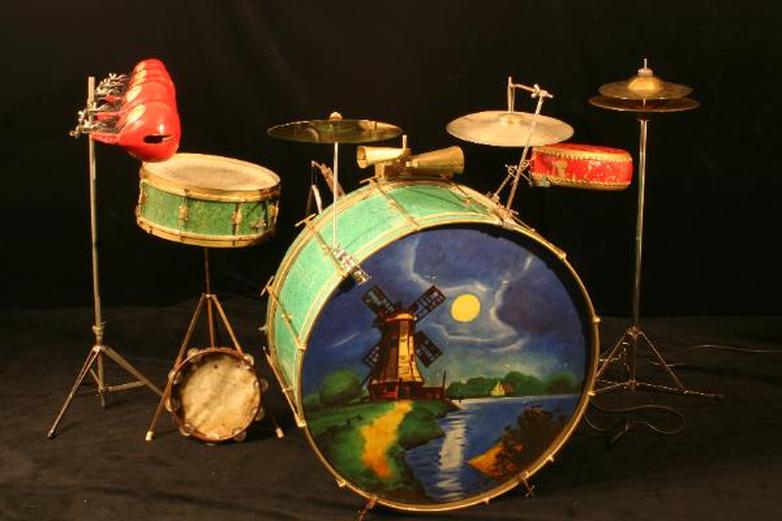
Decades of smooth, swinging cymbals can also make the syncopated, staccato beats of snares, rims, woodblocks and cowbells sound strange. “March-like” is the description and death sentence often thrown around for this style of drumming. Rag-a-jazz drummers were often influenced by marching band techniques as well as the ragtime drumming inspired by those techniques. All influences apparently not being equal, many jazz writers imply that marches are an inferior inspiration next to Afro-Cuban rhythms, hip-hop or other sources.

Drummer Hal Smith, on the other hand, talks about Tony Sbarbaro and other rag-a-jazz drummers as merely having their own distinct, often challenging approach a part from but just as valid as that of Zutty Singleton or Jo Jones (or for that matter, Elvin Jones or Terri Lyne Carrington). Nick Ball praises the prominent drums of Louis Mitchell, Anton Lada, Benny Peyton and others as “thrilling, riotous, imaginative, highly individualistic, incredibly technically proficient and, for the time, very well-recorded.”

For other listeners, this style may be vaguely familiar from some of the hippest names in jazz drumming. Jazz educator Mark Gridley explains:

The earliest jazz drummers often devised lines of activity bearing rhythmic and melodic contours that were distinctly different from the contours of lines being contributed by their fellow musicians. The practice of playing an independent line of activity was suppressed in swing [during the thirties]…It enjoyed a resurgence, however, in bop [during the forties]…This independent line of activity…provides a layer of boiling sounds that increases the excitement of the combo performance. The use of this activity continued through the fifties and sixties [and] has been an accepted practice for all modern drummers of the seventies and eighties…The rhythms used by the modern drummers were not those of ragtime, but the spirit in which they played is analogous to the conception shown by the earliest drummers.

Jazz scholar Dr. Lewis Porter debunks the myth of early jazz drummers as mere timekeepers while also drawing attention to their intricate fills and contrapuntal playing. Porter describes Sbarbaro “going crazy” in the best sense of the term. Whatever these drummers gained from ragtime or military music, it worked for them, their colleagues and anyone who wanted to listen.

20drumskitCareOfPolarityRecordsDotCom

Dance Music And Duple Feel

In some ways rag-a-jazz’s most radical difference from the ragtime that preceded it and the postwar jazz that is now lingua franca was that listening was a secondary activity. Rag-a-jazz, as well as most prewar styles of jazz, was above all intended for dancing. Ragtime had its own signature lilt but the new “jass” music really moved bodies.

Traditional jazz musician and writer Chris Tyle reminds that at the time, records were labeled “fox trot, tango, waltz, etc.” for a reason; “Original Dixieland One Step” was just that, a one-step. He also points to the symbiotic influence between music and dancing and the need to ask, “did music change because the dancing changed, or vice-versa?”

Rag-a-jazz musicians (and later on New Orleans via Chicago and big band swing players) had to serve a very practical purpose. Besides the need to get dancers out on the floor, Tyle also points to the material conditions that not only shaped the music but also made it so varied. The size of the venue or a record label’s budget determined band size and repertoire. In some ways this practical basis allows for far more variety than the wide-open plains of art music.

Ball explains that as a style, rag-a-jazz “was so brief that no kind of standardization had time to be established, virtually no two ensembles had the same or even similar instrumentation and every band seemed to have approached the music completely different to each other in terms of image, repertoire, performance practice; no individual’s singing or playing style became familiar enough to become cliché.” It’s why this era includes such fascinating combinations as the Louisiana Five, with Yellow Nunez playing lead on clarinet without a trumpet in sight:

or novel sounds such as the Whiteway Jazz Band’s arrangement of “Blues My Naughty Sweetie Gives To Me,” where the saxophone plays the melody and the trumpet plays obbligato around it, a touch of role reversal in a traditional jazz setting (listen here or below):

How Do You Like Your Eighth Notes?

While simultaneously departing from ragtime, part of this music’s unique excitement and sound has to do with the musicians phrasing in eight, a holdover from ragtime’s pianistic basis. Similar to fingers flying across the keyboard, the notes fly out of these groups in a jittery “rat-tat-tat-tat” that is agitatedly exciting and a world a part from jazz’s later, more vocally-conceived lines.

Vince Giordano mentions the ODJB and vaudeville artists of the early twenties as just a few examples of a bass part playing two-to-the-bar, just like in ragtime, while horns phrase in eight like the right hand of a ragtime pianist. Later on in the twenties, some jazz bands would keep the two-beat bass but without the ragtime “tinge” of the earlier bands.

Giordano raises phrasing in eight as a key part of rag-a-jazz, stressing the eight feel with his own sidemen when they perform this repertoire. As a few other examples of this feel, he cites The Virginians’ “Aunt Hagar’s Blues” in a Ferde Grofe arrangement:

Lillyn Brown’s early recording of the jazz warhorse “Jazz Me Blues,” especially its vocal and trumpet:

the instrumental asides of Mamie Smith’s “I Want A Jazzy Kiss,” especially its chattering wood blocks:

and Mamie Smith’s “Sax-O-Phoney Blues”:

On “Sax-O-Phoney Blues,” the staccato syncopations, chains of eighth notes and reedy arrangement sound very much like orchestral ragtime. The growling trumpet and Smith’s vocal speak to something broader, in terms of phrasing as well as spirit.

Levinson emphasizes that the eighth notes in rag-a-jazz “don’t ‘swing’ the way eighth notes do in most form of jazz,” and are instead “played ‘straight’ or ‘even,’ the way eighth notes are played in ragtime, classical music and every other style of music.” Those even eighth notes can make a huge impact on today’s jazz lovers. Decades of uneven eighth notes as well as post-Armstrong phrasing can make this music sound like it’s simply not jazz. Yet taken on its own terms and without comparison to other rhythmic concepts, it is just another approach to the tradition. Jazz has become a very big tent but its own backyard still has much to offer.

They Always Call It “Music”

The word “jazz” itself also seems to distinguish the new style from ragtime, not just musically but in terms of personal identity. In chronological and cultural terms, Giordano sums up this shift well:

You’re just getting out of World War I, which was such a horrific event, and I think young people just said, ‘We’re going to have a good time,’ and the music really reflects that.

What could be more personal, more joyful and more representative of jazz than a love song to the saxophone?

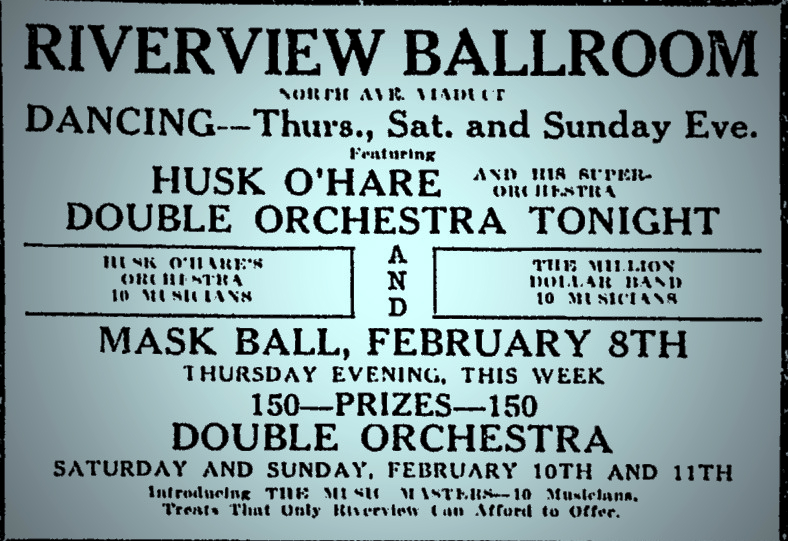
http://the78rpmrecordspins.files.wordpress.com/2014/03/the-milwaukee-journal-google-news-archive-search-feb-4-1923-husk-ohare.jpg

Transitional period, stylistic amalgam, generational signifier, offshoot of ragtime, jazz unlike any before or since and expression of peacetime ecstasy: labels are never airtight but “rag-a-jazz” has come to encompass all of these things. Most musicians and collectors agree that Leonard Kunstadt originated the term in its current usage. Depending on the source, Kunstadt either began using it in the pages of Record Research magazine, which he founded in 1955 and continued to edit and publish, in Jazz: A History of the New York Scene, published in 1962 and coauthored by Kunstadt and Samuel Charters, or at some later point in the seventies.

The phrase does appear much earlier in the name Southern Rag-A-Jazz Band. Yet this London-based band (by way of Nebraska) used it for catchy marketing rather than stylistic labeling. Obviously the musicians themselves were just playing music that came naturally to them. It’s hard to imagine that they understood what they were doing as an offshoot or development.

Garvin Bushell actually saw no distinction between ragtime and jazz. He proudly declares that, as a young pianist, “my knowledge of ragtime assured me I would not have any trouble [playing] jazz. Since there was very little difference between the two, I knew I could master it.” His comments about the repertoire and approach of his earliest bands are also revealing:

As I recall, we also had copies of “Maple Leaf Rag,  Way Down Yonder In The Corn Field, ‘The Whistler And His Dog,” and “Give My Regards To Broadway.” Although poorly reproduced, these records contained the foundation of the jazz that was to come, particularly “Maple Leaf Rag.” I make this statement with no fear of contradiction. Ragtime, as it was called then, had the technical essence that was later required in jazz. While ragtime was always played in the moderate or fast ‘two’ tempo, jazz merely slowed it down to a fast or medium ‘four’ … We’d usually have eight or nine guys: trumpet, trombone, clarinet, saxophone, piano, banjo, tuba and drums. Maybe a violin or a bandolin (half banjo, half violin). Since there weren’t dance arrangements then for saxophones and trumpets, the pieces we rehearsed were mostly pit orchestrations. We’d pull out one clarinet part, one sax part, and on like that. The piano player had a part, as a rule, and the bass player faked. In fact, most everybody faked, since none of us could read that well. The style was very much what you hear on the early records-we called it “ragtime jazz.”

At the time and like any time before and since, musicians were simply drawing upon what was around them, what historian Richard Sudhalter called “the rich fermentation of American popular music between 1917 and 1923.” That doesn’t make latter-day commentary and analysis superfluous; in fact, hindsight lets us appreciate and understand the wide variety of music offered by history. iPods can store Phil Napoleon’s trumpet right alongside Miles Davis and Louis Armstrong’s horns.

Play “Ricky-Tick” For Me

Giordano explains that by 1923 or 1924, the rag-a-jazz style began to fade as musicians and audiences absorbed the New Orleans via Chicago “stomp” style and its quarter note feel. Berresford also notes that “the 1923 date is seen by many as the seminal date by which jazz had thrown off all the shackles of its ragtime antecedents and strode forth into the world in its own right – it is no coincidence that 1923 saw the first recordings by King Oliver’s Creole Jazz Band (with a young second cornetist named Louis Armstrong), Jelly Roll Morton, Bessie Smith and Ma Rainey, whilst Coleman Hawkins had made his first, faltering records with Mamie Smith the year before and Bix Beiderbecke was to appear on records just a year later.”

As one example of this change, Chris Tyle points out the difference between Kid Ory’s first recording of his “Ory’s Creole Trombone”:

and his later performance with Louis Armstrong’s Hot Five:

Compared to Louis Armstrong’s “legato” phrasing and the rhythm section’s regular beat, the earlier record is “choppier.” Ory plays his breaks more clipped and cornetist Mutt Carey’s “punchier” attack is reminiscent of Freddie Keppard, one of the few New Orleans trumpets to came out of the older, ragtime based tradition.

louis armstrong“Choppy” may sound like a criticism while “smooth” is the preferred descriptor, but only from one  perspective. The smoother attack and more swinging flow of these groups wasn’t a matter of inventing jazz as we know it, but a different set of influences and musical ideas. Exactly when, where, how and why those musical priorities changed remains a hotly debated topic, but it was clearly not a matter of some artistic teleology. As Nick Ball says, “jazz didn’t actually burst fully-formed from the mind of Louis Armstrong in 1923, as many books and films imply.”

The influence of these New Orleans bands and eventually King Oliver’s second trumpeter on young musicians cannot be overstated. By 1928, Boston-born trumpeter Max Kaminsky knew which musicians spoke to him:

The crush roll of the Chicago drummers [such as George Wettling] was unheard of back East, where they were still playing oom-pah and ricky-tick, breaking up the rhythm into choppy syncopations instead of keeping a steady beat you could play against…That nervous, ragged, ricky-tick beat of the white dance bands of the twenties was one of the factors that had been at the bottom of my confusion when I listened to my records back home in Boston, trying so desperately to unravel the puzzle of jazz. None of the white musicians I heard on them could keep time. None of the early white popular bands had really understood the beat yet…of playing the melody simply and purely without all the little flutings and corny licks that were regarded as “hot” in those days.

“Oom-pah, ricky-tick, choppy syncopations, nervous” and above all “ragged” are just loaded descriptions for the music that preceded the Oliver/Armstrong hegemony. For players like Kaminsky and later historians, Armstrong and the Chicago sound were not just another way to play jazz; they were the only way to play.

Southern Rag-a-Jazz BandWay Off The Record

The tendency to dismiss so much pre-war and especially pre-Armstrong jazz hasn’t helped the historical record or modern outlets of this style. To some commentators, the term “pre-Armstrong jazz” itself is a contradiction.

Ideally, all source material would be treated equally. A fusion would be a fusion would be a fusion. Yet instead of another interesting example of cross-pollination, most major jazz trades treat rag-a-jazz, and several other styles of early jazz, with the knowing silence reserved for “old music.”

It could just be a matter of age: raga jazz, for example, surfaced during the sixties, while rag-a-jazz had its heyday in the late teens and early twenties (never mind that ragtime itself is a baby compared to the raga tradition). Gabor Szabo is much closer than Earl Fuller in terms of stylistic generations as well as human ones.

Earl Fuller's Famous Jazz Band , 1917: Harry Raderman, Ted Lewis, John Lucas, Earl Fuller, Walter Kahn.

Earl Fuller’s Famous Jazz Band, 1917: Harry Raderman, Ted Lewis, John Lucas, Earl Fuller, Walter Kahn.

Maybe it’s the intangible but powerful factor of “coolness.” Ragtime is made in America, historically distant but geographically and culturally local. It doesn’t have the same connotation of open-mindedness associated with most brands of “world music.” Ragtime is also close enough to the classical conservatory, and therefore Europe, to make it seem old-fashioned and staid (never mind that, as Berresford, Tyle and others explain, ragtime itself is a rich and varied idiom that is not limited to what’s printed on sheet music). Small wonder that, as Sudhalter says, “standard jazz histories usually represent [American popular music between the years 1917 and 1923] as little more than organized disorder, the vaudeville clatter of the ‘nut jazz’ craze set in motion by the Original Dixieland Jazz Band and their legions of imitators…”

Once An Era But Still A Style

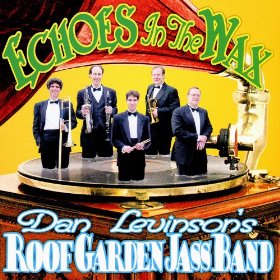
EchoesInTheWaxLike any musical era, these years included their share of “clatter” but they also featured musicians drawing upon a variety of influences, listening to and absorbing a range of styles and making music that doesn’t sound like anything else. It also continues to enthrall today’s musicians and audiences.  Rag-a-jazz, and its distance from even the towering presence of Louis Armstrong as well as more modern styles of jazz, may even seem like a breath of fresh air.

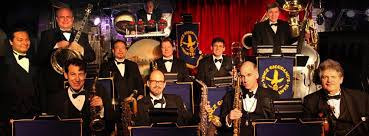
Vince Giordano frequently arranges rag-a-jazz numbers such as “Wang Wang Blues” for his big band, the Nighthawks, to the delight of dancers at live gigs and viewers of the acclaimed television series Boardwalk Empire. Chris Tyle enjoys playing the style with numerous groups, including his own Silver Leaf Jazz Band; their Freddie Keppard tribute album actually highlights the cornetist’s ragtime influences.  Nick Ball declares that rag-a-jazz “just keeps pulling [me] more and more strongly. I love that it’s rude and it’s louche and it has pretensions of elegance, you can dance to it and you can sit and listen to it too.” Matt Tolentino and his Singapore Slingers look at rag-a-jazz “not [as] a forgotten artifact or a museum piece” but as “music that appeals to all generations, young and old alike.”

Trumpeter Jon-Erik Kellso and trombonist David Sager, two contemporary musicians who play rag-a-jazz as well as many other genres, both cite its unique challenges. Kellso says that “all that ensemble blowing, with little or no rest can be painful” but also explains, with a chuckle, that it “adds character.” Sager describes rag-a-jazz as “some of the most technically demanding stuff [he has] ever attempted.” So much for the assumption that jazz reached its technical zenith with bop.

nighthawks

Both Kellso and Sager play with Dan Levinson’s Roof Garden Jass Band, which Levinson founded in 1987 and has since released three albums of rag-a-jazz. Levinson’s context for the music applies equally well for 1920 or 2014:

Just imagine the liveliness of all these guys who were playing a kind of music nobody had ever heard before. We hear the music today, and might sometimes think it’s rather tame in comparison to some of what we’ve heard since. But think about what people were used to listening to at that time: here comes these guys from New Orleans by way of Chicago, and just blew the roof off.

 Wilbur Sweatman and His Acme Syncopators, 1923: Maceo Jefferson, Ralph Esudero, Duke Ellington, Wilbur Sweatman, Flo Dade, Sonny Greer, Ian Anderson, Otto Hardwick.


Wilbur Sweatman and His Acme Syncopators, 1923: Maceo Jefferson, Ralph Esudero, Duke Ellington, Wilbur Sweatman, Flo Dade, Sonny Greer, Ian Anderson, Otto Hardwick.

“Blowing the roof off” will never be a historical concept, and people are obviously playing and listening to this music. Is it even fair to call “rag-a-jazz” a historical period when it continues to make these kinds of sounds?

***

From the writer: I would like to personally thank Nick Ball, Mark Berresford, Vince Giordano, Dan Levinson, Hal Smith, Michael Steinman, Matt Tolentino and Chris Tyle for taking the time to share their insights about this topic with me. In the most literal sense of this often-used expression, the above piece would simply not have been possible without their help.

I also invite readers to please share their comments, insights, disagreements and suggestions for further reading about this topic. This piece is intended as an introduction to anyone who is interested in rag-a-jazz, so if you found it useful, I also ask that you please share this article and get the word out about this music and its advocates. Thank you!

Finally, and more importantly, here are a few more examples of this music:

Tagged , , , , , , , , , , , , , , , , , , , , , , , , , , , , , , , , , , , , , , , , , , , , , , , , , , , , , , , , , , , , , , , , , , , , , , , , , , , , , , , , , , , , , , , , , , , , , , , , , , , , , , , , , , , , , , , , , ,

A (The?) Larry Binyon Story

The following post first appeared in multiple parts on this blog, and I was asked to consolidate it into one single entry (and more than happy to oblige). Larry Binyon has been a personal favorite since I first started listening to jazz. Hopefully, this post will shed some light on his life and work, and perhaps inspire someone with better resources to research that life, and more importantly Binyon’s music, further. Either way, please enjoy!

Larry BinyonReality television notwithstanding, ubiquity and fame are two very different accomplishments. Just ask Larry Binyon. More practically, Google him: he appears on dozens of record dates (150 jazz sessions alone according to Tom Lord), usually listed alongside some legendary names. Yet that’s all most historians and musicologists have to say about him. Larry Binyon is all over jazz history but not a well-known part of it.

He must have been an impressive musician to get work so consistently, especially with the likes of Benny Goodman, Fats Waller, Red Nichols, the Boswell Sisters, the Dorsey Brothers, and other famous names. He also doubled several instruments, mostly playing tenor saxophone but contributing on flute when it was rarely heard in a jazz context. Binyon could also improvise in addition to read and double. Given the company he kept, he got to read and double far more often than he got to take a solo.

Years later and with very few solos on record, sidemen like Binyon can seem like historical packaging material. They surround the names we know best, provide musical as well as personnel background but otherwise end up padding the “real” artistic goods. After all, isn’t jazz “really” about improvisation? Weren’t there “better” improvisers around? Didn’t other musicians double? Couldn’t “anyone” have read the chart, as Binyon did?

Perhaps, but only from the luxury of listening decades later. To musicians, someone who could do all three (and maybe even show up on time and in uniform) would be a precious resource. There must have been a reason why Larry Binyon got to play so often. He also recorded quite a bit, even some of those improvised solos that jazz purists like to hunt down between all the written stuff, which Binyon also made possible. That sounds like far more than filler, and it definitely sounds like an important part of the music.

Chicago And Back Again: The Early Years

Lawrence “Larry” Fiffe Binyon was born in Illinois on September 16, 1908, the younger of Claude and Josephine Armstrong Binyon’s two children (their first child Hugh was born in 1905). Census records show the Binyon family renting one unit of a two-family home in Chicago’s twenty-seventh ward in 1910, with Claude Binyon listed as an unemployed funeral director and somehow still employing a live-in servant. By 1920 the family was renting a single home in the city of Urbana, about 150 miles south of Chicago. Claude now worked as a secretary for an oil company. Josephine was now also employed as a music teacher working out of the Binyon home, now servant-less.

Urbana was a much less densely populated city, and census records show more white-collar jobs among the Binyons’ neighbors in Urbana than those in Chicago. Perhaps the quality of life was a factor in their move. Maybe Urbana was simply where Claude could find another steady paycheck, albeit now supplemented with a second income. If there was financial hardship, it could have influenced Larry’s understanding of the value of a dollar. Claude’s death in 1924, when Larry was just sixteen years old, certainly would have put a financial strain on the family. Larry might have developed his later well-documented work ethic at an early age.

It’s unclear how early Larry Binyon started playing music, but safe to assume that his mother shared at least some of her musical knowledge. By age eighteen, Binyon was at the University of Illinois at Urbana-Champaign, listed on E flat (soprano) flute in the school’s concert band as well as (standard) flute and piccolo in its first regimental band during the 1926-27 school year.

Binyon would only spend one year at college. By 1927 he was already playing professionally in Chicago as part of Beasley Smith’s band, which also included drummer Ray McKinley and clarinetist Matty Matlock. Drummer and future swing era star Gene Krupa was playing across the street from Beasley in Joe Kayser’s band, and Binyon would have encountered an even wider pool of talent in the jazz mecca. Flute may have been Binyon’s first instrument, or at least his primary one at school, but tenor sax would have by now become his main horn for dance bands.

Later on that year, drummer, bandleader, and talent incubator Ben Pollack came back to Chicago after an unsuccessful gig at the Venice Ballroom in California. His third saxophonist and arranger Fud Livingston had left the band earlier that year (to work with conductor Nat Shilkret in New York City). It’s unclear exactly when or how Binyon hooked up with Pollack, but he was with the Pollack band on December 12, 1927, when it returned to the Victor’s Chicago studio after a five-month hiatus. He even got to solo!

On the final bridge of “Waitin’ For Katie,” Binyon stays pretty close to the melody on the first take and loosens up slightly for the second one. Both takes find Binyon jumping in on a break and ripping into the upper register (here is the issued first take):

Like many jazz musicians from this period, Binyon “routines” his solo but still has something unique to offer. His reedy tone and declaratory, trumpet-like phrasing are very different from Coleman Hawkins’s metal and rapid-fire arpeggios. Binyon has been compared to Bud Freeman, but Freeman generally played in a more agitated style at this time. Binyon sounds more relaxed even at faster tempos. Stated bluntly, he just played fewer notes than those guys.

Apparently, Pollack liked Binyon’s notes; his tenor saxophone gets another solo on the session’s other issued side, “Memphis Blues,” where Binyon once again varies things just slightly between two takes (the issued first take follows):

He sounds tentative playing counterpoint in the introduction, and his brief solo might not seem like a model of construction. Yet he doesn’t get much room to stretch out on the W.C. Handy standard. Fud Livingston’s arrangement inserts some snappy chord substitutions from the band into the middle of Binyon’s chorus, which Binyon leaps into with a beautiful, well-executed lick. His preceding improvisation/routine is closer to an earlier, pre-Armstrong tradition that emphasized variety over contiguity. It’s also the work of a nineteen-year-old cutting his first record. Better things were still to come but this was an admirable start.

Pollack’s band was filled with young talent, including eighteen-year-old Benny Goodman and twenty-year-old Jimmy McPartland. They usually got more solos, and have certainly received more ink since this session, but Binyon got to play alongside them and make the Pollack band possible. He must have been doing something worth talking about.

pollackband1929careofredhotjazzdotcom

Making It Work: The Pollack Years

Much to Ben Pollack’s short-term benefit, his band and Larry Binyon parted ways following their December 7, 1927 recording session. Variety’s issue of January 25, 1928, reported that the band had already started a residency at the Club Bagdad in Chicago’s Pershing Hotel. By February 25 it had closed at the Bagdad and was onto New York City. Binyon might have played with the Pollack band during its remaining time in Chicago, but Pollack apparently had another saxophonist in mind for its next move.

Bud Freeman explains that Pollack first heard him play at a late-night jam session in Chicago, and was so impressed by the saxophonist’s solos with McKenzie and Condon’s Chicagoans that he asked Freeman to join the Pollack band in New York. These now-famous recordings are widely considered the birth of the “Chicago style.” Yet it’s hard to believe their loose format was a decisive factor in Pollack’s decision. Pollack was running a jazz-infused dance orchestra, not a jam-oriented jazz band. He needed musicians with the ability and discipline to read written arrangements as well as improvise solos. Freeman never hid his distaste for dance band work and didn’t like New York. Pollack fired Freeman after three months for clowning around on the bandstand and then rehired him for an Atlantic City engagement in July, only to have Freeman quit at the end of the month.

Pollack Reed Section c. 1927: Benny Goodman, Fud Livingston and Gil Rodin

Pollack Reed Section c. 1927: Benny Goodman, Fud Livingston and Gil Rodin

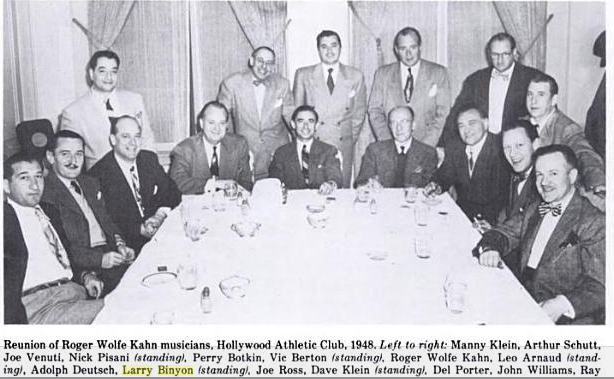
After some traveling gigs and a brief dry spell, the Pollack band began a long-term engagement at the prestigious Park Central Hotel on September 28. Pollack already had Jimmy McPartland, Benny Goodman and Jack Teagarden (who had joined in June) to contribute hot solos. By this point, he was probably willing to sacrifice some improvisational fire for a third saxophonist who could, and would, do the job. That included doubling the numerous other reed instruments that Pollack, apparently inspired by bands such as Roger Wolfe Kahn’s, wanted to show off.

Binyon probably continued to work with Beasley Smith’s band or one of several bands in Chicago while Pollack was in New York. It’s uncertain when Binyon got to New York, whether Pollack sent for him or if he just happened to be one of the many musicians starting to move to the musical epicenter, but by October 1, 1928, Binyon was back on record with the Pollack band in New York.

With three powerful soloists and the band’s tendency to rely on written arrangements, Binyon didn’t get many solos on record with Pollack. With Benny Goodman frequently doubling alto and baritone saxes, he wasn’t even the only saxophone soloist. Pollack instead capitalized on Binyon’s strength as an ensemble player.

A lush waltz like “Forever” or the muted trumpets, violins, and (most likely Binyon’s) flute on “Let’s Sit And Talk About You” might not interest jazz listeners but the records work on strictly musical terms. Attention to dynamics, ensemble balance, and lyricism are fairly consistent through even the Pollack band’s most commercial dates. Its sax section of Binyon, Goodman, and lead alto Gil Rodin play with a bright, creamy blend, for example answering the full band on the Victor recording of “Futuristic Rhythm”:

or “From Now On,” on which they achieve an especially transparent sound, right down to Binyon’s purring tenor:

Talented musicians, a steady gig at a famous venue and sheer hustle helped the Pollack band grow incredibly popular, allowing them to move onto radio work, Broadway, various touring appearances, and a few short films. The band is featured exclusively on a Vitaphone film shot on July 29, 1929. Binyon is seen in the middle of the sax section, soprano sax, clarinet, and flute impressively displayed in front of him while he plays tenor throughout:

Pollack obviously liked Binyon; he appears on every title cut under Pollack’s name (save for one small group session by “Ben’s Bad Boys” in January 1929). Yet a dependable player from a well-known band who could read, double and improvise was bound to get additional offers. Based on his discography, Larry Binyon was more than happy to work on the side.

A Sideman Soloing On The Side

Larry Binyon was talented (and fortunate enough) to have joined the Ben Pollack band just in time for its peak of popularity. He appeared on nearly every title cut under Pollack’s name, but side dates with studio pickup groups let the tenor saxophonist stretch out as more than a section player. He gets to join in with Pollack’s favored soloists on “Whoopee Stomp” under Irving Mills’s leadership, kicking off a string of solos featuring Benny Goodman, Jack Teagarden, and Jimmy McPartland:

It’s tempting to compare Binyon with these now-marquee names in terms of relaxed phrasing, catchy licks, and bluesy inflection, but Binyon’s style works on different priorities. It doesn’t display the same technical confidence but remains driving and tense. Binyon rarely stays in one place, wriggling up and down phrases, emphasizing variety over linear continuity. Binyon played hot solos: no frills, high on energy and contrast yet very personal. Binyon pushes the beat but without the agitation and gritty tone of fellow tenor player Bud Freeman or his cohorts Eddie Miller and Babe Russin. Binyon’s approach is also far removed from the dense arpeggios and metallic tone of the Coleman Hawkins school.

Binyon’s tone—husky, reedy, and distinct—could be an asset unto itself. On “Wont’cha” with Pollack, Binyon gets a paraphrase (one of his few solos of any kind with Pollack) after the vocal that shows off his warm, centered sound:

It’s not an improvised solo but it is an effective orchestral voice, probably appreciated in a dance band setting. Twenties bandleaders would occasionally use a light-toned baritone sax in a melodic role, but it sounds like Binyon’s tenor providing the broad, cello-like lead on the transition to the last chorus of “A Japanese Dream” with Mills:

“Blue Little You” includes a similar voicing in its introduction and right after the vocal. Contrasted with the standard alto lead that immediately follows, it makes an especially colorful effect on what might otherwise be dismissed as a straight dance chart:

Binyon also tosses out an improvised bridge before the ensemble conclusion. His jagged lines come across as flip commentary on the vocalist’s elongated, slightly nasal delivery. Brief solo spots like this one allow Binyon a concentrated burst to say just enough in a few measures. He snaps into the final bridge of “Little Rose Covered Shack,” once again on McPartland’s heels, this time with snaking, clarinet-like lines along with his usual rich tone and tendency to begin phrases in the upper register:

He really cuts loose on one of the few mixed dates of the Jazz Age, a freewheeling session with no less than Fats Waller. With Waller as well as Teagarden, Red Allen, Albert Nicholas, Eddie Condon, and Gene Krupa on hand, it’s no surprise that Binyon sounds like he’s having fun. He wails and moans (showing he also listened to Hawkins) through both the introduction and one chorus of “Ridin’ But Walkin’”:

On “Won’t You Get Off It Please?” Binyon sticks to declaratory, at times trumpet-like exclamations, popping out high notes and plunging into the lower register for the release:

Binyon also seems to enjoy himself on “Shirt Tail Stomp,” one of the novelty tunes that “the Pollack band without Pollack” recorded to satisfy popular demand. His big tone stays intact through all of the mooing and whinnying:

Benny Goodman “created” this number after a recording engineer overheard his band mocking a cornball jazz act. Binyon has the perhaps dubious honor of appearing on three of its five versions on record. In addition to reading, doubling, and improvising, he was apparently also a capable musical clown.

careofsaxophonedotorgBinyon could obviously fit into a variety of musical settings, from Pollack’s snappy dance band setting to looser blowing sessions and everything between; trumpeter and band organizer Red Nichols had even started hiring him on orchestral pop dates modeled after Paul Whiteman (though mostly doubling oboe and flute as well as tenor sax, with Babe Russin handling solos). He was nothing if not versatile, and a versatile musician was usually a busy one.

By the summer of 1929, Goodman and McPartland had left the Pollack band. They were more than capably replaced by Charlie Teagarden and Matty Matlock. Jack Teagarden would stay on for another three years. Yet Binyon may have seen Goodman and McPartland’s departure as a sign that the Pollack band had peaked. He might have been smarting under the same conditions that drove them out of the band; Pollack had fired two of his top soloists for showing up to work with scuffed shoes! A good reputation as a multitalented player in New York would have enabled Binyon to forego the life of a touring musician. It also would have provided more opportunities to perform in different settings.

Something convinced Binyon to leave his first regular employer and a still widely respected band. Binyon’s last session with Pollack was in January 1930. As usual, he didn’t get any solos. One of the two tunes recorded at that session, “I’m Following You” featured yet another one of the leader’s comically earnest vocals. Larry Binyon might have simply been ready for something different.


A Heavy Gig Bag And Phonebook: The Thirties

U.S. Census records state that in April 1930, Larry Binyon was renting a room in his hometown of Urbana, Illinois. Jazz discography shows that by this time, said “saxophonist” working in the industry of “orchestra” (a federal category, or Binyon’s own prestigious description?) was firmly settled in New York City.

Red Nichols Photo care of Stephen Hester

Red Nichols (care of Stephen Hester)

Binyon had stopped recording with popular bandleader Ben Pollack by mid-January 1930, but his big sound is clearly audible in the sax section of Sam Lanin’s band on several dates from March through May of that year. A careless census taker may have counted Binyon while he was in town for his mother’s wedding to her second husband. It’s also possible that the twenty-two-year-old sideman simply neglected to change his address. He was certainly busy enough: his post-Pollack resume reads like a directory of the most popular names in jazz and popular music of the time. He was also working alongside the cream of New York’s musical crop. With Lanin alone, Binyon got to record with Tommy Dorsey, Miff Mole, Manny Klein, Leo McConville, and Al Duffy.

He was also part of the veritable all-star band that Red Nichols assembled for the Broadway musical “Girl Crazy.” Binyon had already worked with the trumpeter and booker on a few sessions, including large, symphonic jazz sessions where he doubled flute, oboe, and clarinet. Composer George Gershwin wanted a jazz band for “Girl Crazy.” Nichols assembled Pollack alumni Benny Goodman, Glenn Miller, Charlie and Jack Teagarden, and drummer Gene Krupa among others. Binyon isn’t usually mentioned as being part of the group, but neither are several other players needed to fill out the band. Binyon’s familiarity with the other players as well as his ability to read and double would have made him a welcome addition to this (or any other) pit.

“Girl Crazy” opened on October 14, 1930. Nine days later Nichols recorded two tunes from the show with several members of the band, including Binyon. Binyon doesn’t get to solo on “I Got Rhythm,” and “Embraceable You” doesn’t leave much room to distinguish any of the musicians. It’s unclear whether Binyon would have preferred more solo opportunities, but he must have been more than used to an ensemble role by this point.

Binyon continued recording with Nichols and Lanin as well as Benny Goodman on some of the clarinetist and future swing powerhouse’s earliest sessions leading a big band in 1931. Goodman assigns Binyon straight, almost dutiful melodic statements on both “I Don’t Know Why” and “Slow But Sure.” He also gets a flowery flute lead on “What Am I Gonna’ Do For Lovin’?” switching to tenor sax as well as a darker tone and more swinging approach for a duet with Goodman on the last chorus:

Given Goodman’s disagreements with Pollack while in his band, it may seem ironic that both bandleaders took a similar approach to Binyon’s role. Yet by the time Goodman began leading bands, that role may not have necessarily reflected Binyon’s abilities as a soloist. Solo space on jazz and dance records grew increasingly limited during the early thirties. Depression-era listeners preferred more sedate pop arrangements to driving hot jazz numbers. Even with the most exciting soloists on hand (Goodman’s 1931 bands included the likes of Bunny Berigan and Eddie Lang), many studio dates from this period stay fairly tame. Binyon may have had a varied toolkit, but his bosses may have needed one specific device.

The joy in listening to a sideman like Binyon is not just listening for when he pops up but what he gets to do. When a band did get to cut loose, for example Roger Wolfe Kahn’s orchestra performing “Shine On Your Shoes,” Binyon could throw down a hot solo on tenor sax:

or use his brawny sound to heat up even straight melodies like “Sweet And Hot” with Nichols:

Binyon’s flute could add the requisite touch of sweetness and refinement as needed. It could also bring an unusual color to up-tempo numbers like “Walkin’ My Baby Back Home” with the Charleston Chasers:

The combination of the Binyon’s flute with ensemble syncopations and Krupa’s drums points to more than just a sweet context. Musicologist and historian Gunther Schuller mentions Binyon’s flute as well as Glenn Miller’s arrangement as examples of a sound “well beyond the normal dividing lines between commercial dance music and late twenties jazz.”

Along with Albert Socarras (who had soloed on flute as early as 1929 on “Have You Ever Felt That Way?” with Clarence Williams) and Wayman Carver, Binyon was one of the first to bring the flute into a jazz context. His smoky introduction to the Boswell Sisters’ “Sentimental Gentleman From Georgia” must have made musicians and bandleaders reconsider the possibilities of this instrument in a jazz setting:

In addition to the Boswells, Binyon accompanied vocalists Grace Johnston, Phil Danenberg, Dick Robertson, Chick Bullock, Mildred Bailey, and Ethel Waters during the early thirties. He was usually backing these singers alongside members of the same circle of top-notch New York musician that he would have known very well by this point. He impressed Tommy and Jimmy Dorsey enough to land work with their band. At this point the Dorsey Brothers Orchestra was a smaller studio band, allowing Binyon room to solo on instrumentals such as “Mood Hollywood”:

and “Old Man Harlem”:

It’s unclear exactly what type of work Binyon landed outside of the studios during the early thirties. Arranger Don Walker recalls Binyon playing in the band for Hit Parade of 1933 as well as “first (legitimate) flute” in the 1935 musical Maywine. Walker and his copyist Romo Falk excitedly noted Binyon’s presence (expressing similar accolades for Binyon’s section mate, Artie Shaw).

Binyon played with Paul Whiteman’s orchestra for one month in 1936 before moving onto radio work, including jobs under Red Nichols’ direction, as well as other work outside of an expressly jazz context. It was around this time that Binyon also married his first wife, Polly. Seven years younger than Larry, she was born in Puerto Rico and living in Syracuse by 1935, before marrying Larry at some time before 1940. The steadier work and more regular hours of radio may have eased his transition to married life, or vice-versa. Binyon even had time for a trip to Bermuda (though it is unclear whether it was for work, honeymoon or one last bachelor outing).

Binyon also did sax section work on jazz dates with Frank Trumbauer, Joe Venuti, Bob Zurke, and Dick McDonough during the mid to late thirties. McDonough was an experienced, well-connected guitarist who had his pick of sidemen for the few sessions he ever directed during 1936 and 1937. Binyon was on hand for two of McDonough’s dates, getting in some paraphrases as well as a quick-fingered, slightly more modern solo on “He Ain’t Got Rhythm”:

At this stage, Binyon had the reputation as well as the chops to work in a variety of settings alongside some of the best players in New York. He even found the time to change his address: by 1940, one Larry Binyon, now a “musician” in the “orchestra” industry, was officially living in New York City.

1940 US Census per AncestryDotCom

Talent, Opportunity And Choice: Final Years and Legacy

The All Music Guide states that Larry Binyon “needed someone to hold the door open for him when he arrived at a recording studio or radio broadcast date.” It’s an unsubstantiated anecdote but an accurate image. By the early thirties, Binyon was, in violinist Harry Hoffman’s words, one of New York’s “first-call” studio musicians who could “play anything.” With his move to full-time radio work in 1936, Binyon would have been playing his tenor sax, flute and oboe, probably clarinet (and possibly the “few fiddle credits” mentioned by AMG writer Eugene Chadbourne) in any number of musical settings.

From The Big Band Almanac by Leo Walker

While trombonist Larry Alpeter adds, “most of these [first-call] guys had fine jazz skills,” Binyon’s appearances on jazz records and already sparse solo spots dried up by the mid-forties. He is one of two tenors on Billie Holiday’s 1944 Decca sessions with Toots Camarata’s orchestra, but it’s unclear whether Binyon or Paul Ricci handle the few brief solos on these recordings. Binyon is strictly an ensemble player on his final jazz session, with Jess Stacy’s big band in June 1945.

After close to twenty years of having his hands literally and figuratively full in New York City, Binyon moved to Los Angeles in 1946. Binyon worked once again with Nichols in California, this time in Bobby Dolan’s orchestra on The Ford Show (starring Dinah Shore) from September 18, 1946, through June 11, 1947. Yet Binyon had also relocated to work as a recording contractor for the American Federation of Musicians.

If Binyon was looking to segue into a “behind-the-scenes” role, the paucity of documents from this period indicates that he got his wish. Drummer Johnny Blowers does recall a February 8, 1950 session with Phil Harris organized by Binyon, but Binyon’s activities as an organizer are otherwise largely unrecorded. A new home, warmer climate, and slower pace on the West Coast were probably a welcome change for him. It also would have allowed him more time with his son Claude (born in 1940 and named after Larry’s father). Blowers actually secured the Harris date when he ran into Binyon in New York, who was on a vacation of all things.

Blowers also notes that Binyon was still playing with West Coast bands, though it must have been less hectic than the New York scene. Binyon frequently worked with Phil Harris in Los Angeles, previously co-writing “Bump On The Head Brown” for the entertainer along with Chauncey Morehouse and Frank Signorelli (now that would have been a trio!).

Binyon worked the 1952 and 1953 seasons of the Phil Harris and Alice Faye radio show alongside Nichols in Walter Scharf and Skippy Martin’s bands, recorded five numbers with Harris on December 27, 1953, for RCA Victor, packed his gig bag(s) for a tour of Asia in the early fifties and booked sessions for fellow players: it all must have been a breeze for this seasoned musician.

for Phil Harris care of discogsdotcomHe seems to have stopped playing completely by 1955. Based on Binyon’s track record, that must have been by choice rather than necessity. His story fades even further after that decision: marriage to a second wife in Nevada in 1962 and then a third wife in California in 1966, followed by a divorce two years later. Larry Binyon passed away on February 10, 1974 (followed by his brother Hugh in 1978 and then son Claude in 1999, both of whom died childless).

Other than personnel listings and occasional mention by his contemporaries, most of whom are now also gone, Larry Binyon has faded into the background behind more famous names. It’s easy to make a comparison between his legacy and his work, but that would dismiss the talent that earned Binyon such fast company in the first place. How else does one get to play with everyone from Tommy Dorsey to Benny Goodman to Billie Holiday and Fats Waller?

Binyon’s versatility and sheer ubiquity may have actually helped force him into the background. Had he stuck to one or even two instruments, it might have been easier for bandleaders and listeners to remember him. Yet jumping between dozens of dance bands, jazz groups, studio ensembles, and radio orchestras while covering a multiplicity of parts as the schedule demanded and always being on hand to make every arranger’s whim seem like an easy task, it was easy to see that Binyon was capable of anything but probably harder to associate him with one thing.

There are enough accolades to show that he wasn’t just any sideman, yet not enough solos to determine what kind of a jazz musician he was (in a world where “jazz” is synonymous with “soloist,” anyway). Depending on how one hears his music, Binyon either lacked the ability or opportunity to inspire followers (though musician and writer Digby Fairweather detects Binyon’s influence in Georgie Auld’s earliest performances). In the end, it’s hard to depict him as a “jazz artist” and inaccurate to dismiss him as some studio drone.

Depending on how one reads his story, Larry Binyon is either a neglected musician or a person who made a life’s work doing something he was very good at and presumably enjoyed very much. Whatever the interpretation, his ability as well as his impact on jazz and/or/a.k.a. American popular music is undeniable. He was right there next to some of music’s greatest names, as much by his choice as theirs. Maybe Larry Binyon was simply exactly where he wanted to be.

LarryBinyonCareOfDiscogsDotCom

Tagged , , , , , , , , , , , , , , , , , , , , , , , , , , , , , , , , , , , , , , , , , , , , , , , , , , , , , , , , , , , , , , , , , , , , , , , , , , , , , , , , , , , , , , , , , , , , , , , , , , , , , , , , , , , , , , , , , , , , , , , , , , , , , , , , , , , , , , , , , , , , , , , , , , , , , , , , , , , , , , , , , , , , , , ,

Mark Berresford And All That Syncopated Music

CareOfUniversityPressOfMississippi

Mark Berresford has made countless hours of music possible for listeners across the globe. It’s not just his personal library of “syncopated music,” a century’s worth of ragtime, jazz and everything between, collected throughout his life and shared with the most respected providers of early jazz reissues. Berresford’s lifelong love/study of the music has also translated into pages upon pages of informative, insightful liner notes.

Even if you already own the complete Johnny Dodds’s Black Bottom Stompers, Retrieval’s Definitive Dodds album is worth purchasing just for Berresford’s commentary. If you’re downloading Timeless Historical’s From Ragtime To Jazz series, you’re missing out on his meticulous yet breezy annotation; ditto for Frog’s Johnny Dunn disc and anything else with Berresford in the credits.

He began by collecting music as a teenager in his native England, also starting to write around that time. In addition to liner notes for several labels, for twenty-four years Berresford has written for Vintage Jazz & Blues Mart (which celebrated its sixtieth anniversary in 2012, making it the oldest continually-published jazz magazine in the world). Berresford’s biodiscography of clarinetist Wilbur Sweatman received an Association for Recorded Sound Collections Award in 2011, and his liner notes to the Rivermont Records CD Dance-O-Mania: Harry Yerkes and The Dawn Of The Jazz Age, 1919-1923 were nominated for a Grammy Award in 2009. Mark does all of this while also selling “records, gramophones and associated ephemera” from his store in Derbyshire.

Berresford has not only made rare music available to a wide audience, he’s made supposedly rarefied music make sense to all those listeners. The collector, historian and writer has helped me understand and enjoy this music since I first started listening to it, so I was thrilled to speak with him and find out more about his beginnings and hopes for the future.

CareOfJazzhoundDotNetAndrew Jon Sammut: What was your entryway into collecting early jazz?

Mark Berresford: I started collecting 78s when I was about eleven or twelve years old. I had been brought up with vintage music around me: my grandparents had a large radiogram full of music by Fats Waller, the Dorsey brothers, Glenn Miller and many others.

AJS: What drew you to “that” music, as opposed to more contemporary forms of jazz or popular music, and how did you first start writing about it?

MB: I had grown up with “old” music and it seemed perfectly normal to me. As far back as eight or nine years old, I was taking records by Henry Hall’s BBC Dance Orchestra or Tommy Dorsey into school on Monday mornings, when we were encouraged to bring along our favorite records. This was the time of The Beatles, The Rolling Stones and The Dave Clark Five!

As for writing, I started writing on early jazz when I was about sixteen years old. My English teacher at school was a keen jazz fan and played bass, and he encouraged me in my scribbling. There was so little about pre-1923 jazz available, either on LP or in books. I had read Gunther Schuller’s Early Jazz in the school library (can you imagine a book like that in a school library nowadays?), and I wanted to share what I was enjoying and discovering about this music.

AJS: And now we have whole companies devoted to reissuing this music, such as Retrieval, Frog and Jazz Oracle, and you have written extensive liner notes for these labels.

MB: Retrieval was born out of Fountain Records in the seventies and founded by Norman Stevens, Ron Jewson, Chris Ellis and John R.T. Davies, expressly to produce sensibly programmed reissues of the highest quality. Dave French started Frog in the early nineties with the same purpose, with Davies also doing the transfers. Jazz Oracle was founded in the mid-nineties by Canadians Colin Bray (an expatriate Englishman) and John Wilby, once again with Davies, to do the same sort of thing with longer, glossier liner notes.

AJS: How did you first get involved with these reissue labels?

MB: I first got involved with reissues around 1978 or 79, when I was asked by Norman Stevens to write the liner notes for an LP of Gene Fosdick’s Hoosiers/Broadway Syncopators. I was twenty-one years old at the time. Apparently I already had a reputation as an early jazz champion, via my collecting taste as well as the articles I wrote in magazines such as The Gunn Report.

I really got involved in the reissue scene in the early nineties, when I became very friendly with John R.T. Davies and Chris Ellis at Retrieval. I had known both of them for years, but as my collection grew they realized that I was sitting on a lot of material they could use, either as whole projects or to fill in the gaps of their collections for a project. I used to go down to John’s place with a boxful of my 78s for him to make transfers for ongoing projects.

As many of the projects centered on material I knew and loved, I also became the choice to write the liner notes. I suppose that my years of writing magazine articles and editing VJM’s Jazz & Blues Mart (twenty-four years now) made me an obvious choice. Of course, I also got to suggest projects that interested me too, and am still doing so!

AJS: What criterion do you use when suggesting a project? Do you see an overarching mission for these reissues?

MB: I want to see a new audience exposed to unfamiliar or out of favor music. I also want to get established collectors and fans to go back and listen to material they had discounted, or perhaps never even bothered to listen to.

A good case in point is the four-volume set From Ragtime To Jazz on Timeless. I chose tracks that went back to 1896, and material recorded not only in New York City but also in Europe; many American collectors don’t realize the wealth of syncopated music recorded by American artists in Europe, many of whom never recorded in their homeland. An American music teacher told me that he uses these as a core part of his teaching on American popular music history.

I was also actively involved with Rainer Lotz and the German record company Bear Family’s astonishing Black Europe project. It reissued over two thousand sides made in Europe by Black performers, all recorded before 1926! For instance, Black American singer Pete Hampton was the most prolific African American singer until Bessie Smith, and he died in 1916 without ever making a record in the United States! I supplied many items from my collection. The final package was forty-four CDs, plus a three hundred page hardbound book that included photos of every record label and biographies of the artists involved. It was limited to five hundred numbered sets worldwide.

CareOfRivermontRecordsDotComAnother good example is the Harry Yerkes/Happy Six CD set on Rivermont: obscure material but an important developmental link. It was nominated in 2009 for a Grammy Award! That same determination to get recognition for overlooked performers also drove me to write my [ARSC award winning] bio-discography of clarinetist Wilbur C. Sweatman.

AJS: What do you think are some of the obstacles to getting this music heard?

MB: The biggest obstacles in the past were the companies themselves, who always tended to be conservative, and wanted tried-and-tested material that guaranteed sales. Timeless was brave when it issued From Ragtime To Jazz, but the set has sold well.

Of course Archeophone has totally moved the goalposts, reissuing the most obscure material with a “to hell with the sales figures, let’s get people listening to this material!” attitude, which of course chimes with me 100%. Needless to say Rich Martin and Meagan Hennessy are good friends now and we regularly work together. I am discussing an idea for a project with them as we speak.

So much of his music points to things-to-come musically. We can hear themes, ideas, and styles that will be picked up and carried and changed, and it is always better to know where one is coming from. People are surprised when they hear Gene Greene scat singing in 1910, or Black singer Ashley Roberts scatting in London in 1915.

Another obstacle is that often little or nothing is known about a particular artist. When I wrote the liner notes for the Frank Westphal Orchestra CD on Rivermont, there was virtually nothing in print about him (other than Sophie Tucker’s one-sided reminiscences). I had to go back to square one, but I think people will now know a little more about Frank.

AJS: So, what does “square one” look like (for us laymen)?

MB: Birth records, Census records, World War One and World War Two records, newspaper archives, photo libraries, searching eBay for photos or sheet music, etc. A lot of work goes into it, and a lot of burnt midnight oil!

AJS: Have you ever come to any total dead-ends, or is it just a matter of time, energy and patience until you find something out about the artist?

MB: Time will out! I’ve come to many apparent dead ends, but a hunch or pure luck will frequently come into play. It’s just a case of keep plugging away. I won’t admit defeat, simple as that! My website has been a boon: I upload photos of old bands and performers, and you would be amazed how many relatives find me this way!

AJS: Which performers would you like to see get more attention in jazz histories or reissues?

MB: To paraphrase Joe Venuti when he was asked what his favorite record was, whomever I’m working on right now! For example, I have recently been working with Bryan Wright from Rivermont on a Paul Specht Orchestra CD and my old friend sound restorer Nick Dellow was here doing transfers, so I’ve been immersing myself in the life of Mr. Specht!

AJS: Sort of a dance band with jazz as a seasoning rather than a main course?

MB: Correct, but careful sifting of his large output reveals some hidden gems, and again, not all made in the United States. And some surprises too. For instance, a number of the 1928 and 1929 sides have great scoring for clarinet and/or sax choruses, and when you factor in Don Redman’s little-noted quote that he enjoyed arranging for Paul Specht, one realizes that these are Don Redman arrangements! Also, don’t forget the remarkable Frank Guarente on trumpet, who swapped music lessons with King Oliver in the teens!

PaulSpechtBandCareOfWikipedia

AJS: That brings us to tricky subject of labels. Do you describe most of this music as “early jazz, hot dance, popular music, etc.” and do you see any difference?

MB: I prefer the term “syncopated music” because it transcends the rather artificial boundaries that the other terms you mention imply. It can describe Edgar Cantrell and Richard Williams’s amazing London 1902 banjo/mandolin and vocal recordings, a crossover between minstrel, ragtime, folk and blues. It also includes material by James Europe’s Society Orchestra, George Fishberg’s stomping piano accompaniments to the Trix Sisters on their 1921 recordings and Ory’s Sunshine Orchestra equally well.

I think “difference” is a modern concept. At the time it was all the same, just as Paul Whiteman was the “King of Jazz” in the eyes of John Q. Public!

AJS: It seems many music historians use the concept of difference to demarcate what music is worth “saving” and what can go marching into obscurity. For you, what determines what should be preserved and what can be forgotten after a century?

MB: Difficult. I think that the music has to speak to people listening outside its time, or at least have the opportunity to speak to them. Straight dance music may have its enthusiasts, but it ultimately belongs in its time, with little or nothing to say to the present generation other than a feeling of nostalgia a la “Pennies From Heaven.” In that respect, acoustically recorded dance music fares even less well. That’s not to decry that music, but it doesn’t strike a chord for me.

That being said, I am also a keen fan of British music hall records, and recordings of original cast theater performers; they can shed amazing light on the time in which they were made. For instance, much of the revue material recorded in England during World War One took a very jaundiced view of the people running the war, quite contrary to the “keep the home fires burning” brigade that contemporary observers now associate with the period. So in that respect, that music is very valid now because it has a story to tell which is contrary to received wisdom.

AJS: As for the material labeled “jazz” or music that you feel influenced or was influenced by jazz, how would you characterize jazz from the period before Charlie Parker and Dizzy Gillespie, or even before Duke Ellington and Benny Goodman?

MB: I think of “jazz” from this period as rhythmically driven, multifaceted, polyphonic, creative, joyous and sometimes a little scary. If there are a few solos to liven things up, even better!

AJS: “Scary?”

MB: Yes, I thought you might like that! What I mean by “scary” is dark and brooding, but also the fact that these artists were writing new, previously unwritten rules as they went along. Is Sidney Bechet really going to get back into line with the rest of the band at the end of “New Orleans Hop Scop Blues?” Isn’t Louis Armstrong on a different planet from the rest of Erskine Tate’s band on “Stomp Off, Let’s Go?”

AJS: Do you think jazz has kept that “scariness?”

MB: No. I lose interest when posturing and self-importance become the norm.

AJS: Are you characterizing contemporary jazz that way?

MB: Yes, and a lot of non-jazz too. Can you really listen to “Stomp Off, Let’s Go” without the hairs on your arms standing up? I can’t.

AJS: If so much contemporary jazz lacks that hair-raising quality, why don’t more contemporary jazz listeners appreciate “Stomp Off, Let’s Go” or “Knockin’ A Jug?”

MB: I think unfamiliarity and un-coolness are important factors. Yet I also think that when more material is presented in an appropriately packaged way i.e. beautifully transferred, without over-processing (which is guaranteed to turn new listeners off), the neophyte listener is more likely to come back for more. For the past few years I’ve been widening the tastes of a younger guy who came to our music via forties Jump music. He is now collecting the State Street Ramblers, Fess, Lem Fowler and Clarence Williams!

What is quite interesting is that a younger generation is getting interested in early jazz that has never been swayed by the writings of some of the more entrenched critics and authors, and are thus coming at this music with open ears and minds.

AJS: So do you see your work as chipping away at the unfamiliar and uncool, or will this music always be an esoteric pursuit?

MB: Well it beats counting how many angels can sit on the point of a needle! Personally I’ve never worried about such stuff. I remember hearing Doc Cooke’s Dreamland Orchestra for the first time at age fifteen or sixteen, and being floored by the power of the band (particularly cornetist Freddie Keppard). I needed to share this, so I phoned a school friend who was very into Led Zeppelin, and played “Here Comes The Hot Tamale Man” for him over the phone: not to him, but at him.

“Now THIS is music,” I screamed! He must have thought I was insane, but who cares? The music is all that matters.

Tagged , , , , , , , , , , , , , , , , , , , , , , , , , , , , , , , , , , , , , , , , , , , , , , , , , , , , , , , , , , , , , , , , , , , , , , , ,

A Sideman Working On The Side: Larry Binyon’s Solos

This post is part of a series covering the music and life of saxophonist Larry Binyon.  You can read  the earlier parts here, here and here, but this one has much less biography and a lot more music, so please feel free to dive right in!  A few of the titles listed do have alternate takes and I do look forward to covering those in the future, but for now I wanted to stick to (what I consider) the best examples of Binyon’s playing.  I hope you enjoy them.

Larry Binyon was talented (and fortunate enough) to have joined the Ben Pollack band just in time for its peak of popularity. He appeared on nearly every title cut under Pollack’s name, but side dates with studio pickup groups let the tenor saxophonist stretch out as more than a section player. He gets to join in with Pollack’s favored soloists on “Whoopee Stomp” under Irving Mills’s leadership, kicking off a string of solos featuring Benny Goodman, Jack Teagarden and Jimmy McPartland:

It’s tempting to compare Binyon with these now-marquee names in terms of relaxed phrasing, catchy licks and bluesy inflection, but Binyon’s style works on different priorities. It doesn’t display the same technical confidence but remains driving and tense. Binyon rarely stays in one place, wriggling up and down phrases, emphasizing variety over linear continuity. Binyon played hot solos: no frills, high on energy and contrast yet very personal. Binyon pushes the beat but without the agitation and gritty tone of fellow tenor player Bud Freeman or his cohorts Eddie Miller and Babe Russin. Binyon’s approach is also far removed from the dense arpeggios and metallic tone of the Coleman Hawkins school.

Binyon’s tone, husky, reedy and very distinct, could be an asset unto itself. On “Wont’cha” with Pollack, Binyon gets a paraphrase (one of his few solos of any kind with Pollack) after the vocal that shows off his warm, centered sound:

It’s not an improvised solo but it is an effective orchestral voice, probably appreciated in a dance band setting. Twenties bandleaders would occasionally use a light-toned baritone sax in a melodic role, but it sounds like Binyon’s tenor providing the broad, cello-like lead on the transition to the last chorus of “A Japanese Dream” with Mills:

“Blue Little You” includes a similar voicing on its introduction and right after the vocal. Contrasted with the standard alto lead that immediately follows, it makes an especially colorful effect on what might otherwise be dismissed as a straight dance chart:

Binyon also tosses out an improvised bridge before the ensemble conclusion. His jagged lines come across as flip commentary on the vocalist’s elongated, slightly nasal delivery. Brief solo spots like this one allow Binyon a concentrated burst to say just enough in a few measures. He snaps into the final bridge of “Little Rose Covered Shack,” once again on McPartland’s heels, this time with snaking, clarinet-like lines along with his usual rich tone and tendency to begin phrases in the upper register:

He really cuts loose on one of the few mixed dates of the Jazz Age, a freewheeling session with no less than Fats Waller. With Waller as well as Teagarden, Red Allen, Albert Nicholas, Eddie Condon and Gene Krupa on hand, it’s no surprise that Binyon sounds like he’s having fun. He wails and moans (showing he also listened to Hawkins) through both the introduction and one chorus of “Ridin’ But Walkin’”:

On “Won’t You Get Off It Please?” Binyon sticks to declaratory, at times trumpet-like exclamations, popping out high notes and plunging into the lower register for the release:

Binyon also seems to enjoy himself on “Shirt Tail Stomp,” one of the novelty tunes that “the Pollack band without Pollack” recorded to satisfy popular demand. His big tone stays intact through all of the mooing and whinnying:

Benny Goodman “created” this number after a recording engineer overheard his band mocking a cornball jazz act. Binyon has the perhaps dubious honor of appearing on three of its five versions on record. In addition to reading, doubling and improvising, apparently he was also a capable musical clown.

careofsaxophonedotorgBinyon could obviously fit into a variety of musical settings, from Pollack’s snappy dance band setting to looser blowing sessions and everything between; trumpeter and band organizer Red Nichols had even started hiring him on orchestral pop dates modeled after Paul Whiteman (though mostly doubling oboe and flute as well as tenor sax, with Babe Russin handling solos). He was nothing if not versatile, and a versatile musician was usually a busy one.

By the summer of 1929, Goodman and McPartland had left the Pollack band. They were more than capably replaced by Charlie Teagarden and Matty Matlock. Jack Teagarden would stay on for another three years. Yet Binyon may have seen Goodman and McPartland’s departure as a sign that the Pollack band had peaked. He might have been smarting under the same conditions that drove them out of the band; Pollack had fired two of his top soloists for showing up to work with scuffed shoes! A good reputation as a multitalented player in New York would have enabled Binyon to forego the life of a touring musician. It also would have provided more opportunities to perform in different settings.

Something convinced Binyon to leave his first regular employer and a still widely respected band. Binyon’s last session with Pollack was in January 1930. As usual, he didn’t get any solos. One of the two tunes recorded at that session, “I’m Following You” featured yet another one of the leader’s comically earnest vocals. Larry Binyon might have simply been ready for something different.

The next Larry Binyon post will explore his work as a very busy freelancer during the early thirties, and include music with the Boswells, Dorseys, a young clarinetist named “Benny Goodman” first getting into the bandleading business and others.

Tagged , , , , , , , , , , , , , , , , , , , , , , , , , , , , , , , , , , ,

Modern Music “Whoops And Hollers” Once More

postercareofabbevilledotcomPaul Whiteman’s “An Experiment In Modern Music” at Aeolian Hall on February 12, 1924 is well known for the premiere of George Gershwin’s Rhapsody In Blue. Yet it also placed an American popular music ensemble in a concert setting, at a venue typically associated with classical artists, to perform several original works that challenged preconceptions of both jazz and classical (fourteen years before Benny Goodman’s Carnegie Hall concert and several decades before “crossover” entered the lexicon).

Critics have weighed in on the merits of the rest of the program as well as Whiteman’s supposed aim to refine jazz. Now there’s an opportunity to hear all of the music live and judge for oneself.

To celebrate the ninetieth anniversary of this event in American music, Vince Giordano And The Nighthawks will perform the entire program, with conductor Maurice Peress directing the band on his meticulously researched transcription of Rhapsody In Blue, featuring pianist Ted Rosenthal.

Peress’s transcription draws upon several original sources as well as insights from members of the Whiteman orchestra. He notes that “…during the [Whiteman band’s] road tour, which immediately preceded the recording sessions, some of the jazz embellishments added by the players or Gershwin became ‘frozen,’ such as the little bundles of turning notes that flavor a phrase and klezmer-like whoops and hollers that clarinetist Ross Gorman introduced here and there, not only into the familiar opening.” On February 12, 2014 at New York City’s Town Hall, concertgoers can experience a performance of Gershwin’s work “chock-a-block with details never written down in the score or parts.”

The audience also gets to enjoy Whiteman’s own dance music performed with the Nighthawks’ distinct blend of energy and understanding, as well as pianist Jeb Patton playing Zez Confrey’s whirlwind piano pieces.  If you are in or around New York City on February 12 (and let’s face it, anywhere on Earth might as well be around New York City), don’t miss this music.

Tickets and more information are available online here.

careofvincegiordano

Tagged , , , , , , , , , , , , , , , , , , , , , , , , , , ,

A Stan King Playlist

Photo Care of @onlyapaprmoon

Photo from Timeless CD CBC 1-090 courtesy of @onlyapaprmoon

Like most early jazz drummers, Stan King was not well served by technology. He first appeared on hundreds of sessions with the California Ramblers, including the band’s numerous offshoots for different labels, starting in the early twenties. Acoustic recording techniques at that time limited the equipment that drummers could use, and the technology wasn’t kind to what remained of the kit. King does manage to burst out of the Five Birmingham Babies (a.k.a. the California Ramblers) on “Arkansas” and bang out some springy drum rudiments on Ray Kitchingham’s banjo:

Unfortunately, outbursts like this one were rare. King didn’t use the standard acoustically sanctioned percussion (like cymbals and blocks) as much as his contemporaries Zutty Singleton, Baby Dodds, and Chauncey Morehouse. So despite all the records, it’s hard to hear what or how King was playing early on his career. Either way, it got him plenty of work! He must have been doing something worth hearing.

Based on slightly later recordings, it involved plenty of snare drum. Jazz drumming now often tends to emphasize metal as the primary beat maker. Yet as “Broken Idol” with the Ramblers shows, King could move a band with “just” drum skins. It’s a pity he was so skilled with what amounted to kryptonite for most recording engineers of the twenties:

Aside from a few cymbal crashes, the “exotic” blocks, and tom-toms, King’s main rhythmic medium here is his snare and bass drum. He keeps up a simple but buoyant bounce alongside Tommy Felline’s banjo and then steps out behind Pete Pumiglio’s red hot alto sax solo. The brushes are pure momentum, more than compensating for Ward Lay’s slightly ponderous tuba. There’s none of the military-style heft that so many historians associate with prewar, snare-centric jazz drumming.

King’s work with Frank Trumbauer’s orchestra demonstrates his light but propulsive touch on drum heads while never drawing too much attention to the wheels moving the band. “Futuristic Rhythm” includes a head-bobbing rhythm in the first chorus and percolating accompaniment to the leader’s vocal and cymbals behind Bix Beiderbecke:

King’s airtight press rolls and last chorus backbeat on “I Like That” (a.k.a. “Loved One“) are simple, impeccably timed, and very effective:

Listening to King nearly 60 years later, renowned drummer Mel Lewis pointed to King’s “clean” style with definite praise. A crisp, precise, and utterly unobtrusive approach defines King’s style more than any part of the drum set. He was above all an ensemble player who rarely soloed but always made sure that the band was “well fed” (to paraphrase bass sage Walter Page describing the role of the rhythm section).

With the Charleston Chasers, King leaves most of the rhythmic heavy lifting on “Loveable and Sweet” and “Red Hair and Freckles” (what were these guys thinking about on this session?) to pianist Arthur Schutt and bassist Joe Tarto:

Dancers and jazz aficionados may not be listening for King’s sizzling brushes and tapping rims or how his drums click in with Tarto’s bass to produce a deliciously buzzy sonority or for his simple but firm beat. Listening to those touches reveals how subtly King could color and catalyze a band. It also points to an attention to detail and a knack for musical nuance that might not be heard could be felt. For example, while many drummers use press rolls, and King relied on them throughout his career, the way that he loosens his press rolls up behind Tommy Dorsey’s trumpet solo on “Hot Heels” with Eddie Lang makes a difference:

Audio wizard, historian, and trombonist David Sager recalls an “old-time drummer” he met at a gig in California “who nearly shouted when he said, ‘Stan King had the best press roll in the business!’” King’s press rolls with none other than Louis Armstrong on Seger Ellis’ “S’Posin” might not impress on their own, but Armstrong scholar Ricky Riccardi explains that “Armstrong liked loud, emphatic drumming, and he obviously dug what King was putting down.”

[Listen to “S’Posin” via Riccardi’s outstanding blog here, and subscribe while you’re at it.]

According to Richard Sudhalter, King didn’t read music. His “natural drive and quick ear” were enough to make him one of the most in-demand drummers in New York during the twenties and thirties, performing with Paul Whiteman, Jean Goldkette, the Boswell Sisters, Ben Selvin, the Dorsey Brothers, and Benny Goodman among others. A session directed by bass saxophonist Adrian Rollini finds King with the cream of the New York jazz crop at that time on standards such as” Sugar” and  “Davenport Blues”:

On “Somebody Loves Me,” King lays out behind George Van Eps’s solo, which allows the guitar to get heard and changes up the ensemble texture, but digs in behind Goodman’s clarinet and Arthur Rollini’s tenor saxophone while easing back behind trumpeter Mannie Klein and trombonist Jack Teagarden. It’s a model of sensitive, rhythmic jazz drumming (or “dance band” drumming, depending on one’s preferred pigeonhole):

King could also turn up the heat on his own. On “The Man From The South” with Rube Bloom, he locks in with Adrian Rollini, tossing out fast snappy fills and bearing down just a little harder behind Goodman before making room for Rollini’s solo:

On “Here Comes Emily Brown”—again with the Charleston Chasers but without Joe Tarto’s booming slap bass—King add a sizzle to his shuffle behind Tommy Dorsey’s trombone while his cowbell accents practically kick Benny Goodman from behind. Fills and backbeat on the out chorus also boot the ensemble:

King even gets some spotlight in a call and response episode with the ensemble on “Freeze and Melt” with Lang:

Occasionally, King would get away from a steady beat and toss out unexpected accents and syncopations, for example early on his career behind Bobby Davis’ alto solo on “That Certain Party” with the Goofus Five (a.k.a. the California Ramblers):

or his offbeat rim “bombs” behind Jimmy Dorsey’s alto on “You’re Lucky To Me”:

Yet it’s all within the context of the band. Record after record shows King to be a clean, precise, utterly musical drummer. His preferred instrumentation may have limited his recorded legacy, and his unflashy style may have hindered his historical one. Singer Helen Ward, speaking about King’s tenure with Benny Goodman’s band, said “we called him strictly a society type of musician. Everything he played was ‘boom-cha, boom-cha.’ There was no fire there.” Goodman described King as “merely adequate.”

The entry for King in the Encyclopedia of Popular Music describes “an exceptionally good dance band drummer with meticulous time [whose] jazz work always left something to be desired. Listening to, for example, Goodman’s recordings in late 1934 will reveal how King’s playing never lifts the band in the way Gene Krupa did when he took over as drummer…” John Chilton describes Louis Armstrong’s “I’m Putting All My Eggs In One Basket” as a “typical example of [King’s] somewhat foursquare playing:

King isn’t Krupa, Dodds, Sid Catlett (or for that matter Elvin Jones), but it’s easy to imagine any of those players taking the same approach that King does given the thin material, flimsy arrangement, and the fact that this is really Armstrong’s show. Riccardi astutely points out King’s “tasty” accents during Armstrong’s opening trumpet chorus and the fact that “relaxation is the key” here. There’s a difference between playing stiffly and playing appropriately, a difference King was more than experienced enough to understand.

In the stylistic wake of louder, better-recorded, and busier drummers, it is easy to overlook someone like King, who performed an essential role seamlessly and without drawing attention to his work. What some overlook, others celebrated. Drummer Chauncey Morehouse would praise King for his solid time years after his colleague’s death. When Morehouse led his own date playing his patented N’Goma drums, he chose King to handle traps duty.  Fud Livingston thought King was “the world’s greatest drummer!” Saxophonist and historian Loren Schoenberg noted how King continued to get work despite his well-known status as a “fall-down drunk.” It didn’t seem to matter: King got the job done.

Jazz historian Scott Yanow, who credited King for his “fresh” sound, explains that King’s alcoholism finally did get the best of him. King eventually took a low-key job with former California Ramblers sideman Chauncey Grey before fading from attention and passing away in 1949. King made his last recordings ten year earlier, with pianist (and fellow victim of alcoholism) Bob Zurke. “I’ve Found A New Baby” wasn’t the last thing King recorded but it provides explosive closure:

Fud Livingston’s arrangement gives King and the rest of the band plenty of room. King is a force of nature, crisp and light as always but distinctly forward in the mix, perhaps the influence of what Krupa and Chick Webb were bringing to the table at the time. King still remains his own man, with press rolls in first chorus and rim shots and backbeats egging on Zurke’s contrapuntal flurries and Sterling Bose’s trumpet. At a time when most drummers were emphasizing cymbals and a steady horizontal flow, King stuck to skins and a charging but tight vertical feel. He had something unique to contribute and put the needs of the band first. That certainly sounds like a jazz drummer, or maybe a just a good band drummer, but definitely a drummer worth hiring and hearing.

Tagged , , , , , , , , , , , , , , , , , , , , , , , , , , , , , , , , , , , , , , , , , , , , , , , , , , , , , , , , , , , , , , , , , , , , , , , , , , , , , , , , , , , , , , , , , , , , , , , , , , ,

Random Thoughts On The Sax Section

VincentLopezSaxSection1926VerticalIn trying to describe what makes Bennie Moten’s saxophone section so wonderfully different from any other in the continuum, I started to think about what jazz listeners have come to expect from the entity known as a “saxophone section.” The following began as an introduction for the Moten posts, went in its own direction and then turned into some random thoughts on this very important part of the jazz orchestra. The reader may be able to extract some larger point, or at the very least enjoy the music and photos.

jazz-consortium-bandleaderblogdotcomPaul Whiteman called the saxophone section the string section of a big band. There’s more to his comparison than plush harmonies and fast scales. Just as the string section of a classical orchestra identifies the group as another link in a particular musical tradition, while distinguishing the best orchestras as unique members of that particular musical community, so does the saxophone section of a jazz big band. That’s not to diminish the distinct sound of a particular brass or rhythm section. Yet what instrument signifies “classical” like the violin, or “jazz” like the saxophone?

http://archive.org/details/BenPollack-91-100Think of Benny Goodman’s well-drilled but warm foursome under Hymie Schertzer’s transparent lead, or Earle Warren’s searing alto atop the twin tenors of Lester Young and Herschel Evans, with Jack Washington anchoring it all on baritone. Duke Ellington’s saxophone sections patched together various reeds in different combinations yet remained instantly recognizable despite, or because of, their versatility. Whiteman wasn’t just commenting on notes in a score or crafting good copy: how much does a single note from this instrumental part reveal about the musical whole?

Walter Thomas, Andrew Brown Arville Harris, Eddie Barefield in 1934The modern saxophone section lives and thrives by concerted blend and drive as well as the power of its soloists. Woody Herman’s “four brothers” section is best known for solos by Stan Getz, Zoot Sims, Herbie Steward, and Serge Chaloff, but their famous titular number shows how well they work(ed) together as well as individually. The best sax sections are their own band within a band. There’s enough differentiation of register and timbre between the two to three instruments that comprise the section to create a self-contained ensemble. At the same time, solid improvised solos splintering out of the unit are a given. Several “Meets the Sax Section” albums illustrate the idea, as well as how powerful that idea has remained for listeners.

Vanguard Jazz Orchestra c/o nj.comThe swing era may not have introduced the concept of a saxophone section (which was already de rigueur for dance bands by the twenties), but it did codify a certain conception of it. From the big, rich sound of Count Basie’s new testament saxes, through the Thad Jones-Mel Lewis band grooving under Jerome Richardson’s greasy soprano, to the thick, ultra-precise reeds directed by Bob Mintzer and other contemporary players, there’s a clear expectation of what a saxophone section should “do,” which still allows individual texture and growth.

Mingus Big Band JazzTimesUnlike the classical string section, where individual tone is incidental to the “ideal tone” taught and striven for in conservatories, the ideal tone in a jazz band is the musician’s tone. Individual timbres may balance one another but never disappear into the mix. Every metaphor has its limits…

Thomas County Central High School Saxophone Section

Tagged , , , , , , , , , , , , , , , , , , , , , , , , , , , ,

Nic in Fight: Jazz, “Jazz” and Nicholas Payton as the Savior of Archaic Pop

Nicholas Payton Hates the Word “Jazz” Applied to His Music, and So Did Paul Whiteman

Trumpeter/bandleader/composer Nicholas Payton lit a cyber bonfire recently when he judged “jazz” to be a narrow, outdated, and even racist term.  With so many artists, jazz journalists, “jazz” defenders, label haters and twit heads out there weighing in, I’m going to avoid discussing whether Payton is “Right” or “Wrong.”  He has inspired plenty of thoughts and feelings though, and that’s vastly more important than any value judgments that will come out of this debate.

Most of the discussion hinges upon one very specific word (but given Payton’s commentary on race in America, it’s become just part of the argument).  Payton insists that he is “…not dissing an art form.  [He is] dissing the name [emphasis mine], Jazz.”  Criticizing “jazz” (but not jazz) is a fascinating proposition since this blog spends so much time reconsidering a lot of music that is denied “jazz”/jazz’s street cred.  Many historians and critics don’t know what to call the music of the early Fletcher Henderson band, Red Nichols’ various ensembles, forgotten twenties dance orchestras and musicians such as Buster Bailey, Don Murray and Adrian Rollini.  Letting them all into the proud family tree of “jazz” has proven tricky.

Sorry Red, Hugues Panassie Says You Can’t Be Filed Under “Jazz”

Yet the people who enjoy and care about vintage jazz and early American pop have been eager to extend a branch to their heroes.  For many people (excluding Payton, of course) “jazz” denotes something perennially hip, music requiring flawless technique and a unique voice.  It has a rich history, yet it continuously evolves.  It’s also a proudly American invention, fed from the blues, rhythmic nuances and vocal inflections that could only have appeared in this country with its complex, often troubling cultural and ethnic history (I’ll leave it up to Payton and his interlocutors to discuss where those elements came from and how they define the music).

Adrian Rollini’s Bass Sax Has Found Equal Difficulty Getting Through Doorways and Jazz History Books

Best of all, “jazz” gets played in swank nightclubs, fancy concert halls and prestigious college campuses.  “Jazz” is a passionate, sincere and intelligent “art form,” a much more impressive name than “old pop,” “syncopated concert music” or other sobriquets given to piles of 78rpm explorations.  “Jazz” is respectable, and it’s cool.  It’s no wonder fans want their favorites to get on the tree, even on some obscure branch that never bore fruit.

Yet here’s Nicholas Payton, asserting that “jazz” itself is a rotten root!  According to him, “jazz” died in 1959, and it’s way too limited and self-conscious to be considered “cool” anymore.  Payton also describes the word as an external imposition on the actual music and its voices (who Payton has always expressed vast admiration for, in both words and discography).  Based on Payton’s description, “jazz” doesn’t even seem like it’s worth the fight.

Maybe giving up that fight is what all that old music needs.

Payton’s politics and occasionally confrontational tone aside, what if all us trad fans, moldy figs and hep cats of latter day swing took his suggestion to heart?  What if we simply stopped using the word “jazz?”

Aside from making it much harder to organize our record collections, it might excuse a lot of music we love from taking a stylistic blood test.  Couldn’t we do without yet another debate on whether Bix Beiderbecke and Benny Goodman are “jazz?”  Wouldn’t Gunther Schuller’s verdicts about which bands are not “jazz” seem much less damning?  And whatever it is that Fletcher Henderson, Duke Ellington and so many original New Orleans musicians were doing before they “learned how to swing” might even be respected on its own musical terms, not just some stepping stone to the title of “jazz” bestowed by critics and scholars.

If I’m hijacking Nicholas Payton’s ideas for other ends than he assumed, it demonstrates how powerful those ideas are, but also how simple they turn out to be.  Not to deflate the scope of Payton’s ideas, and the anger and attacks of his critics notwithstanding, all he is doing is criticizing a word; he’s protesting a label.  He’s not even the first artist to do so.  As he points out, Duke Ellington and Miles Davis, not to mention Charlie Parker and Eddie Condon among many others, have expressed varying degrees of reticence about “jazz” and other labels.  Judging from Payton’s commentators, he won’t be the last to get the word out about putting “jazz” out to pasture.

Speaking of which, maybe the pop of yester-century can stay just as exciting and intelligent without having the title “jazz.”  Maybe “jazz” needs to be as open about its past as it does its future.  Or maybe “jazz” is simply as limited as Payton describes.  Words are as powerless or as powerful as we make them.  Nicholas Payton merely points out how powerful we have made one word.

And if he’s reading this he may or may not appreciate my posting a ten year old clip, but good music has no expiration date here.  Here’s Nicholas Payton scorching “Tiger Rag” with ample ‘postmodern’ swagger:

Tagged , , , , , , , , , , , , , , ,

Jimmy Dorsey Tells His Story

In Lost Chords (Oxford, 2001), Richard M. Sudhalter describes a backstage scene from a 1976 Paul Whiteman commemoration that treads the line between heartfelt veneration and chest-beating swagger:

[S]axophonists Al Gallodoro (a Whiteman alumnus), Johnny Mince (soloist with Tommy Dorsey’s 1930s orchestra), and Eddie Barefield (star of the Cab Calloway and Chick Webb bands) astonished fellow-bandsmen by reeling off [Jimmy Dorsey’s full chorus solo from Whiteman’s 1927 “Sensation Stomp”] from memory, in faultless unison. “Why, of course everybody picked up on that one,” was Barefield’s explanation…”

Judging from Dorsey’s original solo [at about 1:27 on the following clip] “everyone” also had a razor sharp ear, not to mention several hours to practice.  This one couldn’t have been easy to transcribe:

Sudhalter goes on to describe Dorsey’s solo as “a model of fleet, assured playing, full of swooping, hill-and-dale phrases, nimble ‘false fingering,’ and other tricks of the saxophonist’s trade.”  Between the manic starts and stops and relentless instrumental shifts that comprise “Sensation Stomp,” unbridling Dorsey’s technique over a steady, racing tempo also provides the perfect sense of balance on this chart. For contemporary listeners, Dorsey’s creamy alto may sound quaint next to the tangier timbres of post-Bird saxophonists, and his jittery arpeggios point to the influence of Rudy Wiedoeft and other classically trained sax virtuosos from outside of jazz.

Did Lester Young seem like the type to get caught up in labels?

On the other hand the false fingerings that Dorsey uses at 1:35 would become a mainstay of tenor saxophonist and bop forefather Lester Young when he began to record in the early thirties.  By playing the same note but using different fingerings, saxophonists can alter the pitch of the note ever so slightly, causing it to wax and wane in the listener’s ear. Dorsey’s false fingering builds up tension until the release of a somersaulting break (that manages to work in still more false fingerings).

Young penned the phrase “tell a story” to describe the best improvisers, and Dorsey’s mix of speed and structure makes for a gripping narrative.  Yet we know that Dorsey worked out this solo in advance, first playing it on Red Nichols’ recording of “That’s No Bargain” the year before.  Putting aside the fact that many musicians from this time (including Louis Armstrong and Coleman Hawkins) similarly “routined” their solos, can we still classify Dorsey’s “party-piece” solo a work of jazz?

Gallodoro, Mince, Barefield and their Dorsey-loving colleagues didn’t seem to care either way.  Improvised or not, they were impressed enough to recall the solo several decades later.  Legendary saxophonist and bona fide jazz soloist Benny Carter didn’t seem to care when he “borrowed” Dorsey’s solo, note for note, on his 1936 recording of “Tiger Rag” with his Swing Quartet.  Several weeks ago I was blessed and blown away by the sound of Vince Giordano’s reed section bending and vaulting in unison over Dorsey’s solo, with the Nighthawk’s crisp beat booting Dorsey’s legacy into the next millennium.  Critics and academics can debate improvisation as a benchmark for jazz.  Apparently, the musicians made up their minds several years ago.

I haven’t done the research to confirm whether Jimmy Dorsey improvised his clarinet work on “Buddy’s Habits” with Red Nichols.  I did spend several hours trying to get his tumbling runs under my fingers.  Either way, I’ve remained hooked since I first heard this side:

Tagged , , , , , , , , , , , , , , , ,