Tag Archives: King Oliver

Five Letters That Feel Like Four

Fire That Press Agent, Eddie

I’ve hated the word “Dixieland” since I first gathered a few friends from my high school band to play the music of Jelly Roll Morton, the Bobcats and other prewar jazz musicians. No matter how much I insisted that we were playing “traditional jazz,” the label “Dixieland” stuck with teachers, parents and other (unfortunate) listeners.

My distaste for that word had nothing to do with any cultural or chronological connotations.  Ironically, as a kid who had spent his whole life in Brooklyn with occasional travel as far as City Island, I had no idea that “Dixie” signified the South, especially some (ridiculous) vision of an idyllic antebellum South. If “Dixie” meant “archaic,” my teenaged reverse conformism just thought, “the older, the better!” No, I hated that five-letter word because it reminded me of an earlier childhood treat that had neither the longevity or nutritional value of jazz.

I had only heard “Dixie” in reference to the circular bricks of processed ice cream that elementary school teachers deposited on my desk as a sign of celebration (read, pacification), food that didn’t merit a spoon but just included a small, dull, wooden plank, a utensil that correctional officers might like because inmates couldn’t carve it into a shank. “Dixieland” reminded me of Dixie Cups, and that was an outrage.

“‘Cause Ice Cream Scoops Are Bourgey!”

Sure, the word “Dixie” could have seemed like a bite of nostalgia, almost the way it did for the lyricists of tunes such as “Anything Is Nice If It Comes From Dixieland” or “There Ain’t No Land Like Dixieland,” anthems to a kinder, simpler time (that was never kind or simple).  “Dixieland” bands did reference the early days of jazz through choice of repertoire, collectively improvised ensembles and their preference for blue thirds over flatted fifths. Some Dixielanders paid obvious (sometimes gratuitous) homage to the original artists.
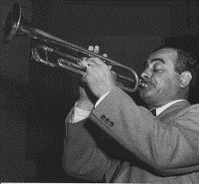
Phil Napoleon Never Played Dixieland.

Yet those artists’ music had to deserve a better label than that of a tiny, soggy, syrupy sweet confection aimed at underdeveloped palettes. By extension, the thin horns and bloodless rhythm sections I heard from many so-called “Dixieland” groups was a far cry from Bix Beiderbecke’s popping ensembles, King Oliver’s dense, earthy polyphony or even the Original Dixieland Jazz Band’s almost frighteningly frantic attack. The music of the “Chicagoans and the best contemporary “trad” players listened back but resounded in the here and now. By contrast “Dixieland” seemed like sugarcoated revision rather than sincere reflection.

Of course the distinction between good music, bad music and bad labels gets clearer as I get older (while straw hats and red suspenders will always be just plain awful): like ice cream or a host of other delights, everyone knows what’s good or bad when they hear it.  “Dixie” remains something that’s tolerable in small doses but will eventually make me sick.

Tagged , , , , , , , , , , , , , , , , , , , , , , , , , , , , , , , , , , , , , , , , ,

The Vindication of Woody Walder

Woody Walder Wails (and Then Some) on Clarinet

Woody Walder didn’t so much play the clarinet as deploy it.  His solos with Bennie Moten’s band are closer to sonic found art sculptures than the poems, speeches and epigrams of his Jazz Age colleagues.  Walder pieced together squeals, squeaks, whinnies, whines and cries, sometimes through the insertion of foreign objects into the bell of his instrument, other times with just his mouthpiece.  The effect (Walder seemed all about effect) could be humorous or disturbing, at times grating, but was always surprising.

Walder’s particular sound of surprise hasn’t served his legacy well. Most jazz historians locate Walder’s playing somewhere between a tolerable novelty of the times or a now dated commercial evil, perhaps higher than comb playing and barnyard theatrics, but far below the fine art of plunger-muted brass.

Courtesy of chaka85.wordpress.com

It’s a pity Walder missed out on noise music, the Art Ensemble of Chicago’s experiments or the deliberately nasal, percussive and off-pitch curveballs of the World Saxophone Quartet.  The avant-garde as well as Walder and contemporaries such as Fess Williams (and even King Oliver at his onomatopoeic) all relished vocally inflected, “unmusical,” weird and occasionally cacophonous sounds.  Apparently Walder’s mistake was doing it for a willing and wide audience.

It’s best to listen to Walder on his own terms, neither as historical victim or stylistic precursor, but simply as a musician playing on a record.  Better yet, forget the man and just listen to the wholly unique, singularly “ugly” sounds twisting pitch and time on “Elephant’s Wobble,” “Thick Lip Stomp” and “Yazoo Blues.”  If you’re craving context, listen to how Walder’s solo on “Midnight Mama” at times resembles a hybrid of Rex Stewart’s half-valving and Bubber Miley’s gutbucketing, transplanted to Eric Dolphy’s honking, metallic reed.   It’s a hell of an act, or art, if you’re into that sort of thing.

Tagged , , , , , , , , , , , , , , , , , , , , , , , , , , , , , , , , , , , , , , , , , , , , ,

A Song By Any Other Name: The Right Amount of “Deep Henderson”

“Deep Henderson” illustrates one pop tune that became just popular enough. Tom Lord’s Jazz Discography lists thirteen different bands recording Fred Rose’s composition in 1926, the same year it was published in Chicago, with four other groups cutting the tune the following year (in three different countries, no less). Most bands also used the publisher’s stock arrangement, adapting it to their needs and style rather than starting over fresh as they might with so many other jazz warhorses. Unlike “St. Louis Blues” or “Tiger Rag, ” “Deep Henderson” became a controlled study in the variety of bands and approaches at one small juncture in American popular music.

Bill Edwards describes “…one of the most sorrowful and wistful songs [he’s] encountered,” with “…long sustained high notes leading downwards to the end of each phrase help[ing to] punctuate [his feeling].” Apparently the secret to this song’s success was jettisoning its sad, I-wanna’-go-back-to-the-South lyrics and slow, bluesy feel (which can still be heard courtesy of Edwards here). By the time the Coon Sanders Nighthawk Orchestra hit the studio to give “Deep Henderson” its inaugural recording, the tune was gussied up to make it more flapper friendly:

The Nighthawks were an immensely popular group, and their creamy saxes, strutting brass and re-playable shellac introduced a wide audience to “Deep Henderson.” Co-leader and pianist Joe Sanders handles the written solo with enough downhome swagger to offer some reminder of Rose’s original vision. Yet the rhythm is overwhelmingly upbeat (almost coy), aided by Pop Estep’s bumping tuba walking four to the bar behind the trumpet solo. While their reliance on written music and novelty numbers may deny them entry into the hallowed chapters of “jazz” history, the Nighthawks gave many Americans a good idea of how loose and lowdown pop can get.  They sound downright raunchy compared to Mike Markel’s band (follow the arrow to the link):

Deep Henderson

Markel’s block chord introduction and racehorse tempo likely impressed dancers, with robust saxes and clipped brass choreographing their stomping feet. Yet the band’s jerkier rhythm doesn’t leave much space for legs flying off the dance floor. The horn man (Red Nichols? Earl Oliver? An unknown player?) soars to the occasion, as do the saxes behind the brass, recalling society band string sections. In light of sax riffs getting faster, trickier and uniformly high-flying in the years ahead, their sustained harmonies are a nice touch. Markel’s approach has a nostalgic charm, a reminder of when pop music was intense and tight (in feeling if not always execution). Yet the recording does make the “New Orleans effect” even more apparent when listening to King Oliver and some neighborhood colleagues:

Oliver’s cornet immediately presages a much earthier, more personal account of the tune. The Dixie Syncopators’ tempo isn’t much slower than the Nighthawks, but their easygoing inflection and subtle backbeat make it sound like they’re taking their time. The saxophone section parts way for Barney Bigard’s slap-tonguing tenor, perhaps dated but undeniably percussive (and as texturally original as prepared piano or distorted guitar). Even the soprano sax adds a howling, haunting dimension to the clarinet trio.

Drummer Paul Barbarin’s “Oh, play it Mr. Russell!” during Luis Russell’s solo plays up the informal air, yet such exclamations may or may not reveal the insidious, timeless hand of marketing. Improvisation and swing are the breaking news here: Oliver’s greasy responses over the saxes (especially heroic in light of his aging embouchure), and Kid Ory’s lurching, sly trombone over the closing chorus make this, the second recording of “Deep Henderson” pressed, a very distinct chapter of the tune’s short but hot history.

Of course Miff Mole adds his smoother, more rounded yet equally punchy trombone over the chirping clarinets that close Markel’s recording, and even the drummer gets in some solo syncopations. The way each group, section and soloist navigates this arrangement points to a difference of delivery with a shared intent. The “same old stock” can never be the same, not if you’re a musician with something to say or a record consumer with a paycheck. At a time when pop is reticent to market covers (even as the same tune in the same rendition gets beaten into the ground over air and internet), it’s also a reminder that the question of originality often begins with “how” as well as “what.”

Lord lists seventy-one recordings total of “Deep Henderson.” I must admit that in light of Oliver and others’ experiments, Bela Dajos’ rich, buttery society version comes across as either insularity, or the sincerest form of parody:

Last one, I promise: here’s British bandleader Bert Ambrose’s thoroughly modern swing account from 1937:

Well, we can’t end without hearing Vince Giordano do it!  Live, in 3D, with glorious sound and from outside of Lord’ discography:

Want more? Be sure to share your favorites in the comments, and hope you enjoyed the tour.

Tagged , , , , , , , , , , , , , , , , , , , , , , , , , , , , , ,