Tag Archives: Jazz

A Brief Tour of “Two Kinds of Music”

“There are only two kinds of music: good music, and the other kind.”

People usually credit Duke Ellington with this phrase, or some variation of it, without specifying where or when he said it. We also don’t typically include the exact section of Genesis for “Am I my brother’s keeper?” or Star Trek II for “the needs of the many outweigh the needs of the few.” A citation can seem pedantic in its redundancy.

I’m a member of a small group: people who have been told they like “the other kind” of music and care why it’s not “good.” I often wonder what Ellington meant by this statement. So, I got pedantic and tried to find a citation.
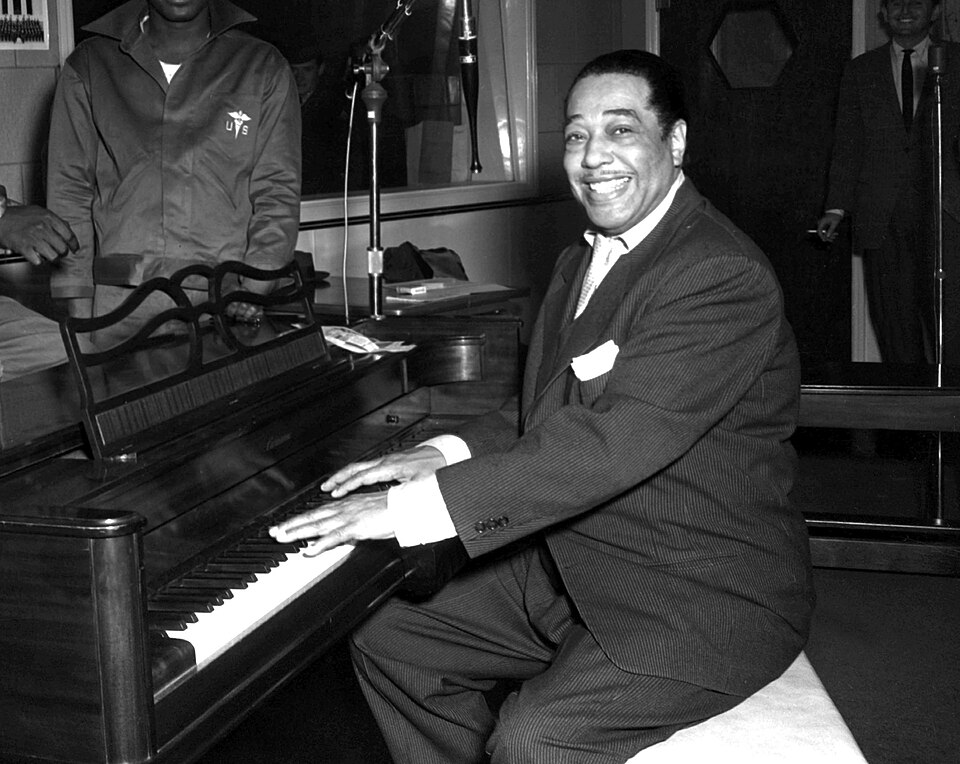
Duke Ellington, 1943. http://www.defenseimagery.mil; VIRIN: HA-SN-99-00410 (cropped), Public Domain, https://commons.wikimedia.org/w/index.php?curid=8378297.

Sources

The best connection to a literary source I could find was by Alex Ross, who cites Ellington’s article “Where is Jazz Going?” from the March 1962 issue of the Musical Journal.

In that piece, Ellington reflects on the “future of jazz.” He considers whether musicians with “a background of educational equipment that is way out ahead” of earlier jazz musicians will affect the music’s folk roots. Ellington highlights the need to grow a supportive audience. He describes being told his music isn’t sufficiently Black and why rock and roll is the most “raucous form of jazz.”

The piece is worth reading in full, but I was looking for this passage:

“As you may know, I have always been against any attempt to categorize or pigeonhole music, so I won’t attempt to say whether the music of the future will be jazz or not jazz, whether it will merge or not merge with classical music.

There are simply two kinds of music, good music and the other kind. Classical writers may venture into classical territory, but the only yardstick by which the result should be judged is simply that of how it sounds. If it sounds good, it’s successful; if it doesn’t, it has failed. As long as the writing and playing are honest, whether it’s done according to Hoyle or not, if a musician has an idea, let him write it down.

And let’s not worry about whether the result is jazz or this or that type of performance. Let’s just say that what we’re all trying to create, in one way or another, is music.”

Ellington was not simply stating that jazz and classical music were equally worthwhile; listening to both can demonstrate that. He sounds interested in expanding appreciation for a broader range of music. He ends this passage and his piece with a summary rejection of labels.

At the same time, Ellington witnessed the classical/jazz binary at work since the start of his career. He flanks his soon-to-be-famous words with comments on classical music, highlighting his skepticism of musical hierarchies. As one commenter points out, Ellington was aware of shifts in popular music and diminishing opportunities for musicians in his specific branch of “good music,” so there might also have been a subtle but pointed commentary on “the other kind” of music selling out venues.

Ross goes on to mention an earlier source for this idea, one well outside of jazz, American popular music, or the twentieth century. In the following passage from his 1863 book Social Life in Munich, English jurist and writer Edward Wilberforce attributes the quote to Italian opera composer Rossini (1792–1868):

“Rossini’s saying about music applies to painting. Rossini is supposed to have said to some learned gentleman who was entertaining him with a discourse on nationalities in music, ‘My dear sir, there is no such distinction as you suppose between Italian, French, and German music; there are only two kinds of music, good and bad.’”

Rossini was interested in geographic boundaries applied to music. Critics dismissed his works as frothy, florid stuff best suited for Italian audiences. Some described Rossini’s music as too “German” in its scoring. While Ellington is disputing hierarchies, Rossini is sweeping aside borders.

Both composers encountered criticism about the cultural authenticity of their music and its accessibility. Despite being separated by an ocean and a century, and though they arrived along slightly different paths, both reached similar conclusions. They also avoid describing “the other kind” of music. Ellington won’t even use the word “bad.” Maybe he was having fun with implications. Perhaps he didn’t like such a drastic label. Either way, Rossini had no such issue.

Gioachino Rossini. Hortense Haudebourt-Lescot – Casa Rossini Lugo, Public Domain, https://commons.wikimedia.org/w/index.php?curid=107485463

As for who said it first or where they might have heard it, Ross says that “the real source” of this quote is probably Franz Grillparzer, an influential Austrian playwright. The relevant text appears in the 1856 poem “An die Kritiker.” Here is Ross’s translation from German:

To the Critics

The critics, meaning the new ones, 

I compare to parrots, 

Who have three or four words

That they repeat in every place. 

Romantic, classical, and modern 

Seems a judgment to these gentlemen, 

And with proud courage they overlook

The real genres: bad and good.

It’s unclear if Grillparzer is discussing drama, music, or the arts in general. “Romantic, classical, and modern” can mean both eras and styles. But the quote still resonates. Here, it’s just one part of a larger assault on critics—not just on an idea, but people! Grillparzer is more upset by their overuse of musical labels than by the existence of those labels. “Good and bad music” is the knockout punch in a bigger fight.

Uses

At this point, the chain of authorial custody became less interesting than the usage. A quick search of different online resources revealed hundreds of quotations, misattributions, and possible plagiarisms—though, again, we rarely hear a source for “do unto others, etc.”

For example, this writer for the Bath Weekly Chronicle and Herald of July 20, 1865, could be accused of plagiarizing Rossini, referring to common wisdom, or even relying on what might have already become a cliché:

“[Conductor] Luigi Arditi is unlike most maestri, for he has neither prejudice nor partiality: He only recognizes two kinds of music: good and bad. German, French, Italian, or English, is alike to him, so that it be only first rate.”

The Bath Chronicle of March 8, 1888, was over-generous in its attribution, suggesting collaborative authorship:

“Rossini once told [French opera composer] Gounod that he only knew two kinds of music, good and bad, and Gounod himself says, ‘I dislike all this nonsense about German music, Italian music, French music, and so on: geographical boundaries cannot hedge in harmony.’”

Nearly 60 years later, Metronome writer Arthur McAuliffe (in his “A Treatise on Moldy Figs” from August 1945) retrofits the wisdom by substituting jazz styles for European schools:

“The truth surely is that Metronome judges everything on its individual merits and has only two kinds of music in mind—good and bad—instead of making arbitrary divisions into New Orleans, Chicago, etc. or jazz and swing.”

Jazz lovers may have been splitting those hairs. For classical snobs, “good music” and “bad music” were practically synonyms for “the music of an elite group of primarily Western European composers performed in concert settings and not marketed for mass consumption” and “the other kind,” respectively.

Ellington took on the longstanding “debate” in his piece. In “Meredith Wilson Takes This Stand” (Band Leaders and Record Review, April 1947), the writer uses the quote for more direct criticism of the classical community for looking down on jazz. Composer and bandleader Victor Herbert was fighting these hierarchies decades earlier from other spaces in American popular music. He includes the quote in a few articles, but this interview from the Cincinnati Enquirer on January 6, 1918, is representative of his views:

“When you really analyze music, there are only two kinds: good music and bad music. The mere fact that a certain composition is the work of one of the classicists, or that it is written in the classic style, does not necessarily make it a fine, good work. Nor does it follow that all light opera music is trashy. On the contrary, it is just as artistically important to have good light music as it is to have good music in the larger format.”

As late as 2000, Ray Charles (per Bill Milkowski, “Midnight and Steve Turre,” JazzTimes, October 2000) used the quote to argue that classical music doesn’t get to be grandfathered in as “good music”:

“Duke Ellington once said that there are only two kinds of music: good and bad. And it’s the truth! Because you can find beautiful, good music in every branch of music. And don’t let nobody fool you when they say, ‘All classical music is good.’ That’s a lie, ’cause it ain’t. Just ’cause it’s classical, that doesn’t necessarily mean it’s good.”

Ellington’s quote can become an invitation to seek out new sounds or a subtle dig at listeners who prefer chaff to wheat. Gene Lees, in his Jazzletter of January 1982, mentions “a remark attributed variously to Duke Ellington, Claude Debussy, and Richard Strauss that holds that ‘there are only two kinds of music: good and bad.’” He then expands on the quote:

“But try to ‘prove’ that a certain piece is good or (which is harder) that another is bad. Good or bad intonation, good or bad harmonic motion and voice leading, economy of means and its opposite, all the things by which refined judgment of music is made, mean nothing to someone whose experience has not prepared him or her to notice them. Lalo Schifrin has referred to most contemporary pop composers as ‘diatonic cripples,’ and Clare Fischer, on the same subject, describes ours as an age of ‘harmonic regression.’ They are both right. They are both irrelevant to someone jiving down the street with a Walkman mainlining moronic music into his brain.

For a similar repurposing in an academic setting, there’s William M. Lamers’s article, “The Two Kinds of Music” (Music Educators Journal, 1960). Lamers was the assistant superintendent for the Milwaukee public school system. Note the “Newton’s apple” origin for the quote:

“Long ago, I was struck with the fact that there seem to be two kinds of music: ‘Great’ music, ‘good’ music—to say ‘the classics’ would not be quite accurate—the music we teach in our schools. (2) ‘popular’ music, which we eschew in our school programs as something inferior. Apart from the schools, 16 years ago, in most places, most of the time, ‘popular’ music of a rather low order was the music most Americans lived by. It crowded better music off radio and television. It blared in barber shops and stores. It was what people sang, what the young people in our schools delighted in when they escaped from the control of the school. We seemed then to suffer from a nemesis of less than mediocrity. And for the life of me, I don’t find much change from that pattern today.”

Lamers’s subsequent guidance for his colleagues shows he was a staunch advocate for music education and musical refinement outside the classroom. Alongside his advice to fellow teachers, his suggestions for the larger community include complaining about the music being played inside local businesses and organizing students “in a crusade against musical trash.” To Lamers, musical trash is easy to hear—though he also warns fellow educators to “watch your own [musical] tastes.”
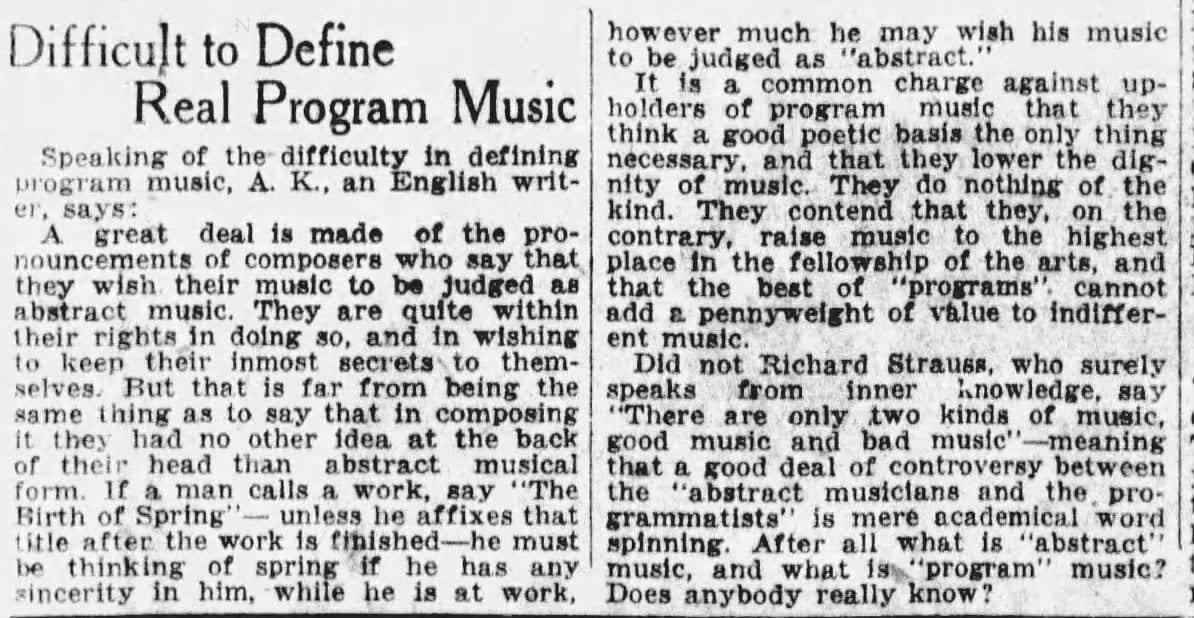
These arguments enlist the quote to reinforce musical hierarchies. It would be excessive to paste it here, but Allan Bloom devoted an entire chapter of his 1987 book The Closing of the American Mind to that end.

On the other hand, for Alonzo Levister (“What is This Thing Called Jazz,” Jazz World, March 1957), the quote is a call to pride in one’s subjective tastes:

“There are, fundamentally, only two kinds of music—good and bad. If it moves you, it’s good. If not, it’s bad.”

Louis Armstrong never seemed embarrassed by what anyone thought was “good.” He had big ears and a drive to bring his music to new and wider audiences. Armstrong scholar Ricky Riccardi explains that Armstrong actually credited the quote to trombonist Jack Teagarden, but because Armstrong almost always quoted Teagarden, people attributed it to Armstrong! He would also occasionally use it without mentioning Teagarden. I haven’t found the interview, but Phillip D. Atteberry (in “A Century of Satchmo,” The Mississippi Rag, April 2001) mentions one such exchange with Edward R. Murrow.

Trummy Young and Kid Ory were both trombonists who played with Armstrong. Young recalled Ory “once telling a San Francisco reporter that ‘there is [sic] only two kinds of music: good and bad.'” Young took the quote as a source of didactic inspiration. To him, it meant that “aspiring musicians should ‘listen to all good music and try to work out their own style. Learn as much as possible and practice for good technique'” (from Charles E. Martin, “Trummy Young: An Unfinished Story,” The Second Line, Summer 1978).

Here are a few more attributions from the jazz pantheon:

Current Biography reported as far back as 1944 that Eddie Condon scoffed at the concept of ‘Chicago-style’ musicians, saying, ‘There are only two kinds of music: good and bad.’ (I’ve also heard that line attributed to other musicians at one time or another, but Condon is on record as having said it a half century ago.)

—Chip Deffaa, “Discusses Eddie Condon: Town Hall Volume 9,” Jazzbeat, Fall 1993”

“I never liked the idea of categorizing music, though. I think Kenny Clarke was right when he said that there are only two kinds of music: good or bad. But I think the industry and consumers need guidance, or help, with jazz music.”

—Peter Schmidlin quoted in David Zych, “Label Watch: TCB,” JazzTimes, December 1997

“For instance, the great ragtime player-composer Eubie Blake, a close friend of [Max Morath]. ‘Eubie said there are only two kinds of music,’ says Max. ‘Good…and bad.’”

—review of The Road to Ragtime in Jazzbeat, Winter–Spring 2000

When Woody Herman passed away in 1987, several articles included the quote, starting a game of “jazz wisdom telephone.” Two days after Herman’s death, an obituary in The Miami Herald on October 31, 1987, quoted him citing Duke Ellington and Igor Stravinsky. An obituary for Herman in the Star Ledger of Newark, New Jersey, on November 2, 1987, included the following:

“For Woody Herman, at all times in a durable and incandescent career, there were only two kinds of music: ‘good and bad.’”

A letter to the editor in the Los Angeles Times published on November 15, 1987, said that the writer “recently heard” the quote from Woody Herman. Numerous articles used some version of the quote in pieces on Herman.

Naturally, the quote spoke to a wide range of artists. Here’s Noel Redding (in an interview with him and the rest of Jimi Hendrix’s band published in Jazz & Pop, July 1968) adapting it to Woodstock parlance:

“There are only two kinds of music—good and bad—regardless of what you play or what sort of bag you might be in.”

A profile of country artist Reba McEntire published in multiple publications during 1987 quotes her as saying, “Don’t categorize me or my music. There’s only two kinds of music to me: good and bad.” Between Herman’s passing and McEntire’s scolding, 1987 was a banner year for the quote; mentions of it spiked across the United States.

Kiss co-founder Paul Stanley also used it in an interview published in several newspapers during March 2021. Blues musician and scholar Kat Danser (in a profile by journalist Paul Tessier for The Morning Star of Vernon, British Columbia, on March 15, 2019) said that “when you go down south, everybody says, ‘There’s only two kinds of music: good music and bad music. Danser varies the meaning here slightly, chalking the phrase up to a regional insight.

Substitutions

Sabin’s Radio Free Jazz, February 1973

At different points, speakers swapped in other categories for “good music,” “the other kind,” and “bad music.” Not all of them were intentional, and they probably illustrate the speaker’s individual priorities more than their musical philosophy. For example, in a letter to the Cornish Guardian of February 21, 1908, one correspondent declared, “There are only two kinds of music: sacred and silly,” explaining that “everything good in the world is sacred,” taking rarefied taste into spiritual territory.

The erudite, caustic journalist H.L. Mencken was likely familiar with the quote through some classical attribution. In a letter dated March 6, 1925, he wrote that “There are only two types of music: German music and bad music.” Mencken was not being ironic. He genuinely believed in the superiority of his native culture. Sometimes musical taste is about much more than music.

Let’s end with maybe the broadest, most down-to-earth, and humblest variation, by a young artist finding his way. Ornette Coleman was likely familiar with the quote, probably through Ellington, so it’s easy to imagine this as a riff on Ellington’s wisdom:

“I think when I was coming up (starting) to participate in instrumental music, I hadn’t really thought about the problem of what instrument, what kind of music or what. I just thought that since there were only two kinds of music, vocal and instrumental music, there would be enough space left for me to participate in instrumental music.”

—Ornette Coleman, “What Do You Play After You Play the Melody? John Litweiler Talks to Ornette Coleman,” Disc’ribe, Fall 1982.

His modesty is incredible: Imagine Ornette Coleman wondering if there’s room for him!

There’s much more to “good and bad music,” but at this point, who said it is first far less interesting than why so many people keep saying it. I still don’t know which bucket my musical tastes fall into. Most of the speakers don’t spend a lot of time explaining “the other kind” of music, which reminds me of another piece of often unsourced wisdom:

“If you don’t have anything nice to say, don’t say anything at all.”

Thanks

Many thanks to Ricky Riccardi and Michael Steinman for finding material and sharing their thoughts on this topic. Also, thanks to anyone reading this and some of the more abstract posts I’ve been sharing recently.

Tagged , , , , , , ,

Jazz Without All That Improvising

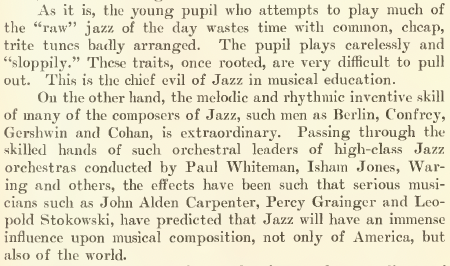
Saying “improvisation is common in jazz” may resemble observing how “stand-up comics often tell jokes.” It might even seem like stating “water usually contains two parts hydrogen to one part oxygen.” For many people, improvisation is a defining aspect of jazz. It may even be the defining feature. Jazz doesn’t simply include improvisation in a unique way; it approaches improvisation unlike any other art form and explores its formal, technical, and expressive potential. Maybe that’s why jazz history seems framed around it. The music’s important composers and arrangers stand out as unique practitioners in a tradition centered on improvising instrumental and vocal performers.

Prepared music—written, memorized or otherwise planned before performance—settles into a complicated position in jazz. Based on a lot of conversations and readings, prepared music might be a silent partner, an active participant, a springboard, an afterthought, a crutch, or a barrier to jazz. Abbey “Chinee” Foster makes it sound like a contradiction. At one point in an interview for Tulane University’s Hogan Archive of New Orleans Jazz Oral History and included in Archeophone’s Cabaret Echoes compilation, the New Orleans-based drummer exclaims that “There’s no music for jazz! There’s no writing for jazz; jazz comes out [of] your head. You never know what you’re going to do until you stumble upon it.”

Foster’s fellow New Orleanian Sidney Bechet expands on this position throughout his autobiography. Treat It Gentle gradually reveals a complicated but overall skeptical view of written music in jazz (what Bechet also refers to as “ragtime” in the book). For example, he tells the reader that “no one can write down for you what you need to know to make the music over again…no one can write down the feeling you have to have. That’s from inside yourself, and you can’t play note by note like something written down.”

Bechet also explains that “we had arrangers back in New Orleans” but advises “you don’t play just because there’s an arranger. He isn’t going to be able to show you how to play…not if you know inside yourself where it is the music has to go.” It sounds like an open-minded and even common-sense point about bringing life to all music, but it follows criticism of the rise of big bands and orchestration:

these [recording] companies got to adding all sorts of instruments. They began adding saxophone in bands: there’d never been a saxophone when we played. About 1921 they even took out the clarinet. And they began having three, four saxophones. And they got arrangers to arrange all these pieces for things like that.

At another point, Bechet implies that written music opens itself up to inauthenticity:

…once you had a thing arranged and down like that, you got to owning it. You could put your name on it and almost believe it really was yours. But you can’t own a thing like that unless you understand a lot more about it than just repeating what’s written down.

Bechet is not saying that every use of prepared music is simply “repeating what’s written down.” But he does imply that written music lends itself to unimaginative or derivative music-making.

The insistence on improvisation as more than an alternative, as an integral conduit to something authentic, becomes both an uplifting call to creative autonomy and a partial dismissal of the expressive potential of prepared music. Even the best transcriber can’t notate feeling, but a skilled musician makes written music moving, individual, and even surprising. Some improvised solos can be predictable, and the best symphonic performances inspire and even surprise audiences. The player, not the thing being played, might be decisive here. 

Of course, Foster and Bechet probably weren’t being literal. Bechet even references positive experiences with orchestrated music during his time with Duke Ellington (though he prefers a collective approach where notation follows rehearsal, not the other way around). Even purist musicians and listeners allow some written or rehearsed music.

In a review of McKinney’s Cotton Pickers from the December 1933 issue of Jazz Tango Dancing magazine, critic George Frazier implies a more moderate position. He describes leader and arranger Don Redman’s writing as “over-arranged,” which still makes room for some degree of arrangement. But it better be the right amount of written music.

Frazier unequivocally states that “there is no greater barrier to attaining the true hot than arrangements that are too elaborate. They create a stiffness that is alien to improvisation.” In other words, if you pass a threshold of arranged material, you stifle the potential for improvisation, so intricate scores are anathema to real jazz. He suggests some specific proportion of arrangement to improvisation before a piece of music lost its authorization as jazz. It would have been fascinating to overhear Frazier and Don Redman compare ratios! But the issue here is once again with the written music (and not the musician playing the chart). Written music just impedes the musician’s flow of spontaneously generated music.

Frazier and other purists obviously had a deep aesthetic commitment to the centrality of improvisation in jazz. They had also seen promoters, fans, journalists, and even musicians label almost any form of upbeat popular music as “jazz.” By 1933, maybe enough was enough. For prophets of the “true hot” like Frazier, the insistence on improvisation was one way to kick the pop merchants out of the temple of jazz (even as they also understood that jazz meant more than improvisation).

“Jazz” and Creativity

It’s tempting to associate Frazier and the focus on improvisation as upholding creativity against the crass commercialism of the music business. But if a threshold for written music in jazz seems subjective, so was the word “jazz,” and not just for profiteers. Just as Frazier’s artistic critique may be countering commercial encroachment, the supposedly inauthentic music called “jazz” might have had an aesthetic dimension.  There were numerous designs for “jazz” as a commercial product, and there were also ideas about this developing music—including how “jazz and improvisation” was not an inevitability.

Thanks to the person who shared this via Facebook.

In hindsight, categorizing the music of Paul Whiteman, Vincent Lopez, Nathan Glantz, hot dance bands, novelty groups, symphonic jazz orchestras, popular singers, and others as “jazz” might seem funny or frustrating (while reading about Duke Ellington’s “dance band” may seem reductionist). Yet taking these retroactive misapplications at face value creates an interesting parallel history. They contextualize music once referred to as “jazz.” Some will argue it was never anything near jazz, but it does still remain music. This music sheds light on a different aesthetic and things that never left jazz but were redistributed based on different musical priorities in all that jazz-that’s-not-jazz. They also show us the tastes and prejudices—musical or otherwise—of listeners who didn’t think “jazz” needed to concentrate on or even include improvisation.

“Jazz” Doesn’t Need Improvisation

Take George Hahn, writing for Jacobs’ Band Monthly of September 1923 (generously provided by Ralph Wondraschek), who describes how post-World War I-era jazz had too much collective “filling in” (i.e., improvisation or variation of the tune). Thankfully, for Hahn:

…able musicians tamed down [filling in] to one instrument at a time, until today we have it really being done artistically and according to rule…the erstwhile blatant jazz has given way to smoothly flowing beautifully voiced harmony and rhythm…arrangers and directors who took the raw jazz as it came from New Orleans and change it into the aristocratic variety we have today…If jazz was the essence of the noise we experienced in some popular types of music four or five years ago, then we have very little jazz left, as it can be proved with anyone’s ears that noise minus reason is virtually absent in our good orchestras of today.

The class-centric and racially coded language, the reduction of so much music to disorganized “noise,” and Hahn’s condescending approval capture the perfect balance between infuriatingly elitist and comically superficial. Still, in his own way, Hahn was forward-thinking, preferring solo improvisation (i.e., a single player “filling in” at a time) to the collective stuff!

For Hahn, harmony, the orchestrated combination of multiple players presumably based in European classical techniques, stands right next to rhythm in “jazz.” The music only reaches its true potential through scored music. He also singles out the efforts of arrangers and band leaders—the forces some consider responsible for watering down jazz into a mass-produced commodity. It’s like jazz history from an alternate universe.

Many academic jazz histories and mainstream criticisms treat the move toward greater arrangement strictly as a calculation to cash in on the “jazz” craze. But this denies the possibility that some of this music could have been both a commercial and an aesthetic object. For listeners like Hahn, even if we no longer call it jazz, “jazz” was more than just an ephemeral mass product aimed at making a buck.

Don Knowlton’s essay “The Anatomy of Jazz” (from Harper’s Magazine of April 1926) damns “jazz” with faint praise, complimenting the music’s variety within the “simplicity” and “prescribed limitations” in terms of form and emotion. Like Hahn and many other commentators at the time, whatever “jazz” was or would come to be, improvisation was beside the point. In fact, it might just get in the way:

It is the arranger who provides life and color and contrasts and lively dissonances and blasts of indigo harmony and contrapuntal runs…The arranger, while adhering to the formal limitations of jazz, employs in its decoration all of the devices which he can steal from classical music…The ingenuity of the arranger is amazing. For the orchestra, the simplest piece is built up with the utmost care, and jazz orchestrations are as correctly done, as well balanced, and as effective in rendition as are those produced for our symphony orchestras. The days of playing by ear are rapidly passing. Each man must play his part as written, for it has been carefully calculated with respect to every other part…

Excerpt from Etude, August 1924; issue on “The Jazz Problem”

Faithfulness to the score, meticulous rehearsal, arrangers, and bandleaders (not soloists) were finally allowing “jazz” to realize its potential. Instead of hit-or-miss playing by ear, harmony and counterpoint allow jazz to borrow from and compare with symphonic music. In fact, for Knowlton, “jazz’s” true potential was as a road to appreciating European classical music:

The encouraging thing about jazz is that, in its orchestrations, it is initiating countless thousands into sound principles of harmony and counterpoint, and thus definitely raising the average level of musical intelligence. Snort if you will, but the fact remains that the shop girl who has heard Paul Whiteman has taken a step toward appreciation of Beethoven’s Seventh Symphony.

Knowlton makes jazz into homeopathic music appreciation. Eventually, the mature listener will learn to appreciate the indisputable quality of the great European masters (i.e., the handful of German classical composers Knowlton probably swore by).

Paul Whiteman: Musician and Populist

Nearly a century later, using Paul Whiteman as an example may seem hilariously on-the-nose. Whiteman was one of the most commercially successful popular musicians in history based on his work in “symphonic jazz” with its intricate scores, tight ensemble performance, and incorporations of classical techniques and allusions.

Whiteman is still damned with faint praise himself when contemporary historians aren’t outright declaring his work pretentious, shamefully commercial, and racist. In hindsight, his goal of making “a lady out of jazz” seems presumptuous and insensitive. But taking Whiteman’s other comments at face value, he did have an aesthetic mission and creative goals alongside commercial strategies and problematic opinions.

While he may not have liked being called “the king of jazz,” Whiteman confidently called the music he played “jazz.” He collected his views in a 1926 book of the same name. Whiteman highlights the music’s unique rhythmic flexibility by contrasting it with ragtime, explaining that “To rag a melody, one threw the rhythm out of joint, making syncopation. Jazz goes further, ‘marking’ the broken rhythm unmistakably.”

He adds how “jazz” goes even further as combining blues and ragtime “with a certain orchestral polyphony that neither had.” The music’s essential “question and answer,  sound and echo…unacademic counterpoint” leave him in awe. A jazz ensemble reaches its full potential in the “counterbalancing of the instrumentation, a realization of tone values, and their placement.”

Whatever Whiteman meant by “jazz,” it was inexorably linked to scored ensemble interplay. In Jazz, he advises that “unless the music is cleverly scored, the greatest musicians cannot make it popular with the public.” But this wasn’t just about selling records and tickets. Perhaps sincerely or self-servingly, Whiteman also suggests trusting audiences, even when they can’t fit in a small club or even a concert hall:

Why should it be supposed that all the good taste in the world is monopolized by a few people? Isn’t it possible that the so-called masses have considerable instinctive good judgment in matters of beauty that they never get credit for? My notion is that beauty is for everybody, that anything too precious for the common gaze is out of place in a world God has created for ordinary people. That’s why I resent the self-assurance of certain high and mighty art circles.

At the same time, Whiteman seemed ambivalent about the word. The concert program for his 1924 Aeolian Hall concert (quoted in Howland’s Ellington Uptown) references “the tremendous strides which have been made in popular music from the day of discordant Jazz [sic]…to the really melodious music of today, which—for no good reason—is still called Jazz.” He told an interviewer for Jacobs Band Monthly of January 1925 that “jazz” was just a word:

I’m not so sure it’s even that. Perhaps it isn’t in the dictionary. I can’t really tell you what jazz is, because we might not understand each other, but I can explain my ideas about music in terms that will mean to you what they do to me. Come to [Boston’s] Symphony Hall tonight and I’ll play some jazz for you. Then you’ll know what I think jazz is. Only I’d just as soon it would be called by some other name.

He also stressed that jazz was still just a “musical treatment”:

With a very few but important exceptions, jazz is not as yet the thing said; it is the manner of saying it. Some critics think this fact establishes the unimportance or even the vulgarity of jazz. I believe it is true that if jazz does not develop its own theme, its own distinctive language, it will fail to  be musically valuable. But it will do so.

Knowlton saw “jazz” as the pathway to appreciating European classical music, while Whiteman saw it as a stage in the development of distinctly American music. He sets out his vision in the introduction to Secrets of Dance Band Success, a 1936 compilation of interviews with band leaders and musicians:

Bear in mind that from the dance orchestra will probably be evolved a purely American orchestra that will interpret the emotions of the American people and incidents of American life as accurately and faithfully as the symphonies have done for the old world.

Whiteman had his eyes and ears set on the new world, both geographically and chronologically. In this alternate “jazz” timeline, improvisation was just a stop along the way.

The Dignity of the Written Page

For others, the debate over improvisation in “jazz” (a statement seemingly transmitted from that parallel universe) hinged on upholding tried-and-true values and even cultural dignity against the disorder of new trends. John Howland’s Ellington Uptown provides a musical, historical, and cultural analysis of concert works by Duke Ellington and James P. Johnson. Howland also discusses shifting attitudes toward improvisation among different generations and geographical communities of musicians who had other attitudes toward improvisation.

As Howland explains, with the rise of large show and dance bands like Fletcher Henderson and Erskine Tate during the twenties, some older musicians began tamping down on the greater liberties musicians were taking. Senior Clef Club musicians were especially wary. Howland explains this, in part, as a reflection the New Negro philosophy: self-control and dignity represented in sight-reading and adhering to music written and prepared by trained professionals (over “faking it” and “playing by feeling”).

A speech to Clef Club musicians in June 1921 by Tim Brymn, cited in George Hoefer’s liner notes to The Sound of Harlem LP, puts this philosophy into musical practice. Brymn advises musicians to closely follow the written score  and “not try so much of their ‘ad lib’ stuff.” Brymn noticed “a growing tendency to make different breaks, discords, and other things which make a lot of noise and jumble up the melody until it is impossible to recognize it.”

Brymn believed that white musicians “excelled” their Black colleagues because “they are willing to supply novelty music and let it be done by the publisher’s arranger, who knows how to do it.” He goes as far as to say that if musicians find ways to improve the part, “have it done on paper so that the improved way of playing will be uniform and always the same.”

Brymn’s comments are close to the stern warnings from a local musicians’ union published in the correspondence section of The Musical Courier in November 1922:

This correspondence contains bigoted language and assumptions. The insinuation about which musicians do or don’t stick to the score and the cultural assumptions behind those associations is a whole other topic.

Still, for both Brymn and this union official, “jazz” is just fine and maybe even “good” when musicians stick to the printed score. Compare that to today’s jazz lovers who love music that is anything but “uniform and always the same” and love hearing soloists “jumble up the melody.”

Who Needs Musicians

The idea that jazz would be fine if it weren’t for all that pesky improvisation may now seem odd and even insulting. It doesn’t simply leave out some musical element. It distances the improvising musician from the music and disrespects the human being making the sound.

Arthur Lange literally wrote the book on dance band arranging in his time, Arranging for the Modern Dance Orchestra. But his column “Instructive Notes on Modern Dance Orchestra,” published in Metronome in February 1925, makes perhaps the most galling and certainly the most professionally self-serving argument for the importance of arranged music.

Lange attributes the superiority of European orchestras to the musicians receiving credentialed formal training from conservatories. He contrasts them with American musicians, who “just pick up an instrument and enter an orchestra.” Thankfully, professional arrangers and instrumental composers like Lange save audiences from instrumentalists; their “ingenuity for obtaining beautiful results for small orchestra” makes up for the “shortcomings of the American musician” and “lack of individual perfectness [sic].”

Ignore the reality that American musicians attend conservatories, formally trained musicians seek opportunities in popular music, and some of the most gifted musicians are autodidacts.  As for “just picking up an instrument” and getting to play in a band, it’s an understatement that defies even ironic statement. Instead, note how Lange admires the musical and creative potential of arrangement for “jazz,” jazz, or any genre.

Lange’s book on arranging shows the care and imagination he put into his creative work, even if it was also commercial work that paid the bills. But his statements here ignore what musicians bring to that work. Taking Lange’s argument literally, he uses a trumpet player like that player uses a trumpet. But there are countless anecdotes about musicians making suggestions, adding embellishments, and doctoring arrangements in the studio and even onstage. We’re back to the idea of musicians adding nothing to the written page. Both Bechet and Lange make musicians into passive elements in creating music. Bechet thinks it’s soulless, and Lange calls it progress.

Music Minus Jazz

Lange, Hahn, Whiteman, and others cited here—and in several critical pieces and interviews during the twenties—illustrate a different attitude toward improvisation in “jazz.” They shed light on whatever many musicians and critics meant by that word. But having a critical attitude on improvisation means not taking it as a given (the same way humans don’t have an opinion on oxygen). It recontextualizes a lot of unimprovised popular music. It may not have been Jazz, and it may have made a lot of money, but it was still music.

Tagged , , , ,

Rediscovering Frank Quartell by Colin Hancock

Quartell’s band in Cuba. Image from The Miami Herald, February 23, 1935.

This blog is thrilled to welcome a guest post from Colin Hancock: a bandleader, multi-instrumentalist, researcher, and sound preservationist who has built his musical career around playing, recording, and documenting early jazz, blues, ragtime, and old-time music.

Colin Hancock has worked as a producer, curator, and researcher on several historical albums, including Grammy-nominated compilations.In 2023, Hancock and Mark Berresford wrote the liner notes for The Moaniest Moan of Them All: The Jazz Saxophone of Loren McMurray (Archeophone, 2023),  which received a Grammy nomination for Best Historical Album that year. Hancock’s liner notes for The Missing Link: How Gus Haenschen Got Us from Joplin to Jazz and Shaped the Music Business (Archeophone, 2020) received a Grammy nomination in 2020. In addition to his ongoing research projects, he writes the “Discographical Ramblings” column of Vintage Jazz Mart magazine, the world’s oldest magazine for collectors of vintage jazz and blues records.

Colin Hancock regularly plays with and leads bands nationwide at various venues and events. While studying at Cornell University, he founded the Original Cornell Syncopators—a 12-piece dance orchestra that toured the United States, headlined the San Diego Jazz Festival, and recorded an album for Rivermont—Colin also operates the Semper Phonograph Company, one of the few operations in the world specializing in acoustical cylinder and disc recording.

Please enjoy this typically insightful and vivid piece of scholarship and the accompanying playlist from Colin!

The first time I heard the trumpet playing of Frankie Quartell (1901–1984), I was confused. While perusing the titles of a reissue of Okeh dance band oddities, I heard the 1924 rendition of Elmer Schoebel’s “Prince of Wails” by Quartell’s band, and it wasn’t much like any other rendition of the tune I was familiar with. His sound was not conventional: shaky, almost quavering at times, yet powerful and directional—he knew how to lead a band and shape every phrase. It seemed old-fashioned in some ways, harkening back to Ray Lopez and Louis Panico’s vibrato and subdivision of notes. But it also seemed abstract: those guys often played hot solos and offered the occasional or orchestrated lead. Quartell led in an almost folksy manner, sort of like a pastor or cantor leading a congregation. My confusion eventually turned to intrigue.

Over time, I have accumulated much information on Quartell with the help of many great jazz scholars and friends. Jazz legend Vince Giordano pointed me in the direction of an interview from the University of Texas at El Paso conducted in 1977, which set up a framework to start digging. I compiled a list of bands he played with—Ben Pollack, Isham Jones, Paul Biese, Art Kahn, Nick Lucas, Arnold Johnson, Dan Russo and Ted Fiorito—practically a laundry list of Chicago’s most popular dance band leaders. I heard tales from Kevin Coffey of Quartell’s own tours in Texas, Louisiana, and even Mexico, only adding to my intrigue. A closer look at some of the non-Chicago acts he worked with (like Paul Whiteman, Marion Harris, Paul Specht, and even a Wisconsin territory band) demonstrated that he was not afraid to put down roots in multiple groups. This is a side of musicians far too overlooked by scholars who often vilify musicians’ need to afford a bite to eat. Quartell is a perfect example of how this is woefully unjust and was as much a part of a working musician’s life then as it is now.

So, why does it all matter, and why is Quartell virtually unknown today? I think a lot of people don’t know about Quartell because he is hard to pinpoint. After all, describing him as a “jobbing, ragged, second-generation, Chicago-meets-territory trumpeter-bandleader” is an understatement! He doesn’t just exist as a dichotomy but as a representative of so many things happening in jazz, Chicago, and the world in those days. I think this is where his real value is: his career is like rings on a tree, with each event demonstrative of a milestone in the music and the world of the first half of the twentieth century while still indicative of the unique environment that created him. From confusion to intrigue, my approach to Quartell had finally developed into appreciation. I hope your opinion will follow a similar trajectory.

The Outer Ring: The Quaratiellos

Frankie Quartell’s early years begin like so many Chicago jazz musicians, with a story of immigrants overcoming the near-inconceivable obstacles of moving across the world in that era. His parents, Vincenzo (1864–1944) and Crestina (1868–1941) Quaratiello, were both Italian, moving from the southern Italian hill town of Ruvo del Monte in the province of Potenza to Chicago in the 1880s. The Quaratiello family settled in the city’s 19th Ward on the “Near West Side,” described at the time as the “most desolate part of the city,” notorious as the neighborhood where the treacherous 1871 Chicago fire began. It was a rough part of town, and Vincenzo did what he could as a day laborer to help the family put down roots.

As the years went on, the Quaratiellos welcomed their first child, Anthony, into the world in 1887, followed by another boy, Dan, in 1889. That same year, Vincenzo’s mother Carmela joined the family from Italy, and things seemed to be looking up. A daughter, Carmela Jr., was born in 1893, but tragedy struck the family when she died after only one month. Possibly, two more attempts at bearing children in the 1890s may have had a similar fate.[i] Fortunately, a new century brought new luck to the family. On October 6, 1901, they welcomed their third child, Francesco “Frank” Quaratiello, into the world. The family went on to have at least five other children:  Molly (1904–1988), Emily (ca.1905–1987), Joe (1906–1974), Anna (ca.1908–1987), and Ernie (1911–1995).

With eight kids and three generations living in the Quaratiello household, the large family was strapped for resources in a city and country that was usually very unforgiving toward Italian immigrants. Fortunately, the 19th Ward was home to the “Hull House,” a famous Chicago settlement house for all nationalities. Founded by humanitarians Jane Addams and Ellen Gates Starr, it focused on socializing and community growth as well as the sharing of knowledge and the arts. It boasted a strong music program, and many young boys like Frankie and even Benny Goodman got their musical starts in Hull House bands. In 1911, Quartell picked up the clarinet but soon switched to the cornet. He took lessons from fellow resident James Sylvester, and one of Quartells’s older brothers eventually helped him purchase his first cornet, a silver-plated Lyon and Healey horn, for $25.

While Quartell was discovering music, the city of Chicago was experiencing a musical revolution through an explosion of a new form of syncopated dance music taking the city by storm. Though hot music had existed there since at least the 1893 World’s Columbian Exposition, in the first 15 years of the twentieth century, out-of-towners like Wilbur Sweatman, the Original Creole Orchestra, Tom Brown’s Band from Dixieland, Jelly Roll Morton, Johnny Stein, and countless others made their mark on the city by introducing a new way of playing it (it’s entertaining to think that the same year Wilbur Sweatman published “Down Home Rag” in Chicago, Quartell played his first notes!) Indeed, some argue Chicago is where the term “jazz music” was coined. It certainly was in use there as early as 1915, when Bert Kelly’s legendary band began using it to signal potential patrons that his brand of music possessed a certain kind of “pep” that set it aside from regular social dance music. What’s not debatable is that a lot was going on musically and that generations of musicians would be swayed by all the goings on. With the “discovery” of another out-of-town band, the Original Dixieland Jass Band, in 1916 by another out-of-town act, Al Jolson, the city’s fate as a center of jazz music was sealed.

Quartell was instantly bitten by the jazz bug, though whether he heard any of those bands early on is unknown. Ray Lopez did sing Quartell’s praises in later years due to his work with the Oriole Terrace Orchestra but didn’t mention anything earlier.[ii] What we do know is that he started a small five-piece band that played for high school dances starting around 1915. Due to Quartell’s October 1901 birthday, he barely missed the 1917 Selective Service Act’s 1917–18 drafts and instead focused on his music and working as a chauffeur.[iii] By 1919, he was officially a card-carrying union musician (by way of the Alma, Michigan union) and briefly joined a small band called the “Kentucky Five” that went to St. Louis, where he played his first major professional show.[iv] The show was a success, and it’s not a stretch to imagine Quartell must have seen something more promising in the stage lights of St. Louis than on the streets of the 19th Ward. Trumpeter Louis Armstrong, who came from a similarly tough background and similarly discovered St. Louis in this era, described the feeling of seeing the city for the first time:

“There was nothing like that in my hometown, and I could not imagine what they were all for. I wanted to ask someone badly, but I was afraid I would be kidded for being so dumb. Finally, when we were going back to our hotel, I got up enough courage to question [bandleader] Fate Marable. ‘What are all those tall buildings? Colleges?’” [v]

At that time, St. Louis boasted some fascinating music, such as the aforementioned Marable band with Armstrong and the earliest version of Charlie Creath’s famed group. That Quartell heard bands like these during this time and incorporated their styles into his own music is certainly a possibility. Quartell appears to have stayed for an indefinite amount of time in St. Louis before returning to Chicago in the mid-spring of 1921, when he deposited his musician’s union card there for the first time.[vi] Incidentally, the guitarist and banjo player Nick Lucas deposited and removed his union card at the same time, in March of 1921. Could this have also been the beginning of his relationship with Quartell?[vii]

The Second Ring: “Dangerous Blues”

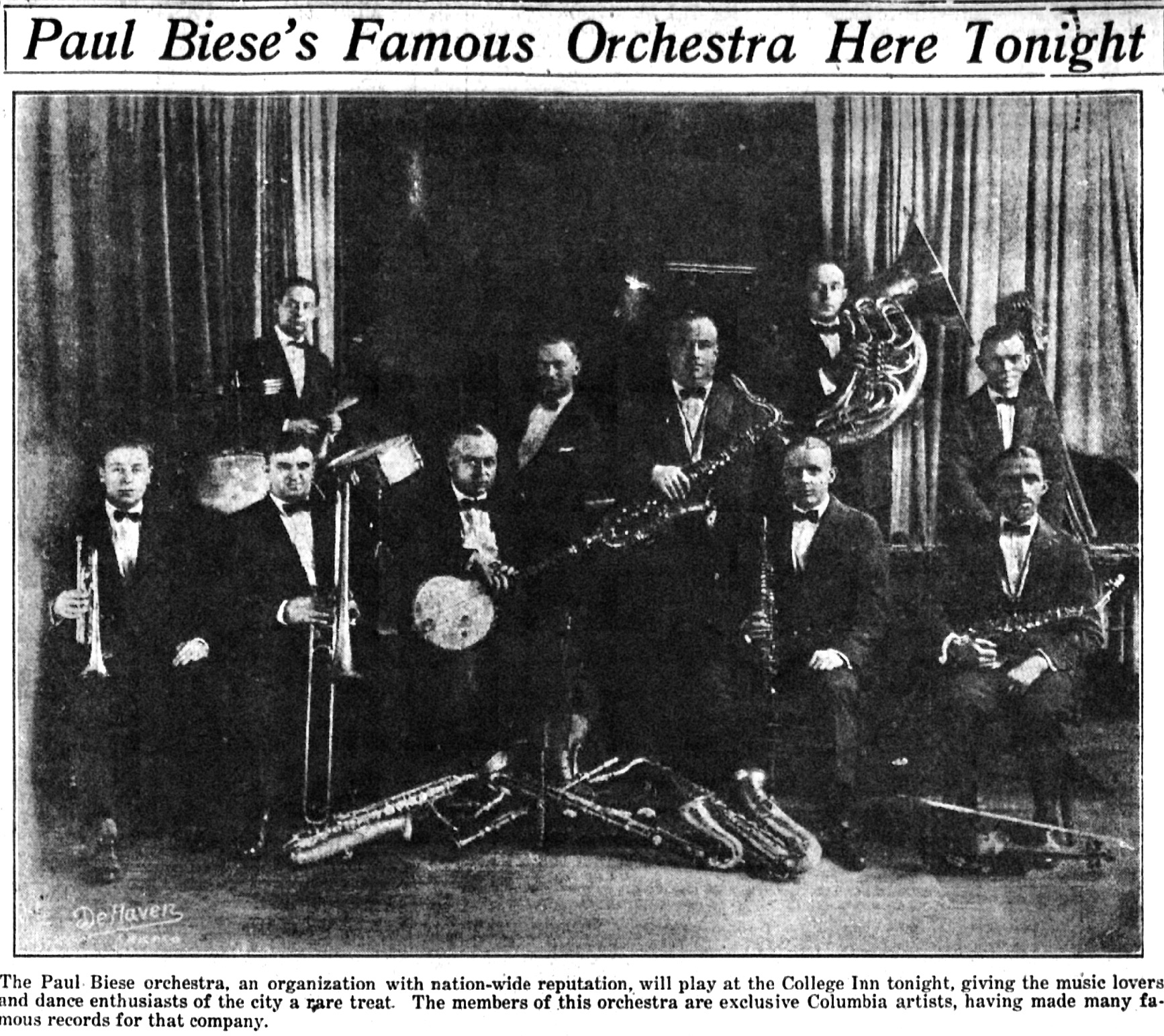
Image from The Fort Wayne Journal Gazette, November 28, 1921.

Sometime around March or April of 1921, Quartell was approached by the tenor saxophonist, bandleader, and Columbia Records recording star Paul Biese. Known for his husky presence and even huskier sound, Biese was instrumental in putting the post-ODJB Chicago jazz scene on the map and attracting the attention of several phonograph companies. While leading a successful band at the city’s College Inn, Biese decided he wanted a new lead trumpeter to replace Henry “Rags” Vrooman and likely hired Quartell sometime in April of 1921.

It was with Biese that Quartell, now going by that Americanized version of his last name instead of “Quaratiello,” probably made his first records, likely traveling with the band to New York City in May.[viii] Among these recordings are three beautiful selections backing Marion Harris where what sounds like Quartell’s distinctively raspy and quavering tone can be heard. However, he is featured very little otherwise. The band’s instrumental sides aren’t much better, though it certainly sounds like he is leading the band on their June recording of “Crooning.” To me, the most obvious candidates are the several sides cut with Biese’s trio, where an unnamed cornetist possessing the same tone and a knack for mutes contributes many fine obbligatos and even a gorgeous open horn solo of the melody of “Sweet Love” interpolated into the Biese recording of “Dangerous Blues.” This four-piece “trio” also backed singer Frank Crumit on some great sides, including a particularly bluesy rendition of “Frankie and Johnny” (incidentally a St. Louis tune.)

In later years, Quartell recalled staying with the band for about six months, substantiated by a clipping in the July 1926 issue of Radio Digest. Given that he is photographed and mentioned as being with the band as late as November of 1921, by the end of the year, his tenure with the band appears to have been complete.

The Third Ring: “Oriole Blues”

In May of 1922, Quartell boarded a train from Chicago headed to New York City. He had been hand-picked by the proprietors of the brand-new Oriole Terrace Ballroom in Detroit and by Gus Haenschen, head A&R man of Brunswick Records, to play hot cornet in a new ensemble that the ballroom and company were putting together: the Oriole Terrace Orchestra. Touted as the “greatest orchestral combination in America,” being “composed of jazz experts from the levees and Chicago,” and “12 jazz mad musicians from the nifty home of jazz,” the band’s personnel was indeed a mix of musicians from cities such as Chicago, New Orleans, and Kansas City­, all major influences on the development of jazz. The dozen-piece unit possessed a dreamy sound, with such talents as pianist Ted Fiorito, violinist Dan Russo, lead trumpeter Marty Campbell, New Orleans-born trombonist Roy Maxon, ex-Kansas City accordionist Frank Papilla, saxophonist Clayton Nassett, and later on Nick Lucas, who may have begun recording with the band as early as September of 1922 before joining them full time the following year. In between beautiful sonorities from the reeds, accordion, and strings, the sound was punctuated by hot muted breaks and choruses from Quartell and Maxon, such as on their recordings of “Oriole Blues” and the phenomenal “Serenade Blues.” The whole thing was supported by a steady and sweeping rhythm section. The band’s first gig appears not to have been a gig at all but their first recording session![ix]

Advertisement for the first Oriole Orchestra show. Image from Detroit Free Press, May 26, 1922 (edited by Colin Hancock).

After several days of rehearsals and recording, the band played their first show at the Detroit Arcadia Ballroom on May 30, 1922.[x] Their records became instantly popular, and they quickly secured a contract for a summer engagement at Chicago’s Edgewater Beach hotel, which really became their home base for the next several years despite the Oriole name (they would eventually drop “terrace”). They continued routine trips back to New York to record for Brunswick as well, cutting many fantastic features for Quartell, including “Toot Toot Tootsie,” “Bee’s Knees,” and “Carolina in the Morning,” which Quartell falsely recalled as the first record to feature a “wah-wah” mute sound.

(Author’s note: David Sager and I have concluded that this was likely done by another Chicagoan, Louis Panico, on “Wabash Blues” with Isham Jones’s Orchestra in 1921, also for Brunswick. Of course, the “wah-wah” effect had existed in jazz going back to Buddy Bolden, but that’s a conversation for another time.)

All of the positive attention earned the band a great reputation that slowly worked its way all the way up to the nation’s top bandleaders, including Paul Whiteman. In January of 1923, the band had its first public appearance in New York City at the B. F. Keith Palace. It was a huge success, and Whiteman, who was in attendance, was floored.

Over the next few months, Quartell’s relationship with the Oriole Orchestra seems to have started fizzling. The Oriole Orchestra played a long engagement in St. Louis that spring, during which he and Frank Papilla also moonlighted with the Maxwell Goldman Orchestra. This was followed by a three-month stay in Cleveland, during which Quartell also joined up with the Vernon-Owens Hotel Winton Orchestra. Though he is present on the recordings the Oriole band made in May, it seems that by that summer, Quartell had left the band, at least on stage.[xi]

The Fourth Ring: “You Should Have Told Me”

Around August of 1923, Quartell and Maxon were both offered positions in Paul Whiteman’s band, which Quartell recounted:

“Now, I had an offer from Paul Whiteman in [1923]. I went to New York, I made a recording with him, but he didn’t offer me enough money to stay with his band. Mr. Gus [Haenschen], recording manager for Brunswick Records, asked me if I would like to go back to the Edgewater Beach Hotel with Bennie Krueger for more money, and I did. I didn’t accept Mr. Whiteman’s offer. I came into Chicago with Bennie Krueger, I made several recordings for Brunswick, and I came to the Edgewater Beach Hotel.”

It seems that this recording must have been either the September 20 or 26, 1923 session, given that Maxon’s first confirmed appearance was September 20. The most likely candidate for this recording is “Cut Yourself a Piece of Cake” from that date, which features two cornets in a muted “wah-wah” chorus, presumably Quartell and the orchestra’s regular lead trumpeter, Henry Busse, who is prominent on the other recording from that day, “I Love You.” However, it is quite difficult to tell whether or not Quartell is truly present. Whatever the case, by October of 1923, Quartell was back in Chicago with Krueger at the Edgewater Beach Hotel, likely thanks to Haenschen and Brunswick’s relationship with both the band and the venue.

In early 1924, Quartell traveled again, this time for a brief stint with bandleader Arnold Johnson in Miami alongside fellow Chicagoan Vic Berton. He also began working with the pianist Art Kahn around this time, possibly thanks to his relationship with Berton (a member of Kahn’s Columbia recording orchestra) that went back to the Paul Biese days. It’s not known if Quartell recorded with them at this time (it may be him contributing the hot derby muted solo on “Bahama”), but he would certainly record with them later in 1924 and on the band’s January 1925 sessions. He is particularly well-featured on “You Should Have Told Me” and “Insufficient Sweetie,” the former a fast-paced romp featuring his “dicty” straight lead style and hot improvisations and the latter a low-down affair.

In between Johnson and Kahn, Quartell found his way back to New York again to play with bandleader Paul Specht. Replacing Italian-born trumpet player Frank Guarente, Quartell spent much of the summer with Specht, recording many great sides for Columbia, including a lovely blues waltz entitled “Come Back to Me,” his most beautiful performance on record to date. At the end of this engagement, he took a brief vacation to Wisconsin, where he played with Frank Doyle’s Orchestra in Green Bay.[xii]

The Fifth Ring: The Melody Boys, Isham Jones, and the Mid-20s

The mid-1920s were good to Quartell. Returning to Chicago in the fall of 1924, he began fronting his own band for the first time since joining Paul Biese. Likely road-weary and ready to take a break from being a sideman, he organized “Frankie Quartell and His Melody Boys.” Before long, the band was quickly engaged at the city’s Montmartre Café, the revamped Green Mill Gardens, where the Chicago Cellar Boys and many other groups still hold court to this day. Although his usual reedmen were Al Hyatt, Dave Sholden, and Maurice Morris (how’s that for a name!?), around this time, Quartell also briefly employed Benny Goodman, though the venue made him fire the young clarinetist for his “unconventional” style. I guess they weren’t ready for the sounds coming out of Hull House.

The Melody Boys recorded two sides for the General Phonograph Corporation’s Okeh Records in December of 1924: “Prince of Wails” (which this article begins with) and the even stranger “Heart Broken Strain.” Both feature Quartell’s lead and distinctive mute work, very much up-to-date for late 1924. The rest of the band isn’t quite as tight, although the final chorus of “Prince of Wails” is fantastic, particularly thanks to Morris’ slap tongue saxophone work. Hyatt’s sour clarinet work leaves much to be desired, though some phrases are hip.

In early 1925, Quartell was once again compelled to work as a sideman when he received an offer from Isham Jones to replace Louis Panico as the hot cornetist in his band. Three years Panico’s junior, Quartell was quite similar in style and approach to Panico and was a logical choice. Further, his skills as a veteran recording artist only made him more attractive to the business-minded Jones. Quartell contributed many fine solos to the band’s mid-1920s Brunswick records and even traveled with them to the United Kingdom in 1925 to play the Kit Kat Club, replacing Ted Lewis and Vincent Lopez before that.[xiii] His playing on the band’s “River Boat Shuffle,” “Danger,” “Sweet Man,” and “The Original Charleston” are among the cornetist’s finest recordings.

(Author’s note: One of the more entertaining stories (to me at least…) relating to this era of Quartell’s life was a mix-up I made between Quartell and Frank Cotterell (1903–1940), who Wolverines authority Chris Barry helped explain was another Chicago trumpeter and reedman who preceded Bix Beiderbecke in the Wolverines, and probably is the guy present on the Dudley Mecum’s Wolverines tests for Paramount in fall of 1925, as opposed Quartell, who was either about to leave for Europe with Isham Jones or was already en route!)

After his tenure with Jones, Quartell briefly returned to the Edgewater Beach Hotel in 1926, where he performed with the new Edgewater Beach Hotel Orchestra fronted by violinist Joe Gallicio and directed by pianist Roy Bargy. During this stint, he traveled with the band to play a Kentucky Derby overnight excursion train, which pulled over in French Lick, Indiana, to let patrons use the town’s gambling establishments. During the trip, Quartell had a most interesting conversation with Mr. S. G. Gonzalez of El Paso, Texas, who was a passenger on the train. During the discussion, Quartell recounted that:

“Mr. Gonzalez said, ‘If you ever decide to come to El Paso, I own the Central Cafe in Judrez, Old Mexico, and would like to have you work for me as my orchestra leader.’”[xiv]

Though he did not initially take up Gonzalez, this exchange would change Quartell’s life in later years.

Returning to Chicago, Quartell briefly rejoined his fellow Hull House alum Benny Goodman, this time as a member of Ben Pollack’s famed band, where he contributed some second cornet work to such jazz classics as “Waitin’ for Katie.” Sadly, Quartell is virtually indistinguishable on this lauded recording, but his presence only adds to the magic.

The Sixth Ring: “Way Out West in Texas” and “Way Down ‘Yonder in New Orleans”

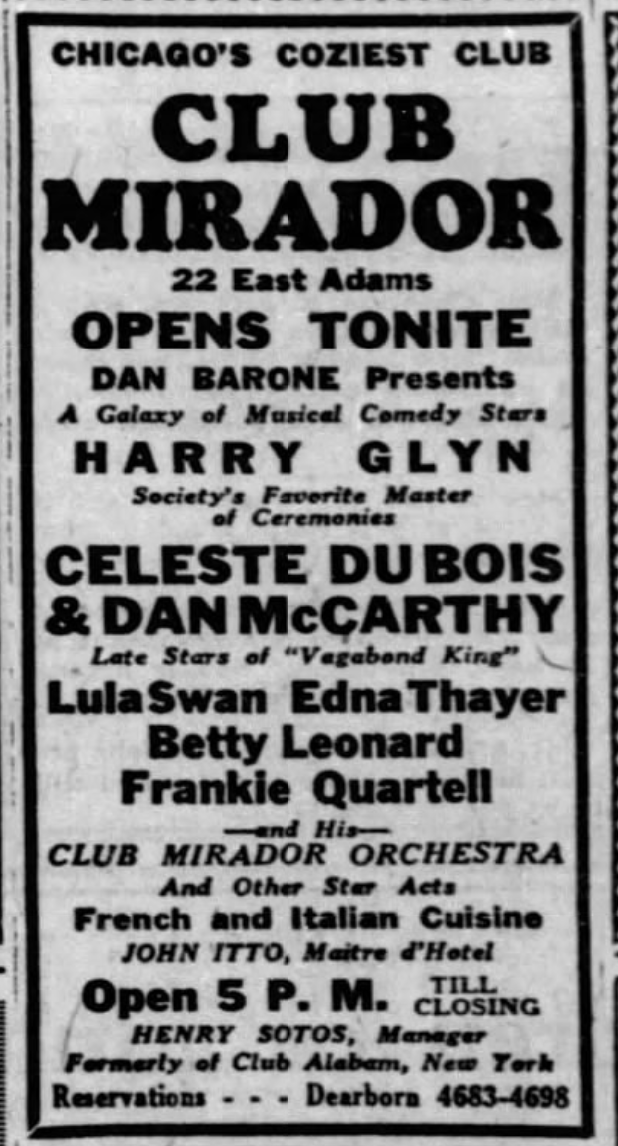
Image from Chicago Tribune, September 20, 1927.

In 1927, Quartell founded a new band at the Club Mirador in Chicago that achieved some success. However, it seems Quartell fell in with the wrong crowd at this time as he picked up a bad habit of gambling that eventually led to a nasty separation from his wife, Arvilla.[xv] In the wake of all of this drama, Quartell wanted to get away, and that opportunity soon arrived at the behest of Texas gangster Sam Maceo, who offered Quartell a chance to play a season at the Grotto in Galveston, Texas, a well-known nightclub and gambling casino in that gulf-side city.[xvi] Maceo was an interesting character who rented a suite of rooms in the palatial Hotel Galvez and traveled annually to New York to buy the latest white suits specially tailored for him.

Hiring a band that included Quartell’s brother Joe on trombone, this group was quite popular and generally a good experience for Quartell. He fondly recalled hanging around Galveston Island’s speakeasies and red-light districts as well as at the Hotel Galvez, where he also took up temporary residence and where bandleader Dandy Wellington now leads Jazz Age-style bands at an annual summer soiree.

Following the Grotto engagement, Quartell played a short stint at the Little Club in New Orleans, Louisiana. While there, his band recorded two sides for Brunswick Records, who were on a field trip through the American South to record local talent for local markets. “Sweet Baby” and “Pining,” the two recordings the Quartell Little Club Orchestra waxed, are stylistically quite different from his 1924 recordings, focusing more on rhythmic heat than oddball arrangements. What is consistent, however, is Quartell’s raspy and driving lead tone that shines through on both sides. Unfortunately, the Little Club engagement ended early due to unsatisfied management, resulting in an early departure from New Orleans and a lawsuit from Quartell.[xvii]

Traveling back to Chicago in early 1929, Quartell found work at the Beaumont Club and recorded a couple of sides with Nick Lucas, including the Spikes Brothers’ latest “Someday Sweetheart” knockoff, “Some Rainy Day.” He longed for the road again and booked his band for engagements in Cleveland, Los Angeles, New York, and a six-week engagement at the El Tivoli nightclub in Dallas. During this gig, he began to recall his run-in with Mr. Gonzalez during the Kentucky Derby excursion three years earlier and figured he’d see for himself if it was true. Further, he had recently discovered that his wife had contracted tuberculosis, which a dry climate would help cull. Boarding a Texas and Pacific train, he headed for the border town of El Paso with little more than Gonzalez’s name and address.

The Seventh Ring: “The Voice of the Rio Grande”

Despite its remote location, in the 1920s and 30s, El Paso boasted many fine bands and jazz musicians like the Doc Ross orchestra with Wingy Manone and Jack Teagarden and Dallas trombonist Bert Johnson’s Sharps and Flats, which included a young Don Byas and Milt Hinton as well as Ida Cox on vocals. Its location across the border from Mexico also meant that it was in close proximity to vices that were still illegal in the United States, including alcohol. As such, clubs across the river in Juarez offered steady work for musicians without the competition of larger scenes. Given that Quartell had been working professionally for over a decade and with the nation’s top bandleaders for eight years, it makes perfect sense that El Paso was an attractive option to the trumpeter from a work standpoint.

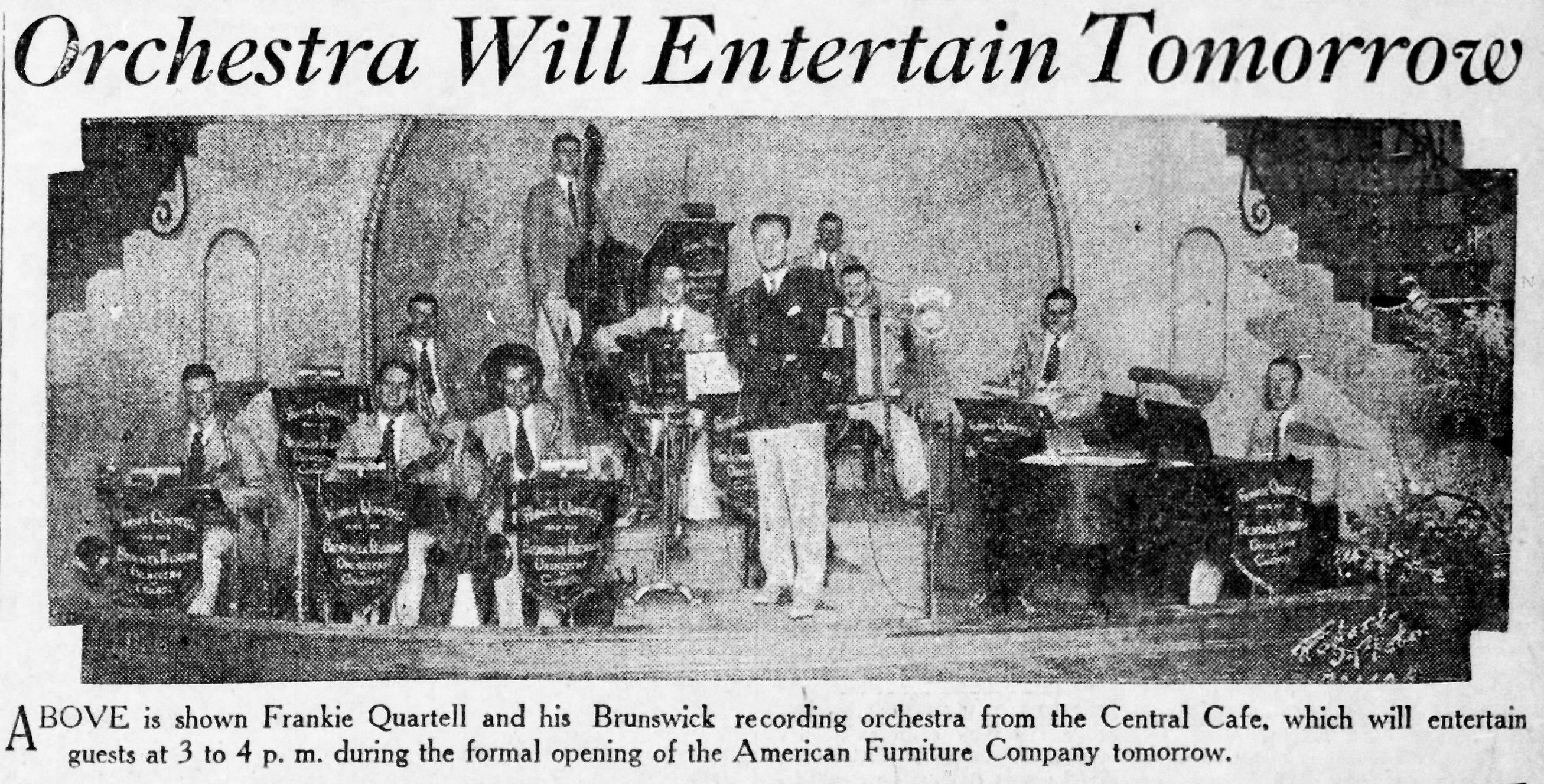
After locating Mr. Gonzalez, Quartell set up an international band of American and Mexican musicians at the Central Café in Juarez. A trio from the larger band (likely Quartell and the group’s two other American musicians) began broadcasting from the radio station WDAH, “The Voice of the Rio Grande,” on the roof of the El Paso Del Norte Hotel that still stands.[xviii] Quartell recalled that the amateur station only paid the band a weekly salary of $15.00 (only about $285 in today’s money) for daily half-hour shows six days a week![xix] Quartell functioned as emcee, bandleader, soloist, and vocalist, singing his theme, “The Bouncing Baby.” Through these broadcasts and performances, Quartell became the most popular musician in the city and achieved a decent amount of wealth. By the fall of 1929, he was even able to open “Frankie Quartell’s Music Shop” that sold Brunswick records, radios, and instruments.

Quartell’s band ca. 1928. Image from El Paso Herald, October 21, 1929.

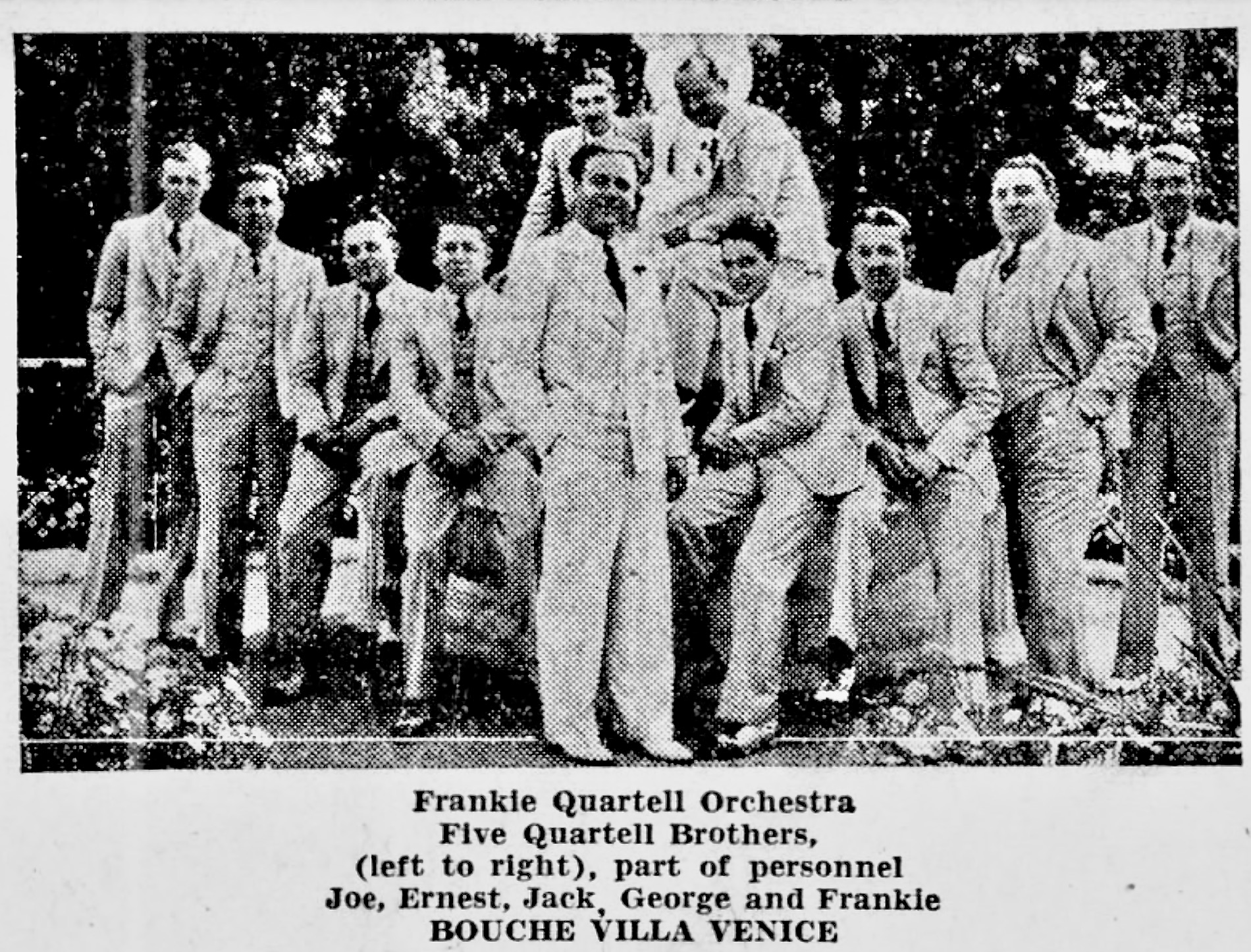
Despite the difficulties of the stock market crash, Quartell hustled even more to find steady work through much of the 1930s. Leaving El Paso and his shop due to the Depression, he ended up back in Chicago leading a band called the “Playmates” at the Edgewater Beach Hotel back in Chicago before relocating to the city’s Villa Venice.[xx] He continued playing around Chicago but routinely brought bands back to Texas, including shows in Galveston and Corpus Christi in 1932.[xxi] In 1934, the band traveled to Miami to play New Year’s Eve at the city’s own Bouche Villa Venice. The band also featured his brothers Joe, Ernest, Jack, and George, billed as the “Five Quartell Brothers,” a hot band within the band.[xxii] This, combined with the venue’s other acts, turned into a steady review that was so popular that the band was brought down to Cuba to play the Teatro Nacional in Habana, one of Quartell’s proudest moments and one of the farthest excursions music would take him on..[xxiii]

The Eighth Ring: Later Years and Epilogue

As the Great Depression wore on, Quartell began struggling to find work. He became a sideman again when, in 1936, he reconnected with his old Oriole Orchestra pal Nick Lucas to play a brief stint at New York’s Hollywood Dinner Club and (briefly) marrying 19-year-old Virginia Lee Chew. Relocating to Chicago once more, he led another band that played throughout the Midwest and was based at Colosimo’s café. This band had a steady engagement for a few years and was one of the longest tenures Quartell had in one place. It seemed that years on the road had finally caught up with him.

In 1942, just as World War II began for the United States, Quartell enlisted in the U.S. Air Force. Like so many other musicians who served, he was involved in music leadership, conducting the Air Force Training Command band at the Stevens Hotel in his hometown of Chicago. In between this, he also managed to manage the city’s Morocco Theatre Café until the war ended. In classic Quartell fashion, he was ready to move once again, this time to Los Angeles, where he became manager of the city’s Stowaway Room. Evidently, this didn’t last long. By the early 1950s, he moved back first to Chicago, where he married his last wife, Lois Zuber, and then to Florida, where he managed the Colonnade Hotel auditorium in Riviera Beach. But something in him once again called him back to El Paso, where he eventually retired for good, convincing much of his family to move there in the process. He spent the last two and a half decades of his life there, enjoying the sunshine and fond memories of the days when he was the city’s musical kingpin. It was there that he would eventually pass away on August 22, 1984.

Frankie Quartell’s life story is unique. Like a pinball, he bounced around the country and, indeed, the world during some of the most economically challenging times in American history. Raised from almost nothing, he worked his way into the national spotlight and made an impact nearly everywhere he went. But, like the music he loved, he faded into obscurity with the changing of the tide, and so too did much of his legacy. But thanks to a few scratchy old records, some faded newspaper clippings, and the tireless love of jazz fans from around the world, we can rediscover and revive the legend of Frankie Quartell and the music that captured audiences from the Hull House to Havana one side (or tree ring) at a time.

From Colin Hancock and Dave Bock’s collections.

Acknowledgments

Special thanks to Dave Bock, Kevin Coffey, Ate Van Delden, Vince Giordano, Javier Soria Laso, David Sager, Andrew J. Sammut, and Dustin Wittman for their help in preparing this article and providing precious source materials including recordings, clippings, and photographs.

Thanks to Kevin Coffey and Andrew J. Sammut for their careful edits to this piece. Thanks also to Coffey for his help with establishing an accurate timeline of the Oriole Orchestra. Thanks to Sammut for inclusion of this piece on his Pop of Yestercentury blog.

Thanks to Dustin Wittman for his restorations of “Prince of Wails,” “Sweet Baby,” and “Pining.”

Personnel and discographical information taken from Brian Rust’s Jazz and Ragtime Records, 1897–1942 and The American Dance Band Discography, 1917–1942; Richard J. Johnson and Bernard H. Shirley’s American Dance Bands on Records and Film, 1915–1942; and the Discography of American Historical Recordings with edits, additions, and revisions by Kevin Coffey, Javier Soria Laso, and Colin Hancock.

Endnotes

[i] A birth certificate for Maria Carmela, born July 4, 1894, to Vincenzo and Crestina, exists in the Cook County records but no records appear to exist after that besides an 1896 New York State death certificate that lists Maria Carmela to have been born in 1895 yet is unconfirmed as to whether or not the parents are Vincenzo and Crestina. Another Carmela, aged one and born in 1898, is listed in the 1900 census as a daughter living at the Quaratiello household beneath her grandmother, Carmela Sr. Could this one-year-old be the same as the ca. 1894 Carmela? Could she have been yet another premature death in the family. So far, we do not know.

[ii] Dick Holbrook: “Mr. Jazz Himself: Interview with Ray Lopez, Part II,” Storyville no. 69 (1977)

[iii] In his 1977 interview, Quartell claimed to join the Kentucky Five in 1918. Though there is a Kentucky Five performing in St. Louis in 1918 with the Zeigler Sisters, Kevin Coffey pointed out that it’s unlikely that Quartell would have traveled this early before being a card-carrying union musician. Quartell also misremembered his dates by about two years in the interview (stating, for instance, that he joined the Oriole Orchestra in 1920 rather than the actual date of 1922), which would place his tenure with the Kentucky Five closer to 1920–21.

[iv] 1977 UTEP interview; research by Kevin Coffey.

[v] Kennedy, William Howard: Jazz on the River, chapter 3: Louis Armstrong and Riverboat Culture.” University of Chicago Press, 2005, p. 66.

[vi] Research by Kevin Coffey.

[vii] Id.

[viii] Contemporary advertisements for the band specified that each musician was a “exclusive Columbia recording artist.” Judging by the frequency that Biese recorded at this time, aural evidence on the recordings, and photo evidence, Quartell’s presence is almost without question.

[ix] “Fine Dance Hall is to Displace Theatre,” Detroit Free Press, May 7, 1922, p. 45; The Brooklyn Daily Times, Jan 7, 1923, p.16; Brooklyn Eagle, Jan 7, 1923, p.36.

[x] “Arcadia Closes Tonight with Wonder Orchestra,” Detroit Free Press, May 30, 1922, p.1.

[xi] Research by Kevin Coffey. Though Quartell claimed to have been in the band “a year and a half,” Kevin Coffey points out that contemporary press for the Oriole Orchestra stop mentioning Quartell (but keep mentioning Papilla, Lucas, etc.) around June of 1923. Could Quartell have just stayed on for the recording sessions after the Cleveland engagement? It is also worth noting that though the Vernon-Owens band did make records for Gennett that year, their recordings were made in February, and therefore Quartell’s presence is doubtful

[xii] Research by Kevin Coffey.

[xiii]Id.

[xiv] 1977 UTEP interview.

[xv] “Stinting Wife to Play Poker Wrong Court Says,” The St. Louis Star and Times, Feb. 28, 1927, p.3.

[xvi] 1977 UTEP interview.

[xvii] Research by Kevin Coffey.

[xviii] Id.

[xix] Id.

[xx] Brooklyn Eagle, Feb. 14, 1930, p.2; 1977 UTEP interview.

[xxi] “Noted Dance Band to Play Here Friday!” Corpus Christi Times, May 23, 1932, p.3.

[xxii] “Appearing at Metropolitan Miami Supper Clubs,” The Miami Herald, Feb. 23, 1935, p.12.

[xxiii] “Villa Venice Open Until End of the Month,” The Miami Herald, Mar. 23, 1935, p.28.

[Thanks so much to Colin for sharing his post here!—AJS]

Tagged , , , , , , , , , , , , ,

The Harrison Records Story

Each Harrison Records LP is indexed with just one letter. The Harrison catalog starts with Harrison A, including the famous Glen Gray band as well as the lesser-known Mack Rogers band, and runs through a Stu Pletcher compilation on Harrison X. That index typifies the charming modesty underneath this label’s wide range of hot music. I’m still searching for Y and Z.

Harrison records also sport endearingly simple graphics, an immediately recognizable and welcome sight in record stores bins and flea market crates. A Harrison logo means something interesting from slightly outside the twenties Top 40. It might be something unissued elsewhere. It’s often music that might not meet more doctrinaire definitions of “hot music, traditional jazz,” or whatever one might label the sounds on the vinyl.

It seems like Harrison’s producer cared more about rhythm, texture and open-eared history than categories. There is plenty of jazz, especially from obscure territory bands. Yet there are also opportunities to appreciate the color and craftsmanship of non-improvising dance bands and even some “sweet’ outfits. Harrison introduced me to the joys of Eubie Blake’s big band—treading greyer and greyer areas between jazz and show music—as well as Adrian Schubert’s elegantly hot dance music and Henny Hendrickson’s Louisville Serenaders in all their thumping glory:

The engineering delivers the music clearly and the information on the back covers is beautifully no-frills: dates, personnel, and an occasional note about the music, but no extended essays or personal reflections. There is plenty of white space for the listener to literally or figuratively write their own notes (many of my Harrisons are pockmarked with discographical shorthand). In a time before Google, this music had to speak for itself.

Tom Crowley’s “Doc’oligy” appears on Harrison C, Let’s Start With Jack Teagarden, which lists nothing other than unidentified personnel, a date in 1935 and “Atlanta.” A note mentions that Casa Loma trumpeter Grady Watts played with the Crowley band years earlier, but the bare context makes this track’s pumping wail that much more mysterious:

Unlike Frog or Jazz Oracle, Harrison came and went before the internet. When I first started finding Harrison records, its staff and mission were a mystery. The only thing I knew was that at some time (the seventies or eighties, from the look and wear of the records), someone took it upon themselves to bring over two dozen LPs of music from the twenties and thirties into the world. Then it ended up on my turntable to let me hear Hal Denman and the hotter side of Kay Kyser. On paper, that simply sounds like any record company. Through my speakers, it was a miracle.

The credits were as self-effacing as the packaging They listed collectors who contributed 78s, a sound engineer and occasionally a cover artist. The only clue to the genesis of these records was a label on each: “Produced and Distributed By Edward H. Reynolds,” with an address in Wakefield, Massachusetts. Wakefield is a fine town on Massachusetts’s North Shore yet (to the best of my knowledge) not famous for its music scene or record industry. What was going on in Wakefield?

It turns out Ed Reynolds was going on in Wakefield, and he was all that was needed to make Harrison happen.

A Google search revealed that Edward Harrison Reynolds passed away recently enough that I could have interviewed him had my curiosity struck sooner. In addition to a record producer, he was also a decorated veteran, a husband, and a father. His son Bill has played drums with nationally known local favorites The Back Bay Ramblers and the New Black Eagle Jazz Band. I reached Bill through his website, and he was kind enough to share the following memories with me:

My father was a passionate record collector and hot jazz aficionado. He had about 4,000 78s in his collection and loved everything about traditional jazz, including hunting all over the Northeast for rare records.

During the 50s, he and three fellow record collectors would get together every Saturday night for a listening session. They would take turns hosting the session, with the host supplying the music (and the food). The music was arranged in setlists, much like a bandleader would do before a gig.

The host offered no information about the tracks. It was a “blindfold” game: each listener would be given a pencil and paper to write down information about each track while it was playing, like the name of the band, the label it was recorded on, the year of the recording, and any additional information about the musicians. They had a complicated point system that determined the winner of each session. Each guy owned a reel-to-reel tape recorder and would freely share music from their collections.

Dad just loved these listening sessions, especially sharing the music. He decided that more people needed to be exposed to the music that he loved, so he researched the process for having some of his favorite music from his own collection professionally copied, packaged, and pressed.
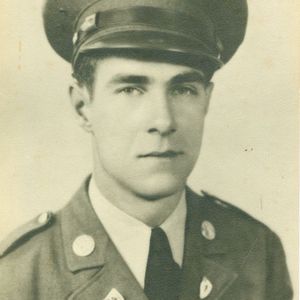
The newly pressed records would be sent to his home, and he would advertise in all of the traditional jazz magazines. He personally packed them and shipped the records. It was a one-man operation! He probably broke even financially but stuck to his original plan of doing 26 volumes, one for each letter of the alphabet.

The Harrison Records story did not stop there. Apparently not one to rest on his laurels or his record collection, Ed moved on to producing hot music by contemporary practitioners and knew just where to start. Bill explained further…

After finishing the first 26 volumes, Dad asked me what I thought about organizing a recording band made up of the best traditional musicians on the east coast and recording studio albums under the Harrison Records label. He would choose all of the songs and would market the records in the same manner as his previous releases. Other considerations were the musical arrangements, studio time, and paying the musicians.

We named the band “The Back Bay Ramblers.” It was my father’s dream band: trumpet, trombone, two reed players, piano, bass/tuba, banjo, and drums, and vocalists. The band members contributed arrangements in the style that my dad loved: tightly arranged ensembles featuring the horn sections with plenty of hot jazz solos and a driving rhythm section. Most of the songs were chosen by my dad. Bob Connors, the great trombone player and bandleader, was the principal arranger and musical director.

Photo courtesy of nejazz.com.

We recorded three albums for Harrison and another four CDs for Bob Erdos’s Stomp Off label. The band also performed concerts and at many jazz festivals on the East Coast. However, due to the size of the band, most available venues couldn’t financially support us. It got harder and harder to get bookings.

In his last few years, my dad would always suggest that I put the band back together. I was busy doing other gigs, teaching, and raising a family, and just didn’t have the time. I had retired from my teaching gig at about the same time that my dad got sick. After he passed away, I put the band back together for a series of tribute concerts honoring him.

That pretty much covers the whole story. It was a labor of love. It was Harrison Records.

It is a testament to Mr. Reynolds that it still is Harrison Records. It’s just a pity that the alphabet wasn’t longer.

Edward H. Reynolds. Photo courtesy of McDonald Funeral Homes of Wakefield, MA.

Tagged , , , , , , , , , , , ,

Irick, Seymour: 1899-1929

A post about Seymour Irick probably seems fairly obscure so another one may cause retinal detachment. There is so little on record and in the records about this rag-a-jazz trumpeter. Yet four sides, the last he left to posterity, show a distinct musical personality.

Garvin Bushell described Irick as “immaculate…kept himself clean [and] dressed well.” Not to psychoanalyze the dead or their music, but those phrases describe Irick’s work on “Charleston Geechie Dance” well:

Irick’s trumpet is neat and stylish, playful in a somewhat finicky way. His style comes out of a pre-Armstrong improvisatory idiom, emphasizing melodic embellishment, textural variety and tense syncopation (rather than harmonic exploration or rhythmic ease). Irick is like a cat batting away at a toy, never letting it out of his sight and certainly not trying to break it. It’s easy to hear why this style was “hot.” Its precise attack, combined with accents on the offbeat, builds up staccato intensity against the regular beat of the rhythm section.

Bushell also notes that Irick was a “Geechie,” a member of a rich and distinct African American culture in parts of South Carolina as well as Georgia. Seymour Izell Irick was born February 1899 in Summerville, South Carolina, Dorchester County, one of the South Carolina “low country” areas inhabited by Geechie communities. Tom Delaney (of “Jazz Me Blues” fame) is listed as the composer for “Charleston Geechie Dance,” perhaps an overt homage to his own Geechie birthplace in Charleston, South Carolina. Charleston was also home of The Jenkins Orphanage, an incubator for jazz talents such as Gus Aiken (trumpeter), Cat Anderson (another trumpeter) and Jabbo Smith (ditto). Irick never developed an eighth of the discography or reputation of those others, so any linkages are unknown at this point, but Irick did belong to this distinct group of expatriates living in New York City during the Jazz Age.

It is fun to imagine Irick getting a kick out of the title of the song. On record, he certainly seems to be enjoying himself, but that could just be the mark of a passionate professional. He’s just as energetic on “Shake That Thing” from the same session. Listening past the surface noise and a few stylistic revolutions, this record becomes a master class in subtle rag-a-jazz theme/variation:

Solos as well as unison and harmonized sections with Percy Glascoe’s reeds squeeze a lot of variety into a three-minute quartet side. Irick’s tight mute adds new color to the melody. He plays clipped, heavily syncopated allusions to the theme, at times like he’s playing the harmony part without the lead. Irick’s third solo varies each phrase ending ever so slightly, an attention to detail like the cuffs on a dress shirt. His banter with Glascoe is cute and clever without degenerating into hokum.

Garvin Bushell provides a musical description of Irick by way of Bunk Johnson. He notes that
“[Johnson] didn’t play the New Orleans style I expected to hear. He played the way they used to all up and down on the East Coast, in New York, or even in Springfield[, Ohio]–he sounded more like Jack Hatton or Seymour Irick. It was a ragtime style of trumpet.” Bushell’s comments point out the uniqueness of regional styles in jazz’s earliest days and indicate that New Orleans musicians themselves were not a monolith.

The “ragtime style of trumpet” or “old-time pit orchestra” sound is on display for the bulk of Irick’s recorded output. His earliest sides with the backing band for blues singer Lucille Hegamin are mostly show music, orchestrated in a lilting but somewhat faceless manner. Yet Irick’s lead crackles through “Mama Whip! Mama Spank!”:

Lord’s discography lists either Irick or Wesley Johnson on these sessions with Hegamin. Contemporaneous newspaper articles mention Irick as a member of the band at the Shuffle Inn of Harlem with Hegamin as the headliner. That doesn’t necessarily clinch his presence on these sides but does provide another link. Maybe Irick got the job done live and earned his spot in the recording studio.

Radio program guides from the time also show Irick in William West’s Colored Syncopators of New York, a 35-piece group playing dance music on WJZ out of Newark, New Jersey. Irick was likely a “reading musician” (like Johnson) who could be counted on for a solid lead. He doesn’t show up on record for a few years until a session with gas pipe clarinetist George McClennon. His presence is there also uncertain. If it is Irick, he is there to once again lay down a solid lead, allowing New Orleans trombonist John Lindsay and a completely unknown but highly extroverted alto saxophonist to dance over the simple ascending riff-like theme of “New Orleans Wiggle”:

KB Rau (whose extraordinarily annotated discographies and essays are an object of awe for this writer) notes that the “fine” trumpeter on this side is not as “stiff” and “ragtime derived” as Irick. Irick might have just been developing as a stylist. The slightly raspy but overall clean muted tone and clear articulation on “New Orleans Wiggle” (to my ears) point to Irick (no disrespect to Mr. Rau). On “Michigan Water Blues,” the muted wah-wah trumpet solo is more about the sound superimposed on the melody rather than rhapsodizing the tune, which also sounds like Irick. Less than a year later, he was in the studio confidently waxing “Shake That Thing” and “Charleston Geechie Dance.”

Four days later, he recorded with another Lem Fowler quartet, this time in pristine Columbia sound, making pellet-like variations and then joining Glascoe for some contrasting legato statements on “Florida Stomp”:


“Florida Stomp” and “Salty Dog” are both reminders of jazz’s role as dance music, rhythm machines not just keeping a beat but making bodies move on dance floors as well as in homes. These records probably made many people move the furniture and roll up the carpets.

From there, Irick’s musical trail stops. Lord’s lists either Irick or Bubber Miley accompanying blues singer Martha Copeland, but an extensive Miley discography compiled by Swedish researchers (no longer available online) says it is definitely Miley.

By February 1929, four years after his last recording and within weeks of his thirtieth birthday, Irick was living in a newly built home on Fish Avenue in the Bronx. He was renting from entertainer Johnny Hudgins and living with twenty-year-old Mary Schnepps, who he had met while she was hostessing at a dance hall. Records show he had married one Luella Clemons in 1923 but apparently that relationship had already dissolved one way or another. Schnepps would later describe Irick making good money as a musician, the two of them going out all night to various clubs in a fancy new car. Her description of Irick is at odds with Bushell’s recollection of him as a “pinchpenny.”

Bushell’s other term for Irick, “erratic,” must have taken on strange overtones in light of news of his being shot dead by Schnepps. She claimed self-defense during a struggle following an argument about her supposedly flirting with other men, and was later acquitted of manslaughter charges. Newspaper coverage concentrated on a white woman living with an African American man, not even getting Irick’s instrument correct.

Irick’s body was remanded to his father William back home. His military-issued tombstone proudly states his rank of “Mess Attendant” with the United States Navy, a reminder of his service aboard several ships during World War One. Even in death, Irick’s musical career didn’t seem to make much of an impact. Still, there are those four sides, less than fifteen minutes of music hinting at a larger musical presence and a complicated person. What is left to say?

Tagged , , , , , , , , ,

Trumpet(s) A La King

Ear witnesses insist that King Oliver’s Creole Jazz Band had to be heard live to be believed, leaving the thirty-seven extant sides by the band doomed to fall short of historical imagination. Bill Johnson is bass-less, Baby Dodds (more than) makes do with a stripped-down kit and the ensemble balances can sometimes turn frustratingly lopsided. Still, if that’s “all we get,” it could be far worse; the group’s easygoing swing and earthy yet graceful polyphony continue to proselytize for New Orleans jazz. Next to Johnny Dodds’s high-flying clarinet cutting through all of that well-worn shellac, the twin cornets of Oliver and young Louis Armstrong are often the main attraction:


Aside from Oliver wanting the incredible talent of Armstrong in his band, a second cornet allows unison parts, harmonies, counterpoint, trading the lead, call and response, concerted breaks and a range of colors and textures, all within a uniform timbre that opens up subtle gradations of personal tone. Without taking anything away from today’s five-person trumpet sections, Oliver and Armstrong’s miniature brass section attained an ideal balance between arrangement and improvisation, preparation and spontaneity, a unique power and swing that made it famous in its day and beyond.

Creative as well as commercial impulses were bound to inspire others to take something as seemingly simple as two trumpets playing together and make it their own. Armstrong joined the KOCJB in the summer of 1922. By October of the same year, Frank Westphal’s trumpet team is showing off a stop-time duet on “She’s A Mean Job” (though there might be a trombone in the stack too):

Their syncopated break and subsequent variations on it momentarily take the record in a different direction. The rhythm gets more intense while the texture gets lighter, a sort of hot concerto grosso in the middle of Westphal’s big band.

It is possible that Westphal and his sidemen visited the Lincoln Gardens to check out Oliver’s band and crib a few ideas. Yet in “February of 1922, several months before Armstrong joined Oliver, Westphal’s band waxed “That Barkin’ Dog” and featuring its own hot trumpet routine:

It is unclear if trumpeters Charles Burns and Austyn Edward or the arranger were deliberately trying to imitate Oliver’s band. The slightly clipped articulation and shaking vibrato also show traces of Freddie Keppard. Whoever they were listening to, the concluding ride-out remains a hot and clever piece of arranging and performance. The title of this track portends animal onomatopoeia but it instead immediately settles into a medium-tempo, proudly two-beat, fancy and funky early twenties stomp that likely left dancers eager for more.

Hot trumpet duets may seem like the inevitable result of the typical size of bands at the time, with their configuration of two trumpets, one trombone, three saxophones and rhythm section. As another commentator pointed out, the KOCJB was itself only two additional reeds short of being a typical twenties tentet. Hearing two trumpets play hot might not seem like a stylistic event, unless it happens to be a few years later, out in Texas, under Lloyd Finlay’s direction:

Hot trumpet sections spring up throughout all three sessions by this obscure territory band. It’s a musical monument to the incredible cross-pollination between local musical idioms, a time before national dissemination of music could be taken for granted and there were still distinct local traditions that could absorb others, like this group of European American musicians clearly learning from Southern expatriate African American musicians in Chicago. “Ride ‘Em Cowboy” is a telling example: things start out unpromising but pick up as soon as the trumpets join in. The parts aren’t in lockstep but closer to heterophony, with just enough slack between them to add depth and spontaneity. It also sounds like one of the brass players might be muted, adding yet another layer.

A year later in New York, Duke Ellington’s trumpets sound even closer to the King Oliver model:

The syncopation and vocalized inflection point back to the Oliver band while the alternation between open and closed bells has a distinctly Ellingtonian color: darker, more atmospheric than earthy and more incisive. Ellington was a musical sponge savvy enough to synthesize ideas from across several jazz communities and was bound to draw inspiration from hearing the Oliver band (live or on record). Gunther Schuller singled out this section as a deliberate and poor imitation of the KOCJB’s hot trumpet duets, but that description seems a little unfair to Ellington or trumpeters Harry Cooper and Leroy Rutledge. This writer is going to humbly disagree with Schuller’s analysis and suggest that the trumpets bursting in right after Sonny Greer’s comparatively understated vocal actually reignite the side, providing a semi-improvised variation on the tune proper and building tension before the full band comes back in.

Critics and historians have completely ignored Hoagy Carmichael’s trumpet section on “Friday Night,” cut one year later than the Ellington side and coming across like a sock time rendition of the KOCJB sound:

[Thanks to the commenter below for finding that clip!]
Carmichael played cornet on a few sessions in addition to his usual role as a pianist. Byron Smart was the sole cornet on several sides with Emil Seidel, meaning he would have been able to hold down the trumpet chair on this Carmichael session on his own. Yet Carmichael adds his horn alongside that of Smart for this date, indicating a specific sound that he wanted for the tune. This was not just a happenstance of instrumentation but a deliberate musical choice that opened up new possibilities.

As for the line between sincere tribute, outright imitation or shameful knockoff, descriptions like Schuller’s appear throughout jazz criticism, right back to accusations (by others and not by this writer) that the Original Dixieland Jazz Band was playing a crude, commercialized caricature of “real” New Orleans jazz. Suffice it to say that there is little reason to expect every jazz band recorded during the twenties to sound like a handful of musicians from New Orleans at that time (or every musician playing now to sound like the Blue Note catalog circa 1961). If none of these groups had ever even heard of King Oliver, let alone focused on his cornet parts, their shared efforts would be all the more remarkable. In the right musical hands, two of the same instrument can make a world of difference!

Tagged , , , , , , ,

A Stan King Playlist

Photo Care of @onlyapaprmoon

Photo from Timeless CD CBC 1-090 courtesy of @onlyapaprmoon

Like most early jazz drummers, Stan King was not well served by technology. He first appeared on hundreds of sessions with the California Ramblers, including the band’s numerous offshoots for different labels, starting in the early twenties. Acoustic recording techniques at that time limited the equipment that drummers could use, and the technology wasn’t kind to what remained of the kit. King does manage to burst out of the Five Birmingham Babies (a.k.a. the California Ramblers) on “Arkansas” and bang out some springy drum rudiments on Ray Kitchingham’s banjo:

Unfortunately, outbursts like this one were rare. King didn’t use the standard acoustically sanctioned percussion (like cymbals and blocks) as much as his contemporaries Zutty Singleton, Baby Dodds, and Chauncey Morehouse. So despite all the records, it’s hard to hear what or how King was playing early on his career. Either way, it got him plenty of work! He must have been doing something worth hearing.

Based on slightly later recordings, it involved plenty of snare drum. Jazz drumming now often tends to emphasize metal as the primary beat maker. Yet as “Broken Idol” with the Ramblers shows, King could move a band with “just” drum skins. It’s a pity he was so skilled with what amounted to kryptonite for most recording engineers of the twenties:

Aside from a few cymbal crashes, the “exotic” blocks, and tom-toms, King’s main rhythmic medium here is his snare and bass drum. He keeps up a simple but buoyant bounce alongside Tommy Felline’s banjo and then steps out behind Pete Pumiglio’s red hot alto sax solo. The brushes are pure momentum, more than compensating for Ward Lay’s slightly ponderous tuba. There’s none of the military-style heft that so many historians associate with prewar, snare-centric jazz drumming.

King’s work with Frank Trumbauer’s orchestra demonstrates his light but propulsive touch on drum heads while never drawing too much attention to the wheels moving the band. “Futuristic Rhythm” includes a head-bobbing rhythm in the first chorus and percolating accompaniment to the leader’s vocal and cymbals behind Bix Beiderbecke:

King’s airtight press rolls and last chorus backbeat on “I Like That” (a.k.a. “Loved One“) are simple, impeccably timed, and very effective:

Listening to King nearly 60 years later, renowned drummer Mel Lewis pointed to King’s “clean” style with definite praise. A crisp, precise, and utterly unobtrusive approach defines King’s style more than any part of the drum set. He was above all an ensemble player who rarely soloed but always made sure that the band was “well fed” (to paraphrase bass sage Walter Page describing the role of the rhythm section).

With the Charleston Chasers, King leaves most of the rhythmic heavy lifting on “Loveable and Sweet” and “Red Hair and Freckles” (what were these guys thinking about on this session?) to pianist Arthur Schutt and bassist Joe Tarto:

Dancers and jazz aficionados may not be listening for King’s sizzling brushes and tapping rims or how his drums click in with Tarto’s bass to produce a deliciously buzzy sonority or for his simple but firm beat. Listening to those touches reveals how subtly King could color and catalyze a band. It also points to an attention to detail and a knack for musical nuance that might not be heard could be felt. For example, while many drummers use press rolls, and King relied on them throughout his career, the way that he loosens his press rolls up behind Tommy Dorsey’s trumpet solo on “Hot Heels” with Eddie Lang makes a difference:

Audio wizard, historian, and trombonist David Sager recalls an “old-time drummer” he met at a gig in California “who nearly shouted when he said, ‘Stan King had the best press roll in the business!’” King’s press rolls with none other than Louis Armstrong on Seger Ellis’ “S’Posin” might not impress on their own, but Armstrong scholar Ricky Riccardi explains that “Armstrong liked loud, emphatic drumming, and he obviously dug what King was putting down.”

[Listen to “S’Posin” via Riccardi’s outstanding blog here, and subscribe while you’re at it.]

According to Richard Sudhalter, King didn’t read music. His “natural drive and quick ear” were enough to make him one of the most in-demand drummers in New York during the twenties and thirties, performing with Paul Whiteman, Jean Goldkette, the Boswell Sisters, Ben Selvin, the Dorsey Brothers, and Benny Goodman among others. A session directed by bass saxophonist Adrian Rollini finds King with the cream of the New York jazz crop at that time on standards such as” Sugar” and  “Davenport Blues”:

On “Somebody Loves Me,” King lays out behind George Van Eps’s solo, which allows the guitar to get heard and changes up the ensemble texture, but digs in behind Goodman’s clarinet and Arthur Rollini’s tenor saxophone while easing back behind trumpeter Mannie Klein and trombonist Jack Teagarden. It’s a model of sensitive, rhythmic jazz drumming (or “dance band” drumming, depending on one’s preferred pigeonhole):

King could also turn up the heat on his own. On “The Man From The South” with Rube Bloom, he locks in with Adrian Rollini, tossing out fast snappy fills and bearing down just a little harder behind Goodman before making room for Rollini’s solo:

On “Here Comes Emily Brown”—again with the Charleston Chasers but without Joe Tarto’s booming slap bass—King add a sizzle to his shuffle behind Tommy Dorsey’s trombone while his cowbell accents practically kick Benny Goodman from behind. Fills and backbeat on the out chorus also boot the ensemble:

King even gets some spotlight in a call and response episode with the ensemble on “Freeze and Melt” with Lang:

Occasionally, King would get away from a steady beat and toss out unexpected accents and syncopations, for example early on his career behind Bobby Davis’ alto solo on “That Certain Party” with the Goofus Five (a.k.a. the California Ramblers):

or his offbeat rim “bombs” behind Jimmy Dorsey’s alto on “You’re Lucky To Me”:

Yet it’s all within the context of the band. Record after record shows King to be a clean, precise, utterly musical drummer. His preferred instrumentation may have limited his recorded legacy, and his unflashy style may have hindered his historical one. Singer Helen Ward, speaking about King’s tenure with Benny Goodman’s band, said “we called him strictly a society type of musician. Everything he played was ‘boom-cha, boom-cha.’ There was no fire there.” Goodman described King as “merely adequate.”

The entry for King in the Encyclopedia of Popular Music describes “an exceptionally good dance band drummer with meticulous time [whose] jazz work always left something to be desired. Listening to, for example, Goodman’s recordings in late 1934 will reveal how King’s playing never lifts the band in the way Gene Krupa did when he took over as drummer…” John Chilton describes Louis Armstrong’s “I’m Putting All My Eggs In One Basket” as a “typical example of [King’s] somewhat foursquare playing:

King isn’t Krupa, Dodds, Sid Catlett (or for that matter Elvin Jones), but it’s easy to imagine any of those players taking the same approach that King does given the thin material, flimsy arrangement, and the fact that this is really Armstrong’s show. Riccardi astutely points out King’s “tasty” accents during Armstrong’s opening trumpet chorus and the fact that “relaxation is the key” here. There’s a difference between playing stiffly and playing appropriately, a difference King was more than experienced enough to understand.

In the stylistic wake of louder, better-recorded, and busier drummers, it is easy to overlook someone like King, who performed an essential role seamlessly and without drawing attention to his work. What some overlook, others celebrated. Drummer Chauncey Morehouse would praise King for his solid time years after his colleague’s death. When Morehouse led his own date playing his patented N’Goma drums, he chose King to handle traps duty.  Fud Livingston thought King was “the world’s greatest drummer!” Saxophonist and historian Loren Schoenberg noted how King continued to get work despite his well-known status as a “fall-down drunk.” It didn’t seem to matter: King got the job done.

Jazz historian Scott Yanow, who credited King for his “fresh” sound, explains that King’s alcoholism finally did get the best of him. King eventually took a low-key job with former California Ramblers sideman Chauncey Grey before fading from attention and passing away in 1949. King made his last recordings ten year earlier, with pianist (and fellow victim of alcoholism) Bob Zurke. “I’ve Found A New Baby” wasn’t the last thing King recorded but it provides explosive closure:

Fud Livingston’s arrangement gives King and the rest of the band plenty of room. King is a force of nature, crisp and light as always but distinctly forward in the mix, perhaps the influence of what Krupa and Chick Webb were bringing to the table at the time. King still remains his own man, with press rolls in first chorus and rim shots and backbeats egging on Zurke’s contrapuntal flurries and Sterling Bose’s trumpet. At a time when most drummers were emphasizing cymbals and a steady horizontal flow, King stuck to skins and a charging but tight vertical feel. He had something unique to contribute and put the needs of the band first. That certainly sounds like a jazz drummer, or maybe a just a good band drummer, but definitely a drummer worth hiring and hearing.

Tagged , , , , , , , , , , , , , , , , , , , , , , , , , , , , , , , , , , , , , , , , , , , , , , , , , , , , , , , , , , , , , , , , , , , , , , , , , , , , , , , , , , , , , , , , , , , , , , , , , , ,

Bennie Moten’s Sax Soloists

Here’s the second and final part of my discussion of Bennie Moten’s pre-1930 sax section…

naturalsaxdotcom

The range of ensemble colors is directly proportional to the sum of instrumental voices, so that more players equal more instruments and therefore more orchestral possibilities.

At first glance it seems like simple musical mathematics, borne out by jazz history: big bands developed from Jazz Age tentets to the fifteen-piece plus ensembles that are now industry standard. The saxophone section alone started as a three-man operation. Now five players (two altos, two tenors and a baritone) is the norm. The math says that three horns can’t produce the same variety as five, and history paints these changes as a natural and inevitable evolution. Usually the underlying assumption here is that twenties bandleaders were either bad at orchestral arithmetic or good with a bottom line. The idea that musicians just chose the right sidemen and did a lot with what was only later deemed “a little” rarely enters the equation.

For example, Bennie Moten’s sax section does usually stick to the two altos plus tenor arrangement that was standard for most twenties bands. Yet whatever this section may lack in terms of variety as a concerted unit, it more than makes up for in solo permutations. Harlan Leonard, Woody Walder and Jack Washington each play with distinct, contrasting styles. Factor in different approaches to different types of musical material as well as instrumental doubling, and you get a surprisingly broad musical palette.

Leonard plays both bright lead alto and bluesily rococo solos with a delightfully nasal edge. He tosses in fills between the ensemble on “When Life Seems So Blue,” while “Oh! Eddie” and “Mary Lee” include tantalizingly short but hot bridges:

Leonard’s soprano sax is a refreshing alternative to Sidney Bechet’s towering presence as well as the brass clarinet approach many of his contemporaries took to the instrument.  On “Boot It,” he plays with a with a joyous hoedown feel, recalling early jazz’s intersection with country and other folk art forms:

Clarinetist Woody Walder is often demonized for his novelty solos on the earliest Moten sides. Walder’s arsenal of whinnies, pops and barnyard onomatopoeia might be an acquired taste (personally I think he was just anticipating the Art Ensemble of Chicago) but his clarinet solos with the late Moten band deserve more attention. He plays some simple but direct blues in a sandy low register on “That Too Do,” with a few inflections thrown in as a type of musical signature:

Walder interpolates more passionate blues on the non-blues form of “New Vine Street Blues” and plays jittery, high-octane clarinet on faster numbers such as “Sweetheart of Yesterday” as well as shouting obbligatos to close numbers such as “Oh! Eddie.”

Doubling tenor, Walder seems hell-bent on sounding just as massive and brawny on the larger instrument as he is fleet and piercing on the smaller one. On “Everyday Blues” and the jerky, tongue-in-cheek “New Goofy Dust Rag”, he smears notes in a sweaty, agitated style. There are traces of Coleman Hawkins, but none of his harmonic sophistication. This is greasy saloon stuff without any hint of the conservatory:

Jack Washington is best known for anchoring Count Basie’s sax section, but as a younger man he played second alto with Moten and got much more solo space on baritone sax. He displays a burnished, gargantuan sound on baritone that’s closer to a bass saxophone, even pumping out effective bass lines for “That Too Do.” Washington’s unique tone is already put to effective use at this early stage, for example creating dark contrast behind the flashy trumpet on “Rit Dit Ray” and playing lead on baritone for a few tunes. This effect can be heard in other bands from the time, but Washington adds his own unique density:

Washington’s solos are all bottom and darkness, subterranean parties in a delightfully archaic vein. He takes slap tonguing to a whole new level, for example on “New Vine Street” but never forgets to swing; take his solo on “Mack’s Rhythm” or the way he dances all over “Mary Lee”:

“Mary Lee” also includes another Leonard bridge as well as Walder’s percussive clarinet and tenor honks.  Given its sheer range of colors, Moten’s sax section could have been its own band, a front line unto itself. It’s not a Gil Evans affair but neither is it just three players, or five instruments, or even eight if you include the fact that everyone doubled clarinet. It is simply incredible that this was just one section of a band. Then again, who’s counting?

direct proportion

Tagged , , , , , , , , , , , , , , , , , , , , , , , , , , , , , , , , , , ,

Beauty, Rhythm and Paychecks with Ben Pollack’s Boys

Here’s a case for all the popular music that jazz musicians had to record just to make ends meet during the prewar era.

The following session includes some of the best players in New York at that time, regulars in Ben Pollack‘s band and performing here in one of the many studio groups organized by impresario Irving Mills. Young Benny Goodman sticks to reading alto saxophone parts, and Jack Teagarden’s trombone is barely audible, yet it’s not just commercial dross:

Scholars and purists will probably fast-forward to Jimmy McPartland’s cornet solo. Some might even mention criminally underrated saxophonist Larry Binyon. Yet McPartland is as rich, penetrating and warm on straight lead as he is in his Beiderbecke-inspired improvisation.  A typical prewar sax section (two altos and a tenor) has a bright, buttery sound that’s a refreshing change of pace from more modern reeds. Even the unknown, operetta-inspired crooner sounds more than bearable with Dick McPartland’s banjo, Harry Goodman’s tuba and Ray Bauduc‘s drums guarding the beat behind him.

Despite the simple tune and small space given to improvisation, a group of talented musicians makes it beautiful as well as rhythmic.  There’s no way to tell if heroes are happy, but these professionals certainly sound good.

Tagged , , , , , , , , , , , , , , , , , ,

How (Not) To Listen To Early Jazz

All About Jazz has been very supportive of prewar jazz coverage, so I’m thrilled to see my column published on their website. In its latest article, I discuss some of the perceptions that make the music’s early sounds seem so removed from the jazz continuum. Hopefully it’ll inspire some open ears, and maybe a few stuffed stockings.

I also hope you’ll give it a read, right here. Thank you!

Tagged , , , , , , , , , , , , , , , , , , , , , , , , , , , , , , , , ,