And he loves Cab Calloway. The man knows his stuff.
Ask him if he knows the date of the recording, or if there are any alternate takes. Find out if he thinks the arrangement used any interesting techniques, or if the soloists were innovators. Ask if he wishes the lyrics were more political, or if he remembers Calloway’s skin color.
Those are all important, often enlightening facts this person may not have access to at this time in his life. Yet his suddenly open, instantly joyous eyes somehow seem far more important.
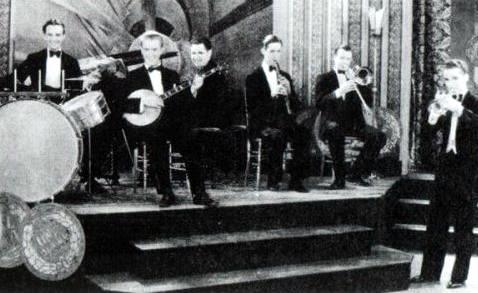
Swing, blues and a completely fresh improvisation at every performance: three common (for some essential) descriptors of “jazz” that were only beginning to take root at the height of Phil Napoleon’s career. Sounds from New Orleans and the Midwest territories were not as widespread when Napoleon was blowing trumpet for the Original Memphis Five. Louis Armstrong’ rhythmic and solo innovations were still to come, and jazz remained a collective experience with strong influences from ragtime. Yet even beyond his musical and historical surroundings, Napoleon always had other priorities.
Those priorities included a brilliant yet inviting tone, given to clipped articulation and rhythmically tense phrasing. That tone usually supported a powerful, balanced lead, but could also supply spare, neatly organized “hot” patterns. “How Come You Do Me Like You Do” features Napoleon’s direct ensemble lead as well as his witty muted obbligato behind Jimmy Lytell’s clarinet:
Richard M. Sudhalter explained, “The Memphis Five appear to have ‘routined’ their arrangements in advance and in detail…A routine on one number doesn’t change from take to take.” This stick-with-what-works ethic makes sense the more one hears (and feels) Napoleon’s overriding concern for balance and blend. If Napoleon knows exactly what he’s going to play next on “He May Be Your Man,” and if the rhythm is more sway than swing, he still conveys spontaneity alongside restraint. He even adds subtle sardonic color to Lem Fowler’s naughty little tune [just follow the arrow to listen]:
The chamber intimacy of these recordings combined with Napoleon’s clean, resilient sound betrays his background as a classically trained player. Even at his most unbuttoned, for example on a later date with Miff Mole, his “Dixieland” sound is perfectly centered, and he executes a tortuous muted passage (in tight harmony with Mole’s trombone!) neatly and convincingly:
Throughout his career, Napoleon never completely absorbed the loose rhythms and bluesy rhetoric of Louis Armstrong, or the coaxing warmth and harmonic palette of Bix Beiderbecke. It’s probably one reason why Napoleon has had a modest presence in most “jazz” histories. Here he is leading a group of other Jazz Age stars, instantly recognizable and dependable as always. Napoleon remained his own man, something even Armstrong and Beiderbecke could have related to:
Working for my father’s home improvement business during high school taught me to appreciate the hard work supporting our household. It also paid for the music in my earphones, which were usually on full blast as I swept floors and fetched coffee. I listened to a lot of music working the family business, but one job still stands out because it introduced me to Eddie Durham.
I had just purchased the Count Basie collection playing on my Walkman as I stuffed insulation. After a string of bright, up-tempo tunes including “One O’Clock Jump,” “John’s Idea,” “Out the Window” and “Swinging the Blues,” a moodier, minor key piece materialized. It had the same loose Basie beat and spare but powerful ensemble figures. Buck Clayton‘s tart-toned muted trumpet was also recognizable. Yet the chromatic drawl I heard gave the band a more structured, darker persona. All the dusty, scratched cassette case in my pocket told me was that the song was called “Topsy.” A lot of curiosity and a little research told me that this was Eddie Durham:
I also realized that I already knew of Eddie Durham without knowing who Eddie Durham was. He had arranged all those other numbers for the Basie band, and his name would keep coming up in the recordings of Jimmie Lunceford, Artie Shaw, Glenn Miller and Jan Savitt. Later on I would discover his electric guitar on the Kansas City Six sides he made with other Basie sidemen for the Commodore label. Eventually I would have to stop counting the number of times I uttered, “Wow, that was Eddie Durham on trombone!” My career responsibilities and knowledge of jazz have changed since first hearing “Topsy,” but more importantly I keep encountering Eddie Durham. It’s just a matter of knowing where to look.
Durham doesn’t receive the same attention as contemporary arrangers like Don Redman, Sy Oliver or the legendary Duke Ellington. His trombone playing never spurred any followers the way Jack Teagarden did, and Charlie Christian’s pioneering work has overshadowed Durham’s electric guitar as well as his influence on the young Christian. Eddie Durham is easy to appreciate but not always easy to find.
Durham’s children, daughter Marsha “Topsy” Durham and son Eric, are helping to change that. Their website honors their father with fastidious, loving care. From Durham’s beginnings as a musical director for a wild West shows to his post-retirement comeback, visitors can read about Durham’s life, peruse photos, find links to other sources and even enjoy a concise, informative documentary featuring Dan Morgenstern, Loren Schoenberg and Vince Giordano. It’s an incredible resource and tribute to their father’s legacy. In the meantime we’ll all look forward to hearing more of Eddie Durham.
Bob Zurke at the Paramount Theater, New York City, 1939
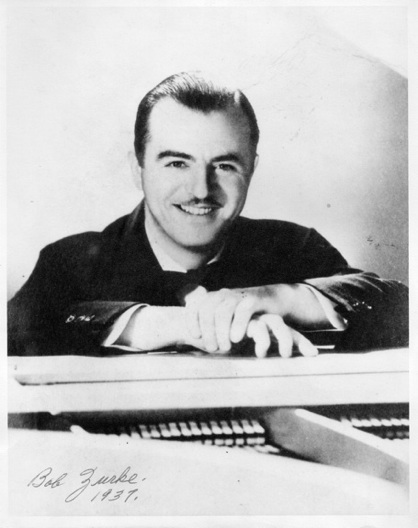
Bob Zurke collapsed while playing his regular gig at the Hangover Club in Los Angeles sixty-seven years ago today. Alcoholism and the worst excesses of life on the road had taken their toll on the pianist, culminating with pneumonia and his death the following day. While most photographs show a much older man with a worn down face, Zurke had just turned thirty-two.
What photographs don’t highlight are the hands behind the wild pianism Zurke left behind on records. Born to Polish immigrants on January 17, 1912 in Michigan, by sixteen Boguslaw Albert Zukowski was professional pianist “Bob Zurke,” whose small hands and short fingers didn’t lend themselves to the wide intervals of stride piano. Blessed with talent, imagination and a genetic dispensation to go his own way, Zurke would spin wildly intricate independent lines on the keyboard, as though separating both hemispheres of his brain and then instigating a fight between the two of them.
Gunther Schuller describes a “dynamic hurricane-like force…light years removed from the polite babbling of most 1930s band pianists.” To be fair, when compared to the swinging polyphony on “Diga Diga Doo” with the Bob Crosby orchestra, any pianist would sound reserved:
The bulk of Zurke’s all-too-brief career was spent with like-minded musical individualists in the Crosby band, which brought the warmth and stomp of New Orleans into the Swing Era. Zurke’s best work with the Crosby group combines brassy exclamations reminiscent of Earl Hines, the rich counterpoint of the Baroque and the sheer “wow” factor of virtuosos and athletes alike. On the usually twee “Tea for Two,” Zurke adds a childlike sense of mirth, like a kid superimposing dirty limericks onto a nursery tune:
Features with the Crosby band such as “Little Rock Getaway” and “Yancey Special” show him to be a uniquely room-rumbling boogie woogie stylist. Yet ironically Zurke’s most impressive, and personal, boogie on record (and coincidentally his last recording) is the accompaniment for the 1944 cartoon “Jungle Jive” (enjoy the music and avert the eyes from the dated, offensive visuals):
Zurke’s solos would occasionally start to ramble, and his intricate lines weren’t always well served by the recording techniques of his time. Musically that was about all all he had in common with most of his colleagues. Unfortunately Zurke did share many musicians’ taste for living hard and fast. After leaving Crosby and briefly leading his own big band, Zurke gigged around Chicago and Detroit before settling, and falling, in Los Angeles.
Bob Zurke, Detroit, 1937
Crosby bandmate Bob Haggart recalled “You could hear only a bar or two, and you’d know it was Bob Zurke.” The late George Shearing admitted “He always amazed me,” and Dick Sudhalter said Shearing was capable of an “uncanny” imitation of Zurke’s piano. Yet an early death, modest discography and idiosyncratic style don’t always allow much of a legacy or influence beyond collectors and specialists. Unlike some other alcoholic martyrs of jazz, Zurke’s story just seems sad, not romantic: a one-of-a-kind voice, destroyed by his vices and largely forgotten.
And then there’s the music. Is there anything those hands couldn’t do?
For more about Bob Zurke, check out Bill Edwards’ well-researched, loving biography of Zurke here.
The music business is difficult, but music history can be murder. Just ask any of a hundred composers laying dead and buried under the immortality of Bach, Mozart and other innovators. In case they’re not around, give Cab Calloway a read:
You hear about the Duke Ellingtons, the Jimmie Luncefords, and the Fletcher Hendersons, but people sometimes forget that jazz was not only built in the minds of the great ones, but on the backs of the ordinary ones.
Sour grapes? Perhaps, but the fact remains that history books don’t pay as much attention to the artists who did what they did well without breaking barriers or spawning a school of influence. Unfortunately Calloway‘s energetic singing and swinging bands were “merely” exciting music that was played incredibly, but which didn’t build the foundations of big band jazz like Henderson, reinvent jazz orchestration along the lines of Ellington or even define an iconic rhythm a la Lunceford.
Yet even Calloway has enjoyed a modest degree of historical attention compared to many of his other Swing Era colleagues. If Calloway’s back and Ellington’s mind helped build the house of jazz, they did so with the Mills Blue Rhythm Band’s legs running to all the gigs they couldn’t make.
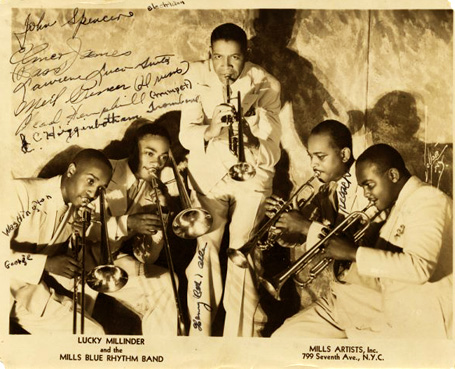
Managed by impresario Irving Mills, the Mills Blue Rhythm Band was a New York based outfit designed as a third tier cash cow underneath Mills’ other two clients, Duke Ellington and Cab Calloway. The Blue Rhythm Band would cover Ellington/Calloway fare such as “Minnie the Moocher” and “Black and Tan Fantasy” along with their own swinging originals, without ever being allowed to compete with Mills’ star operations. What short shrift the MBRB does receive in jazz history texts frequently reiterates that given a revolving door of musicians fronting the band, and absent a distinct book, the band was never able to establish a singular identity or distinguish itself from other swing groups.
The group’s discography reveals a variety of big band sonorities, roof-raising soloists (many drawn from the star-studded ranks of Fletcher Henderson’s band after it folded) and the type of innately danceable rhythm that defined “swing” as a musical adjective, verb and noun during the thirties.
“Harlem Heat” pulls all of these elements together. The cut opens with Edgar Hayes’ crystalline piano wrapping around a trio of baritone, tenor and bass saxes, followed by JC Higginbotham punching into his trombone’s upper register and Buster Bailey’s deliciously tinny clarinet acrobatics. Between it all there’s an assortment of simple, infectious riffs:
“Dancing Dogs” intersperses the brass barking thoroughly modernistic chords between Gene Mikell’s soprano sax, Red Allen‘s vicious trumpet growls, Joe Garland (of “In the Mood” infamy) on husky tenor, Buster Bailey’s reed seesaws and and more great piano from Edgar Hayes. Five soloists, a world of contrasts and less than three minutes in hot music heaven [just follow the arrow to listen]:
Here’s the band under Baron Lee’s banner and vocals, in a stoner-iffic number made popular by Calloway. Potential identity crises aside, they sound like they’re having a ball. Their snappy rhythm and Harry White’s snarling trombone more than compensate for some comedic misfires:
The rhythm is a little chunky but not stiff, and it rides forward, never up and down. Pianist Hayes, along with bassist (and future Ellington alumnus) Hayes Alvis and drummer O’Neil Spencer aren’t doing anything groundbreaking as a rhythm section, just laying down an addictively steady beat in solid four. There’s none of the percussive color of Sonny Greer, the dynamic technique of Jimmy Blanton or the world-altering glide of the Basie rhythm section. Like Al Morgan and Leroy Maxey, Cab Calloway’s bass and drum team, the MRBB’s rhythm section provided an assembly line of groove: steady, reliable, and easy to take for granted. Calloway’s back may have been sore by the end of his career, but the Mills Blue Rhythm Band needed corrective surgery.
Irving Mills has been discussed, debated and demonized, but there’s no denying he had an impressive portfolio of talent under his wing. Here’s some footage of Irving promoting all three of the bands mentioned above, with period marketing rhetoric and an accent not unlike a few of my uncles:
During his victory speech in South Carolina on Saturday night, Newt Gingrich joked about allowing President Barack Obama to use a teleprompter in debates. Gingrich has made this joke before, implying that the president needs far more preparation than he does to discuss the issues. I haven’t found any statistics comparing the ratio of Gingrichian teleprompter comments to criticisms against President George W. Bush for using similar devices, but let’s agree that neither side is safe from these attacks. It’s also safe to assume that they arise out of some powerful perceptions (if not necessarily actual facts) about the candidates.
Speaking off the top of one’s head in an articulate, exciting manner seems more impressive than doing so from a script. Spontaneity implies intelligence, poise and sincerity, while canned lines imply inauthenticity, an indicator that the orator doesn’t really know his or her stuff. After all, isn’t it easier just to read something? Aren’t we hearing something more honest when someone improvises?
Let’s face it, many jazz lovers make the same value judgment. Even if we listen to and love a variety of composed and extemporized genres, deep down we assume we’re hearing “more” of an artist when they’re improvising. The use of the phrase “opens up” is telling: it’s rarely used to describe an arrangement. A good jazz chart knocks our socks off, but we hear the “true” musician when they’re creating in the moment. It’s also why highlighting a musician’s inspirations rather than their innovations can be damning: referencing another player too much in a solo implies planning, and worse, imitation. Creating something entirely original from an admired colleague’s utterances never seems as personal when compared to offering something totally unfamiliar.
The Tyranny of the Written Score
For even casual listeners, jazz is primarily associated with a soloist improvising multiple choruses. Stylistically jazz has steadily shed all perceived impediments to completely “free” improvisation: first the written score, then the set melody, next chord changes, then key and in some cases even a steady groove. This development not only leaves a lot of jazz in stylistic limbo, it passes over some great music that happens to be on paper.
In an interview I conducted with Vince Giordano last year, the bandleader, performer and historian glowingly described the music of the twenties and thirties as “a combination of orchestrated stuff and loose jazz.” In his liner notes to An Anthology of Big Band Swing, Loren Schoenberg applauds arranger Bill Finegan’s ability to “…create scores with little or no improvisation that were still highly effective jazz.” It’s also worth noting that many jazz musicians have found inspiration from the written and rehearsed pages of the classical tradition (which itself is not always reducible to a score).
And if all the performers of Bach, Mozart and Brahms are doing is simply reading from a score, then anyone can be a great orator; all they need is a speechwriter and a research staff. There are quite a few ways to express knowledge and sincerity (or for that matter to sound knowledgeable or sincere). Whatever the relationship is between jazz and improvisation, music and spontaneity or expertise and preparation, the point is “what,” rather than “how.”
Duke Ellington understood his players so well that many parts he composed for them were mistaken for improvisations. In performance, where the sheer sound of “Concerto for Cootie” comes from seems like a footnote:
Freddie Keppard’s entire discography fits on one compact disc. It’s an ironically modest recorded legacy, especially for someone who was known for everything but modesty in their lifetime.
By most accounts Keppard was proud to the point of arrogance. He came up through the ranks of New Orleans cornetists, drew crowds on the vaudeville circuit of both coasts and was more than willing to proclaim and demonstrate his musical prowess. A photograph of the cornetist, dressed smart but tough in double-breasted suit, wide brimmed Boss of the Plains Stetson and ornate lapel medal, looking out intently with a touch of haughtiness, provides a visual allegory of the musician that no less than Jelly Roll Morton and Sidney Bechet would praise years after his passing.
Keppard’s few recordings provide teasing glimpses of his huge sound and dominating style on cornet. In Keppard’s time jazz was still transitioning from collective ingredient to solo expression. The cornet was intended to provide a solid lead, with power and color supporting an ensemble. Extended solo outings, decorous lines and multi-chorus explorations wouldn’t come into play until one of Keppard’s younger New Orleans colleagues arrived on the scene.
In addition, most of Keppard’s recordings were cut with Doc Cooke‘s large dance orchestra, in which Keppard actually played the second horn part, not lead. Keppard’s role was to heat things up during an out chorus, or contribute intense but short breaks to Cooke’s written arrangements. Many of Keppard’s sides also suffer from the worst indignities of twenties audio technology. It’s a miracle anyone still cares about this loud-mouthed ensemble player.
True to reputation, Keppard demands attention. The Cooke band’s sides on Columbia Records’ certainly help: a pristine electric recording process and the diffuse acoustics of an empty hotel ballroom capture the Cooke band cutting loose on some of their hottest charts. Keppard’s brash interjection on the aptly named “High Fever” [at 0:23 in the following clip] doesn’t have anything to prove; though brief, its cocky stride tells the listener Keppard knows exactly “who he is”:
Following the piano solo, Keppard’s blasting riffs behind lead cornet Elwood Graham [at 1:07] might not provide the best instruction in providing accompaniment. Yet Keppard wasn’t there to teach or blend or simply be heard; his presence was meant to be felt. By the time the closing “dog fight” arrives [at 2:15], whatever name was written on the lead part becomes moot. This is Keppard’s tune, with driving phrases and an infectiously “funky” break [at 2:26] bringing it to a close.
Keppard isn’t doing much technically, but his impact on the Cooke band is immense. A few months later, he brings an equally gripping effect to the clean, almost concert band-like reading of the opening theme on “Sidewalk Blues,” an interpretation that he seems to self-parody and then detonate for the ride out [starting at 2:12 in this clip]:
Keppard’s hair-trigger change is the type of “sweet to hot” juxtaposition that twenties bandleaders loved to include in even their most straight-laced material. Yet Keppard’s changeover also reminds us of the brash, occasionally volatile personality he was known for. Perhaps his most powerful maneuver was turning down an offer from Victor Records to record in 1916. The reasons for Keppard’s refusal are now legend, ranging from a concern that listeners could “steal his stuff” to balking at having to record a test pressing without pay (standard operating procedure for record labels at the time).
Whatever his motivations, they point to a man who refused anything short of what he wanted. They also point towards the Original Dixieland Jazz Band’s session of February 26, 1917, considered to be the first “jazz” recording ever made, courtesy of a group of “non-improvising White musicians” and an event still debated (and despised) on both musical and cultural grounds.
Whatever else might be said of Freddie Keppard’s music or his personality, even his smallest gestures had huge consequences. He wouldn’t have had it any other way.
“Deep Henderson” illustrates one pop tune that became just popular enough. Tom Lord’s Jazz Discography lists thirteen different bands recording Fred Rose’s composition in 1926, the same year it was published in Chicago, with four other groups cutting the tune the following year (in three different countries, no less). Most bands also used the publisher’s stock arrangement, adapting it to their needs and style rather than starting over fresh as they might with so many other jazz warhorses. Unlike “St. Louis Blues” or “Tiger Rag, ” “Deep Henderson” became a controlled study in the variety of bands and approaches at one small juncture in American popular music.
Bill Edwards describes “…one of the most sorrowful and wistful songs [he’s] encountered,” with “…long sustained high notes leading downwards to the end of each phrase help[ing to] punctuate [his feeling].” Apparently the secret to this song’s success was jettisoning its sad, I-wanna’-go-back-to-the-South lyrics and slow, bluesy feel (which can still be heard courtesy of Edwards here). By the time the Coon Sanders Nighthawk Orchestra hit the studio to give “Deep Henderson” its inaugural recording, the tune was gussied up to make it more flapper friendly:
The Nighthawks were an immensely popular group, and their creamy saxes, strutting brass and re-playable shellac introduced a wide audience to “Deep Henderson.” Co-leader and pianist Joe Sanders handles the written solo with enough downhome swagger to offer some reminder of Rose’s original vision. Yet the rhythm is overwhelmingly upbeat (almost coy), aided by Pop Estep’s bumping tuba walking four to the bar behind the trumpet solo. While their reliance on written music and novelty numbers may deny them entry into the hallowed chapters of “jazz” history, the Nighthawks gave many Americans a good idea of how loose and lowdown pop can get. They sound downright raunchy compared to Mike Markel’s band (follow the arrow to the link):
Markel’s block chord introduction and racehorse tempo likely impressed dancers, with robust saxes and clipped brass choreographing their stomping feet. Yet the band’s jerkier rhythm doesn’t leave much space for legs flying off the dance floor. The horn man (Red Nichols? Earl Oliver? An unknown player?) soars to the occasion, as do the saxes behind the brass, recalling society band string sections. In light of sax riffs getting faster, trickier and uniformly high-flying in the years ahead, their sustained harmonies are a nice touch. Markel’s approach has a nostalgic charm, a reminder of when pop music was intense and tight (in feeling if not always execution). Yet the recording does make the “New Orleans effect” even more apparent when listening to King Oliver and some neighborhood colleagues:
Oliver’s cornet immediately presages a much earthier, more personal account of the tune. The Dixie Syncopators’ tempo isn’t much slower than the Nighthawks, but their easygoing inflection and subtle backbeat make it sound like they’re taking their time. The saxophone section parts way for Barney Bigard’s slap-tonguing tenor, perhaps dated but undeniably percussive (and as texturally original as prepared piano or distorted guitar). Even the soprano sax adds a howling, haunting dimension to the clarinet trio.
Drummer Paul Barbarin’s “Oh, play it Mr. Russell!” during Luis Russell’s solo plays up the informal air, yet such exclamations may or may not reveal the insidious, timeless hand of marketing. Improvisation and swing are the breaking news here: Oliver’s greasy responses over the saxes (especially heroic in light of his aging embouchure), and Kid Ory’s lurching, sly trombone over the closing chorus make this, the second recording of “Deep Henderson” pressed, a very distinct chapter of the tune’s short but hot history.
Of course Miff Mole adds his smoother, more rounded yet equally punchy trombone over the chirping clarinets that close Markel’s recording, and even the drummer gets in some solo syncopations. The way each group, section and soloist navigates this arrangement points to a difference of delivery with a shared intent. The “same old stock” can never be the same, not if you’re a musician with something to say or a record consumer with a paycheck. At a time when pop is reticent to market covers (even as the same tune in the same rendition gets beaten into the ground over air and internet), it’s also a reminder that the question of originality often begins with “how” as well as “what.”
Lord lists seventy-one recordings total of “Deep Henderson.” I must admit that in light of Oliver and others’ experiments, Bela Dajos’ rich, buttery society version comes across as either insularity, or the sincerest form of parody:
Last one, I promise: here’s British bandleader Bert Ambrose’s thoroughly modern swing account from 1937:
Well, we can’t end without hearing Vince Giordano do it! Live, in 3D, with glorious sound and from outside of Lord’ discography:
Want more? Be sure to share your favorites in the comments, and hope you enjoyed the tour.
Music critic, arts journalist and Columbia professor David Hajdu rightly inspires pause and even protest when it comes to celebration. His rebuke of Stan Kenton, spurred by what would have been Kenton’s hundredth birthday and the ensuing centennial tributes to the bandleader and “progressive jazz” impresario, remind us that anniversaries and events are only as valuable as the person or cause behind them.
Hate the Man, Hear the Music (and Make Sure the Bandstand is Big Enough)
Unfortunately Hajdu’s scathing critique of the man, his music and his ego (as well as the connection between the three shared by plenty of other musicians) is all too familiar. Kenton’s bombastic big bands, seeming love of complexity for complexity’s sake and dominating personality made him a welcome whipping post for critics throughout his career (and beyond, apparently).
As Marc Myers points out, Leonard Feather nicknamed Kenton “Can’t Stand Him,” and the monumental accompanying text for Ken Burns’ Jazz miniseries includes an informative but ultimately troubling portrait of Kenton courtesy of Gerald Early’s essay White Noise and White Knights. Kenton not only had the audacity to (try to) play bigger, louder and more intricately than everyone else, he had the sheer chutzpah to tirelessly promote work that he believed in. In light of current events, his christening that work “jazz” while simultaneously questioning or denying jazz’s African-American roots adds a whole other layer of discussion (best left to other platforms).
Besides borrowing some boilerplate Kenton invective (“…ostentation, gimmickry, and bloat…pretentiousness”), Hajdu takes a page from Gunther Schuller when he criticizes Kenton for increasing his instrumentation and playing “overwrought emulations of the early postwar avant-garde.” Kenton wasn’t the first musician to try different instruments or new pieces; surprisingly it’s a fairly common practice in music. That Kenton’s experiments were deemed null by some critics while being praised by some musicians is another song heard before.
Yet Hajdu’s most familiar criticism comes when he mentions Kenton’s incestuous relationship with his own daughter. Not every artist gets accused of incest, but there’s always enough criticism of creative work based upon personal attack to go around. Reading this type of criticism can even feel comfortable, like a story we know so well or an old chair that we can’t help flopping down on, even though there’s a spring sticking out.
Richard Wagner, aka One "Behind the Music" You Can Put Off
The point of what this disgusting aspect of Stan Kenton the man has to do with the music of Stan Kenton is unclear, as most musicologists are still unable tell the difference between incestuous music and non-incestuous music. For that matter, the elusive “arrogant, domineering braggart” school of music theory that informed the music of Jelly Roll Morton and Art Tatum is still under review. Scholars still hope that Wagner‘s controversial libretti can offer insight about which of his instrumental passages are anti-Semitic.
The effect of Hajdu’s criticism is less mysterious and all too familiar. His article will no doubt save a lot of potential concertgoers the time, money and (most importantly) the thought of having to hear this music themselves at Jazz at Lincoln Center, Manhattan School of Music, the University of North Texas or anywhere else.
It’s probably for the better. After all, what do they know? They’re just playing music.
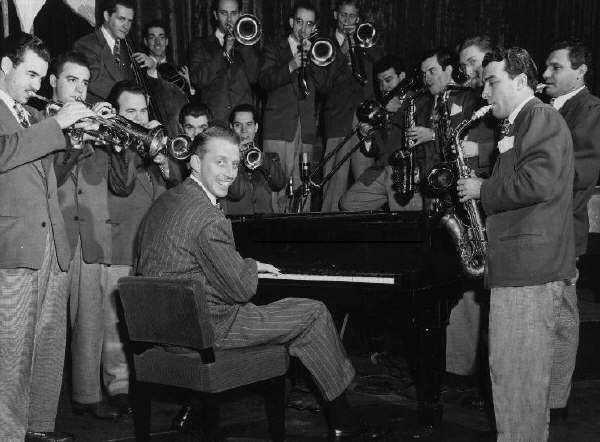
Speaking of music, here’s the Kenton band in all its stentorian glory with “Malaguena.” Dig those mellophoniums, man…
Nicholas Payton Hates the Word “Jazz” Applied to His Music, and So Did Paul Whiteman
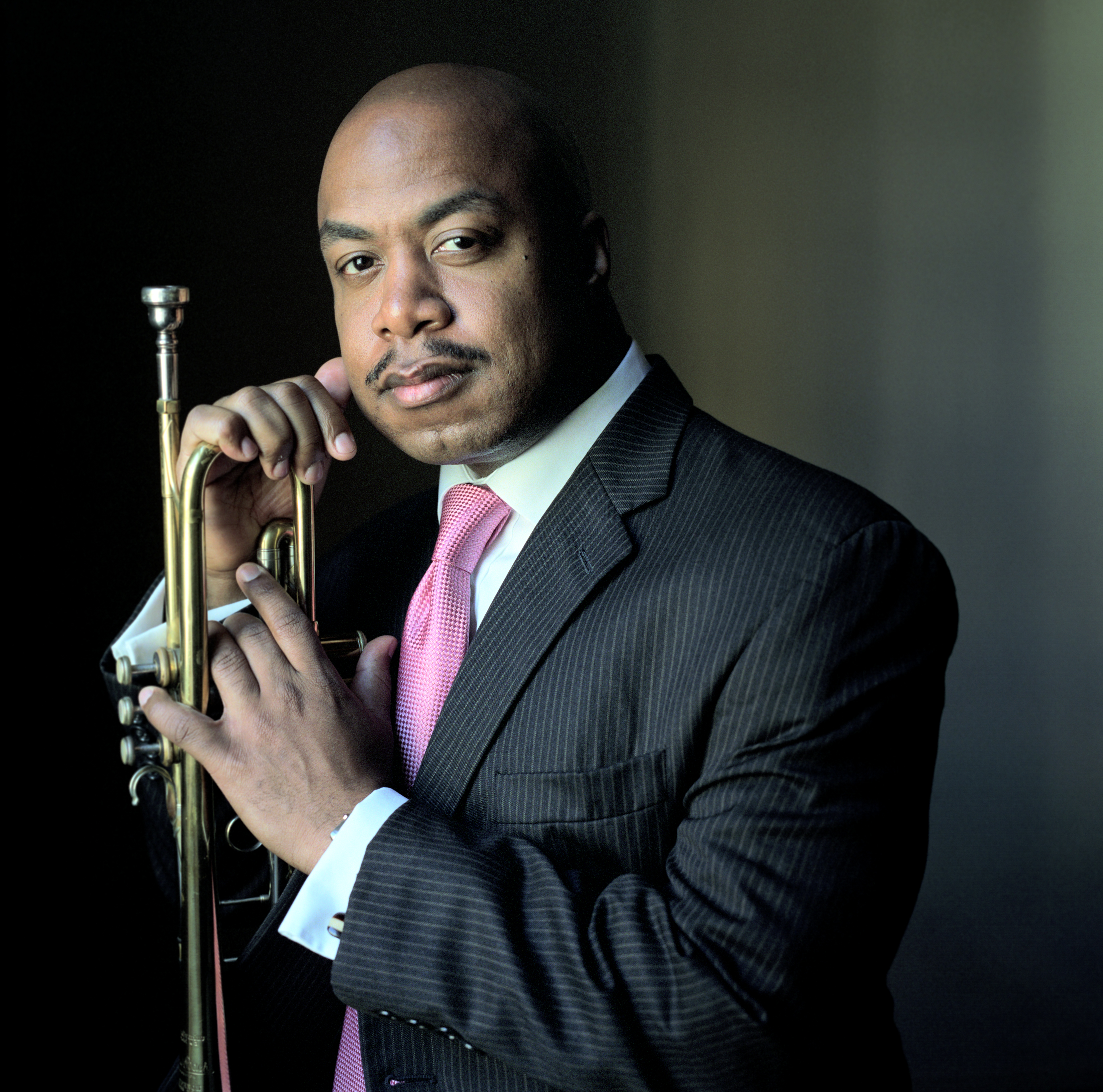
Trumpeter/bandleader/composer Nicholas Payton lit a cyber bonfire recently when he judged “jazz” to be a narrow, outdated, and even racist term. With so many artists, jazz journalists, “jazz” defenders, label haters and twit heads out there weighing in, I’m going to avoid discussing whether Payton is “Right” or “Wrong.” He has inspired plenty of thoughts and feelings though, and that’s vastly more important than any value judgments that will come out of this debate.
Most of the discussion hinges upon one very specific word (but given Payton’s commentary on race in America, it’s become just part of the argument). Payton insists that he is “…not dissing an art form. [He is] dissing the name [emphasis mine], Jazz.” Criticizing “jazz” (but not jazz) is a fascinating proposition since this blog spends so much time reconsidering a lot of music that is denied “jazz”/jazz’s street cred. Many historians and critics don’t know what to call the music of the early Fletcher Henderson band, Red Nichols’ various ensembles, forgotten twenties dance orchestras and musicians such as Buster Bailey, Don Murray and Adrian Rollini. Letting them all into the proud family tree of “jazz” has proven tricky.
Sorry Red, Hugues Panassie Says You Can’t Be Filed Under “Jazz”
Yet the people who enjoy and care about vintage jazz and early American pop have been eager to extend a branch to their heroes. For many people (excluding Payton, of course) “jazz” denotes something perennially hip, music requiring flawless technique and a unique voice. It has a rich history, yet it continuously evolves. It’s also a proudly American invention, fed from the blues, rhythmic nuances and vocal inflections that could only have appeared in this country with its complex, often troubling cultural and ethnic history (I’ll leave it up to Payton and his interlocutors to discuss where those elements came from and how they define the music).
Adrian Rollini’s Bass Sax Has Found Equal Difficulty Getting Through Doorways and Jazz History Books
Best of all, “jazz” gets played in swank nightclubs, fancy concert halls and prestigious college campuses. “Jazz” is a passionate, sincere and intelligent “art form,” a much more impressive name than “old pop,” “syncopated concert music” or other sobriquets given to piles of 78rpm explorations. “Jazz” is respectable, and it’s cool. It’s no wonder fans want their favorites to get on the tree, even on some obscure branch that never bore fruit.
Yet here’s Nicholas Payton, asserting that “jazz” itself is a rotten root! According to him, “jazz” died in 1959, and it’s way too limited and self-conscious to be considered “cool” anymore. Payton also describes the word as an external imposition on the actual music and its voices (who Payton has always expressed vast admiration for, in both words and discography). Based on Payton’s description, “jazz” doesn’t even seem like it’s worth the fight.
Maybe giving up that fight is what all that old music needs.
Payton’s politics and occasionally confrontational tone aside, what if all us trad fans, moldy figs and hep cats of latter day swing took his suggestion to heart? What if we simply stopped using the word “jazz?”
Aside from making it much harder to organize our record collections, it might excuse a lot of music we love from taking a stylistic blood test. Couldn’t we do without yet another debate on whether Bix Beiderbecke and Benny Goodman are “jazz?” Wouldn’t Gunther Schuller’s verdicts about which bands are not “jazz” seem much less damning? And whatever it is that Fletcher Henderson, Duke Ellington and so many original New Orleans musicians were doing before they “learned how to swing” might even be respected on its own musical terms, not just some stepping stone to the title of “jazz” bestowed by critics and scholars.
If I’m hijacking Nicholas Payton’s ideas for other ends than he assumed, it demonstrates how powerful those ideas are, but also how simple they turn out to be. Not to deflate the scope of Payton’s ideas, and the anger and attacks of his critics notwithstanding, all he is doing is criticizing a word; he’s protesting a label. He’s not even the first artist to do so. As he points out, Duke Ellington and Miles Davis, not to mention Charlie Parker and Eddie Condon among many others, have expressed varying degrees of reticence about “jazz” and other labels. Judging from Payton’s commentators, he won’t be the last to get the word out about putting “jazz” out to pasture.
Speaking of which, maybe the pop of yester-century can stay just as exciting and intelligent without having the title “jazz.” Maybe “jazz” needs to be as open about its past as it does its future. Or maybe “jazz” is simply as limited as Payton describes. Words are as powerless or as powerful as we make them. Nicholas Payton merely points out how powerful we have made one word.
And if he’s reading this he may or may not appreciate my posting a ten year old clip, but good music has no expiration date here. Here’s Nicholas Payton scorching “Tiger Rag” with ample ‘postmodern’ swagger: