Check them out here.
The Pop of Yestercentury
More Hep Than Hip
Author Archives: AJS
The Anxiety And Influence: Post-Armstrong Cadenzas
A little over two weeks from now musicians, musicologists, scholars, historians, collectors, aficionados and fans will mark the eighty-sixth anniversary of a revolution in jazz and a landmark occurrence in American music. Some of them may even discuss the remaining three minutes and ten seconds of “West End Blues,” the part after Louis Armstrong’s introductory cadenza:
Armstrong plays masterfully throughout the record but generations (rightfully) continue to focus on his cadenza. Blazing fast, encompassing the trumpet’s entire range, technically dazzling, artfully constructed and as easy on the senses as the curves of a Botticelli bathing beauty, Armstrong could have easily played just this brief free-tempo improvisation and more than satisfied most listeners.
As for his fellow trumpeters, Armstrong’s cadenza must have invited another Italian phrase, namely agita. It’s not a musical term but it is a fair description of what some players no doubt experienced after first hearing “West End Blues.” Musicians are as much working professionals with their ears open for competition as they are sensitive artists seeking inspiration. It’s easy to imagine Armstrong’s contemporaries hearing “West End Blues” as the work of a genius, a tough act to follow and even something to top. Thankfully, many of them tried, several on record.
Brian Harker describes Jabbo Smith as “the only trumpet player, according to many contemporaries, who posed a threat to Armstrong’s supremacy,” a threat that Rex Stewart described as truly “blowing.” Gunther Schuller points out that Smith “evidently worshipped Armstrong [and] imitated many of the latter’s most famous solos (particularly ‘West End Blues’).” Thomas Brothers cites Smith’s recording of “Take Me To The River” as “a response to Armstrong’s celebrated performance”:
Smith’s blistering edge and intense delivery are far removed from the melodicism Armstrong maintained even in his rapid-fire excursions. That’s a statement of musical priorities rather than an evaluation (though melody often keeps listeners coming back for more, which may explain Armstrong’s longevity). Smith’s Rhythm Aces were actually the Brunswick label’s attempt to compete with Armstrong’s Hot Fives on Okeh. Not one for understatement or easing into a task, Smith picked “Jazz Battle” as the first song at his first session as a leader and started it off with an ornamental call to arms:
Smith’s introduction is less of a cadenza and more an instrumental break before the tune or the band even starts up. Armstrong is majestic while Smith is defiant; Armstrong pulls the audience in but Smith dares them not to blink. Equally telling is how instead of easing into a relaxed air, Smith bursts into a racehorse display. He may have “worshipped” Armstrong but doesn’t sound like he’s ready to serve in heaven.
Reuben Reeves also admired Armstrong even as he sought to knock him down a few pegs. Reeves’s high note displays had impressed Chicago audiences, and bandleader/promoter/journalist Dave Peyton had advocated for Reeves as a classically schooled, more respectable alternative to Armstrong. By the time that Vocalion set up Reuben “River” Reeves and His River Boys a.k.a. the Hollywood Shufflers as another competitor to the Hot Fives, Armstrong and Reeves had faced off against one another at the Regal Theater a month earlier in late April, 1929.
That particular jazz battle did not end well for Reeves. Despite a showy piece arranged by Peyton to show off Reeves, Armstrong excelled in terms of musicality, stamina, technique and roaring crowds. Reeves’s defeat may explain the lack of overt references on his own dates to Armstrong’s by now well-known record. The closest thing to an Armstrongian cadenza is the mid-register, in-tempo introduction to “Blue Sweets,” which is as pastoral as Armstrong’s is urbane:
Reeves does seem to hint at and perhaps parody “West End Blues” with searing sustained high notes on “River Blues” that resemble Armstrong’s final chorus (and follow an Earl Hines-esque piano solo by Jimmy Prince):
Reeves’s upper register is steelier and more penetrating than Armstrong’s, and the answers from Omer Simeon’s clarinet are either the trumpeter’s attempt to avoid outright plagiarism or splitting his lip. Decades later it’s easy to dismiss Reeves with the knowledge that Armstrong was far more than a squeaker. Harker writes that Reeves seemed to absorb the letter but not the spirit of Armstrong’s style. That might imply a shortcoming, but “spirit” is as personal as it is important. Maybe Reeves, like Smith, was content to use Armstrong’s letters to express his own soul.
Louis Metcalf might seem to imitate Armstrong in his note-for-note rendition of “West End Blues” with the King Oliver band. Yet his departures from the original, whether deliberately subtle or entirely unintentional, make it a wholly individual statement:
The bluesy run connecting the third and fourth notes of the opening arpeggio, hesitations such as the split-second too long pause before the shaky high note or even potential clams like the slight stutters on the opening chorus all act like little signatures by Metcalf. It’s a sincere form of flattery as well as bravery: who else was willing to not just attempt this solo but to record it with none other than the inspiration for the source leading the band?
Red Allen, leading his New York Orchestra on Victor, falls between imitation and complete rejection of Armstrong’s lessons. Just a few years younger than Armstrong and a fellow New Orleanian, according to Ted Gioia Allen actually absorbed most of Armstrong’s playing through records. For his first session as a leader (and second-ever experience in a recording studio), he begins “It Should Be You” with a cadenza that does his hero proud without trying to clone him:
Speaking of this session in his solography of Allen, Jan Evensmo notes how Allen had “already found his [own] style, an open pure sound, a sparkling technique, a fantastic inventiveness, a unique sense of harmony and a rhythmic sureness…” At the same time Allen obviously loved Armstrong’s easygoing yet confident swing, declaratory phrasing and glissandi. Like Armstrong, he also seems to believe in not fixing what isn’t broke: that cadenza remains the same throughout all three takes of “It Should Be You.”
For trumpeters from the pre-Armstrong era or who were less obviously influenced by him, simply the idea of an introductory cadenza allowed them to channel their own gifts. Bill Moore’s chattering lines and tightly muted sound weave a slick, pithy epigram before the Ben Bernie band takes over on “I Want To Be Bad”:
James “King” Porter tacks a miniature cadenza onto to his lush introduction to “Between You And Me” with Curtis Mosby and His Dixieland Blue Blowers:
While on “Buffalo Rhythm” by Walter Barnes’s Royal Creolians, Cicero Thomas rushes through his introduction like a trumpeter at a bullfight with a bus to catch:
Armstrong himself would of course return to the device on record and throughout his career. His introductory cadenza on “Blue Again” is a personal favorite of this blogger:
Its poise, its subtle mixture of drama and detachment and the casual, humorous way that Armstrong “muffs” the reference to his own cadenza from “West End Blues” show that even Armstrong could look to Armstrong as a springboard to something different.
Armstrong himself was initially inspired by the tradition of concert soloists in European music and American marches. He didn’t play the first cadenza at the start of a piece or a record but it likely seemed that way for many trumpeters. All of “West End Blues” is a marvel but its elevation of a single musical device within the jazz community is equally impressive.
With the exception of the Reeves sides (July and May of 1929) and “Blue Again” (1931) all of these records were made just seven or eight months after Armstrong cut “West End Blues.” Allowing for time between Armstrong recording and Okeh distributing it, “West End Blues” must have been fresh enough to convince trumpeters, and record executives, that they needed a flashy cadenza. Eleven seconds generated enough creative curiosity, professional jealousy and/or commercial trendiness to inspire several individual contrafacts, and of course there are more out there and to come. That really is an amazing introduction.

Colin Hancock’s One-Man Creole Jazz Band
The following is the first I have ever heard of Colin Hancock, but what an introduction:
Mr. Hancock plays all of the instruments and Mr. Jorni Budich made this (beautiful) acoustic transfer of the music. The result is impressive and (for this listener) at times a little eery, like looking just a little too long at a wax sculpture of a good friend.
Having said that, I hope they both continue to make these recordings and post them on YouTube. Their work lets us consider both this style and this recording technology as more than just a historical compromise.
Baby’s First Hot Jazz Book
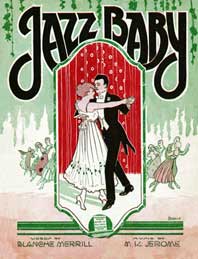
Even as a younger generation of hot jazz lovers begins to spread the gospel of Rust, it never hurts to seed the ground for the future. Here’s a kid-friendly educational resource to start their children on the right path:
A is for Louis Armstrong, who taught jazz to sing,

B is for Bix Beiderbecke, who brought a softer side to swing.
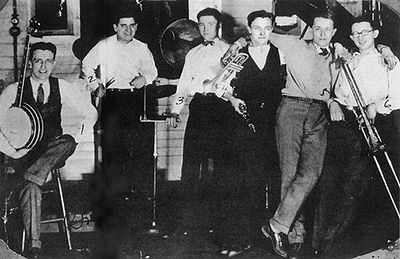
C is for Bill Challis, who wrote great charts though history books often leave him out,
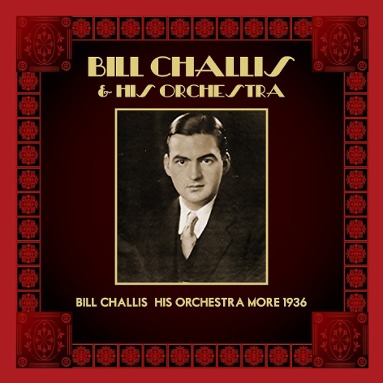
D is for Don Redman, an arranger even Ken Burns talks about!

E is for Ellington, a serious composer who made people dance,

F is for Fletcher Henderson: name a great soloist and he probably gave them their first chance!

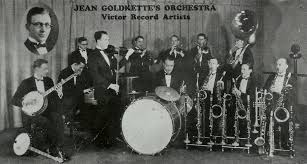
G is for Goldkette, he had great sidemen but never gets his due,
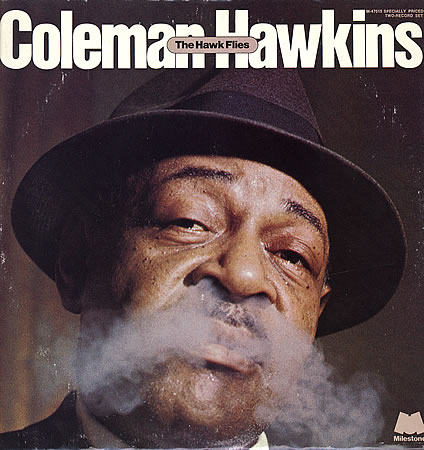
H is for Coleman Hawkins, the father of jazz saxophone and a tough cookie (though his early sides he clearly did rue).
I is for “I Never Miss The Sunshine,” Frank’s Trumbauer’s amazing premier,
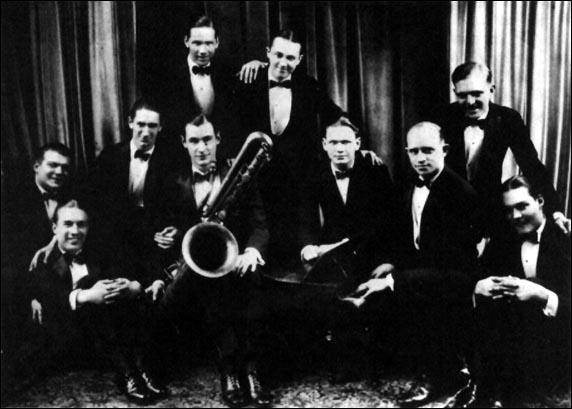
Left to right: Ray Thurston, Marty Livingston, Pee Wee Russell, Frankie Trumbauer, Dee Orr, Bix Beiderbecke, Bud Hassler, Louis Feldman, Dan Gaebe, Wayne Jacobson.
J is for Jack Pettis, who wasn’t a “father” but whose originality was clear.

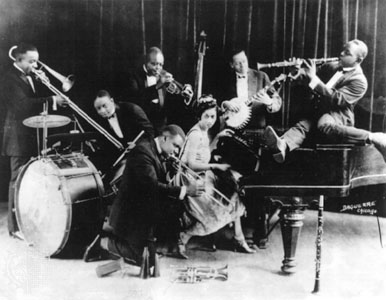
K is for King Oliver, who taught young Satch but also had his own great style,
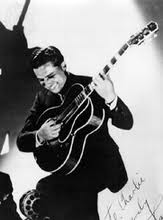
L is for Eddie Lang, who also shaped the music, even if he only stayed a little while.
M is for Miff Mole, trombone original with a name that’s silly,

N is for Red Nichols, his partner, another original whose playing was far from just frilly.

Red Nichols Photo care of Stephen Hester
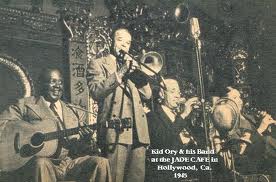
O is for Kid Ory and his bluesy, big slip horn,
P is for poor Ben Pollack, who gave Teagarden, Miller, and Goodman a break and even led the Bob Crosby band before it was born!

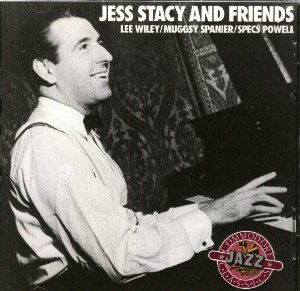
Q is for QRS, a label featuring Jelly, Fats, James P. Johnson, Clarence and Fatha’ Hines,

R is for respect to all of them plus Willie Smith and other piano lions.
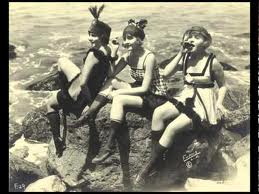
S is for Mamie, Bessie, Clara and other Smiths of the blues,

T is territory bands, whose music is still making news.

U is for underdog, because that’s how this music got its start,
Groupies
V is for “Variety Stomp” for no other reason than the tune is close to this writer’s heart.
W is for the first record you like, which will change everything.
X is for that favorite record, to be discovered by you and admired because it will make you sing!
“Y” is a good question, but not every day…
because Z is for “zing”: if the music makes you say that, what else is left to say?
Buster & Louis And Louis Vs. Buster
Louis Armstrong’s entry into Fletcher Henderson’s big band is well established as a watershed moment in jazz history. Almost as well accepted is the fact that before he became the most influential artist in jazz history, Armstrong was a crowd-pleasing, critically acclaimed sideman, but a sideman nonetheless. Apparently he was even susceptible to bandstand politics. Speaking of Armstrong’s reaction to reedman Buster Bailey joining the band shortly after his arrival, James L. Dickerson notes that “he was annoyed at the [actual] reason Henderson wanted Bailey, which was to add another solo instrument to the group.”
Bailey’s lightning fast technique has earned him the reputation of being more of a technician than a soulful jazz musician, yet the music itself evidences a talent that must have aroused that special blend of admiration and suspicion among artists. On a peppy “My Rose Marie,” the arrangement gives Armstrong a designated hot chorus all to himself and he fulfills his role magnificently. Bailey on the other hand takes his own limelight, jackknifing in with a dazzling obbligato behind the band during the last chorus:
The acoustic recording makes it a little difficult to hear Bailey, which just adds to the tension between ensemble and individual, written parts and improvised licks, lead and counterpoint. Yet Bailey is there, on his own terms, playing with the listener’s expectations.
By 1924, at age twenty-two, Bailey was already a seasoned musician, having joined WC Handy’s orchestra as a teenager before gigging with blues and jazz star Mamie Smith and then King Oliver, where he first met Armstrong. Playing in Oliver’s band, Bailey must have honed his skill at providing the fast upper-register lines around the lead crucial to the New Orleans ensemble concept. Compared with frequent Oliver clarinetist Johnny Dodds and other New Orleans ensemble clarinetists, there is a busier, more penetrating approach to Bailey’s lines, as much informed by Bailey’s classical studies as his own “wicked” sense of humor.
Bailey never derails the Henderson band but rarely sticks to mere decoration. Fast, straight-ahead jazz numbers such as “Copenhagen” find Bailey soloing within the ensemble, rather than between or on top of it like Armstrong:
The peaks of Bailey’s phrases are easy to hear, hooks to grab onto before the next dizzying plunge. Even as Armstrong began to bring a new sense of ease and cohesion to jazz, Bailey insists on a peculiar intensity that remains unique to jazz of this period/style. Just compare Bailey’s second solo and then Armstrong’s right after it on “Twelfth Street Blues”:
Even alongside Armstrong’s towering presence, repeated and open-eared listening to Bailey reveals another player integrating his own influences into a deeply personal style: facile but proud to sweat, unashamedly “vertical,” energetic and mesmerizing in its jittery poise.
Armstrong himself would later refer to Bailey as “the great clarinetist and alto saxophonist,” implying an appreciation for his talents as both a clarinet soloist and a section man. Dickerson also points out that Armstrong was still “happy to see another Midwesterner” join the Henderson band and that the two would eventually became good friends. We can now admire Armstrong’s magnanimity and even forgive his youthful competitiveness, but it’s no surprise that Armstrong, and not to mention fellow Hendersonian and future “father of jazz saxophone Coleman Hawkins, were eyeing the tall, smirking gentleman from Memphis coming up behind them.
Lester, Bobby And The Story Of Improvisation
 Lester Young’s description of how Frank Trumbauer “always told a little story” through his music is the type of quietly stated but philosophically explosive idea that was bound to change everything.
Young was probably not the first person to use the term “story.” He was certainly not the first musician to conceive of a jazz solo as a coherent narrative implying something beyond notes and rhythms (though his words, like his music, perfectly express that concept). Whenever the metaphor first appeared or whoever first began “telling stories,” before Young, Trumbauer and maybe even Louis Armstrong, the idea has not only stuck but has become synonymous with jazz improvisation.
Solos are often described in terms of their “beginning, climax” and “conclusion.” Even the most diehard free jazz player will mention a desire to “communicate” with the listener. Describing a musician as “just playing notes” often means that their playing lacks something crucial. It’s a popular way to dismiss players or entire styles, indicating that whatever else “jazz” means, it is about “saying something.” What young Lester Young described as a new possibility now seems like the only way to play jazz.
The analogy between a jazz solo and a story has also inspired enough thought and ink to fill books such as Sven Bjerstedt’s Storytelling In Jazz Improvisation. The Swedish scholar considers and dissects this metaphor using sources ranging from hermeneutic philosopher George Gadamer to the contemporary Swedish jazz scene, across more than three-hundred meticulously cited and often dense (but not impenetrable) pages. Even if you don’t have the inclination to read or the time to finish it, the mere existence of Bjerstedt’s book illustrates the ubiquity and impact of the storytelling metaphor.
Ironically, while reading Bjerstedt’s thesis I wasn’t thinking about Young, Armstrong, Coleman Hawkins, Charlie Parker or even Thelonious Monk, John Coltrane, Eric Dolphy and other players considered “storytellers.” Instead, I could not stop playing Bobby Davis’s music.
Bobby Davis never led his own date and practically vanished from disographical and historical records after the early thirties, passing away fairly young in 1949. Yet he was prominent as both a soloist and an ensemble player with the California Ramblers in all their pseudonymous glory during the twenties. Eugene Chadbourne’s All Music Guide entry on Davis describes “a brilliant multi-instrumentalist” and Richard Sudhalter credits Davis’s “bright-toned and upbeat” clarinet and alto saxophone at several points in his landmark Lost Chords. Hundreds of sides feature Davis playing an intense, personal style that I would never describe as telling a story.
Instead, Davis’s solos careen every which way except straightforward. He plays in the arpeggio-rooted manner of many pre-swing reed players but his “saw tooth” lines are especially jagged, for example on “Wang Wang Blues”:
It’s not Davis’s tone, which is actually quite smooth if occasionally (and delightfully) nasal, adding that spiky atmosphere. Nor is it his frequent recourse to broken chords; Davis keeps returning to the top of a new phrase before letting the last one finish, like starting down a new stairway before getting to the bottom of another. If you had to make a literary analogy, it might be to some William S. Burroughs cut and paste outing, but if anything Davis conjures an M.C. Escher landscape reimagined by John Held.
This overtly “vertical” style is now written off as amateurish and unimaginative, yet taken on its own terms it generates plenty of energy and frenzied charm. Jazz is now often praised for its ability to move hearts and minds, yet listening to Davis on “Hot Henry” with the Little Ramblers or his two solos on “Alabamy Bound” with the Goofus Five, it’s worth reassessing the music’s power to move bodies:
Even when Davis hews closer to the melody, frequently on the first chorus of records such as “Tomorrow Morning,” he launches into ecstatic asides that don’t just decorate the theme but collide with it sideways:
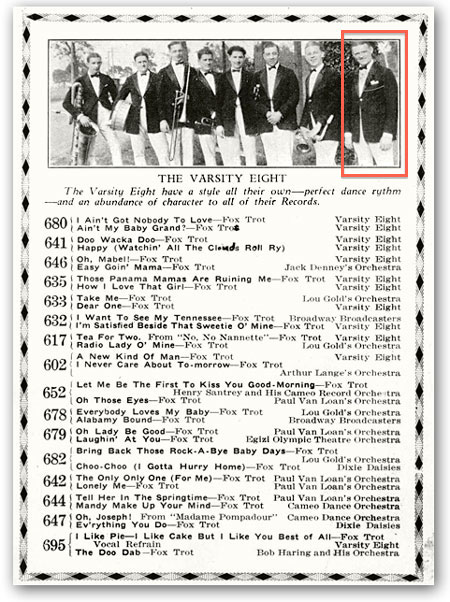
His licks, though harmonically correct and rhythmically in step, sometimes sound completely unrelated to the melody. His breaks are just that, splintering off from the line, as for example on “She Loves Me” with the Varsity Eight:
On “Go Back Where You Stayed Last Night,” with the Five Birmingham Babies, he’s wobbly and angular all at once, a funhouse distortion of the melody that comes teasingly close to throwing out the theme altogether:
Even on the relaxed, relatively straight-laced “Deep Sea Blues” with the same group, there remains a sense of disconnected phrasing:
Many soloists are praised for their “seamless” legato, and Sudhalter points to Trumbauer’s occasional influence on Davis. Yet for the most part Davis indulges in seams, sudden twists and turns that may seem superfluous, or can be heard as exercises in disconnection, a reveling in choppiness and unpredictability. Davis ups the ante on a slightly faster version of “Deep Sea Blues” with the Goofus Five, chopping the melody to pieces with some angular ornamentation (and a few wrong notes):
Davis builds a peculiar, very powerful tension between the written melody and his interpretation of it. This is not the warm, well-wrought approach of Louis Armstrong, who could take his own paring down of a song and make it fit the tune like a glove, or the flurrying personalizations of Coleman Hawkins or Charlie Parker, with those long, twisting runs between phrases that sound like part of the sheet music. It’s also not the wide-open, relentlessly individualistic flights on blank canvas of many free or avant-garde players. There’s an eschewal of story at work in Davis’s playing, that of both the composer and the performer.
If Davis sounds scattered, it was probably by design. Variety was paramount for pre-Armstrong jazz musicians. Brian Harker cites trumpeter Louis Panico’s advice that “never more than two measures of similarity be used” and to incorporate a “new idea about every other measure.” Panico, writing in 1923, describes an approach still prevalent during the mid to late twenties, even as a young trumpeter from New Orleans (perhaps among others) offered an alternative. As opposed to this “patchwork” aesthetic, Harker explains the revolution that was/is Louis Armstrong:
[Armstrong] rejected the prevailing standard of novelty that encouraged a rambling, disjointed rhetoric in order to provide a more or less constant sense of the unexpected. In its place he substituted a structural conception that later musicians would identify with telling a story.
 Harker’s elegant summary, also cited by Bjerstedt, places two concepts of a jazz solo next to one another. It’s easy to hear terms such as “rambling” and “disjointed” as pejoratives but worth remembering that we’re hearing those terms long after the other concept won out. It’s no small wonder that the storytelling model of a jazz solo seems like a stretch when applied to Bobby Davis’s music. Instead of coherence, Davis emphasizes variety. Instead of narrative, he works in collage. In place of allusion, he provides non sequitur. Rather than telling a story or drawing a portrait, at most Davis provides a few Rorschach blurs.
Either the moldy fig or the contrarian in me (perhaps one and the same) couldn’t stop thinking about Davis’s music while reading Bjerstedt’s thesis. That music comes from before the storytelling model as well as later rejections of it. It’s completely removed from what most jazz musicians and listeners have taken for granted over several decades. There are now several options for Davis’s music, or that of Panico, Don Murray, Buster Bailey, Bill Moore, Woody Walder and others: reduce it to a nostalgic experience, write it off as a misstep on the way to some supposed jazz teleology or explore it as some vestigial limb of jazz. Personally, I just hear another approach to playing a jazz solo.
I also hear a refreshing lack of pretense in Davis’s playing. I don’t hear a storyteller, a spontaneous composer, a sensitive artist or a pensive experimenter. There is no story or deep sentiment at work, just pitch, rhythm, harmony, timbre and other sounds, left to their own devices, freed from encumbrances such as dramatic arc and emotional expression, exploding in real time over a danceable beat, never reminding me of anything else, not needing to reference anything but themselves and never taking themselves too seriously. It’s just another way of doing things, even if it doesn’t make a good story.
To The Victor, Columbia or Maybe Even A Grey Gull: The JJA Jazz Awards And Early Jazz
 Last Tuesday the Jazz Journalists Association announced the winners of its 2014 Jazz Awards. The JJA presents these awards “as an assertion that informed, professional, independent coverage of jazz across genre is vital to the preservation and promotion of contemporary music.” As for non-contemporary music, the Columbia Legacy album Miles Live in Europe 1969 beat out ECM’s Jack DeJohnette Special Edition boxed set and Mosaic’s Complete Strata Recordings of Clifford Jordan for “Historical Record of the Year.” For some jazz lovers, these young players robbed the likes of Benny Goodman, Fletcher Henderson and King Oliver. There is a segment of the jazz community who appreciate and enjoy contemporary artists drawing upon the rich traditions developed in the wake of bop, but whose main interest remains in jazz’s prewar idioms. The JJA Jazz Awards may not seem relevant to moldy figs, big band fanatics and ears that perk up for Bix Beiderbecke over Terence Blanchard. Looking back, postwar artists playing in modern styles take up the bulk of the awards. Yet the Awards have included at least one category for reissued material since the first ballot in 1997, adding the term “Historical” to the category in 2008. Voting starts with professional members submitting up to three nominees for each category. Finalists are then selected based on the number of votes, and a second round of votes determines the winner in each category. This blogger was not able to find finalists for every year, but past finalists have included Mosaic’s Jimmie Lunceford collection competing next to a winning Miles Davis set, and the same label’s Complete Louis Armstrong Decca Sessions 1935-1946, which lost to Ella Fitzgerald’s Twelve Nights in Hollywood on Verve. This survey does not even account for the large pool of first-round nominees (which, based on the size of the JJA, would probably be an impressive and inundating list to post and sort through). Past JJA Jazz Award winners have included Columbia Legacy’s Hot Fives and Sevens set in 2001, the same label’s Billie Holiday Columbia 1933-1944 sessions in 2002, its Charlie Christian CD in 2003, BMG Bluebird’s Coleman Hawkins Centennial in 2005 (right next to fellow saxophonist Albert Ayler in the boxed set version of this category) and Duke Ellington’s Complete 1932-40 Brunswick, Columbia and Master Recordings, once again from Mosaic, in 2011. Also noteworthy is the 2010 competition between Armstrong’s Decca set and Mosaic’s Classic Artie Shaw Bluebird and Victor Sessions for Best Liner Notes. For the JJA, bebop and other languages are spoken here. “Early jazz” has a noticeable, if not overwhelming, presence in these well-known awards. Yet is that presence likely to stay there, and possibly even grow? Unsurprisingly that issue is about more than musical taste or academic debates between traditionalists and progressives. JJA President Howard Mandel very graciously shared some of his insights and thoughts on the matter via email.
  Andrew Jon Sammut: The JJA’s 2014 “Historical Record of the Year” award was “for CDs, vinyl or digital recordings recorded at least ten years ago (prior to 2003), issued during calendar year 2013.” What was the JJA’s philosophy behind using such a wide concept of “historical”? Howard Mandel: The JJA Jazz Awards essentially focus on the past twelve months of jazz activity, but jazz journalists have often (at least since the forties) or perhaps typically (since the seventies) been interested in reissues and music from earlier in history. It’s basically essential to understand the music’s past in order to understand the music’s present, and to listen to the past is often to come to love it, because a lot of the music endures across time, regardless of stylistic differences among the various eras. AJS: There is also a wide stylistic range within that category. Miles Davis reissues are frequently nominated and frequently win (including in 2014, 2012 and 1997 through 2000) but Louis Armstrong and Duke Ellington’s earlier efforts have also been nominated and won. What is it that artists as diverse as Armstrong, Charlie Christian, Davis, Ellington, Ella Fitzgerald, Coleman Hawkins and others in this category share? HM: The artists you mention all have well-established reputations as being icons of the art of jazz. All of them were stars of their day, and with the exception of Christian (who gets extra credit for being the first prominent electric guitar player in jazz, and in almost, with exception maybe T-Bone Walker, any kind of American music) their careers were long. Most of these musicians’ works have remained in print or essentially available since they were first issued. They have been written about a lot, and with the possible exception of Coleman Hawkins or Christian their names are familiar to non-jazz audiences, including editors. So it is often possible to write about these artists for general or jazz publication, if there is something startlingly new about them to report (like an issue of newly discovered or “historic” music). AJS: So do you think there are other ways that the JJA Jazz Awards could honor historical artists within more specific eras or stylistic idioms? HM: I’ve been against breaking out the Awards into new categories for specific eras or stylistic idioms. Stylistic idioms: it’s impossible to adequately define and enforce such divisions. Eras: What is the value? Does one consider Vince Giordano‘s recordings with a contemporary band along with original source material from the same era? Who should receive the Awards: the producers of the albums, for making the music available, or heirs of the musicians who made the music? Also, it is my personal feeling that the history of jazz be the province of the historians, and not all jazz journalists are historically minded. In general the organization has the mindset that journalism is about the present not the (receding) past, and that we better mind jazz’s present if we want to ensure it has a future. AJS: I didn’t see this category listed in 2013. Was that due to lack of submissions, consensus or some other reason(s)? HM: I think that may have been an unintended error. AJS: It looks likes this category has undergone some changes over the years. In past years, the award was for “Boxed Set Reissue,” it featured separate categories for “Historical Record/Reissue” and “Historical Boxed Set” and early on it did not even mention the word “historical” for reissue or boxed set categories. What went into rethinking this award? HM: Each year we are rethinking each category and the overall structure of the Awards. We do not want to have more Awards. The ballot is long and complex enough. If anything, we want to limit the number of Awards. We also want the categories to reflect what’s being issued, and what kinds of excellence are emerging from jazz activities. “Boxed set” clearly pertained to big packages, rather than a single CD that might be of equal significance or pleasure, and so single-album releases were getting overlooked in favor of the big package that attracts more attention to begin with. We wanted to provide a more even playing field.
 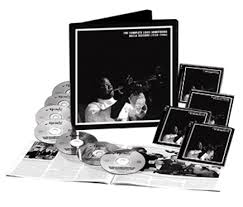 I would think that reissues are conceptually synonymous with “historical.” This year the ballot committee discussed whether a recording was “historical” and fit in this category if the majority of the music was recorded as little as three years ago. It was determined that some artists record and then the record doesn’t come out for three or four years, but that doesn’t mean it is “historical.” AJS: Reviewing past nominees and winners, it seems like prewar jazz is almost entirely represented by reissues on the Mosaic and Columbia Legacy labels, with labels such as Frog, Jazz Oracle, Timeless Historical, Archeophone and others apparently not being mentioned. How would you explain those two labels’ apparent “lock” on early jazz and the absence of other labels with similar missions? HM: Marketing and promotion by Mosaic and Columbia is far superior to that of the other labels you mention. JJA members may or may not pursue recordings on their own, but they are surely most likely to pay attention to recordings that are sent to them for review, with all attendant press releases and also the (perhaps subconscious) impact of ads that show up in jazz publications they read has an effect, and it also makes a difference if they are pitching a review to an editor, or an editor is commissioning them. That happens far more frequently with Columbia and Mosaic packages than with the other labels mentioned. AJS: Have those labels with similar missions been represented in the selection process, before the nominees are announced? HM: Yes, often. The first stage of nominations is an open call: all professional JJA members are invited to submit anything issued in the previous year as a nominee. For the 2014 Awards between a quarter and a third of professional members submitted first round nominating ballots. There are many albums that receive single or perhaps three or four votes. Yet the three albums that have received THE MOST nominations are the ones that advance to being finalists. They are almost always albums that have been released, promoted and marketed by a decently financed and very business-and-media-savvy company. AJS: How does the JJA understand the role and impact of historical music in this process? HM: I’m writing from my personal point of view, because the JJA as an organization does not have any sort of official take on issues of this sort. Current jazz is based on earlier jazz. One of the very essences of jazz is to respect the music’s history, original creators and creations, without allowing that respect to deter development but rather to use it as an inspiring stimulant, a creative touchstone. In an era during which post-Modernism seems to be a dominant critical modality, all the history of an art form is as one for purposes of study and derivation of newly produced material. The neoconservative musical attitudes promoted by Wynton Marsalis have also contributed to this notion. Yet “free jazz” never went against “early jazz” (only maybe “square jazz”). As the Art Ensemble motto went, “Great Black Music, Ancient to the Future,” except for most jazz journalists it doesn’t have to be “Black” music only; the internationalist embrace has become wider in the past 50 years, too. The digital revolution has also made an even larger amount of historic work much more widely available. And we simply find we like that music! So it’s with us now, not merely a historical relic. That acceptance of older music may furthermore be a result of the baby boomer generation getting old. Baby boomers are still the bulk of membership of the JJA. AJS: Do you think there is room for other, lesser-known historical artists to “compete” in this area (provided there is a reissue released during the nomination year)? Could you imagine Chu Berry, Red Nichols or the New Orleans Rhythm Kings winning this award? Is the “Historical Record” category intended to reflect contemporary appeal, continuing school of influence, both, or some other factor(s)?
  HM: Again, the JJA does not promote any particular view of what the “Historical Record” category is meant to reflect. It’s simply the preferences of the most of the voters opining about releases that fall into that very general category. Yes, I can imagine some of those artists you mention winning the Award, but it doesn’t seem likely to me. I would not expect it unless material was released that completely revised the oeuvre of those artists as we know it, and probably released by one of the more prominent labels (such as you’ve mentioned, Mosaic or Columbia Legacy). It would most probably happen if such a release were widely publicized, on the order of the discovery of the Monk/Coltrane tapes in the Library of Congress vaults (which doubled the little bit of Monk/Coltrane already available with a superb concert very well recorded and issued by Blue Note Records). I was always surprised that the “suitcase tapes” of Parker and Gillespie from a hotel room in 1942, issued I think by Stash, never made much of a splash. The challenge is greater for lesser-known artists, because not everybody agrees that something is great, and not everybody sees everything. Several years ago I was enthusiastic about Bluesiana, by pianist Frank Melrose and issued on Delmark, but few of my colleagues seemed intrigued by it, and it attracted few votes other than mine. AJS: What is the role of this category? Why does the JJA choose to honor artists whose work may have been created close to a century ago? As much as I’m concerned about the present and future, there are many pleasures to be had from jazz that’s one hundred years old. I read books that are at least that old and I like movies from the thirties and forties. I listen to music that has ancient roots and has not been technologically updated. I’m interested in anything that endures to have a lively presence now, whenever it was created. I would like my fellow critics (of every art form) to act on similar principles, because it seems to me what critics try to do is determine what works of art are worth our continued attention. There’s no reason to assume music made decades ago can’t please people today. People today are not so different than people were then. Hail Jelly Roll, Pops, the Dodds brothers, James P. Johnson, the Boswell Sister, Red Allen, Duke’s Jungle Band, Bessie Smith and the other classic blues singers, James Reese Europe, Bechet and all the originators. They had the right ideas, there at the founding of music that keeps generating new and exploratory manifestations.
***
In other words, keep looking for Armstrong and Ellington as well as Beiderbecke, Goodman, Oliver and Henderson, perhaps even Nichols and Wooding, on the JJA’s rosters. Yet be patient finding them. More importantly, keep reissuing them and get the word out! 
A Dillon Ober Playlist
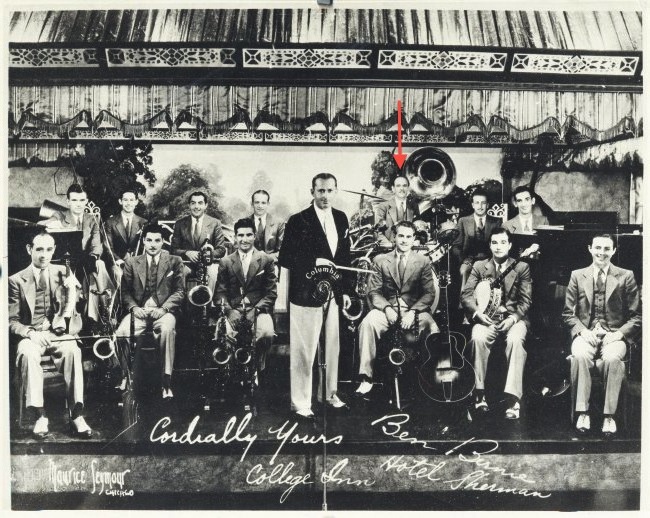
Virtually all of Dillon Ober’s legacy as a jazz musician was recorded with just two bandleaders over a four and a half year period and without a single solo. It’s a modest discography, perhaps appropriate for such an unflashy drummer, but it illustrates an energetic, at times arresting spirit behind the kit.
How Ober began playing is unclear but he obviously started young. Born April 8, 1904 in West Virginia, by 1919 young Dillon was already listed as a “musician” in the Clarksburg town directory. He cut his first record in 1922 playing marimba with the Mason-Dixon Seven Orchestra. The band included future dance band star Ted Weems and his brother Art and was popular at West Virginia University. It also traveled as far as University of Michigan and the town of Beaver, Pennsylvania as well as New York City to cut one unissued take of “I’m Just Wild About Harry” for Columbia with the young marimba player. The Seven might have also worked in Philadelphia, or perhaps Ober was in town solely for his wedding to Alice “Nellie” Broadwater in 1922. The young couple lived with Ober’s (apparently very patient) parents through 1925 while he continued to work as a musician.
Ober no doubt continued to gig and gain experience, including on drum set. By December 1926, he was confident enough to return to New York City and record with saxophonist Jack Pettis and several of Pettis’s fellow sidemen from Ben Bernie’s Hotel Roosevelt Orchestra. Bernie led an incredibly popular and well-respected band. Playing with its crack sidemen as well as jazz greats Joe Venuti and Eddie Lang in the music capital of the world must have excited the twenty-two year old pro from down South. He sticks to rhythmic background for most of “He’s The Last Word” but bears down harder behind the leader’s red-hot saxophone:
Ober’s drumming is more like great seasoning than a whole recipe: it flavors the performance and never overpowers the whole, occasionally jumping out before fading back into the mix. Ober is back on drums at Pettis’s next session and while it’s hard to hear Ober on “I Gotta’ Get Myself Somebody To Love,” it’s easy to feel his contribution to the side’s breezy momentum:
Ober sounds downright electrified on a Pettis date with guest clarinetist Don Murray. This was Ober’s sixth session in New York since his arrival, including one directed by Bernie’s arranger Kenn Sisson, and he must have been making a name for himself. Murray’s jittery arpeggios obviously contribute to the bright mood. The up-tempo “Hot Heels” lives up to its name:
Even at a medium tempo, “Dry Martini” picks up steam from Murray’s reedy phrases and Ober’s simple but spurring “1…1,2…” behind them:
Perhaps feeling more comfortable at his next record session (his first with the famous Victor label), Ober varies his technique more for “Bag O’Blues”:
He alternates cymbal backbeats and syncopations next to Nick Gerlach’s violin but sticks to a simpler beat behind trumpeter Bill Moore and Murray, allowing guitarist Eddie Lang to push the soloists and change up the rhythmic texture. Ober then switches to wood blocks behind Moore’s solo, while the “ting” and “swish” of his cymbals behind Lang’s solo add even more contrast. Far from just keeping time, Ober varies his beats, plays tasteful fills and inserts himself just enough to add color at key points. He chimes behind Bill Moore’s chatter on “Doin’ The New Low Down” and also taps an interesting paraphrase of Gerlach’s paraphrase, as Gerlach plays it, on woodblocks:
Ober would play drums on all of Pettis’s sessions as a leader. Pettis started out with no less than the New Orleans Rhythm Kings before becoming Ben Bernie’s star soloist. His light, swinging “Chicago style” sax enlivens every recording it’s on, he penned hot instrumentals such as “St. Louis Shuffle” and “Up And At ‘Em” and his Band, Orchestra, Pets and Lumberjacks produced some of the hottest jazz of the pre-swing era. Ober must have been doing something right if Pettis liked his drumming.
Pettis and possibly some of his sidemen must have spread the word: Ober took over the drum chair in Ben Bernie’s Hotel Roosevelt Orchestra and would stay there for the next three years. He’s off to a brilliant start on record with Bernie, waxing “Ten Little Miles From Town” and “When Polly Walks Through The Hollyhocks,” two sugary titles that really move (and include alternate takes without vocals) as well as Kenn Sisson’s novel arrangement of Joseph Northrup’s “Cannon Ball Rag”:
Highlights include Ober’s backbeat on the last chorus of “Ten Little Miles” and the way that he and pianist Al Goering gradually add more decoration to the end of each vocal phrase on “Polly.” Ober also really digs in behind the trumpet and trombone on “Cannon Ball.” The Bernie band was based out of the swank Hotel Roosevelt in midtown Manhattan. While not expressly a jazz band and even with tightly arranged charts, it played with energy as well as elegance and left room for dynamic ensembles and soloists. “Rhythm King” and “I Want To Be Bad” are models of crisp, buoyant and warm twenties dance grooves:
Playing with Bernie at the Hotel Roosevelt would have kept Ober occupied and financially stable but the drummer continued to record with Pettis’s side groups. He got to play with young jazz luminaries such as Benny Goodman, Jack Teagarden and Tommy Dorsey through working with Pettis, and for one date worked under the direction of vocalist and impresario Irving Mills. Word of mouth went far in the Manhattan musical community of the time and work was plentiful, so it’s likely Ober picked up work outside of the studio. Ober’s drive as well as sense of balance on “At The Prom” is a fine sample of his portfolio:
Ober and the propulsive (still unidentified) string bassist take turns driving the band. The bass does the heavy lifting behind the vocal and the violin while Ober plays cymbals behind the sax, stopping after the break to avoid monotony, then alternates open and closed hits for the bridge of the trumpet solo. He’s clearly thinking about how to deliver rhythm as well as variety, something the well-connected, band-booking Mills must have heard. Back with Pettis’s Pets for “Bugle Call Blues,” Ober plays crisp press rolls behind the trombone and piano, indicating he probably listened to New Orleans expatriates or their Chicago disciples:
Ober’s doubling ability would have also made him a versatile hire. He had started on record playing marimba, and his xylophone obbligato behind Pettis’s first chorus bridge on the Victor pressing of “Freshman Hop” is a short but catchy hint of Ober’s inventive touch at the keys:
“I’m In Seventh Heaven” by the Bernie band has a catchy lilt, but Ober’s gliding xylophone obbligato, combined with Merill Klein’s slap bass and the low-register clarinet (perhaps played Manny Prager, Pettis’s sub?) steals the show:
On September 18, 1929, Ober, Ben Bernie and several members of the Bernie band arrived in England to play at London’s fashionable Kit Cat Club. Mark Berresford indicates that unfortunately the band was poorly received by the press. Ober and his colleagues returned to the States a month later. That same year, Bernie lost his longtime spot at the swanky Hotel Roosevelt and lost much of his savings in the stock market crash. He handed leadership of the band over to Jack Pettis in April 1930, moving onto less jazz-oriented groups for radio while Pettis led the band through the end of the year.
Ober made his last credited record, for Bernie and forever, in 1931 (Wikipedia claims that Ober also worked with Ace Brigode but neither Tom Lord’s Jazz Discography nor Brian Rust’s The American Dance Band Discography list Ober playing with Brigode). Working with Bernie must have earned Ober something of a reputation so it’s likely he continued to work outside of record sessions. He lists his occupation as “hotel musician” on the 1930 census, and The Premier Drum Company thought enough of Ober to include a photo of him eyeing one of their products alongside several other noted musicians in its 1930 catalog.

The 1930 census shows Dillon and Nellie Ober living in Queens, but by 1934 he begins to appear in credits for movies made in California, starting with the comedy short “Old Maid’s Mistake,” followed by “Every Night At Eight” in 1935 and “The Country Doctor” and “The Crimes Of Dr. Forbes” in 1936. Ober wasn’t a complete stranger to acting, having already appeared in the 1928 Broadway musical Here’s Howe (with music by bandleader Roger Wolfe Kahn and introducing the standard “Crazy Rhythm”). He didn’t seem to need much theatrical range for film, given roles such as “comedy singer, piano player” and “trick drummer.” More importantly, Ober had an entryway into the West Coast studios. By 1937, the Pittsburgh Post Gazette reported Ober was “…on Walt Disney’s payroll out in Hollywood, tapping out sounds in animated talkies.” Ober’s un-credited work from this period might not have been glamorous but it was steady and he seemed to enjoy it.
Musician Don Ingle, who described Ober as “…one of the great drummers who disappeared into the movie studios in California and was rarely known outside of that arena in the years of large studio orchestra staffs” provides a very personal portrait of Ober during those years in California:
Dillon Ober was a very nice man, looking as I recall a lot like Robert Benchley. We used to go to visit at his place in the Valley not far from our home, as Dad [big band sideman “Red” Ingle] and he had become good friends in the thirties through their mutual friend Orm [Ormand] Downes, another of the unsung but superb drummers who had shared the stand with Dad for much of the thirties in the Ted Weems band. Dillon and Orm and Dad often gathered to socialize when not working, and Dillon’s home was often the site of poker parties, barbeques and a pleasant place to visit. I learned by listening to [Ober’s] descriptions of working with the great musical directors of Hollywood and how they scored the films, a very technical and critically timed process. They would also tell war stories from the big band days and talk about the players they’d come up with in the business.
Ober may have also played for the military after he enlisted in the Army Air Corp in 1942, as it’s unlikely the thirty-eight year old would have been placed into combat at the height of World War Two. He passed away just five years later, barely middle-aged and outlived by his father.
It’s clear that Ober didn’t record much and perhaps easy to suggest he didn’t “do” much behind the drum set, but he played exactly what was needed for his fellow musicians. Record after record reveals a no-frills, reliable, rhythmic drummer with his own subtle but instantly galvanizing personality. As for how much he recorded, in this case something is far better than nothing. Ober’s modest style and modest discography make for some very distinguished music.
***
For the completest Dillon Ober, check out Retrieval’s excellent Ben Bernie album and try to hunt down the now discontinued Jack Pettis double CD set from the King’s Crossing label. For a whole other look at Ober and a good laugh, please check out Michael Steinman’s notes here.
Max Jones And The Garden Of Jazz
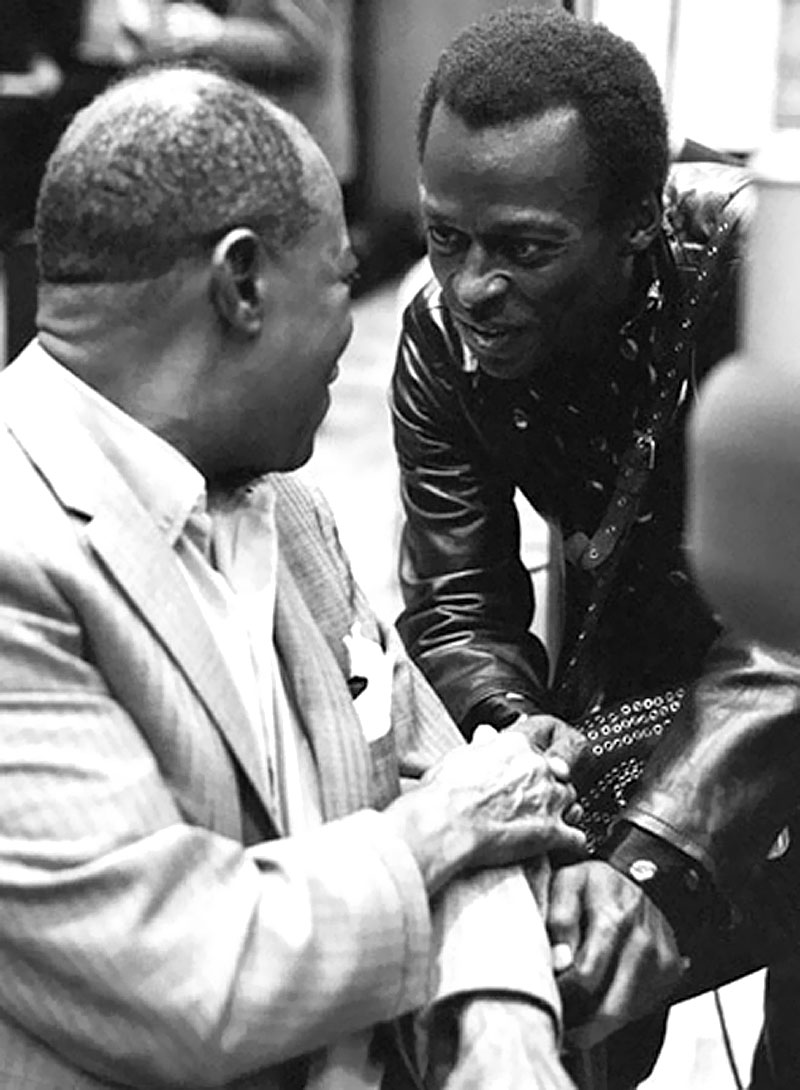 On a Friday, before we all pack up for the weekend and retreat to our iPods and musical monasteries, here are some of Max Jones’s memories of a time before Google and even Gunther Schuller, expressed lyrically but not pedantically:
In those times [the early thirties] anything in the jazz garden seemed lovely. Criticism had hardly raised its head, jazz history was obscure, and we accepted the styles as they came to us, on record or in person. Instruction, from John Hammond, an early guru, was printed in the Melody Maker and let us know that, say, a rival to Coleman Hawkins (Chu Berry) was “out of this world.” But we had little analysis or weighty criticism to go on, and tell us how to react. So we listened to all we could, relying on our ears to form our taste; I imagine we were none the worse for it…
My studies helped me acquire knowledge of jazz history and pre-history, of territory styles and New Orleans traditions, but seriously restricted my outlook. Time taught me the errors of purism.
These statements are offered without judgment or temporal prejudice. Happy listening!
In Search Of Rag-A-Jazz
Another Corner Of The Hothouse
Jazz loves hybrids, though some blends get more sunlight than others. A web search for “raga jazz” turns up pages of results showing the cross-pollination between jazz and Indian classical music. Yet a search for the union of ragtime and jazz known as “rag-a-jazz” just generates more results for raga jazz. Google won’t even ask if you meant rag-a-jazz.
So, what are web crawlers missing out on? One example is a watershed moment in American pop and a million seller for Paul Whiteman, his recording of “Wang Wang Blues”:
It keeps the syncopation and staccato attack of ragtime but has its own popping sense of tension and release, as well as a humor that is not just ragged but downright raucous; just listen to Buster Johnson’s trombone or how clarinetist Gus Mueller slices and slurs into each chorus. How do we describe this music, teasingly similar yet ultimately unlike ragtime or most of the jazz discussed in history books and played in swanky clubs? How would we find other examples of this sound?
Unsurprisingly, musicians, historians and open-eared listeners prove far more illuminating than search engines. Reed player and contemporary rag-a-jazz performer Dan Levinson defines rag-a-jazz as “a hybrid style of dance music that existed briefly from the mid teens through the early twenties, while ragtime was evolving into jazz” and which “still held onto many characteristics of ragtime in terms of syncopation, song forms and even the way eighth notes were played.”

Early jazz bandleader Vince Giordano describes the “baby steps of jazz,” with “elements of both jazz and ragtime” as well as “early syncopation but still a little bit of ragtime feel.” Giordano explains that rag-a-jazz surfaced around the time of Scott Joplin’s death and the end of the ragtime era, continuing through a period when “jazz was just taking shape and many orchestra leaders weren’t sure which way to go.” Levinson also mentions the “betwixt-and-between state of ragtime and jazz [that is] no longer quite ragtime.”
Rag-a-jazz conductor and multi-instrumentalist Matt Tolentino notes “ragtime still managed to hang on as a powerful musical force. Ragtime had a strong presence that more or less drove popular music in America from about 1895 to about 1917, so even though the general public had grown tired of it, they couldn’t escape it. The syncopation that ragtime had introduced was what America was used to listening to, and even though it wanted to say it was through with ragtime, such a night and day change in listening would be impossible.”
For rag-a-jazz drummer and bandleader Nick Ball, rag-a- jazz is “…the original ‘Rosetta Stone’ of music that is stylistically in the cracks, where one clearly defined idiom was merging into another or being strongly influenced by a parallel one from elsewhere in the world.” Ball also calls rag-a-jazz “the oldest of these transitional subgenres to have been documented on record in anything like enough detail for us to understand the process of its birth and its demise…a subgenre which lasted less than a decade, subsequently almost hidden in the long shadows cast by its parent, pure ragtime, and its child, pure jazz.”
More than a historical note, the music grouped under the term “rag-a-jazz” (or in search engine syntax, “‘rag-a-jazz’ -raga jazz”) is an example of fusion from decades before anyone plugged into an amplifier. It’s also an example of musical ideas that some would dismiss as wrong turns, many more would forget and others, thankfully, hear as another musical universe.
The Avant-Garde ODJB
Levinson points to what many consider the first jazz record as a prime example of rag-a-jazz, the Original Dixieland Jazz Band’s “Livery Stable Blues”:
Speaking about the “musical revolution” of the ODJB’s earliest records, collector and historian Mark Berresford explains “what the ODJB had done was to simplify and deformalize ragtime to its barest state and, once stripped of its hallmarks, rebuild it into a clearly defined polyphonic structure, placing greater emphasis on maintaining impetus and excitement.” Many history books draw attention to the ODJB’s frantic tempos, barnyard onomatopoeia and madcap spirit, which would have surprised (and possibly irritated) ragtime composers/performers. Yet even the ODJB’s later, more subdued sides display a distinct swagger a part from the lilt of ragtime:
Berresford also explains that “…as musicians’ ability to improvise grew, so their reliance on the structures of ragtime declined.” While ragtime players incorporated improvisation into their performances, it would obviously come to have a much larger role in jazz. Garvin Bushell, an ear-witness to these developments, summarizes his first attempts at playing jazz as “study[ing] rags on piano and omit[ting] the melodic pattern, just improvising on the harmonic pattern.”
Besides musical vocabulary and written notation, song forms themselves began to change. Early jazz maintained multi-strain structures until the swing era of the thirties, but Berresford notes how bands such as the ODJB would use a simpler configuration of fewer strains than formal ragtime. “What the ODJB’s performance lacks in form,” Berresford explains, “more than makes up for in dynamics, excitement and rhythmic drive, using devices such as solo breaks and the three-voice lead to signal its departure from the formality of ragtime.”
Skins And Cymbals
Berresford sums up rag-a-jazz’ musical characteristics as “a strong two-beat feel with predominantly ensemble playing, often heavy drum patterns and frequently fast tempos.” A two-beat feel in jazz is familiar to even occasional attendees at a Dixieland brunch, and contemporary jazz festivalgoers are no strangers to fast tempos. Yet rag-a-jazz’s constant collective interplay can sound strange to contemporary jazz lovers.
There is an unspoken, occasionally questioned but nonetheless powerful definition of jazz as ‘the’ idiom of an improvising soloist. In rag-a-jazz and in a pre-Louis Armstrong soundscape more generally, musicians don’t take turns soloing. Other than occasional short breaks, the emphasis is on ensemble interplay, balance and in some cases competition.
Rag-a-jazz represents a different concept of jazz, as ensemble music, a concept expressed in the unrecorded New Orleans parade bands of its earliest years, in King Oliver’s Creole Jazz Band, in groups led by Miles Davis during seventies and in those led by today’s jazz musicians such as Vijay Iyer and Robert Glasper. The best bands simply know how to play as bands, regardless of era. There is no sense of musical or expressive limitation while listening to the Original Memphis Five’s parts lock and slide into one another, even though no one player get so much as a half-chorus to themselves:
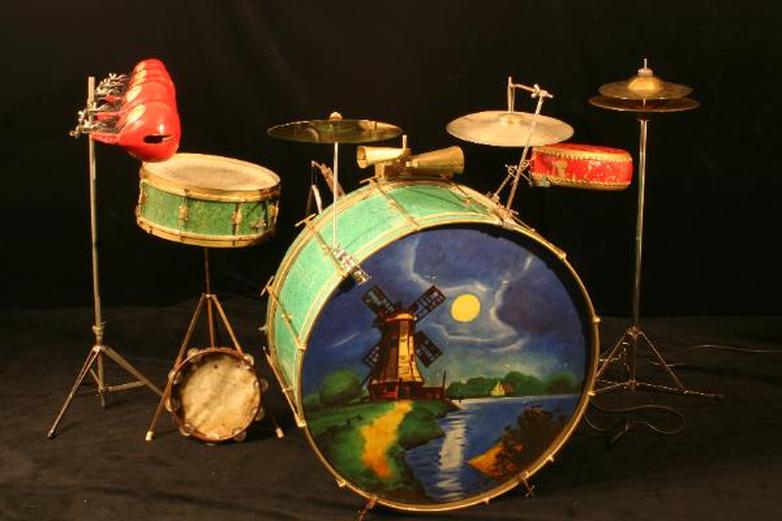
Decades of smooth, swinging cymbals can also make the syncopated, staccato beats of snares, rims, woodblocks and cowbells sound strange. “March-like” is the description and death sentence often thrown around for this style of drumming. Rag-a-jazz drummers were often influenced by marching band techniques as well as the ragtime drumming inspired by those techniques. All influences apparently not being equal, many jazz writers imply that marches are an inferior inspiration next to Afro-Cuban rhythms, hip-hop or other sources.
Drummer Hal Smith, on the other hand, talks about Tony Sbarbaro and other rag-a-jazz drummers as merely having their own distinct, often challenging approach a part from but just as valid as that of Zutty Singleton or Jo Jones (or for that matter, Elvin Jones or Terri Lyne Carrington). Nick Ball praises the prominent drums of Louis Mitchell, Anton Lada, Benny Peyton and others as “thrilling, riotous, imaginative, highly individualistic, incredibly technically proficient and, for the time, very well-recorded.”
For other listeners, this style may be vaguely familiar from some of the hippest names in jazz drumming. Jazz educator Mark Gridley explains:
The earliest jazz drummers often devised lines of activity bearing rhythmic and melodic contours that were distinctly different from the contours of lines being contributed by their fellow musicians. The practice of playing an independent line of activity was suppressed in swing [during the thirties]…It enjoyed a resurgence, however, in bop [during the forties]…This independent line of activity…provides a layer of boiling sounds that increases the excitement of the combo performance. The use of this activity continued through the fifties and sixties [and] has been an accepted practice for all modern drummers of the seventies and eighties…The rhythms used by the modern drummers were not those of ragtime, but the spirit in which they played is analogous to the conception shown by the earliest drummers.
Jazz scholar Dr. Lewis Porter debunks the myth of early jazz drummers as mere timekeepers while also drawing attention to their intricate fills and contrapuntal playing. Porter describes Sbarbaro “going crazy” in the best sense of the term. Whatever these drummers gained from ragtime or military music, it worked for them, their colleagues and anyone who wanted to listen.
Dance Music And Duple Feel
In some ways rag-a-jazz’s most radical difference from the ragtime that preceded it and the postwar jazz that is now lingua franca was that listening was a secondary activity. Rag-a-jazz, as well as most prewar styles of jazz, was above all intended for dancing. Ragtime had its own signature lilt but the new “jass” music really moved bodies.
Traditional jazz musician and writer Chris Tyle reminds that at the time, records were labeled “fox trot, tango, waltz, etc.” for a reason; “Original Dixieland One Step” was just that, a one-step. He also points to the symbiotic influence between music and dancing and the need to ask, “did music change because the dancing changed, or vice-versa?”
Rag-a-jazz musicians (and later on New Orleans via Chicago and big band swing players) had to serve a very practical purpose. Besides the need to get dancers out on the floor, Tyle also points to the material conditions that not only shaped the music but also made it so varied. The size of the venue or a record label’s budget determined band size and repertoire. In some ways this practical basis allows for far more variety than the wide-open plains of art music.
Ball explains that as a style, rag-a-jazz “was so brief that no kind of standardization had time to be established, virtually no two ensembles had the same or even similar instrumentation and every band seemed to have approached the music completely different to each other in terms of image, repertoire, performance practice; no individual’s singing or playing style became familiar enough to become cliché.” It’s why this era includes such fascinating combinations as the Louisiana Five, with Yellow Nunez playing lead on clarinet without a trumpet in sight:
or novel sounds such as the Whiteway Jazz Band’s arrangement of “Blues My Naughty Sweetie Gives To Me,” where the saxophone plays the melody and the trumpet plays obbligato around it, a touch of role reversal in a traditional jazz setting (listen here or below):
How Do You Like Your Eighth Notes?
While simultaneously departing from ragtime, part of this music’s unique excitement and sound has to do with the musicians phrasing in eight, a holdover from ragtime’s pianistic basis. Similar to fingers flying across the keyboard, the notes fly out of these groups in a jittery “rat-tat-tat-tat” that is agitatedly exciting and a world a part from jazz’s later, more vocally-conceived lines.
Vince Giordano mentions the ODJB and vaudeville artists of the early twenties as just a few examples of a bass part playing two-to-the-bar, just like in ragtime, while horns phrase in eight like the right hand of a ragtime pianist. Later on in the twenties, some jazz bands would keep the two-beat bass but without the ragtime “tinge” of the earlier bands.
Giordano raises phrasing in eight as a key part of rag-a-jazz, stressing the eight feel with his own sidemen when they perform this repertoire. As a few other examples of this feel, he cites The Virginians’ “Aunt Hagar’s Blues” in a Ferde Grofe arrangement:
Lillyn Brown’s early recording of the jazz warhorse “Jazz Me Blues,” especially its vocal and trumpet:
the instrumental asides of Mamie Smith’s “I Want A Jazzy Kiss,” especially its chattering wood blocks:
and Mamie Smith’s “Sax-O-Phoney Blues”:
On “Sax-O-Phoney Blues,” the staccato syncopations, chains of eighth notes and reedy arrangement sound very much like orchestral ragtime. The growling trumpet and Smith’s vocal speak to something broader, in terms of phrasing as well as spirit.
Levinson emphasizes that the eighth notes in rag-a-jazz “don’t ‘swing’ the way eighth notes do in most form of jazz,” and are instead “played ‘straight’ or ‘even,’ the way eighth notes are played in ragtime, classical music and every other style of music.” Those even eighth notes can make a huge impact on today’s jazz lovers. Decades of uneven eighth notes as well as post-Armstrong phrasing can make this music sound like it’s simply not jazz. Yet taken on its own terms and without comparison to other rhythmic concepts, it is just another approach to the tradition. Jazz has become a very big tent but its own backyard still has much to offer.
They Always Call It “Music”
The word “jazz” itself also seems to distinguish the new style from ragtime, not just musically but in terms of personal identity. In chronological and cultural terms, Giordano sums up this shift well:
You’re just getting out of World War I, which was such a horrific event, and I think young people just said, ‘We’re going to have a good time,’ and the music really reflects that.
What could be more personal, more joyful and more representative of jazz than a love song to the saxophone?
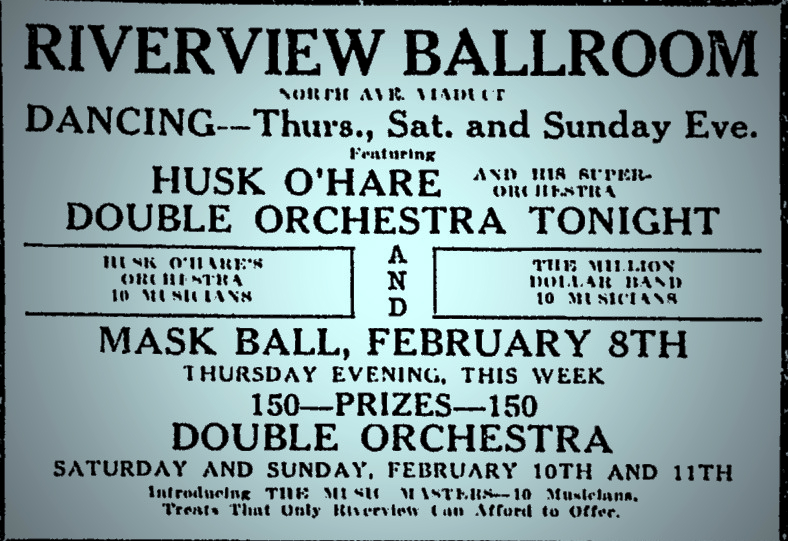
Transitional period, stylistic amalgam, generational signifier, offshoot of ragtime, jazz unlike any before or since and expression of peacetime ecstasy: labels are never airtight but “rag-a-jazz” has come to encompass all of these things. Most musicians and collectors agree that Leonard Kunstadt originated the term in its current usage. Depending on the source, Kunstadt either began using it in the pages of Record Research magazine, which he founded in 1955 and continued to edit and publish, in Jazz: A History of the New York Scene, published in 1962 and coauthored by Kunstadt and Samuel Charters, or at some later point in the seventies.
The phrase does appear much earlier in the name Southern Rag-A-Jazz Band. Yet this London-based band (by way of Nebraska) used it for catchy marketing rather than stylistic labeling. Obviously the musicians themselves were just playing music that came naturally to them. It’s hard to imagine that they understood what they were doing as an offshoot or development.
Garvin Bushell actually saw no distinction between ragtime and jazz. He proudly declares that, as a young pianist, “my knowledge of ragtime assured me I would not have any trouble [playing] jazz. Since there was very little difference between the two, I knew I could master it.” His comments about the repertoire and approach of his earliest bands are also revealing:
As I recall, we also had copies of “Maple Leaf Rag, Way Down Yonder In The Corn Field, ‘The Whistler And His Dog,” and “Give My Regards To Broadway.” Although poorly reproduced, these records contained the foundation of the jazz that was to come, particularly “Maple Leaf Rag.” I make this statement with no fear of contradiction. Ragtime, as it was called then, had the technical essence that was later required in jazz. While ragtime was always played in the moderate or fast ‘two’ tempo, jazz merely slowed it down to a fast or medium ‘four’ … We’d usually have eight or nine guys: trumpet, trombone, clarinet, saxophone, piano, banjo, tuba and drums. Maybe a violin or a bandolin (half banjo, half violin). Since there weren’t dance arrangements then for saxophones and trumpets, the pieces we rehearsed were mostly pit orchestrations. We’d pull out one clarinet part, one sax part, and on like that. The piano player had a part, as a rule, and the bass player faked. In fact, most everybody faked, since none of us could read that well. The style was very much what you hear on the early records-we called it “ragtime jazz.”
At the time and like any time before and since, musicians were simply drawing upon what was around them, what historian Richard Sudhalter called “the rich fermentation of American popular music between 1917 and 1923.” That doesn’t make latter-day commentary and analysis superfluous; in fact, hindsight lets us appreciate and understand the wide variety of music offered by history. iPods can store Phil Napoleon’s trumpet right alongside Miles Davis and Louis Armstrong’s horns.
Play “Ricky-Tick” For Me
Giordano explains that by 1923 or 1924, the rag-a-jazz style began to fade as musicians and audiences absorbed the New Orleans via Chicago “stomp” style and its quarter note feel. Berresford also notes that “the 1923 date is seen by many as the seminal date by which jazz had thrown off all the shackles of its ragtime antecedents and strode forth into the world in its own right – it is no coincidence that 1923 saw the first recordings by King Oliver’s Creole Jazz Band (with a young second cornetist named Louis Armstrong), Jelly Roll Morton, Bessie Smith and Ma Rainey, whilst Coleman Hawkins had made his first, faltering records with Mamie Smith the year before and Bix Beiderbecke was to appear on records just a year later.”
As one example of this change, Chris Tyle points out the difference between Kid Ory’s first recording of his “Ory’s Creole Trombone”:
and his later performance with Louis Armstrong’s Hot Five:
Compared to Louis Armstrong’s “legato” phrasing and the rhythm section’s regular beat, the earlier record is “choppier.” Ory plays his breaks more clipped and cornetist Mutt Carey’s “punchier” attack is reminiscent of Freddie Keppard, one of the few New Orleans trumpets to came out of the older, ragtime based tradition.
“Choppy” may sound like a criticism while “smooth” is the preferred descriptor, but only from one perspective. The smoother attack and more swinging flow of these groups wasn’t a matter of inventing jazz as we know it, but a different set of influences and musical ideas. Exactly when, where, how and why those musical priorities changed remains a hotly debated topic, but it was clearly not a matter of some artistic teleology. As Nick Ball says, “jazz didn’t actually burst fully-formed from the mind of Louis Armstrong in 1923, as many books and films imply.”
The influence of these New Orleans bands and eventually King Oliver’s second trumpeter on young musicians cannot be overstated. By 1928, Boston-born trumpeter Max Kaminsky knew which musicians spoke to him:
The crush roll of the Chicago drummers [such as George Wettling] was unheard of back East, where they were still playing oom-pah and ricky-tick, breaking up the rhythm into choppy syncopations instead of keeping a steady beat you could play against…That nervous, ragged, ricky-tick beat of the white dance bands of the twenties was one of the factors that had been at the bottom of my confusion when I listened to my records back home in Boston, trying so desperately to unravel the puzzle of jazz. None of the white musicians I heard on them could keep time. None of the early white popular bands had really understood the beat yet…of playing the melody simply and purely without all the little flutings and corny licks that were regarded as “hot” in those days.
“Oom-pah, ricky-tick, choppy syncopations, nervous” and above all “ragged” are just loaded descriptions for the music that preceded the Oliver/Armstrong hegemony. For players like Kaminsky and later historians, Armstrong and the Chicago sound were not just another way to play jazz; they were the only way to play.
 Way Off The Record
The tendency to dismiss so much pre-war and especially pre-Armstrong jazz hasn’t helped the historical record or modern outlets of this style. To some commentators, the term “pre-Armstrong jazz” itself is a contradiction.
Ideally, all source material would be treated equally. A fusion would be a fusion would be a fusion. Yet instead of another interesting example of cross-pollination, most major jazz trades treat rag-a-jazz, and several other styles of early jazz, with the knowing silence reserved for “old music.”
It could just be a matter of age: raga jazz, for example, surfaced during the sixties, while rag-a-jazz had its heyday in the late teens and early twenties (never mind that ragtime itself is a baby compared to the raga tradition). Gabor Szabo is much closer than Earl Fuller in terms of stylistic generations as well as human ones.

Earl Fuller’s Famous Jazz Band, 1917: Harry Raderman, Ted Lewis, John Lucas, Earl Fuller, Walter Kahn.
Maybe it’s the intangible but powerful factor of “coolness.” Ragtime is made in America, historically distant but geographically and culturally local. It doesn’t have the same connotation of open-mindedness associated with most brands of “world music.” Ragtime is also close enough to the classical conservatory, and therefore Europe, to make it seem old-fashioned and staid (never mind that, as Berresford, Tyle and others explain, ragtime itself is a rich and varied idiom that is not limited to what’s printed on sheet music). Small wonder that, as Sudhalter says, “standard jazz histories usually represent [American popular music between the years 1917 and 1923] as little more than organized disorder, the vaudeville clatter of the ‘nut jazz’ craze set in motion by the Original Dixieland Jazz Band and their legions of imitators…”
Once An Era But Still A Style
 Like any musical era, these years included their share of “clatter” but they also featured musicians drawing upon a variety of influences, listening to and absorbing a range of styles and making music that doesn’t sound like anything else. It also continues to enthrall today’s musicians and audiences. Rag-a-jazz, and its distance from even the towering presence of Louis Armstrong as well as more modern styles of jazz, may even seem like a breath of fresh air.
Vince Giordano frequently arranges rag-a-jazz numbers such as “Wang Wang Blues” for his big band, the Nighthawks, to the delight of dancers at live gigs and viewers of the acclaimed television series Boardwalk Empire. Chris Tyle enjoys playing the style with numerous groups, including his own Silver Leaf Jazz Band; their Freddie Keppard tribute album actually highlights the cornetist’s ragtime influences. Nick Ball declares that rag-a-jazz “just keeps pulling [me] more and more strongly. I love that it’s rude and it’s louche and it has pretensions of elegance, you can dance to it and you can sit and listen to it too.” Matt Tolentino and his Singapore Slingers look at rag-a-jazz “not [as] a forgotten artifact or a museum piece” but as “music that appeals to all generations, young and old alike.”
Trumpeter Jon-Erik Kellso and trombonist David Sager, two contemporary musicians who play rag-a-jazz as well as many other genres, both cite its unique challenges. Kellso says that “all that ensemble blowing, with little or no rest can be painful” but also explains, with a chuckle, that it “adds character.” Sager describes rag-a-jazz as “some of the most technically demanding stuff [he has] ever attempted.” So much for the assumption that jazz reached its technical zenith with bop.
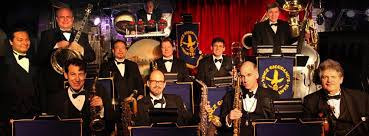
Both Kellso and Sager play with Dan Levinson’s Roof Garden Jass Band, which Levinson founded in 1987 and has since released three albums of rag-a-jazz. Levinson’s context for the music applies equally well for 1920 or 2014:
Just imagine the liveliness of all these guys who were playing a kind of music nobody had ever heard before. We hear the music today, and might sometimes think it’s rather tame in comparison to some of what we’ve heard since. But think about what people were used to listening to at that time: here comes these guys from New Orleans by way of Chicago, and just blew the roof off.

Wilbur Sweatman and His Acme Syncopators, 1923: Maceo Jefferson, Ralph Esudero, Duke Ellington, Wilbur Sweatman, Flo Dade, Sonny Greer, Ian Anderson, Otto Hardwick.
“Blowing the roof off” will never be a historical concept, and people are obviously playing and listening to this music. Is it even fair to call “rag-a-jazz” a historical period when it continues to make these kinds of sounds?
***
From the writer: I would like to personally thank Nick Ball, Mark Berresford, Vince Giordano, Dan Levinson, Hal Smith, Michael Steinman, Matt Tolentino and Chris Tyle for taking the time to share their insights about this topic with me. In the most literal sense of this often-used expression, the above piece would simply not have been possible without their help.
I also invite readers to please share their comments, insights, disagreements and suggestions for further reading about this topic. This piece is intended as an introduction to anyone who is interested in rag-a-jazz, so if you found it useful, I also ask that you please share this article and get the word out about this music and its advocates. Thank you!
Finally, and more importantly, here are a few more examples of this music:
 The Pop of Yestercentury

