Ted Gioiaposted an article by a “Yale music professor” on the death of jazz. I avoid commenting on others’ views online because I don’t always have the training or subject matter expertise to do so. I also avoid commenting on this topic because it usually doesn’t interest me personally. In addition, a Google search leads me to believe that the author is a student rather than a member of the Yale faculty, someone now acquiring the knowledge and critical tools that might make them reevaluate their position or back it up with further examples and different reasoning.
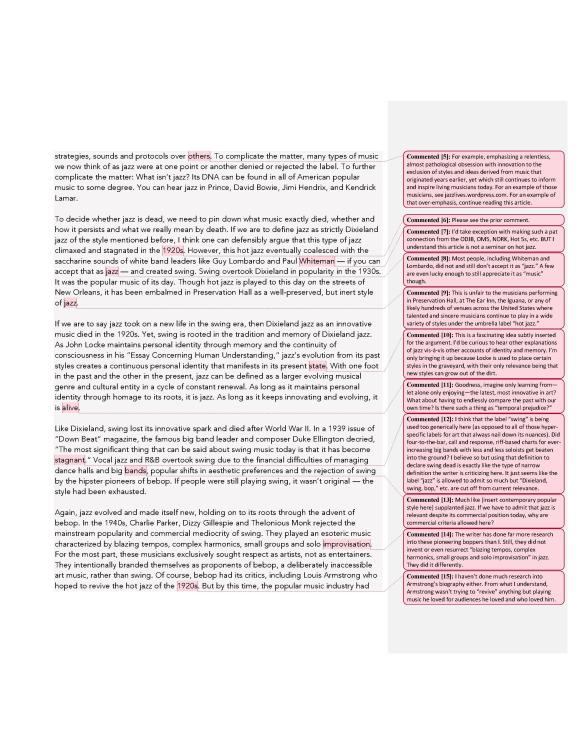
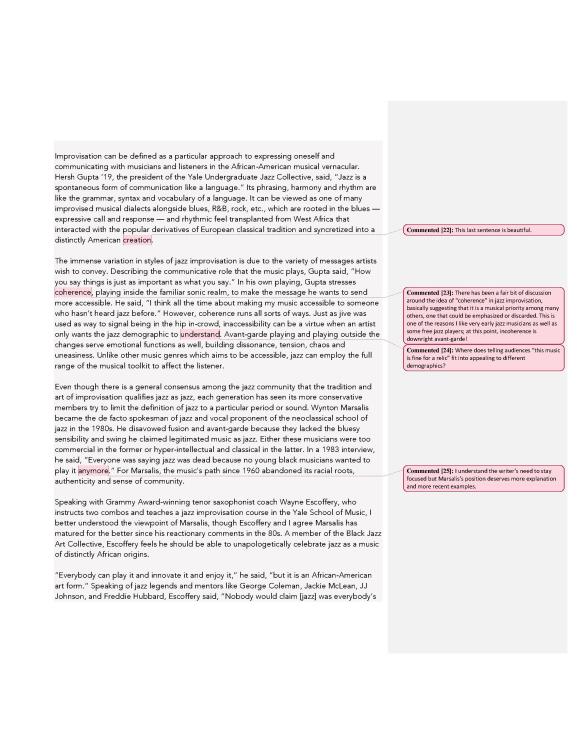
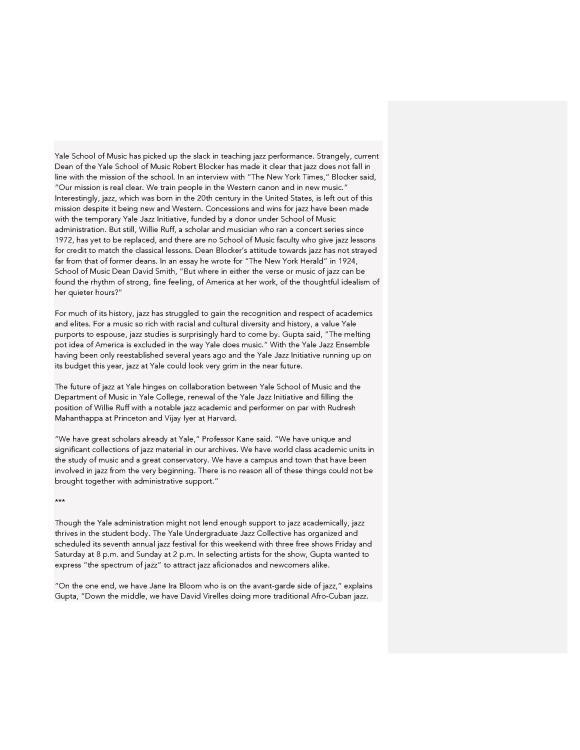
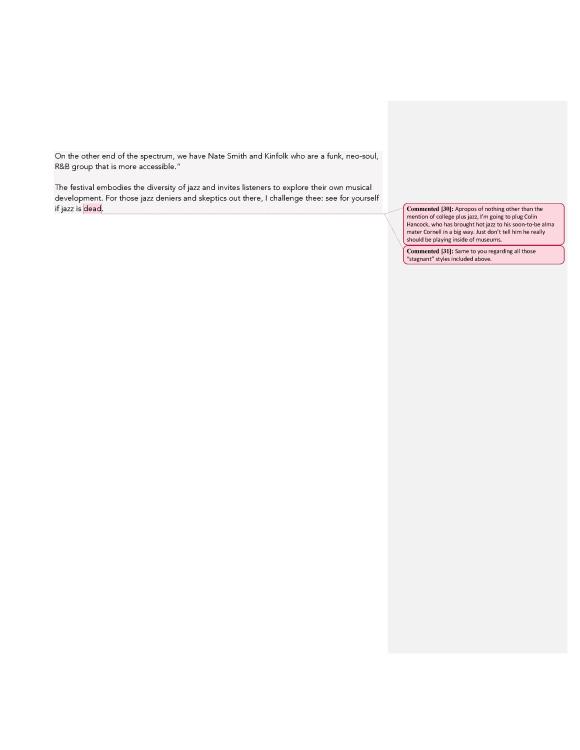
On the other hand, this article encapsulated several ideas about a lot of music I enjoy, which made me think about why these views actually bothered me. Finally, I am very proud of the small but insightful and courteous correspondents who comment on this blog, so I thought it was worth sharing here. The original article is here. I ended up pasting it into a Word document just to get my thoughts on paper, and you can read my three cents in the comment bubbles below.
You might need to zoom in to read it. Alternatively, you can read original content elsewhere rather than my functioning as an intellectual tick. None of this music needs a defense.
I was sharing unpopular opinions about jazz before it was cool… I’ll see your Keith Jarrett and raise you Ted Lewis, whose singing I absolutely and unironically enjoy very much. King Oliver’s Dixie Syncopators is even more “dope” than his Creole Jazz Band. The clarinet never needed a comeback, because it never went away, but wait until bands go back to brass basses instead of string ones.
A little over two weeks from now musicians, musicologists, scholars, historians, collectors, aficionados and fans will mark the eighty-sixth anniversary of a revolution in jazz and a landmark occurrence in American music. Some of them may even discuss the remaining three minutes and ten seconds of “West End Blues,” the part after Louis Armstrong’s introductory cadenza:
Armstrong plays masterfully throughout the record but generations (rightfully) continue to focus on his cadenza. Blazing fast, encompassing the trumpet’s entire range, technically dazzling, artfully constructed and as easy on the senses as the curves of a Botticelli bathing beauty, Armstrong could have easily played just this brief free-tempo improvisation and more than satisfied most listeners.
As for his fellow trumpeters, Armstrong’s cadenza must have invited another Italian phrase, namely agita. It’s not a musical term but it is a fair description of what some players no doubt experienced after first hearing “West End Blues.” Musicians are as much working professionals with their ears open for competition as they are sensitive artists seeking inspiration. It’s easy to imagine Armstrong’s contemporaries hearing “West End Blues” as the work of a genius, a tough act to follow and even something to top. Thankfully, many of them tried, several on record.
Brian Harker describes Jabbo Smith as “the only trumpet player, according to many contemporaries, who posed a threat to Armstrong’s supremacy,” a threat that Rex Stewart described as truly “blowing.” Gunther Schuller points out that Smith “evidently worshipped Armstrong [and] imitated many of the latter’s most famous solos (particularly ‘West End Blues’).” Thomas Brothers cites Smith’s recording of “Take Me To The River” as “a response to Armstrong’s celebrated performance”:
Smith’s blistering edge and intense delivery are far removed from the melodicism Armstrong maintained even in his rapid-fire excursions. That’s a statement of musical priorities rather than an evaluation (though melody often keeps listeners coming back for more, which may explain Armstrong’s longevity). Smith’s Rhythm Aces were actually the Brunswick label’s attempt to compete with Armstrong’s Hot Fives on Okeh. Not one for understatement or easing into a task, Smith picked “Jazz Battle” as the first song at his first session as a leader and started it off with an ornamental call to arms:
Smith’s introduction is less of a cadenza and more an instrumental break before the tune or the band even starts up. Armstrong is majestic while Smith is defiant; Armstrong pulls the audience in but Smith dares them not to blink. Equally telling is how instead of easing into a relaxed air, Smith bursts into a racehorse display. He may have “worshipped” Armstrong but doesn’t sound like he’s ready to serve in heaven.
Reuben Reeves also admired Armstrong even as he sought to knock him down a few pegs. Reeves’s high note displays had impressed Chicago audiences, and bandleader/promoter/journalist Dave Peyton had advocated for Reeves as a classically schooled, more respectable alternative to Armstrong. By the time that Vocalion set up Reuben “River” Reeves and His River Boys a.k.a. the Hollywood Shufflers as another competitor to the Hot Fives, Armstrong and Reeves had faced off against one another at the Regal Theater a month earlier in late April, 1929.
That particular jazz battle did not end well for Reeves. Despite a showy piece arranged by Peyton to show off Reeves, Armstrong excelled in terms of musicality, stamina, technique and roaring crowds. Reeves’s defeat may explain the lack of overt references on his own dates to Armstrong’s by now well-known record. The closest thing to an Armstrongian cadenza is the mid-register, in-tempo introduction to “Blue Sweets,” which is as pastoral as Armstrong’s is urbane:
Reeves does seem to hint at and perhaps parody “West End Blues” with searing sustained high notes on “River Blues” that resemble Armstrong’s final chorus (and follow an Earl Hines-esque piano solo by Jimmy Prince):
Reeves’s upper register is steelier and more penetrating than Armstrong’s, and the answers from Omer Simeon’s clarinet are either the trumpeter’s attempt to avoid outright plagiarism or splitting his lip. Decades later it’s easy to dismiss Reeves with the knowledge that Armstrong was far more than a squeaker. Harker writes that Reeves seemed to absorb the letter but not the spirit of Armstrong’s style. That might imply a shortcoming, but “spirit” is as personal as it is important. Maybe Reeves, like Smith, was content to use Armstrong’s letters to express his own soul.
Louis Metcalf might seem to imitate Armstrong in his note-for-note rendition of “West End Blues” with the King Oliver band. Yet his departures from the original, whether deliberately subtle or entirely unintentional, make it a wholly individual statement:
The bluesy run connecting the third and fourth notes of the opening arpeggio, hesitations such as the split-second too long pause before the shaky high note or even potential clams like the slight stutters on the opening chorus all act like little signatures by Metcalf. It’s a sincere form of flattery as well as bravery: who else was willing to not just attempt this solo but to record it with none other than the inspiration for the source leading the band?
Red Allen, leading his New York Orchestra on Victor, falls between imitation and complete rejection of Armstrong’s lessons. Just a few years younger than Armstrong and a fellow New Orleanian, according to Ted Gioia Allen actually absorbed most of Armstrong’s playing through records. For his first session as a leader (and second-ever experience in a recording studio), he begins “It Should Be You” with a cadenza that does his hero proud without trying to clone him:
Speaking of this session in his solography of Allen, Jan Evensmo notes how Allen had “already found his [own] style, an open pure sound, a sparkling technique, a fantastic inventiveness, a unique sense of harmony and a rhythmic sureness…” At the same time Allen obviously loved Armstrong’s easygoing yet confident swing, declaratory phrasing and glissandi. Like Armstrong, he also seems to believe in not fixing what isn’t broke: that cadenza remains the same throughout all three takes of “It Should Be You.”
For trumpeters from the pre-Armstrong era or who were less obviously influenced by him, simply the idea of an introductory cadenza allowed them to channel their own gifts. Bill Moore’s chattering lines and tightly muted sound weave a slick, pithy epigram before the Ben Bernie band takes over on “I Want To Be Bad”:
James “King” Porter tacks a miniature cadenza onto to his lush introduction to “Between You And Me” with Curtis Mosby and His Dixieland Blue Blowers:
While on “Buffalo Rhythm” by Walter Barnes’s Royal Creolians, Cicero Thomas rushes through his introduction like a trumpeter at a bullfight with a bus to catch:
Armstrong himself would of course return to the device on record and throughout his career. His introductory cadenza on “Blue Again” is a personal favorite of this blogger:
Its poise, its subtle mixture of drama and detachment and the casual, humorous way that Armstrong “muffs” the reference to his own cadenza from “West End Blues” show that even Armstrong could look to Armstrong as a springboard to something different.
Armstrong himself was initially inspired by the tradition of concert soloists in European music and American marches. He didn’t play the first cadenza at the start of a piece or a record but it likely seemed that way for many trumpeters. All of “West End Blues” is a marvel but its elevation of a single musical device within the jazz community is equally impressive.
With the exception of the Reeves sides (July and May of 1929) and “Blue Again” (1931) all of these records were made just seven or eight months after Armstrong cut “West End Blues.” Allowing for time between Armstrong recording and Okeh distributing it, “West End Blues” must have been fresh enough to convince trumpeters, and record executives, that they needed a flashy cadenza. Eleven seconds generated enough creative curiosity, professional jealousy and/or commercial trendiness to inspire several individual contrafacts, and of course there are more out there and to come. That really is an amazing introduction.
Tom Lord’s Jazz Discography lists over one thousand recordings of “Ain’t Misbehavin’.” Pretty good for a song that Ted Gioia explains is ”not quite as important a part of the jazz repertoire nowadays as it once was.”
It is true that beboppers, post-boppers, free-jazzers, fusionites and other modernists never really cozied up to the Fats Waller standard. That still leaves a who’s-who of prewar and prewar-influenced jazz musicians to give it a shot. Yet even with Louis Armstrong’s magisterial interpretations, the composer’s own performances and pianists from Jelly Roll Morton and Art Tatum through Dick Hyman and Jeff Barnhart to choose from, I keep coming back to the Charleston Chasers’ “Ain’t Misbehavin’.”
In fact the the Original Memphis Five working under an alias that Columbia records used for several bands, the Charleston Chasers waxed their version at the height of the song’s popularity. Waller had written “Ain’t Misbehavin’” for the revue Hot Chocolates, where it soon became a feature for Louis Armstrong and eventually the most famous part of the show. The Chasers recorded the tune about a year later, and just a few weeks before Armstrong made his own recording (skip ahead to 0:48 in the following clip to hear the music):
This arrangement never entirely settles, and that’s what makes it so interesting. The Chasers’ two-beat amble has its own magnetic energy, but their rhythm is a little overly delineated. Phil Napoleon’s trumpet is typically crisp yet slightly tense: his high notes during the introduction sound forced while the turnaround notes in the first chorus are hesitant. There’s a carefulness to the Chasers’ playing, the sound of a band feeling their way through a brand new composition.
They’re also figuring out what to “do” with this new song, adding some highly original touches to make it their own. The Chasers feature a standard front line of trumpet, trombone and clarinet, but clarinetist Jimmy Dorsey lays low during the ensembles to let Napoleon and his frequent OM5 partner Miff Mole fashion brass duets. Napoleon and Mole were already seasoned jazz musicians, developing in tandem with the music from its earliest roots in ragtime. The pair displays a refreshingly harder-edged sound and play busier, punchier lines than most of their New Orleans colleagues. Napoleon and Mole even switch roles following the vocal, with muted trumpet decorating the trombone’s burry lead. Eva Taylor’s vocal is charming but Arthur Schutt’s elegant accompaniment behind her is the real find. His classical allusions also turn the minor chords of the bridge into miniature Rachmaninoff preludes. Joe Tarto’s bass keeps snapping throughout while Dorsey’s whinnies add a humorous symmetry to the whole thing.
This performance is a departure from the jamming and stride theatrics now typically associated with “Ain’t Misbehavin’.” It’s also far removed from the weight of history and sense of familiarity attached to even the most relaxed renditions of this song. This was only the fourth recording in the history of Waller’s iconic tune. If it shows its age, that age offers a completely unique experience.
 Ted Gioia posted an article by a “Yale music professor” on the death of jazz. I avoid commenting on others’ views online because I don’t always have the training or subject matter expertise to do so. I also avoid commenting on this topic because it usually doesn’t interest me personally. In addition, a Google search leads me to believe that the author is a student rather than a member of the Yale faculty, someone now acquiring the knowledge and critical tools that might make them reevaluate their position or back it up with further examples and different reasoning.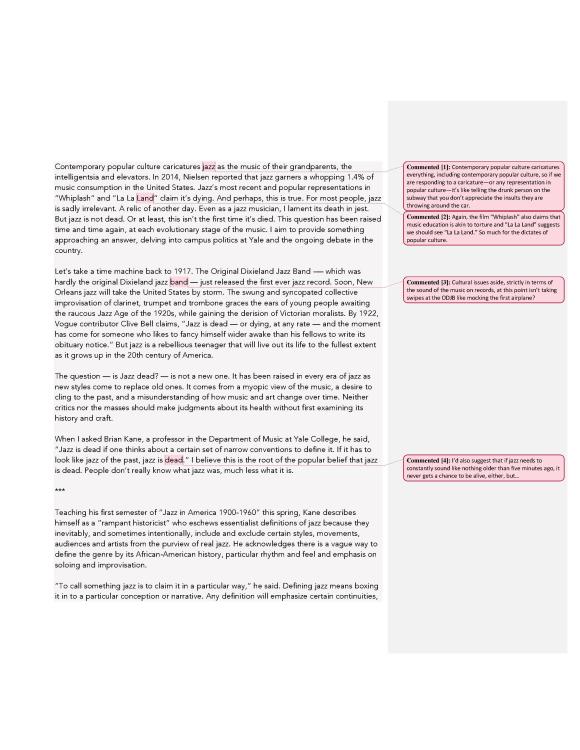





 The Pop of Yestercentury