Tag Archives: Miff Mole

The Original Memphis Five: Some Ideas About Their Music and Importance

Here’s a modified draft of liner notes I submitted some time ago for a reissue of the Original Memphis Five’s recordings. This essay is longer and more subjective in tone than I now aim for in my writing, but I know a few readers also enjoy their music, so I decided to share the draft in case anyone might want some thoughts on this band. You can also skip my verbiage and head straight for a lot of great music (though many of the recordings listed here were unavailable online)!

from Zefren Anderson at YouTube

Historical information below is from Ralph Wondraschek’s landmark, incredibly thorough research into the OM5, which he published in multiple parts for VJM.

How many orchestral combinations, ten times the size of this quintette of exceptionally capable musicians, can boast that they are making records for eleven different concerns, and are scheduled for weekly appearances in three different dance palaces?
The Metronome Orchestra Monthly, December 1922

In their heyday, the Original Memphis Five (OM5) made hundreds of records and earned plenty of press coverage. And they’ve enjoyed a decent number of reissues on LP and CD. Yet even with an extensive historical and discographical legacy, it seems like early jazz specialists and hot music aficionados are the only listeners interested in this band.

Musicologist Gunther Schuller devotes one brief (and far from complimentary) paragraph to the OM5 in his landmark analysis Early Jazz. Richard Sudhalter’s Lost Chords gives the group considered musical appraisal (rather than measuring it against more well-known contemporaries). Liner notes by Mark Berresford and Hans Eekhoff for OM5 compilations on the Frog, Retrieval, and Timeless labels also give the OM5 its creative as well as historical due. And several articles in periodicals for record collectors and jazz aficionados do the same. The OM5 also gets plenty of attention on various online social media boards aimed at such specialists.

Still, Smithsonian anthologies and PBS documentaries don’t bother with the band. Most jazz history textbooks omit the OM5. It’s safe to assume many university jazz courses do the same. Miff Mole gets an occasional mention for the influence of his groundbreaking trombone technique, but typically in passing before the story moves on to Jack Teagarden.

Works of jazz history only have so much room, so they tend to include what the authors deem “historic” but not necessarily all of music history. Jazz blogger Michael Steinman analogizes a Biblical progression along the lines of “Oliver begat Armstrong, who begat Roy Eldridge, who begat Dizzy Gillespie, etc.” This approach generates a tidy sequence that explains the music familiar to most listeners today. Yet it offers a narrow picture of the music as it was performed and experienced in its time. Learners are left with an endless history of the avant-garde that emphasizes innovation above all else.

Bands like the OM5 get overshadowed in a form of jazz history that only catalogs the key musicians and events that took the music to new levels. These narratives—overtly or by omission—sometimes relegate the OM5’s music to a well-crafted dance artifact of its time, perhaps beyond reproach but not groundbreaking enough to make it into jazz hagiography. But, as Sudhalter notes, “no band was more universally popular [and] admired on musical grounds” in the early 20s than the OM5. They must have done something special.

The Price of Being Prodigious

Even the most vehement OM5 detractor has to admire the sheer consistency of energy and polish across the OM5’s many recordings. It’s hard to hear the group having a bad day, missing notes, playing sloppily, or performing with anything less than total commitment.

Yet craftsmanship that impresses audiences or even fellow artists doesn’t always win over music historians. Comments along the lines of “X is no Louis Armstrong, Charlie Parker, Mozart, etc.” make for convenient critical copy: superficially discriminating, self-pleasingly flip, versatile enough to use in academic articles or conversation at cocktail parties, and still saying little about either the idol or the supposed also-ran.

The sheer size of the OM5’s discography makes assessment difficult. For some, it even makes the group’s creative credentials suspect. In his liner notes for Retrieval’s reissue CD of the OM5’s complete instrumental sides recorded for the Pathe label (RTR 79044), Mark Berresford points to the unfortunate and unfair dismissal of the OM5 as “slick manipulators of a jaundiced, racist recording industry system, churning out a production line of anemic, soulless records.” The suggestion that this band actually introduced a unique musical style that set it apart from predecessors and contemporaries rarely enters the mainstream jazz discourse.

More Than ODJB Imitators

The OM5 was one of the groups that arose in the wake of the Original Dixieland Jazz Band (ODJB)’s immense popularity during the 20s. Passing mention of these “fabulous fives” often implies they were all simply trying to seize upon the ODJB’s commercial success through outright, and at times exaggerated, imitation.

The ODJB, the OM5, and similar groups shared instrumentation of cornet/trumpet, clarinet, trombone, piano, and drums. They all played fast and furious instrumentals full of wild collective ensembles. OM5 pianist Frank Signorelli and clarinetist Jimmy Lytell even became regular members of the ODJB:  Signorelli from April 11, 1921, to February 10, 1922, and Lytell from January 14, 1922, to February 10, 1922. ODJB leader Nick LaRocca even accused Signorelli of stealing the ODJB’s arrangements.

Decades later, the OM5 is occasionally mentioned as a  transitional step between the ODJB’s more aggressive (yet nonetheless infectious) rag-a-jazz and the looser, bluesier southern and southwestern bands that began recording more often during the 20s. In academic jazz histories, when they’re even mentioned, the OM5 is portrayed as a stylistic placeholder that held people’s attention until they heard “authentic” jazz (whatever that meant at any given moment to each writer). 

More than a mere copy or variation of the ODJB, the OM5 expanded upon the ODJB’s approach with a different melodic sensibility and a more measured though still exciting ensemble interplay (and in much better sound due to advances in recording technology, specifically on the Victor and Brunswick labels). The OM5 smoothed out the ragtime-derived phrasing of the ODJB while adding a distinctly New York accent and pushy momentum that was always melodic. “Sob Sister Sadie” surges forward as though the lady can barely catch her breath, but the parts still link together naturally without sounding forced. The OM5’s unity of concept and instrumental clarity never let things spill over into excess.

Hot Lyricism

It is also much easier to pick out a tune on OM5 sides, partially because of better sound on certain labels but largely due to Phil Napoleon’s clear, confident lead. Hundreds of sides demonstrate the cornetist’s powerful but always focused drive, his perfect rhythmic placement, and his sheer beauty of tone—especially on acoustic recordings.

Paradoxically, Napoleon’s sturdy style—a clear melody that doesn’t sacrifice thematic invention or sheer drive—may have allowed later commentators to take him for granted as jazz trumpeters began playing higher and faster. But at the height of the OM5’s popularity, that style must have been advantageous for powerful record companies and music publishers eager to get the actual song heard by as many listeners as possible.

All bands recorded pop tunes, but the OM5, as Napoleon told Sudhalter, “learned them as fast as they published ‘em.” In the OM5’s hands, popular songs are both recognizable and personalized. The now well-known melody of “Everybody Loves My Baby” gets its turn as-is through Lytell’s slurring middle register before Napoleon plays squawking variations on the bridge a la Earl Oliver and Tom Morris. Napoleon’s crisp, relatively unadorned chorus of “How Come You Do Me Like You Do?” still sounds deeply personal.

The sheer frequency of OM5 sessions shows that it was meeting public demand for melody and rhythm while maintaining its own musical style. That style also jettisoned the novelty effects that were so profitable for their contemporaries. Far from Schuller’s assessment of the OM5 as being another group “seduced…away from jazz towards commercial dance or slapstick music,” the OM5’s discography has few instances of barnyard onomatopoeia, kazoo solos, and other gimmicks (and this writer makes no negative value judgments about bands using them). Resisting the fad for novelty wasn’t unique; the Georgians, for example, also avoided these effects on record. But selling so many records without novelty effects set the OM5 apart.

A Five-Piece Orchestra

As a regular gigging band and an active recording group, the OM5 developed a rapport that allowed them to develop and adhere to their musical ideas while sharpening their already impressive musicianship. It’s no small wonder the OM5 always sounds so cohesive.

The verse on “Static Strut,” played with Lytell and Napoleon in tight upper-register unison, is so flawlessly executed that it comes across as a section in a larger band with the agility of a small group.

“Cuddle Up Blues” is just one example of the group’s pinpoint dynamic contrasts.

When the band dips down in volume on “I Never Miss The Sunshine” for Brunswick, the parts remain transparent and swinging: Lytell plays counterpoint in his lower register under Napoleon’s soft muted lead while Miff Mole plays a near-whispering bass line on trombone. At a time when jazz was popularly heard as unrelentingly loud, the OM5 played with a wide dynamic range demonstrating taste as well as attention to detail.

Arrangement undoubtedly played a large part in the band’s consistently unified sound. The use of arrangement/memorization was common at the time. It wouldn’t become a death sentence for authenticity as a jazz player until writers introduced more doctrinaire definitions decades later.

Multiple versions of the hot OM5 original “Great White Way Blues” for the Arto, Banner, Brunswick, Edison, Gennett, and Pathe labels may not yield startling differences in improvisation. Still, they display crack musicianship and a sense of constant spontaneity.

The OM5’s consistent energy level throughout hundreds of sides and engagement with predetermined musical roles may even be all the more remarkable given their intense work schedule.

Regardless of the level of arrangement, the OM5’s credentials as an outright hot band and their unashamedly danceable aesthetic are clear. “Laughin’ Cryin’ Blues” struts from the outset with Napoleon’s lead and witty breaks plus drummer Jack Roth’s rims clicking away in the background. “I’ve Got A Song For Sale” shows a lighter side of the OM5, still danceable but perhaps intended for softer steps.

John Cali’s percussive banjo joins the group on the Brunswick recording of “You Tell Her, I Stutter” to create one of the OM5’s most uninhibited sides. On “‘Taint Nobody’s Biz-Ness If I Do” on Pathe and “If Your Man Is Like My Man,” the band dirties up their otherwise clean timbres, adds a deliberate drag, and inserts inflections as carefully placed musical devices rather than stock effects. On “Evil Minded Blues,” Napoleon plays double-time runs that sound similar to those of the Memphis-born, pre-Armstrong New York jazz trumpet virtuoso Johnny Dunn but with fewer blue notes. The OM5 comes across as unified, even cultivated, even on earthier material.

Authentic To Themselves

The OM5’s tight, well-crafted sound has led some commentators to fault them for a lack of visceral drive or raw emotion. Compared with New Orleans bands recording at the time—such as King Oliver’s Creole Jazz Band or even Freddie Keppard’s ragtime-tinged recordings—the OM5’s phrasing sounds more even with more defined articulation and less vocally-inflected timbres. For example, it makes the OM5’s “That Da-Da Strain” seem willfully tense. The Dixieland warhorse comes at modern listeners with a motor energy that now seems to fly in the face of most New Orleans and Chicago-style renditions.

Like fellow New Yorkers such as the California Ramblers and the pre-Armstrong Fletcher Henderson orchestra, the OM5 pushed (rather than rode) the beat with sharp syncopation, adding decidedly instrumental embellishments and insisting on pinpoint note placement. Jazz teleologists are free to sketch a hierarchy of styles. On record, the music is just a different approach to jazz. And in hindsight, the OM5’s style may even be refreshingly unrelaxed. Its two-beat style on “Down By The River” has a more confident, swaggering feel next to the Henderson band’s steady four on its recording of the same tune.

OM5 members likely heard New Orleanians visiting New York City, including Freddie Keppard and Sidney Bechet at Coney Island. Phil Napoleon briefly studied with King Oliver as a young runaway in New Orleans. Trombonist Charles Panely (aka “Panelli”) had played with New Orleanians in the Louisiana Five. Miff Mole even sat in with New Orleans trumpet legend King Oliver’s band in Chicago between February 23 and March 5, 1920.

Yet Lytell, Mole, Napoleon, Panely, Roth, and pianist Frank Signorelli were all native New Yorkers. Garvin Bushell notes in his autobiography that “there wasn’t an eastern [i.e., New York, east coast, non-southern] performer who could really play the blues. We later absorbed it from the southern musicians we heard, but it wasn’t the original with us.” For the OM5, the blues and other folk musical traditions would have been incidental rather than formative. And while many New Orleans musicians trained in the outdoor New Orleans brass band tradition—a unique and popular idiom of the Crescent City—New Yorkers like the OM5 would have been more familiar with the range of theater and dance music popular in the Big Apple.

Why would five musicians sound like musicians from the South? Nearly a century later, do we still need to fault them for sounding like themselves?

Of course, musicians from all regions and communities adapt and learn from various influences. But it’s no surprise that the OM5’s rendition of “Tin Roof Blues” differs from the New Orleans Rhythm Kings (NORK)’s haunting original performance of the tune from just a few months earlier. The NORK is clearly indebted to groups such as King Oliver’s Creole Jazz Band. The OM5’s recording instead plays to the band’s unique strengths: tight interplay, crisp accents, and clean, often breathlessly executed musical statements that are as affecting in their own fashion.

The Sum of Incredible Parts

Comparing Napoleon’s open, almost concert-like lead against NORK cornetist Paul Mares’s big round wail or King Oliver’s raspy, muted declarations, it’s easy to fall into stereotypes about conservatory training versus folk traditions, staid and proper northeast versus the earthy South, etc. Or we can look at mere differences of musical priorities and matters of degree when it comes to rhythm, ensemble color, thematic variation, and other musical elements.

Lytell’s clarinet parts are less incisive than the high-flying descant lines of New Orleanians such as Johnny Dodds and Jimmie Noone. His scoops and smears add a different color to the overall sound. Lytell sometimes fills in the harmony from the top instead of creating independent lines decorating over the lead, for example, on “Snake Hips.”

“Red Hot Mamma” for Emerson demonstrates Lytell’s knack for sneaking slick little asides into breaks or between the briefest pauses. For keen insights into Lytell’s musicianship, check out Phil Melick’s liner notes for Jazz Oracle’s reissue of Lytell’s complete trio recordings.

With his superlative technique, Miff Mole could incorporate the tailgate style of the New Orleans trombonists as just one role in an ensemble. On sides like “Chicago,” Mole’s elegantly swinging lines jell with the ensemble with the inevitability of polyphonic chant. His advanced technique and imagination also allow him to range under, over, and around the ensemble beyond the trombone’s traditional role in the three-person frontline, for example, on “Steppin’ Out.”

Panely’s style comes across as more pared down compared with Mole’s. He emphasizes chord tones rather than linear lines and acts as more of a ground bass. Far from being simpler, any arranger would have been proud to pen the ensemble lines Panely lays down on “No One Knows What It’s All About” and “Duck’s Quack.”

On the New York Scene

Listening to the OM5 within the context of its fellow New York City bands brings their musical style into even sharper focus. For example, just as the OM5 is compared with the ODJB, the Original Indiana Five (OI5) is often compared with the OM5. Perhaps trying to avoid sounding like an OM5 imitator, OI5 clarinetist Nick Vitalo doubled on alto saxophone—something Lytell rarely did on record. Proportionately, far more OI5 sides include a banjo. Yet the OI5 did not display the same effortless technical facility (how many bands could?) or balance of instrumental voices.

On “St. Louis Gal,” as just one example, the OM5’s parts lock in with each other and generate momentum and interest inside the ensemble. On the same tune, the OI5’s horns duplicate notes more often, playing in more of a loose heterophonic style than a polyphonic one. The OI5 rhythm section is also more of an accompaniment rather than an interactive part of the front line. As another example, pianist Harry Ford, banjoist Tony Colucci, and drummer/leader Tom Morton mark the beat more deliberately than either the OM5 or NORK on “Tin Roof Blues.”

The Georgians, Paul Specht’s band-within-a-band, were one of the more overtly jazz-oriented groups of the time. Leader and cornetist Frank Guarente was a King Oliver disciple, pianist Arthur Schutt was already translating the spontaneity of jazz into written arrangements, and drummer Chauncey Morehouse could spur and color a band with even the sparest of studio-sanctioned kits. The Georgians’ and OM5’s recordings of “You Tell Her, I Stutter” demonstrate different but equally valid hot sensibilities: the Georgians’ slightly denser instrumental sections versus the OM5’s more transparent ensembles, the OM5’s brighter edge against the Georgians’ richer voicings, Guarente inserting classically-oriented touches amidst dirty, muted lines while Napoleon plays bel canto even in his folksiest outbursts.

Coming out of Memphis and playing with blues composer WC Handy, cornetist Johnny Dunn was bound to apply more blues inflection than Napoleon. Yet overall, Dunn’s records have a more aggressive, military-influenced feel than those of the OM5. Even the OM5’s tense sound on Dunn’s “Four O’Clock Blues” comes across as more playful next to the slightly ponderous but more spacious approach by the composer’s Original Jazz Hounds. And Dunn’s group was also already incorporating a moaning sax section.

A Constant Quintet

The OM5’s loyalty to the five-person jazz band format and eschewal of the saxophone would become a stylistic hallmark (and perhaps a reason for other bands eventually outpacing it in historical hindsight). The Georgians included a sax section with players doubling other reed instruments. Fletcher Henderson was already synonymous with separate brass and sax sections, setting the stage for an orchestral concept of jazz that would change the course of jazz. Since its inception, the California Ramblers, perhaps the most popular New York band of the 20s, exploited the use of the saxophone in sections, solos, and even its rhythm section via leader and bass saxophone virtuoso Adrian Rollini. Even the Ramblers’ myriad small group spin-offs usually included one or two saxophonists alongside a cornetist rather than the standard three-person front line of trumpet, trombone, and clarinet.

As Wondraschek explains, “after the ODJB’s departure for England in March 1919, the saxophone became more and more regarded as an indispensable part of any jazz band. Nevertheless, the OM5 stuck to their instrumentation and managed to become popular without the use of a saxophone. The OM5 were the torchbearers against the then omnipresent trend of increasing the size of the jazz and dance bands.”

The OM5’s Tennessee Ten sides for Victor did include a two-sax section, and some of its Cotton Pickers sides include one saxophone. While the saxes add a contrasting texture, the core OM5 remains the most musically interesting and exciting part: Lytell’s clarinet answers the saxes on “‘Taint Nobody’s Biz-Ness If I Do” and Napoleon’s magnificent embellished lead on “I Never Miss The Sunshine” becomes all the more rhythmically interesting against the straighter saxes. The effect is so pronounced on “Waitin’ For The Evenin’ Mail” that it borders on parody. Trends aside, the five-person lineup could still give those tentets some competition.

The OM5 also proved downright ingenious within the five-person format. Their arrangements did not always rely on New Orleans-style polyphony with a cornet lead, trombone counterlines, and clarinet obbligato. Napoleon cleverly uses contrasting open and muted horn, as in “A Man Never Knows.” He sounds like two different players when he plays the bridge with a muted squawk on “Take Me.” The lead also gets passed around to other instruments, resulting in such novel effects as a brass duet on “Lovey Came Back,” call and response between the front line and the piano on “Papa Blues,” low register clarinet melody with muted trumpet obbligato on “Hot ‘N Cold” and trombone lead with the trumpet playing the melody as an obbligato underneath it on “Cuddle Up Blues.”

Like most bands on record at the time, the OM5 was primarily ensemble-based, so a full chorus of total solo improvisation radically departing from the melody was rare. Passing along the lead allowed for subtle variation, making the theme one’s own without necessarily transforming it or resorting to harmonic refashioning. In this regard, the OM5 resembled other New York-based bands such as Lem Fowler’s Washboard Wonders, emphasizing melodic embellishment rather than a complete reinvention of the tune. This ensemble variety puts the OM5 miles away from King Oliver’s Creole Jazz Band, with its leader’s documented rigid division of roles and even register between instruments.

One of the OM5’s favorite musical effects was a break in collective improvisation in the middle of the record for the front line to part ways for a single horn over Signorelli’s accompaniment. Nearly all OM5 records include such a chorus, often with Napoleon keeping the lead but now using a mute for added contrast. These horn and piano choruses add further textural and timbral variety as well as another way to share the lead. They could be heard as an embryonic attempt at contrasting a soloist with the full band, an effect that would become the hallmark of swing-era big bands.

Syncopated harmonized breaks for the entire front line as on “Buzz Mirandy,” “Chicago,” “Loose Feet,” and “My Sweetie Went Away” are another favorite OM5 device that points to later section writing that aimed at sounding like a soloist. Ensemble hits on sides such as “No One Knows What It’s All About” or the harmonized patterns between the trombone lead on “Runnin’ Wild” also anticipate swing big band arrangements. The brass riffs behind Lytell’s clarinet on “I’m Going South” separate instrumental families, an essential sound in Don Redman’s pioneering big band charts.

Brief spotlights for drums also spring up with an unusual regularity for the time. “Gypsy Blues” shows the instant rise that Jack Roth’s drums provide by being strategically deployed rather than relentlessly forward in the mix. “Lonesome Mama Blues” demonstrates Roth’s emphasis on syncopated accents rather than steady beats. “Memphis Glide” shows off his variations on cymbals. Jazz age drummers have suffered the most because of technology, with what little equipment they could bring into the studio at the mercy of recording engineers.

Signorelli is now typically mentioned for playing with Bix Beiderbecke, but his work with the OM5 and frequent features with the group show why he got to play with some of the greatest names in jazz. He plays in a florid, stomping style, often simultaneously accompanying and ornamenting the other instruments. The OM5’s “Farewell Blues” comes off as the most intense version of the tune from this period. Granted, it’s faster than recordings by the New Orleans Rhythm Kings or The Georgians, but the hot factor is primarily due to Signorelli’s pumping left hand and treble fills. His accompaniment for the vocal on “That Red Head Gal” seamlessly underscores the sung melody while bursting into carefree asides. Signorelli seems to have never forgotten his ragtime roots, often relying on bright textures and crisp articulation that add a steady sense of tension and release (even as late as 1955 on an album of duets with drummer George Wettling).

Room For More

Of course, more seasoned ears may simply hear all of this music as a well-crafted artifact of its time, which itself might be enough to earn the OM5 some musical kudos. The OM5 had its own signature sound rooted in creative and impressive musicianship. Other musicians would forever change the course of jazz, but, at the very least, the OM5’s music can now be heard as a fascinating alternative, another unique sound of the historical “scene” rather than a vestigial part weeded out through some form of jazz evolution. Unlike jazz history textbooks, record shelves have room for all kinds of music.

Tagged , , , , ,

A (The?) Larry Binyon Story

The following post first appeared in multiple parts on this blog, and I was asked to consolidate it into one single entry (and more than happy to oblige). Larry Binyon has been a personal favorite since I first started listening to jazz. Hopefully, this post will shed some light on his life and work, and perhaps inspire someone with better resources to research that life, and more importantly Binyon’s music, further. Either way, please enjoy!

Larry BinyonReality television notwithstanding, ubiquity and fame are two very different accomplishments. Just ask Larry Binyon. More practically, Google him: he appears on dozens of record dates (150 jazz sessions alone according to Tom Lord), usually listed alongside some legendary names. Yet that’s all most historians and musicologists have to say about him. Larry Binyon is all over jazz history but not a well-known part of it.

He must have been an impressive musician to get work so consistently, especially with the likes of Benny Goodman, Fats Waller, Red Nichols, the Boswell Sisters, the Dorsey Brothers, and other famous names. He also doubled several instruments, mostly playing tenor saxophone but contributing on flute when it was rarely heard in a jazz context. Binyon could also improvise in addition to read and double. Given the company he kept, he got to read and double far more often than he got to take a solo.

Years later and with very few solos on record, sidemen like Binyon can seem like historical packaging material. They surround the names we know best, provide musical as well as personnel background but otherwise end up padding the “real” artistic goods. After all, isn’t jazz “really” about improvisation? Weren’t there “better” improvisers around? Didn’t other musicians double? Couldn’t “anyone” have read the chart, as Binyon did?

Perhaps, but only from the luxury of listening decades later. To musicians, someone who could do all three (and maybe even show up on time and in uniform) would be a precious resource. There must have been a reason why Larry Binyon got to play so often. He also recorded quite a bit, even some of those improvised solos that jazz purists like to hunt down between all the written stuff, which Binyon also made possible. That sounds like far more than filler, and it definitely sounds like an important part of the music.

Chicago And Back Again: The Early Years

Lawrence “Larry” Fiffe Binyon was born in Illinois on September 16, 1908, the younger of Claude and Josephine Armstrong Binyon’s two children (their first child Hugh was born in 1905). Census records show the Binyon family renting one unit of a two-family home in Chicago’s twenty-seventh ward in 1910, with Claude Binyon listed as an unemployed funeral director and somehow still employing a live-in servant. By 1920 the family was renting a single home in the city of Urbana, about 150 miles south of Chicago. Claude now worked as a secretary for an oil company. Josephine was now also employed as a music teacher working out of the Binyon home, now servant-less.

Urbana was a much less densely populated city, and census records show more white-collar jobs among the Binyons’ neighbors in Urbana than those in Chicago. Perhaps the quality of life was a factor in their move. Maybe Urbana was simply where Claude could find another steady paycheck, albeit now supplemented with a second income. If there was financial hardship, it could have influenced Larry’s understanding of the value of a dollar. Claude’s death in 1924, when Larry was just sixteen years old, certainly would have put a financial strain on the family. Larry might have developed his later well-documented work ethic at an early age.

It’s unclear how early Larry Binyon started playing music, but safe to assume that his mother shared at least some of her musical knowledge. By age eighteen, Binyon was at the University of Illinois at Urbana-Champaign, listed on E flat (soprano) flute in the school’s concert band as well as (standard) flute and piccolo in its first regimental band during the 1926-27 school year.

Binyon would only spend one year at college. By 1927 he was already playing professionally in Chicago as part of Beasley Smith’s band, which also included drummer Ray McKinley and clarinetist Matty Matlock. Drummer and future swing era star Gene Krupa was playing across the street from Beasley in Joe Kayser’s band, and Binyon would have encountered an even wider pool of talent in the jazz mecca. Flute may have been Binyon’s first instrument, or at least his primary one at school, but tenor sax would have by now become his main horn for dance bands.

Later on that year, drummer, bandleader, and talent incubator Ben Pollack came back to Chicago after an unsuccessful gig at the Venice Ballroom in California. His third saxophonist and arranger Fud Livingston had left the band earlier that year (to work with conductor Nat Shilkret in New York City). It’s unclear exactly when or how Binyon hooked up with Pollack, but he was with the Pollack band on December 12, 1927, when it returned to the Victor’s Chicago studio after a five-month hiatus. He even got to solo!

On the final bridge of “Waitin’ For Katie,” Binyon stays pretty close to the melody on the first take and loosens up slightly for the second one. Both takes find Binyon jumping in on a break and ripping into the upper register (here is the issued first take):

Like many jazz musicians from this period, Binyon “routines” his solo but still has something unique to offer. His reedy tone and declaratory, trumpet-like phrasing are very different from Coleman Hawkins’s metal and rapid-fire arpeggios. Binyon has been compared to Bud Freeman, but Freeman generally played in a more agitated style at this time. Binyon sounds more relaxed even at faster tempos. Stated bluntly, he just played fewer notes than those guys.

Apparently, Pollack liked Binyon’s notes; his tenor saxophone gets another solo on the session’s other issued side, “Memphis Blues,” where Binyon once again varies things just slightly between two takes (the issued first take follows):

He sounds tentative playing counterpoint in the introduction, and his brief solo might not seem like a model of construction. Yet he doesn’t get much room to stretch out on the W.C. Handy standard. Fud Livingston’s arrangement inserts some snappy chord substitutions from the band into the middle of Binyon’s chorus, which Binyon leaps into with a beautiful, well-executed lick. His preceding improvisation/routine is closer to an earlier, pre-Armstrong tradition that emphasized variety over contiguity. It’s also the work of a nineteen-year-old cutting his first record. Better things were still to come but this was an admirable start.

Pollack’s band was filled with young talent, including eighteen-year-old Benny Goodman and twenty-year-old Jimmy McPartland. They usually got more solos, and have certainly received more ink since this session, but Binyon got to play alongside them and make the Pollack band possible. He must have been doing something worth talking about.

pollackband1929careofredhotjazzdotcom

Making It Work: The Pollack Years

Much to Ben Pollack’s short-term benefit, his band and Larry Binyon parted ways following their December 7, 1927 recording session. Variety’s issue of January 25, 1928, reported that the band had already started a residency at the Club Bagdad in Chicago’s Pershing Hotel. By February 25 it had closed at the Bagdad and was onto New York City. Binyon might have played with the Pollack band during its remaining time in Chicago, but Pollack apparently had another saxophonist in mind for its next move.

Bud Freeman explains that Pollack first heard him play at a late-night jam session in Chicago, and was so impressed by the saxophonist’s solos with McKenzie and Condon’s Chicagoans that he asked Freeman to join the Pollack band in New York. These now-famous recordings are widely considered the birth of the “Chicago style.” Yet it’s hard to believe their loose format was a decisive factor in Pollack’s decision. Pollack was running a jazz-infused dance orchestra, not a jam-oriented jazz band. He needed musicians with the ability and discipline to read written arrangements as well as improvise solos. Freeman never hid his distaste for dance band work and didn’t like New York. Pollack fired Freeman after three months for clowning around on the bandstand and then rehired him for an Atlantic City engagement in July, only to have Freeman quit at the end of the month.

Pollack Reed Section c. 1927: Benny Goodman, Fud Livingston and Gil Rodin

Pollack Reed Section c. 1927: Benny Goodman, Fud Livingston and Gil Rodin

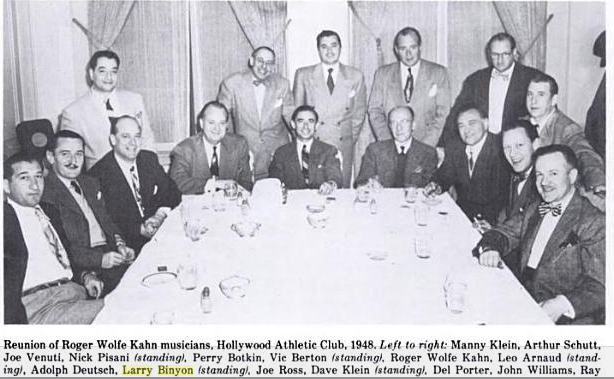
After some traveling gigs and a brief dry spell, the Pollack band began a long-term engagement at the prestigious Park Central Hotel on September 28. Pollack already had Jimmy McPartland, Benny Goodman and Jack Teagarden (who had joined in June) to contribute hot solos. By this point, he was probably willing to sacrifice some improvisational fire for a third saxophonist who could, and would, do the job. That included doubling the numerous other reed instruments that Pollack, apparently inspired by bands such as Roger Wolfe Kahn’s, wanted to show off.

Binyon probably continued to work with Beasley Smith’s band or one of several bands in Chicago while Pollack was in New York. It’s uncertain when Binyon got to New York, whether Pollack sent for him or if he just happened to be one of the many musicians starting to move to the musical epicenter, but by October 1, 1928, Binyon was back on record with the Pollack band in New York.

With three powerful soloists and the band’s tendency to rely on written arrangements, Binyon didn’t get many solos on record with Pollack. With Benny Goodman frequently doubling alto and baritone saxes, he wasn’t even the only saxophone soloist. Pollack instead capitalized on Binyon’s strength as an ensemble player.

A lush waltz like “Forever” or the muted trumpets, violins, and (most likely Binyon’s) flute on “Let’s Sit And Talk About You” might not interest jazz listeners but the records work on strictly musical terms. Attention to dynamics, ensemble balance, and lyricism are fairly consistent through even the Pollack band’s most commercial dates. Its sax section of Binyon, Goodman, and lead alto Gil Rodin play with a bright, creamy blend, for example answering the full band on the Victor recording of “Futuristic Rhythm”:

or “From Now On,” on which they achieve an especially transparent sound, right down to Binyon’s purring tenor:

Talented musicians, a steady gig at a famous venue and sheer hustle helped the Pollack band grow incredibly popular, allowing them to move onto radio work, Broadway, various touring appearances, and a few short films. The band is featured exclusively on a Vitaphone film shot on July 29, 1929. Binyon is seen in the middle of the sax section, soprano sax, clarinet, and flute impressively displayed in front of him while he plays tenor throughout:

Pollack obviously liked Binyon; he appears on every title cut under Pollack’s name (save for one small group session by “Ben’s Bad Boys” in January 1929). Yet a dependable player from a well-known band who could read, double and improvise was bound to get additional offers. Based on his discography, Larry Binyon was more than happy to work on the side.

A Sideman Soloing On The Side

Larry Binyon was talented (and fortunate enough) to have joined the Ben Pollack band just in time for its peak of popularity. He appeared on nearly every title cut under Pollack’s name, but side dates with studio pickup groups let the tenor saxophonist stretch out as more than a section player. He gets to join in with Pollack’s favored soloists on “Whoopee Stomp” under Irving Mills’s leadership, kicking off a string of solos featuring Benny Goodman, Jack Teagarden, and Jimmy McPartland:

It’s tempting to compare Binyon with these now-marquee names in terms of relaxed phrasing, catchy licks, and bluesy inflection, but Binyon’s style works on different priorities. It doesn’t display the same technical confidence but remains driving and tense. Binyon rarely stays in one place, wriggling up and down phrases, emphasizing variety over linear continuity. Binyon played hot solos: no frills, high on energy and contrast yet very personal. Binyon pushes the beat but without the agitation and gritty tone of fellow tenor player Bud Freeman or his cohorts Eddie Miller and Babe Russin. Binyon’s approach is also far removed from the dense arpeggios and metallic tone of the Coleman Hawkins school.

Binyon’s tone—husky, reedy, and distinct—could be an asset unto itself. On “Wont’cha” with Pollack, Binyon gets a paraphrase (one of his few solos of any kind with Pollack) after the vocal that shows off his warm, centered sound:

It’s not an improvised solo but it is an effective orchestral voice, probably appreciated in a dance band setting. Twenties bandleaders would occasionally use a light-toned baritone sax in a melodic role, but it sounds like Binyon’s tenor providing the broad, cello-like lead on the transition to the last chorus of “A Japanese Dream” with Mills:

“Blue Little You” includes a similar voicing in its introduction and right after the vocal. Contrasted with the standard alto lead that immediately follows, it makes an especially colorful effect on what might otherwise be dismissed as a straight dance chart:

Binyon also tosses out an improvised bridge before the ensemble conclusion. His jagged lines come across as flip commentary on the vocalist’s elongated, slightly nasal delivery. Brief solo spots like this one allow Binyon a concentrated burst to say just enough in a few measures. He snaps into the final bridge of “Little Rose Covered Shack,” once again on McPartland’s heels, this time with snaking, clarinet-like lines along with his usual rich tone and tendency to begin phrases in the upper register:

He really cuts loose on one of the few mixed dates of the Jazz Age, a freewheeling session with no less than Fats Waller. With Waller as well as Teagarden, Red Allen, Albert Nicholas, Eddie Condon, and Gene Krupa on hand, it’s no surprise that Binyon sounds like he’s having fun. He wails and moans (showing he also listened to Hawkins) through both the introduction and one chorus of “Ridin’ But Walkin’”:

On “Won’t You Get Off It Please?” Binyon sticks to declaratory, at times trumpet-like exclamations, popping out high notes and plunging into the lower register for the release:

Binyon also seems to enjoy himself on “Shirt Tail Stomp,” one of the novelty tunes that “the Pollack band without Pollack” recorded to satisfy popular demand. His big tone stays intact through all of the mooing and whinnying:

Benny Goodman “created” this number after a recording engineer overheard his band mocking a cornball jazz act. Binyon has the perhaps dubious honor of appearing on three of its five versions on record. In addition to reading, doubling, and improvising, he was apparently also a capable musical clown.

careofsaxophonedotorgBinyon could obviously fit into a variety of musical settings, from Pollack’s snappy dance band setting to looser blowing sessions and everything between; trumpeter and band organizer Red Nichols had even started hiring him on orchestral pop dates modeled after Paul Whiteman (though mostly doubling oboe and flute as well as tenor sax, with Babe Russin handling solos). He was nothing if not versatile, and a versatile musician was usually a busy one.

By the summer of 1929, Goodman and McPartland had left the Pollack band. They were more than capably replaced by Charlie Teagarden and Matty Matlock. Jack Teagarden would stay on for another three years. Yet Binyon may have seen Goodman and McPartland’s departure as a sign that the Pollack band had peaked. He might have been smarting under the same conditions that drove them out of the band; Pollack had fired two of his top soloists for showing up to work with scuffed shoes! A good reputation as a multitalented player in New York would have enabled Binyon to forego the life of a touring musician. It also would have provided more opportunities to perform in different settings.

Something convinced Binyon to leave his first regular employer and a still widely respected band. Binyon’s last session with Pollack was in January 1930. As usual, he didn’t get any solos. One of the two tunes recorded at that session, “I’m Following You” featured yet another one of the leader’s comically earnest vocals. Larry Binyon might have simply been ready for something different.


A Heavy Gig Bag And Phonebook: The Thirties

U.S. Census records state that in April 1930, Larry Binyon was renting a room in his hometown of Urbana, Illinois. Jazz discography shows that by this time, said “saxophonist” working in the industry of “orchestra” (a federal category, or Binyon’s own prestigious description?) was firmly settled in New York City.

Red Nichols Photo care of Stephen Hester

Red Nichols (care of Stephen Hester)

Binyon had stopped recording with popular bandleader Ben Pollack by mid-January 1930, but his big sound is clearly audible in the sax section of Sam Lanin’s band on several dates from March through May of that year. A careless census taker may have counted Binyon while he was in town for his mother’s wedding to her second husband. It’s also possible that the twenty-two-year-old sideman simply neglected to change his address. He was certainly busy enough: his post-Pollack resume reads like a directory of the most popular names in jazz and popular music of the time. He was also working alongside the cream of New York’s musical crop. With Lanin alone, Binyon got to record with Tommy Dorsey, Miff Mole, Manny Klein, Leo McConville, and Al Duffy.

He was also part of the veritable all-star band that Red Nichols assembled for the Broadway musical “Girl Crazy.” Binyon had already worked with the trumpeter and booker on a few sessions, including large, symphonic jazz sessions where he doubled flute, oboe, and clarinet. Composer George Gershwin wanted a jazz band for “Girl Crazy.” Nichols assembled Pollack alumni Benny Goodman, Glenn Miller, Charlie and Jack Teagarden, and drummer Gene Krupa among others. Binyon isn’t usually mentioned as being part of the group, but neither are several other players needed to fill out the band. Binyon’s familiarity with the other players as well as his ability to read and double would have made him a welcome addition to this (or any other) pit.

“Girl Crazy” opened on October 14, 1930. Nine days later Nichols recorded two tunes from the show with several members of the band, including Binyon. Binyon doesn’t get to solo on “I Got Rhythm,” and “Embraceable You” doesn’t leave much room to distinguish any of the musicians. It’s unclear whether Binyon would have preferred more solo opportunities, but he must have been more than used to an ensemble role by this point.

Binyon continued recording with Nichols and Lanin as well as Benny Goodman on some of the clarinetist and future swing powerhouse’s earliest sessions leading a big band in 1931. Goodman assigns Binyon straight, almost dutiful melodic statements on both “I Don’t Know Why” and “Slow But Sure.” He also gets a flowery flute lead on “What Am I Gonna’ Do For Lovin’?” switching to tenor sax as well as a darker tone and more swinging approach for a duet with Goodman on the last chorus:

Given Goodman’s disagreements with Pollack while in his band, it may seem ironic that both bandleaders took a similar approach to Binyon’s role. Yet by the time Goodman began leading bands, that role may not have necessarily reflected Binyon’s abilities as a soloist. Solo space on jazz and dance records grew increasingly limited during the early thirties. Depression-era listeners preferred more sedate pop arrangements to driving hot jazz numbers. Even with the most exciting soloists on hand (Goodman’s 1931 bands included the likes of Bunny Berigan and Eddie Lang), many studio dates from this period stay fairly tame. Binyon may have had a varied toolkit, but his bosses may have needed one specific device.

The joy in listening to a sideman like Binyon is not just listening for when he pops up but what he gets to do. When a band did get to cut loose, for example Roger Wolfe Kahn’s orchestra performing “Shine On Your Shoes,” Binyon could throw down a hot solo on tenor sax:

or use his brawny sound to heat up even straight melodies like “Sweet And Hot” with Nichols:

Binyon’s flute could add the requisite touch of sweetness and refinement as needed. It could also bring an unusual color to up-tempo numbers like “Walkin’ My Baby Back Home” with the Charleston Chasers:

The combination of the Binyon’s flute with ensemble syncopations and Krupa’s drums points to more than just a sweet context. Musicologist and historian Gunther Schuller mentions Binyon’s flute as well as Glenn Miller’s arrangement as examples of a sound “well beyond the normal dividing lines between commercial dance music and late twenties jazz.”

Along with Albert Socarras (who had soloed on flute as early as 1929 on “Have You Ever Felt That Way?” with Clarence Williams) and Wayman Carver, Binyon was one of the first to bring the flute into a jazz context. His smoky introduction to the Boswell Sisters’ “Sentimental Gentleman From Georgia” must have made musicians and bandleaders reconsider the possibilities of this instrument in a jazz setting:

In addition to the Boswells, Binyon accompanied vocalists Grace Johnston, Phil Danenberg, Dick Robertson, Chick Bullock, Mildred Bailey, and Ethel Waters during the early thirties. He was usually backing these singers alongside members of the same circle of top-notch New York musician that he would have known very well by this point. He impressed Tommy and Jimmy Dorsey enough to land work with their band. At this point the Dorsey Brothers Orchestra was a smaller studio band, allowing Binyon room to solo on instrumentals such as “Mood Hollywood”:

and “Old Man Harlem”:

It’s unclear exactly what type of work Binyon landed outside of the studios during the early thirties. Arranger Don Walker recalls Binyon playing in the band for Hit Parade of 1933 as well as “first (legitimate) flute” in the 1935 musical Maywine. Walker and his copyist Romo Falk excitedly noted Binyon’s presence (expressing similar accolades for Binyon’s section mate, Artie Shaw).

Binyon played with Paul Whiteman’s orchestra for one month in 1936 before moving onto radio work, including jobs under Red Nichols’ direction, as well as other work outside of an expressly jazz context. It was around this time that Binyon also married his first wife, Polly. Seven years younger than Larry, she was born in Puerto Rico and living in Syracuse by 1935, before marrying Larry at some time before 1940. The steadier work and more regular hours of radio may have eased his transition to married life, or vice-versa. Binyon even had time for a trip to Bermuda (though it is unclear whether it was for work, honeymoon or one last bachelor outing).

Binyon also did sax section work on jazz dates with Frank Trumbauer, Joe Venuti, Bob Zurke, and Dick McDonough during the mid to late thirties. McDonough was an experienced, well-connected guitarist who had his pick of sidemen for the few sessions he ever directed during 1936 and 1937. Binyon was on hand for two of McDonough’s dates, getting in some paraphrases as well as a quick-fingered, slightly more modern solo on “He Ain’t Got Rhythm”:

At this stage, Binyon had the reputation as well as the chops to work in a variety of settings alongside some of the best players in New York. He even found the time to change his address: by 1940, one Larry Binyon, now a “musician” in the “orchestra” industry, was officially living in New York City.

1940 US Census per AncestryDotCom

Talent, Opportunity And Choice: Final Years and Legacy

The All Music Guide states that Larry Binyon “needed someone to hold the door open for him when he arrived at a recording studio or radio broadcast date.” It’s an unsubstantiated anecdote but an accurate image. By the early thirties, Binyon was, in violinist Harry Hoffman’s words, one of New York’s “first-call” studio musicians who could “play anything.” With his move to full-time radio work in 1936, Binyon would have been playing his tenor sax, flute and oboe, probably clarinet (and possibly the “few fiddle credits” mentioned by AMG writer Eugene Chadbourne) in any number of musical settings.

From The Big Band Almanac by Leo Walker

While trombonist Larry Alpeter adds, “most of these [first-call] guys had fine jazz skills,” Binyon’s appearances on jazz records and already sparse solo spots dried up by the mid-forties. He is one of two tenors on Billie Holiday’s 1944 Decca sessions with Toots Camarata’s orchestra, but it’s unclear whether Binyon or Paul Ricci handle the few brief solos on these recordings. Binyon is strictly an ensemble player on his final jazz session, with Jess Stacy’s big band in June 1945.

After close to twenty years of having his hands literally and figuratively full in New York City, Binyon moved to Los Angeles in 1946. Binyon worked once again with Nichols in California, this time in Bobby Dolan’s orchestra on The Ford Show (starring Dinah Shore) from September 18, 1946, through June 11, 1947. Yet Binyon had also relocated to work as a recording contractor for the American Federation of Musicians.

If Binyon was looking to segue into a “behind-the-scenes” role, the paucity of documents from this period indicates that he got his wish. Drummer Johnny Blowers does recall a February 8, 1950 session with Phil Harris organized by Binyon, but Binyon’s activities as an organizer are otherwise largely unrecorded. A new home, warmer climate, and slower pace on the West Coast were probably a welcome change for him. It also would have allowed him more time with his son Claude (born in 1940 and named after Larry’s father). Blowers actually secured the Harris date when he ran into Binyon in New York, who was on a vacation of all things.

Blowers also notes that Binyon was still playing with West Coast bands, though it must have been less hectic than the New York scene. Binyon frequently worked with Phil Harris in Los Angeles, previously co-writing “Bump On The Head Brown” for the entertainer along with Chauncey Morehouse and Frank Signorelli (now that would have been a trio!).

Binyon worked the 1952 and 1953 seasons of the Phil Harris and Alice Faye radio show alongside Nichols in Walter Scharf and Skippy Martin’s bands, recorded five numbers with Harris on December 27, 1953, for RCA Victor, packed his gig bag(s) for a tour of Asia in the early fifties and booked sessions for fellow players: it all must have been a breeze for this seasoned musician.

for Phil Harris care of discogsdotcomHe seems to have stopped playing completely by 1955. Based on Binyon’s track record, that must have been by choice rather than necessity. His story fades even further after that decision: marriage to a second wife in Nevada in 1962 and then a third wife in California in 1966, followed by a divorce two years later. Larry Binyon passed away on February 10, 1974 (followed by his brother Hugh in 1978 and then son Claude in 1999, both of whom died childless).

Other than personnel listings and occasional mention by his contemporaries, most of whom are now also gone, Larry Binyon has faded into the background behind more famous names. It’s easy to make a comparison between his legacy and his work, but that would dismiss the talent that earned Binyon such fast company in the first place. How else does one get to play with everyone from Tommy Dorsey to Benny Goodman to Billie Holiday and Fats Waller?

Binyon’s versatility and sheer ubiquity may have actually helped force him into the background. Had he stuck to one or even two instruments, it might have been easier for bandleaders and listeners to remember him. Yet jumping between dozens of dance bands, jazz groups, studio ensembles, and radio orchestras while covering a multiplicity of parts as the schedule demanded and always being on hand to make every arranger’s whim seem like an easy task, it was easy to see that Binyon was capable of anything but probably harder to associate him with one thing.

There are enough accolades to show that he wasn’t just any sideman, yet not enough solos to determine what kind of a jazz musician he was (in a world where “jazz” is synonymous with “soloist,” anyway). Depending on how one hears his music, Binyon either lacked the ability or opportunity to inspire followers (though musician and writer Digby Fairweather detects Binyon’s influence in Georgie Auld’s earliest performances). In the end, it’s hard to depict him as a “jazz artist” and inaccurate to dismiss him as some studio drone.

Depending on how one reads his story, Larry Binyon is either a neglected musician or a person who made a life’s work doing something he was very good at and presumably enjoyed very much. Whatever the interpretation, his ability as well as his impact on jazz and/or/a.k.a. American popular music is undeniable. He was right there next to some of music’s greatest names, as much by his choice as theirs. Maybe Larry Binyon was simply exactly where he wanted to be.

LarryBinyonCareOfDiscogsDotCom

Tagged , , , , , , , , , , , , , , , , , , , , , , , , , , , , , , , , , , , , , , , , , , , , , , , , , , , , , , , , , , , , , , , , , , , , , , , , , , , , , , , , , , , , , , , , , , , , , , , , , , , , , , , , , , , , , , , , , , , , , , , , , , , , , , , , , , , , , , , , , , , , , , , , , , , , , , , , , , , , , , , , , , , , , , ,

A Version of Jazz History

john-tenniel-alice-looking-through-the-looking-glass-1-of-2-this-sideThey’re not a proper account of the landmark moments in jazz history, but these records do make for fascinating comparison and enjoyable listening (especially if you’ve already taken one or two Jazz History courses)…

“Livery Stable Blues,” made famous by the Original Dixieland Jazz Band as the first jazz record, played by the New Orleans Rhythm Kings:

The NORK’s “Tin Roof Blues,” best known for trombonist George Brunies and clarinetist Leon Roppolo’s solos, referenced by Miff Mole and Jimmy Lytell on the Original Memphis Five’s recording:

“Singin’ The Blues,” forever associated with Bix Beiderbecke and Frank Trumbauer, given rhythmic tribute by the Fletcher Henderson band:

“West End Blues,” synonymous with Louis Armstrong, in its restrained inaugural recording by composer and Armstrong mentor Joe “King” Oliver:

Duke Ellington, best known as a composer, with a simple but highly personal arrangement of the WC Handy standard “St. Louis Blues” for backing Bing Crosby:

Meanwhile, across the pond, British bandleader paying homage to Ellington’s music by getting people out on the dance floor:

Jelly Roll Morton revisiting Scott Joplin’s ragtime staple “Maple Leaf Rag” on his own pianistic terms:

Morton’s “King Porter Stomp,” perhaps the most popular Morton tune when it comes to distinct approaches by bands, soloists and arrangers, becomes a swinging guitar partita in Teddy Bunn’s hands:

Count Basie’s “One O’Clock Jump,” for many the apotheosis of the riff-based, blues-soaked Kansas City sound, live at Carnegie Hall in 1938 with the Benny Goodman band expressing their admiration as well as their own unique sound:

Finally, Basie’s innovations in the scope and sound of the rhythm section, the prominence of the soloist in an ensemble setting and the very concept of “swing,” taken to turbo-charged abstraction on Gil Evan’s arrangement of the Basie staple “Lester Leaps In”:

These are just a few ways to mess with a jazz history syllabus. They might not be innovative recordings but they do show musicians listening and learning from one another while expressing themselves. That has to count for something in jazz, or music.

Tagged , , , , , , , , , , , , , , , , , , , , ,

A Chauncey Morehouse Playlist

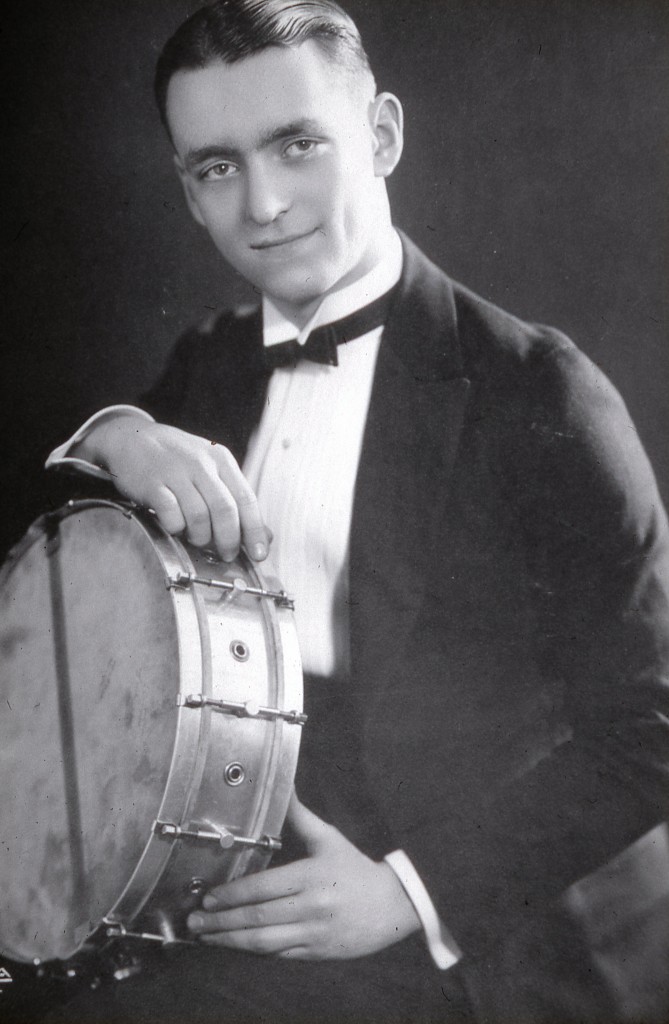
539260_10150949855755807_1433896026_nFull drum kits were rarely heard on records made before 1927. Only the most skilled (and confident) audio engineers were able to compensate so that a low frequency “boom” wouldn’t throw off the recording. Drummers were left to work with cymbals, blocks and anything else they were permitted to bring into the studio.

Adding in the already difficult sonics of many early records and the fact that drummers rarely soloed during the twenties, listening to jazz drums on recordings from this period may seem like an arduous, even fruitless exercise. It’s not quite like a needle in a haystack: instead, the needle has been chopped into several pieces, with only a few of the pieces actually getting mixed into the hay, while the haystack itself is kept in a very dark barn.

Smaller kits, smaller technological resources and smaller role notwithstanding, the best twenties jazz drummers produced imaginative sounds and perhaps most importantly in jazz, a lot of rhythm. As Dr. Lewis Porter points out, early jazz drummers were not just timekeepers. Mark C. Gridley notes that they actually had a very high level of interaction with the rest of the band, something usually associated with much later styles. Drummer, bandleader and percussion historian Josh Duffee describes traditional jazz drumming as “an art form that tests how musical a drummer can be with limited and very unique instruments.” It turns out that these needles were actually crafted by talented, imaginative needle makers, and it’s time to start digging.

For my own survey of this art form, I’m starting with Chauncey Morehouse. He’s the most familiar to me, and probably to even occasional early jazz listeners. Anyone who has taken a Jazz 101 course has heard Morehouse’s cymbal backbeat on Bix Beiderbecke and Frank Trumbauer’s seminal “Singin’ the Blues.” His collaborations with “Bix” and “Tram” in the Jean Goldkette orchestra and on numerous studio dates with the famous duo make him one of the most frequently encountered drummers of the twenties. It’s a little trickier to hear his drums but feeling them is no problem, for example on Morehouse’s own composition “Three Blind Mice” with a Trumbauer-led group:

Morehouse doesn’t play all the way through (at least not audibly), yet when he does it’s simply but confidently. Cymbal syncopations such as those in the second chorus kick things forward like a riding crop. He also clearly enjoys supporting and interacting with Beiderbecke during the cornetist’s solo. His approach is different than the Jones/Webb/Krupa via Dodds and Singleton style that would influence the course of jazz. He punctuates and pushes the beat rather than rides it. John Petters chides Morehouse and his contemporary Vic Berton for their “cumbersome choked cymbal beats, which served only to break up the rhythm, instead of laying it down,” yet he judges these drummers according to a later standard, like criticizing the ancient Greek playwrights for not writing any novels. Morehouse is simply his own man rhythmically.

At the same time Morehouse plays with the creativity and sensitivity associated with the best drummers of any era. He varies his patterns, listens to his band mates, fills in between phrases, sets up ensemble hits and lays out when needed to allow instrumental balance as well as textural contrast. The six sides Morehouse made with Bix Beiderbecke and His Gang (a.k.a. the New Orleans Lucky Seven) highlight his taste as well as his resourcefulness with the limited instrumentation available to drummers at that time. In addition to his cymbals popping behind soloists, Morehouse orchestrates the beat using woodblocks and a brassy cowbell on “At The Jazz Band Ball”:

On “Goose Pimples,” Morehouse taps the melody under Beiderbecke’s lead, fashioning a harmony in rhythm and becoming as much of a partner in the collective improvisation as any of the horns:

His rapid-fire “click-clack” perfectly captures the tense, madcap energy of “Original Dixieland One-Step” with a Red Nichols group:

Morehouse’s earliest records with the Georgians may be the best illustration of his doing a lot with very little. The “band within a band” of the Paul Specht dance orchestra, their acoustically recorded performances and dense (but driving) polyphony make it difficult to hear the drums. Yet Morehouse is there for all forty-six sides, the sense of time that earned him lifelong praise palpably, if not always audibly, moving the ensemble. His wood and temple blocks cut through for an especially dynamic impact on “I Wish I Could Shimmy Like My Sister Kate,” “Chicago” and “You’ve Got To See Mama Every Night,” and his playing is half underpinning, half counterpoint on “I’m Sitting Pretty In A Pretty Little City”:

Plenty of soggy Dixieland ensembles have made woodblocks, cowbells, drum rims, and washboards sound corny, yet for Morehouse and his contemporaries, these things were instruments rather than novelties. Morehouse knew how to add color as well as rhythm using equipment that most drummers would now classify under “auxiliary percussion.” “Margie,” once again with Nichols, contains a range of percussive timbres, from wire brush backbeat in the opening ensemble through cymbals behind the mellophone and woodblock “bombs” behind the clarinet, to the panoply of sounds heard during the final chorus:

Less lucid but just as effective, Morehouse’s percussion helps the unpromisingly titled “Add A Little Wiggle” with a Nat Shilkret’s All Star Orchestra pick up considerable heat. It is difficult to hear what he’s doing behind the full ensemble but it clearly works, and his cymbals step out to dialog with the soloists:

Shilkret’s “Chloe” stays pretty commercial and tame, until Miff Mole’s trombone solo and the ensuing hot small group burst out of the orchestra. Morehouse also bears down, this time on drum skins as well as cymbals:

By the time Morehouse recorded his composition “Harlem Twist” with Red Nichols and His Orchestra, there’s a lot more snare and bass drum in his playing. They add plenty “thwack” but without any sense of military-style heft. Morehouse continues to lift and converse with the rest of the band:

Morehouse’s skins on “Bessie Couldn’t Help It” with Hoagy Carmichael’s band are slightly louder and he uses more regularly recurring beats. That may be a sign of changing styles, or technology catching up with the way Morehouse had been playing on a full kit from the beginning. Either way he remains his same effective but subtle self:

Morehouse’s taste, as well as his time and punch, might have been one of the reasons he ended up performing what some consider the first recorded jazz drum solo while he was still a young man playing with The Georgians, on “Land of Cotton Blues”:

It’s not a Chicago-style explosion, and it’s even further removed from an Elvin Jones odyssey. Morehouse’s solo is short, sweet and spurring. Mel Lewis’ description of the “tap dances” that early jazz drummers spontaneously composed comes to mind. At a time when engineers were wary of drummers and audiences didn’t see them as soloists, Morehouse surprised everyone.

c/o impulsebrass.com

c/o impulsebrass.com

Lewis doesn’t mention Morehouse in a discussion of jazz drummers he delivered on radio several years ago. A part from his association with better-known musicians such as Beiderbecke, Morehouse’s name doesn’t come up very often in jazz histories. He was obviously well respected but is rarely listed as an actual influence on any players. Yet it’s that lack of influence that makes his work so unique. There are no stylistic links with later drummers to make his approach sound basic or cliché, no ideas he originated that have become so commonplace as to seem unremarkable. Morehouse played rhythm and did it in his own way, and he made the band sound better along the way. That has to count for something in jazz.

Jazz writer Warren Vaché describes Morehouse joining an impromptu jam session at a New Jersey Jazz Society picnic, drumming with just two spoons on a plastic beverage tray and bringing the house down. He also recalls Morehouse’s joyous playing with a reconstituted Jean Goldkette orchestra concert sponsored by the New York Jazz Repertory Company. Despite the loss of one leg, the drummer left an impression on Vaché over twenty years later. The man really could make rhythm any time and with anything!

Tagged , , , , , , , , , , , , , , , , , , , , , , , , , , , , , , , , , , , , , , , , , , , , , , , , , , , , ,

My Favorite “Ain’t Misbehavin'”

Tom Lord’s Jazz Discography lists over one thousand recordings of “Ain’t Misbehavin’.” Pretty good for a song that Ted Gioia explains is ”not quite as important a part of the jazz repertoire nowadays as it once was.”

It is true that beboppers, post-boppers, free-jazzers, fusionites and other modernists never really cozied up to the Fats Waller standard. That still leaves a who’s-who of prewar and prewar-influenced jazz musicians to give it a shot. Yet even with Louis Armstrong’s magisterial interpretations, the composer’s own performances and pianists from Jelly Roll Morton and Art Tatum through Dick Hyman and Jeff Barnhart to choose from, I keep coming back to the Charleston Chasers’ “Ain’t Misbehavin’.”

In fact the the Original Memphis Five working under an alias that Columbia records used for several bands, the Charleston Chasers waxed their version at the height of the song’s popularity. Waller had written “Ain’t Misbehavin’” for the revue Hot Chocolates, where it soon became a feature for Louis Armstrong and eventually the most famous part of the show. The Chasers recorded the tune about a year later, and just a few weeks before Armstrong made his own recording (skip ahead to 0:48 in the following clip to hear the music):

This arrangement never entirely settles, and that’s what makes it so interesting. The Chasers’ two-beat amble has its own magnetic energy, but their rhythm is a little overly delineated. Phil Napoleon’s trumpet is typically crisp yet slightly tense: his high notes during the introduction sound forced while the turnaround notes in the first chorus are hesitant. There’s a carefulness to the Chasers’ playing, the sound of a band feeling their way through a brand new composition.

NapoleonThey’re also figuring out what to “do” with this new song,  adding some highly original touches to make it their own. The Chasers feature a standard front line of trumpet, trombone and clarinet, but clarinetist Jimmy Dorsey lays low during the ensembles to let Napoleon and his frequent OM5 partner Miff Mole fashion brass duets. Napoleon and Mole were already seasoned jazz musicians, developing in tandem with the music from its earliest roots in ragtime. The pair displays a refreshingly harder-edged sound and play busier, punchier lines than most of their New Orleans colleagues. Napoleon and Mole even switch roles following the vocal, with muted trumpet decorating the trombone’s burry lead.  Eva Taylor’s vocal is charming but Arthur Schutt’s elegant accompaniment behind her is the real find.  His classical allusions also turn the minor chords of the bridge into miniature Rachmaninoff preludes. Joe Tarto’s bass keeps snapping throughout while Dorsey’s whinnies add a humorous symmetry to the whole thing.

This performance is a departure from the jamming and stride theatrics now typically associated with “Ain’t Misbehavin’.” It’s also far removed from the weight of history and sense of familiarity attached to even the most relaxed renditions of this song. This was only the fourth recording in the history of Waller’s iconic tune. If it shows its age, that age offers a completely unique experience.

Tagged , , , , , , , , , , , , , , , , , , , , , , , , ,

“Sincerely, Bill Rank”

Here’s part three of an insightful documentary on YouTube about Bill Rank and his performances in Holland. Rank is best known as a sideman with Bix Beiderbecke, but “Santopec” comments on a confident, unique trombonist who continued to grow long after Beiderbecke’s Goethe-esque early passing:

The incredible technique is still there after “all those years,” even more well integrated into a highly personal (though clearly indebted to Miff Mole) style based off of wide intervals and suspended harmonies.  The difference is a surer, more rounded sound and suppler sense of construction, which allows those leaps and notes to color Rank’s inventions rather than anchor them (as they occasionally do on earlier records). Hearing Rank’s music on its own terms, without any legendary colleagues surrounding it, is the real find.

As for the “modest and captivating” person playing these solos, he confesses to embarrassment at the privileged treatment by his Dutch fans, and he still pronounces the name of an admired colleague with a Midwestern clip (“Adrian Roll-IN-e“).  Not much to do with the music, but sometimes the brain and heart behind the notes matter.  Who’d have thought?

Tagged , , , , , , , , , , , , , , , , , , , , , , , ,

Phil Napoleon: To Jazz Or…

Swing, blues and a completely fresh improvisation at every performance: three common (for some essential) descriptors of “jazz” that were only beginning to take root at the height of Phil Napoleon’s career. Sounds from New Orleans and the Midwest territories were not as widespread when Napoleon was blowing trumpet for the Original Memphis Five. Louis Armstrong’ rhythmic and solo innovations were still to come, and jazz remained a collective experience with strong influences from ragtime. Yet even beyond his musical and historical surroundings, Napoleon always had other priorities.

Those priorities included a brilliant yet inviting tone, given to clipped articulation and rhythmically tense phrasing. That tone usually supported a powerful, balanced lead, but could also supply spare, neatly organized “hot” patterns. “How Come You Do Me Like You Do” features Napoleon’s direct ensemble lead as well as his witty muted obbligato behind Jimmy Lytell’s clarinet:

Richard M. Sudhalter explained, “The Memphis Five appear to have ‘routined’ their arrangements in advance and in detail…A routine on one number doesn’t change from take to take.” This stick-with-what-works ethic makes sense the more one hears (and feels) Napoleon’s overriding concern for balance and blend. If Napoleon knows exactly what he’s going to play next on “He May Be Your Man,” and if the rhythm is more sway than swing, he still conveys spontaneity alongside restraint. He even adds subtle sardonic color to Lem Fowler’s naughty little tune [just follow the arrow to listen]:

He May Be Your Man

The chamber intimacy of these recordings combined with Napoleon’s clean, resilient sound betrays his background as a classically trained player. Even at his most unbuttoned, for example on a later date with Miff Mole, his “Dixieland” sound is perfectly centered, and he executes a tortuous muted passage (in tight harmony with Mole’s trombone!) neatly and convincingly:

Throughout his career, Napoleon never completely absorbed the loose rhythms and bluesy rhetoric of Louis Armstrong, or the coaxing warmth and harmonic palette of Bix Beiderbecke. It’s probably one reason why Napoleon has had a modest presence in most “jazz” histories. Here he is leading a group of other Jazz Age stars, instantly recognizable and dependable as always. Napoleon remained his own man, something even Armstrong and Beiderbecke could have related to:

Tagged , , , , , , , , , , , , , , , , , , ,

A Song By Any Other Name: The Right Amount of “Deep Henderson”

“Deep Henderson” illustrates one pop tune that became just popular enough. Tom Lord’s Jazz Discography lists thirteen different bands recording Fred Rose’s composition in 1926, the same year it was published in Chicago, with four other groups cutting the tune the following year (in three different countries, no less). Most bands also used the publisher’s stock arrangement, adapting it to their needs and style rather than starting over fresh as they might with so many other jazz warhorses. Unlike “St. Louis Blues” or “Tiger Rag, ” “Deep Henderson” became a controlled study in the variety of bands and approaches at one small juncture in American popular music.

Bill Edwards describes “…one of the most sorrowful and wistful songs [he’s] encountered,” with “…long sustained high notes leading downwards to the end of each phrase help[ing to] punctuate [his feeling].” Apparently the secret to this song’s success was jettisoning its sad, I-wanna’-go-back-to-the-South lyrics and slow, bluesy feel (which can still be heard courtesy of Edwards here). By the time the Coon Sanders Nighthawk Orchestra hit the studio to give “Deep Henderson” its inaugural recording, the tune was gussied up to make it more flapper friendly:

The Nighthawks were an immensely popular group, and their creamy saxes, strutting brass and re-playable shellac introduced a wide audience to “Deep Henderson.” Co-leader and pianist Joe Sanders handles the written solo with enough downhome swagger to offer some reminder of Rose’s original vision. Yet the rhythm is overwhelmingly upbeat (almost coy), aided by Pop Estep’s bumping tuba walking four to the bar behind the trumpet solo. While their reliance on written music and novelty numbers may deny them entry into the hallowed chapters of “jazz” history, the Nighthawks gave many Americans a good idea of how loose and lowdown pop can get.  They sound downright raunchy compared to Mike Markel’s band (follow the arrow to the link):

Deep Henderson

Markel’s block chord introduction and racehorse tempo likely impressed dancers, with robust saxes and clipped brass choreographing their stomping feet. Yet the band’s jerkier rhythm doesn’t leave much space for legs flying off the dance floor. The horn man (Red Nichols? Earl Oliver? An unknown player?) soars to the occasion, as do the saxes behind the brass, recalling society band string sections. In light of sax riffs getting faster, trickier and uniformly high-flying in the years ahead, their sustained harmonies are a nice touch. Markel’s approach has a nostalgic charm, a reminder of when pop music was intense and tight (in feeling if not always execution). Yet the recording does make the “New Orleans effect” even more apparent when listening to King Oliver and some neighborhood colleagues:

Oliver’s cornet immediately presages a much earthier, more personal account of the tune. The Dixie Syncopators’ tempo isn’t much slower than the Nighthawks, but their easygoing inflection and subtle backbeat make it sound like they’re taking their time. The saxophone section parts way for Barney Bigard’s slap-tonguing tenor, perhaps dated but undeniably percussive (and as texturally original as prepared piano or distorted guitar). Even the soprano sax adds a howling, haunting dimension to the clarinet trio.

Drummer Paul Barbarin’s “Oh, play it Mr. Russell!” during Luis Russell’s solo plays up the informal air, yet such exclamations may or may not reveal the insidious, timeless hand of marketing. Improvisation and swing are the breaking news here: Oliver’s greasy responses over the saxes (especially heroic in light of his aging embouchure), and Kid Ory’s lurching, sly trombone over the closing chorus make this, the second recording of “Deep Henderson” pressed, a very distinct chapter of the tune’s short but hot history.

Of course Miff Mole adds his smoother, more rounded yet equally punchy trombone over the chirping clarinets that close Markel’s recording, and even the drummer gets in some solo syncopations. The way each group, section and soloist navigates this arrangement points to a difference of delivery with a shared intent. The “same old stock” can never be the same, not if you’re a musician with something to say or a record consumer with a paycheck. At a time when pop is reticent to market covers (even as the same tune in the same rendition gets beaten into the ground over air and internet), it’s also a reminder that the question of originality often begins with “how” as well as “what.”

Lord lists seventy-one recordings total of “Deep Henderson.” I must admit that in light of Oliver and others’ experiments, Bela Dajos’ rich, buttery society version comes across as either insularity, or the sincerest form of parody:

Last one, I promise: here’s British bandleader Bert Ambrose’s thoroughly modern swing account from 1937:

Well, we can’t end without hearing Vince Giordano do it!  Live, in 3D, with glorious sound and from outside of Lord’ discography:

Want more? Be sure to share your favorites in the comments, and hope you enjoyed the tour.

Tagged , , , , , , , , , , , , , , , , , , , , , , , , , , , , , ,

Spelunking: Bix, Red and The Broadway Bellhops

Song titles such “Oh You Lulu Belle,”  “I Found A Round About Way To Heaven” or “There’s A Cradle In Caroline” don’t exactly scream “excitement” from the back of Vintage Music Productions’ CD of the Broadway Bellhops  (a similarly vanilla sounding name).  Even the double entendres of “Don’t Take That Black Bottom Away” or “Tonight’s My Night With Baby” evidence commercial dates, rather than spontaneous, artist-motivated jazz.  Yet after picking this disc up on a recent pilgrimage to J&R, I was still eager to fly home and discover what might pop out from underneath all this corn.   The cover’s promise of “Bix Beiderbecke, Red Nichols, Miff Mole and More” kept me on the edge of my seat, track listings aside.

Early jazz collectors accept the fact that their heroes were more likely to record popular fare, often with well-rehearsed dance bands, than to cut loose in the studio over “Tiger Rag,” “Royal Garden Blues” or other jazz warhorses.  We keep coming back for what those heroes accomplish with (or in spite of) the songs or bands.

For example, both the title and forgettable melody of “There Ain’t No Land Like Dixieland” portend an innocuous listening experience.  Thank goodness for Joe Venuti’s violin making a hot, bluesy mockery of the tune!  His between the beat phrasing makes the jerky interlude and bellowing vocalist that follow almost bearable, until they completely fade from memory next to Beiderbecke’s lyrical solo.  He squeezes and spikes the tune with unique melodic and harmonic nuances, while never completely throwing the tune away.  By contrast, saxophonist Frankie Trumbauer chooses abstraction rather than augmentation, paring the melody down to the bare essentials, making a ballet out of this square dance.

Venuti, Beiderbecke, Trumbauer and even journeyman trombonist Bill Rank put the arrangement and singer on “Dixieland” miles beside the point.  It’s similarly worth putting up with the  unimaginative score of “I Ain’t That Kind of Baby” to hear Red Nichols turns on the snark with some sarcastic scoops and bends, or sit through the plodding rhythm of “Don’t Take That Black Bottom Away” to hear the horns emerge with a tight, witty passage (not unlike the concertino soloists emerging from the orchestra in a concerto grosso).

Red Nichols & His Orchestra, 1933

Of course recordings such as “Collette” are pure market fodder.  It’s a shame that such a pretty title receives a squeezebox melody and vertical arrangement (while apparently getting recorded underwater with a frog vocalist’s imitation of Mario Lanza); on the other hand, perhaps the musicians ate a good lunch with that session’s paycheck.

Early jazz lovers are also used to bumping into pure, dated banality.  Yet even just a few bars of Beiderbecke’s spirit overcoming the collective, or Joe Tarto’s tuba pushing the beat, makes those encounters worthwhile.  Diamonds aren’t valuable because they fall from the sky or get plucked out of flowerbeds; they’re mined, and coal often makes them seem more brilliant.

Tagged , , , , , , , , , , , , , , , , , , ,