The jazz contrafact, i.e a new composition written on the chord changes of another tune, is usually associated with post-war jazz. Beboppers superimposed dense riffs and angular melodies over popular standards, often adding then “unusual” chord substitutions that would eventually become standard operating vocabulary for jazz as we know it.
In the same spirit, Adrian Rollini and his colleagues in British bandleader Fred Elizalde’s ensemble get to recomposing “Nobody’s Sweetheart” right from the start of their record, and several years before Tadd Dameron and Miles Davis put pen to stave:
The opening ensemble turns Billy Meyers and Elmer Schoebel’s melody (already all too familiar even by 1929) into a completely new theme constructed out of tight, cool gestures. The format of horns stating a “head” followed by round-robin solos would become formula for the boppers, but at a time when collective improvisation and cross-sectional writing were just as prominent, it has the air of one refreshing approach among many. The solos present a variety of instrumental personalities, starting with Chelsea Quealey abstracting the melody further and ending with Rollini’s bass saxophone muscular and lithe all at once.
The execution is slightly different, but the principle has always remained the same. Contrafacts have been around at least since some band got sick of playing “Tiger Rag” the same way over and over again (but we’ll save that long list for another day).
Responding to an earlier post about the loss of Joe Muranyi, a commenter recalled Muranyi trying out his own “metal Conn clarinet, a horn a more self-conscious player would recoil from.” The open-minded Muranyi in turn “played the living heck out of it.” Apparently for some musicians, the instrument is always a catalyst and never a compromise. For Lester Young, a metal clarinet was a choice, maybe even a necessity.
Gunther Schullernotes that when Young put down his tenor, the influential jazz artist and part-time tragic hero “played a cheap metal clarinet that he picked up somewhere on his travels, but whose tone he loved dearly.” Young kept the signature lightness of his sax on the smaller horn, and at fast tempos would use the same triplets and encircling, never inundating lines for the “little stories” he had to tell. At slower tempos and in more reflective settings, he’d come up with a story like the one in “Blues with Helen,” from the 1939 Spirituals to Swingconcert organized by impresario John Hammond [starting at 1:47 in the clip below]:
Hammond introduces Young as “switching over to clarinet,” but there is no sense of “switch” or adaptation here: Young is simply playing clarinet. The tone could be called “thin,” but more like a leaf rather than paper, something likely to tear given the right force but able to support storms and sunlight on its own terms. Sustained notes let the audience absorb that sound while always unfolding a narrative, never halting the action or merely displaying beauty for the sake of itself. If anything is different, it’s that the clarinet’s brighter, at times childlike timbre brings out the fragility of the clarinetist.
Benny Goodman mentions purchasing a Selmer (wood) clarinet for Young while in Europe, an instrument fewer clarinetists might recoil from. While it’s endearing to imagine Young gratefully accepting the gift and sticking to his cheap little instrument, the truth is that it doesn’t matter what kind of clarinet Lester Young played, only that he played clarinet.
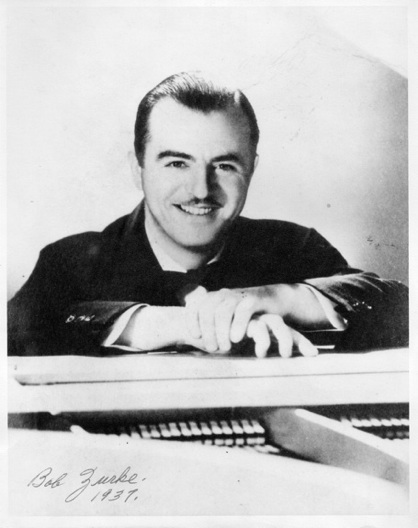
Bob Zurke at the Paramount Theater, New York City, 1939
Bob Zurke collapsed while playing his regular gig at the Hangover Club in Los Angeles sixty-seven years ago today. Alcoholism and the worst excesses of life on the road had taken their toll on the pianist, culminating with pneumonia and his death the following day. While most photographs show a much older man with a worn down face, Zurke had just turned thirty-two.
What photographs don’t highlight are the hands behind the wild pianism Zurke left behind on records. Born to Polish immigrants on January 17, 1912 in Michigan, by sixteen Boguslaw Albert Zukowski was professional pianist “Bob Zurke,” whose small hands and short fingers didn’t lend themselves to the wide intervals of stride piano. Blessed with talent, imagination and a genetic dispensation to go his own way, Zurke would spin wildly intricate independent lines on the keyboard, as though separating both hemispheres of his brain and then instigating a fight between the two of them.
Gunther Schuller describes a “dynamic hurricane-like force…light years removed from the polite babbling of most 1930s band pianists.” To be fair, when compared to the swinging polyphony on “Diga Diga Doo” with the Bob Crosby orchestra, any pianist would sound reserved:
The bulk of Zurke’s all-too-brief career was spent with like-minded musical individualists in the Crosby band, which brought the warmth and stomp of New Orleans into the Swing Era. Zurke’s best work with the Crosby group combines brassy exclamations reminiscent of Earl Hines, the rich counterpoint of the Baroque and the sheer “wow” factor of virtuosos and athletes alike. On the usually twee “Tea for Two,” Zurke adds a childlike sense of mirth, like a kid superimposing dirty limericks onto a nursery tune:
Features with the Crosby band such as “Little Rock Getaway” and “Yancey Special” show him to be a uniquely room-rumbling boogie woogie stylist. Yet ironically Zurke’s most impressive, and personal, boogie on record (and coincidentally his last recording) is the accompaniment for the 1944 cartoon “Jungle Jive” (enjoy the music and avert the eyes from the dated, offensive visuals):
Zurke’s solos would occasionally start to ramble, and his intricate lines weren’t always well served by the recording techniques of his time. Musically that was about all all he had in common with most of his colleagues. Unfortunately Zurke did share many musicians’ taste for living hard and fast. After leaving Crosby and briefly leading his own big band, Zurke gigged around Chicago and Detroit before settling, and falling, in Los Angeles.
Bob Zurke, Detroit, 1937
Crosby bandmate Bob Haggart recalled “You could hear only a bar or two, and you’d know it was Bob Zurke.” The late George Shearing admitted “He always amazed me,” and Dick Sudhalter said Shearing was capable of an “uncanny” imitation of Zurke’s piano. Yet an early death, modest discography and idiosyncratic style don’t always allow much of a legacy or influence beyond collectors and specialists. Unlike some other alcoholic martyrs of jazz, Zurke’s story just seems sad, not romantic: a one-of-a-kind voice, destroyed by his vices and largely forgotten.
And then there’s the music. Is there anything those hands couldn’t do?
For more about Bob Zurke, check out Bill Edwards’ well-researched, loving biography of Zurke here.
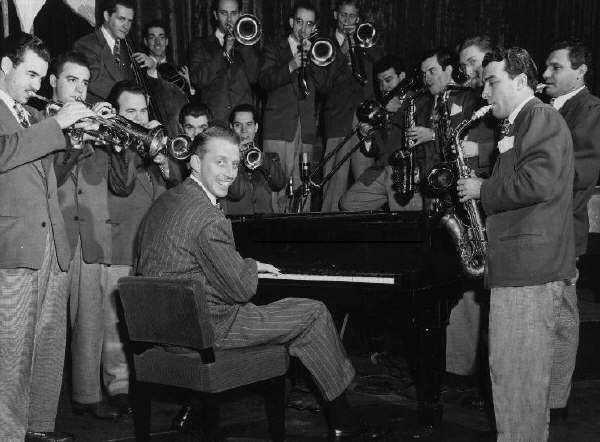
Music critic, arts journalist and Columbia professor David Hajdu rightly inspires pause and even protest when it comes to celebration. His rebuke of Stan Kenton, spurred by what would have been Kenton’s hundredth birthday and the ensuing centennial tributes to the bandleader and “progressive jazz” impresario, remind us that anniversaries and events are only as valuable as the person or cause behind them.
Hate the Man, Hear the Music (and Make Sure the Bandstand is Big Enough)
Unfortunately Hajdu’s scathing critique of the man, his music and his ego (as well as the connection between the three shared by plenty of other musicians) is all too familiar. Kenton’s bombastic big bands, seeming love of complexity for complexity’s sake and dominating personality made him a welcome whipping post for critics throughout his career (and beyond, apparently).
As Marc Myers points out, Leonard Feather nicknamed Kenton “Can’t Stand Him,” and the monumental accompanying text for Ken Burns’ Jazz miniseries includes an informative but ultimately troubling portrait of Kenton courtesy of Gerald Early’s essay White Noise and White Knights. Kenton not only had the audacity to (try to) play bigger, louder and more intricately than everyone else, he had the sheer chutzpah to tirelessly promote work that he believed in. In light of current events, his christening that work “jazz” while simultaneously questioning or denying jazz’s African-American roots adds a whole other layer of discussion (best left to other platforms).
Besides borrowing some boilerplate Kenton invective (“…ostentation, gimmickry, and bloat…pretentiousness”), Hajdu takes a page from Gunther Schuller when he criticizes Kenton for increasing his instrumentation and playing “overwrought emulations of the early postwar avant-garde.” Kenton wasn’t the first musician to try different instruments or new pieces; surprisingly it’s a fairly common practice in music. That Kenton’s experiments were deemed null by some critics while being praised by some musicians is another song heard before.
Yet Hajdu’s most familiar criticism comes when he mentions Kenton’s incestuous relationship with his own daughter. Not every artist gets accused of incest, but there’s always enough criticism of creative work based upon personal attack to go around. Reading this type of criticism can even feel comfortable, like a story we know so well or an old chair that we can’t help flopping down on, even though there’s a spring sticking out.
Richard Wagner, aka One "Behind the Music" You Can Put Off
The point of what this disgusting aspect of Stan Kenton the man has to do with the music of Stan Kenton is unclear, as most musicologists are still unable tell the difference between incestuous music and non-incestuous music. For that matter, the elusive “arrogant, domineering braggart” school of music theory that informed the music of Jelly Roll Morton and Art Tatum is still under review. Scholars still hope that Wagner‘s controversial libretti can offer insight about which of his instrumental passages are anti-Semitic.
The effect of Hajdu’s criticism is less mysterious and all too familiar. His article will no doubt save a lot of potential concertgoers the time, money and (most importantly) the thought of having to hear this music themselves at Jazz at Lincoln Center, Manhattan School of Music, the University of North Texas or anywhere else.
It’s probably for the better. After all, what do they know? They’re just playing music.
Speaking of music, here’s the Kenton band in all its stentorian glory with “Malaguena.” Dig those mellophoniums, man…
The Bix Beiderbecke Memorial Jazz Festival honors the brilliant, short-lived cornetist with four days of music, memorabilia, lectures and more music in Beiderbecke’s hometown of Davenport, IA. Fans have posted a lot of great footage from this year’s festival online, but clips from the “battle” between Vince Giordano and Josh Duffee’s bands capture something truly special from an already unique gathering.
This double bill was inspired by a legendary battle of the bands on October 13, 1926, between Fletcher Henderson’s “home team” at New York’s Roseland Ballroom, and Jean Goldkette’s Detroit-based orchestra. Contemporary musicians knew this was a gladiatorial occurrence, with Goldkette’s group of “tight assed white boys” and “hicks from the sticks” soundly whooping the venerated Henderson orchestra.
At Bix Bash on August 6, 2011, Vince Giordano’s New York based Nighthawks were the guests in town to play the Henderson book, with Duffee’s group on home turf in the Midwest playing the Goldkette charts. Just hearing these arrangements live and liberated from the constraints of twenties recordings techniques is an event. While it shouldn’t matter how old the charts are, in the age of disposable pop stars and last year’s songs making it onto the oldies station, their age makes this performance all the more miraculous.
Aside from the geographic reversal and the more playful nature of this “battle,” as soon as the Nighthawks light into “St. Louis Shuffle,” it’s obvious that the Roseland throw down is a source of inspiration, rather than recreation:
Giordano is a powerhouse player and erudite musician who illuminates gaps on record with historical knowledge and attention to period detail that are second to none. Yet the tone, imagination and drive of the Nighthawks are entirely sui generis. The Nighthawks also forego their usual practice of playing solos from original recordings; the soloists here are creating in the moment.
Recording techniques in the twenties prevent us from knowing what Kaiser Marshall’s full drum kit sounded like. Arnie Kinsella’s rolling snares on “Shanghai Shuffle” are no doubt historically informed, but more importantly they just get this band moving:
Josh Duffee’s band spends more time with the original solos on record, yet none of his guys or gals (another important difference with the original battle) sacrifice their voice. Jazz, “Jazz,” or “jass” has always been about making even a single note all one’s own. It can be as subtle as the saxophonist playing Frankie Trumbauer’s original lines a touch more staccato, or the band accenting sections that were just an afterthought on the original recording of “Proud of a Baby Like You”:
On “Tiger Rag,” there is no recorded legacy to admire or compare. Goldkette’s arrangement was never recorded (or at least never survived the judgment of a conservative A&R man). The notes on the page are just that, aching for interpretation. Duffee and his band respond with a double-barreled reading, with the leader’s splashing cymbals prominent behind roaring trombone, (sadly inaudible) banjo, and a mirthful chase between cornet and saxophone:
Scroll ahead to 5:35 for Duffee’s “Tiger Rag”
Musicians from the twenties recorded “Tiger Rag” and scores of contrafacts based off of its chord changes. Duffee and his sidemen could have easily resorted to reusing these solos (though they do interpolate Jimmy Hartwell’s jittery clarinet chorus from Beiderbecke’s recording with the Wolverines). Without hearing every single cover of “Tiger Rag” from the period, the Duffee band simply sound like they’re improvising. Even if they’re not, that sense of spontaneity and wild abandon is the whole point.
People don’t cross miles or decades for slavish imitation. Just ask the generations of listeners in the audience or across the Internet, or Bixophile Flemming Thorbye, who travelled from his native Denmark to shoot this footage. All four bands on stage, Henderson, Goldkette, Giordano and Duffee, own this music as a communal experience. Things like time, distance or death don’t stop artists from talking.
Special thanks to Flemming Thorbye and “Jazzman Joe” for posting these clips and so much other wonderful jazz on their YouTube channels.


 The Pop of Yestercentury