All About Jazz has been very supportive of prewar jazz coverage, so I’m thrilled to see my column published on their website. In its latest article, I discuss some of the perceptions that make the music’s early sounds seem so removed from the jazz continuum. Hopefully it’ll inspire some open ears, and maybe a few stuffed stockings.
I also hope you’ll give it a read, right here. Thank you!
This is a continuation of an earlier post, which I hope will encourage further discussion. Comments are welcome, greatly appreciated and humbly requested…
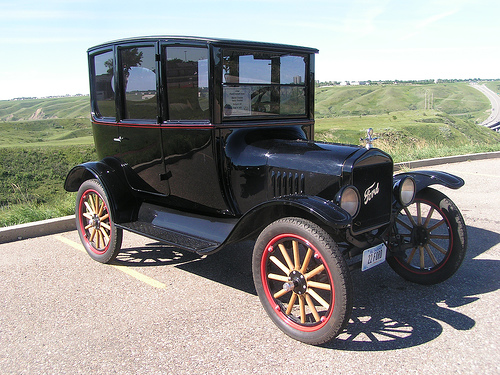
The earliest examples of any musical style, whether it’s hot jazz, Baroque or Bill Haley, live and die by history. The historically-minded listeners comprising classical and jazz audiences readily admit that “early music” got things to where they are now, just like the Model T made the Lamborghini possible. Yet most of them don’t like to drive anything that’s too old. Despite classic music being much easier and cheaper to experience than classic automobiles, it remains just as esoteric, and for many, just as outdated.
Unlike machines (or medicine, the law and late-night comedians), music doesn’t do anything better or worse over time; it just approaches melody, harmony, rhythm, form and other musical considerations differently. For example when it comes to instrumental interplay and tonal organization, Beethoven wrote more intricate chamber works than his predecessors, and Mozart more circumspect operatic works than his contemporaries. Them Austrian boys’ music is “better” for those seeking complexity or dramatic depth.
Boccherini and Paisiello, writing before Beethoven’s innovations and without the blessing or mutation that created Mozart, concern themselves with melody and directness. Using just the meager notes they know, they still manage to make music:
Boccerhini: Sextet, Op. 23 No. 1 in E flat, 1. Allegro (Ensemble 415):
Paisiello: “Mi Palpita Il Cor” from ‘Il Mondo della Luna’ (Gloria Banditelli):
Similarly, Charlie Parker’s rhythm section handles their job in a very satisfying and very sophisticated, very specific manner:
Parker’s band epitomizes a concept of jazz rhythm that can be traced back to the revolution in swing started by Count Basie’s All-American rhythm section, was developed and deconstructed following the bop era and which has influenced jazz through to the present. The texture is spacious and airy, with accents that both support and pull at a smooth, even and relaxed beat. The musicians also interact with and respond to soloists, varying their patterns to add color.
Parker’s group does light and interactive really well, but what if the listener is looking for something else? They could check out The Missourians for some jazz that’s really different:
Pianist Earl Prince, banjoist Morris White, tuba player Jimmy Smith and drummer Leroy Maxey, like so many pre-swing rhythm sections, take their name very literally: they lay out the chords, bass line and ground rhythm, sticking to a punchy background role. Their goal is to create a stage of rhythm for the ensemble and soloists to play over, rather than an accompaniment that’s interesting in and of itself. Musicians who continue to play and find inspiration in this approach explain that supporting the band is the interesting part; locking into a groove and keeping it going for their partners is how they express themselves. That particular groove is not the smooth swing normally associated with jazz. Instead, it’s intense and earthy, based on a very uneven beat, with a chunky feel that give the listener something to bob their head to (sort of like late twenties funk).
In other words, The Missourians have a unique approach to rhythm, just as unique as the Parker rhythm section, or the Basie rhythm section, or the rhythm sections backing Bix Beiderbecke, Albert Ayler or Vijay Iyer. The Missourians’ approach only seems simple, “outdated” or “corny” when judged against a later standard, the equivalent of driving a Model T and expecting a V12 to kick in.
Woody Walder didn’t so much play the clarinet as deploy it. His solos with Bennie Moten’s band are closer to sonic found art sculptures than the poems, speeches and epigrams of his Jazz Age colleagues. Walder pieced together squeals, squeaks, whinnies, whines and cries, sometimes through the insertion of foreign objects into the bell of his instrument, other times with just his mouthpiece. The effect (Walder seemed all about effect) could be humorous or disturbing, at times grating, but was always surprising.
Walder’s particular sound of surprise hasn’t served his legacy well. Most jazz historians locate Walder’s playing somewhere between a tolerable novelty of the times or a now dated commercial evil, perhaps higher than comb playing and barnyard theatrics, but far below the fine art of plunger-muted brass.
Courtesy of chaka85.wordpress.com
It’s a pity Walder missed out on noise music, the Art Ensemble of Chicago’s experiments or the deliberately nasal, percussive and off-pitch curveballs of the World Saxophone Quartet. The avant-garde as well as Walder and contemporaries such as Fess Williams (and even King Oliver at his onomatopoeic) all relished vocally inflected, “unmusical,” weird and occasionally cacophonous sounds. Apparently Walder’s mistake was doing it for a willing and wide audience.
It’s best to listen to Walder on his own terms, neither as historical victim or stylistic precursor, but simply as a musician playing on a record. Better yet, forget the man and just listen to the wholly unique, singularly “ugly” sounds twisting pitch and time on “Elephant’s Wobble,” “Thick Lip Stomp” and “Yazoo Blues.” If you’re craving context, listen to how Walder’s solo on “Midnight Mama” at times resembles a hybrid of Rex Stewart’s half-valving and Bubber Miley’s gutbucketing, transplanted to Eric Dolphy’s honking, metallic reed. It’s a hell of an act, or art, if you’re into that sort of thing.
Swing, blues and a completely fresh improvisation at every performance: three common (for some essential) descriptors of “jazz” that were only beginning to take root at the height of Phil Napoleon’s career. Sounds from New Orleans and the Midwest territories were not as widespread when Napoleon was blowing trumpet for the Original Memphis Five. Louis Armstrong’ rhythmic and solo innovations were still to come, and jazz remained a collective experience with strong influences from ragtime. Yet even beyond his musical and historical surroundings, Napoleon always had other priorities.
Those priorities included a brilliant yet inviting tone, given to clipped articulation and rhythmically tense phrasing. That tone usually supported a powerful, balanced lead, but could also supply spare, neatly organized “hot” patterns. “How Come You Do Me Like You Do” features Napoleon’s direct ensemble lead as well as his witty muted obbligato behind Jimmy Lytell’s clarinet:
Richard M. Sudhalter explained, “The Memphis Five appear to have ‘routined’ their arrangements in advance and in detail…A routine on one number doesn’t change from take to take.” This stick-with-what-works ethic makes sense the more one hears (and feels) Napoleon’s overriding concern for balance and blend. If Napoleon knows exactly what he’s going to play next on “He May Be Your Man,” and if the rhythm is more sway than swing, he still conveys spontaneity alongside restraint. He even adds subtle sardonic color to Lem Fowler’s naughty little tune [just follow the arrow to listen]:
The chamber intimacy of these recordings combined with Napoleon’s clean, resilient sound betrays his background as a classically trained player. Even at his most unbuttoned, for example on a later date with Miff Mole, his “Dixieland” sound is perfectly centered, and he executes a tortuous muted passage (in tight harmony with Mole’s trombone!) neatly and convincingly:
Throughout his career, Napoleon never completely absorbed the loose rhythms and bluesy rhetoric of Louis Armstrong, or the coaxing warmth and harmonic palette of Bix Beiderbecke. It’s probably one reason why Napoleon has had a modest presence in most “jazz” histories. Here he is leading a group of other Jazz Age stars, instantly recognizable and dependable as always. Napoleon remained his own man, something even Armstrong and Beiderbecke could have related to:
According to pianist Marty Napoleon, when his uncle Phil asked the audience at a gig what he should play, they replied, “Play anything!” Here is what “Anything” meant to Phil Napoleon:
For Napoleon, “Anything,” (either song title or aesthetic) signified beauty, warmth, and enough rhythm to keep things laidback but not directionless. The tension and release between minor and major chords (at 0:01 and 0:06, respectively) also illustrates his ear for symmetry in “anything” he played.
Makes you wonder what Phil Napoleon could have come up with had listeners asked for “something special.”
Slack tempo and tender mood aside, this recording points to the power of musical paraphrase. Napoleon’s glistening melody bears repeating, and his “Emperors” rely on recapitulation rather than deconstruction; variety and expression are as simple and infinite as the difference between two voices saying the same lines.
Trombonist Tommy Dorsey starts the side with his mellifluous air column, a preview of the smooth, legato style that would make his Swing Era ballads into the perfect soundtrack for necking. Napoleon’s muted trumpet follows with a clear, unadorned statement of a second theme. The contrast between Dorsey’s rhapsodizing in brass and Napoleon’s pinched “wah-wah” inflection actually offers the most interesting contrast. The second theme just isn’t as memorable as the opening melody, and it’s only a few musical sighs short of smarmy.
Luckily, clarinetist Jimmy Dorsey takes us back to the original melody, with just the slightest variation in notes from his brother’s opening chorus. A trombone and a clarinet naturally have very different sounds, but the difference between a trombone and a clarinet playing “Anything” is so much more than simple mechanics. The repeated melody highlights those differences as distinct aural experiences. Though he doesn’t depart very far from the melody, Dorsey’s reedy tone and liquid phrasing make what’s been said before into a whole new personal expression.
Eddie Lang says “Anything” with tight guitar plucks and a shade of the blues, before his musical twin Joe Venuti glides over the theme on his honeyed violin. The theme we know so well by now moves from downhome to refined and then triumphant when Napoleon enters on open horn. We briefly expect a clarion, assertive cadence, but instead it’s right back to Dorsey’s clarinet, and a more reflective finale.
“Anything” turns out to be a perfectly descriptive title, and a reminder that jazz doesn’t always involve rifling through chord changes or improvising whole new compositions. Jazz is originality and expression of self, no matter how many times a musician has played something (or an audience has heard it). Along those lines, the musician truly can say “anything.”
Special thanks to “Atticus70” for this and all the other incredible music they share on YouTube, and for sharing with me Marty Napoleon’s terrific anecdote about his uncle came up with “Anything.”



 The Pop of Yestercentury