A profile of the Ipana Troubadours in Radio Broadcastmagazine singles out just one sideman in the band. Even among musicians that leader Sam Lanin “picked from the country’s best dance and symphony orchestras,” he receives special attention:
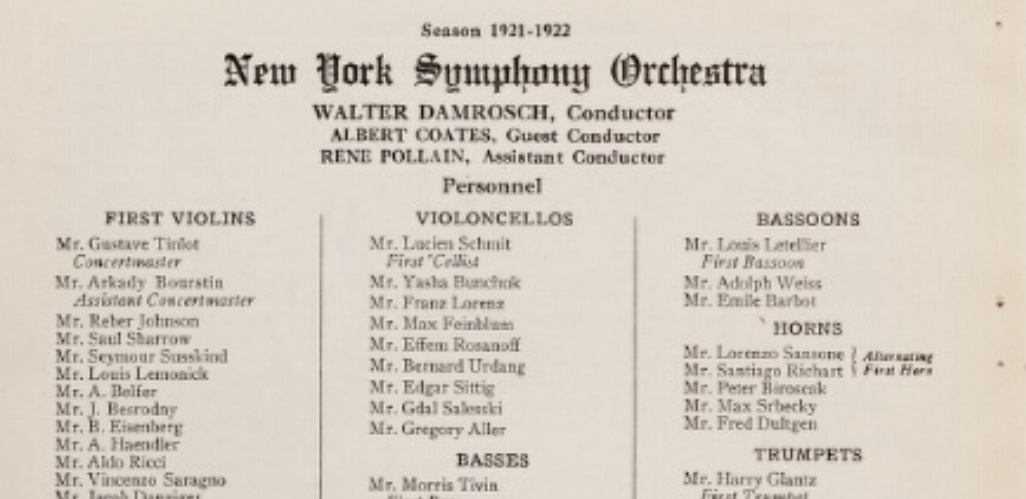
Lucien Schmit, for instance, virtuoso cellist, was Walter Damrosch‘s first cellist for five seasons and is also an accomplished pianist and saxophone player. Schmit is a representative member of the group.
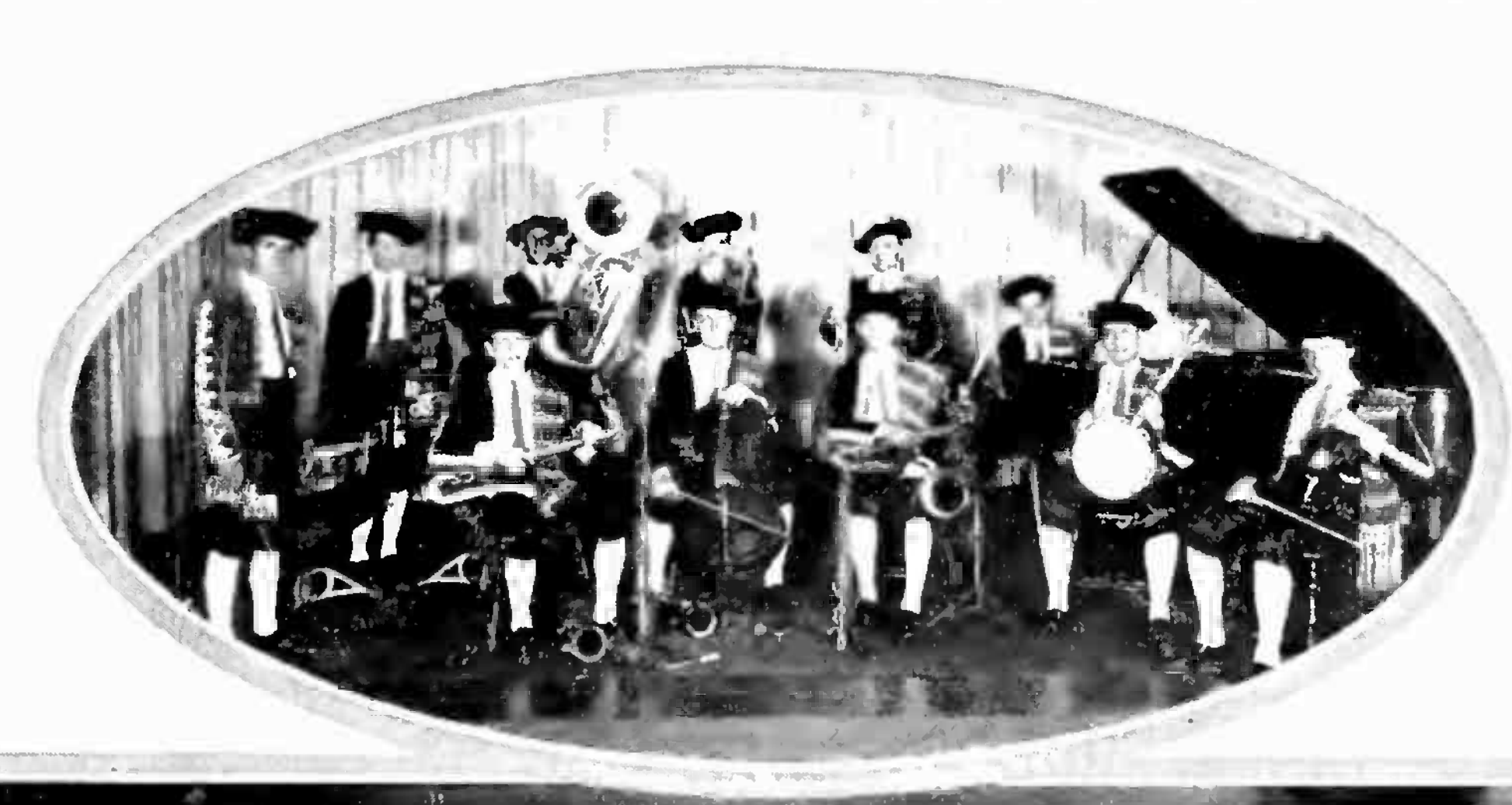
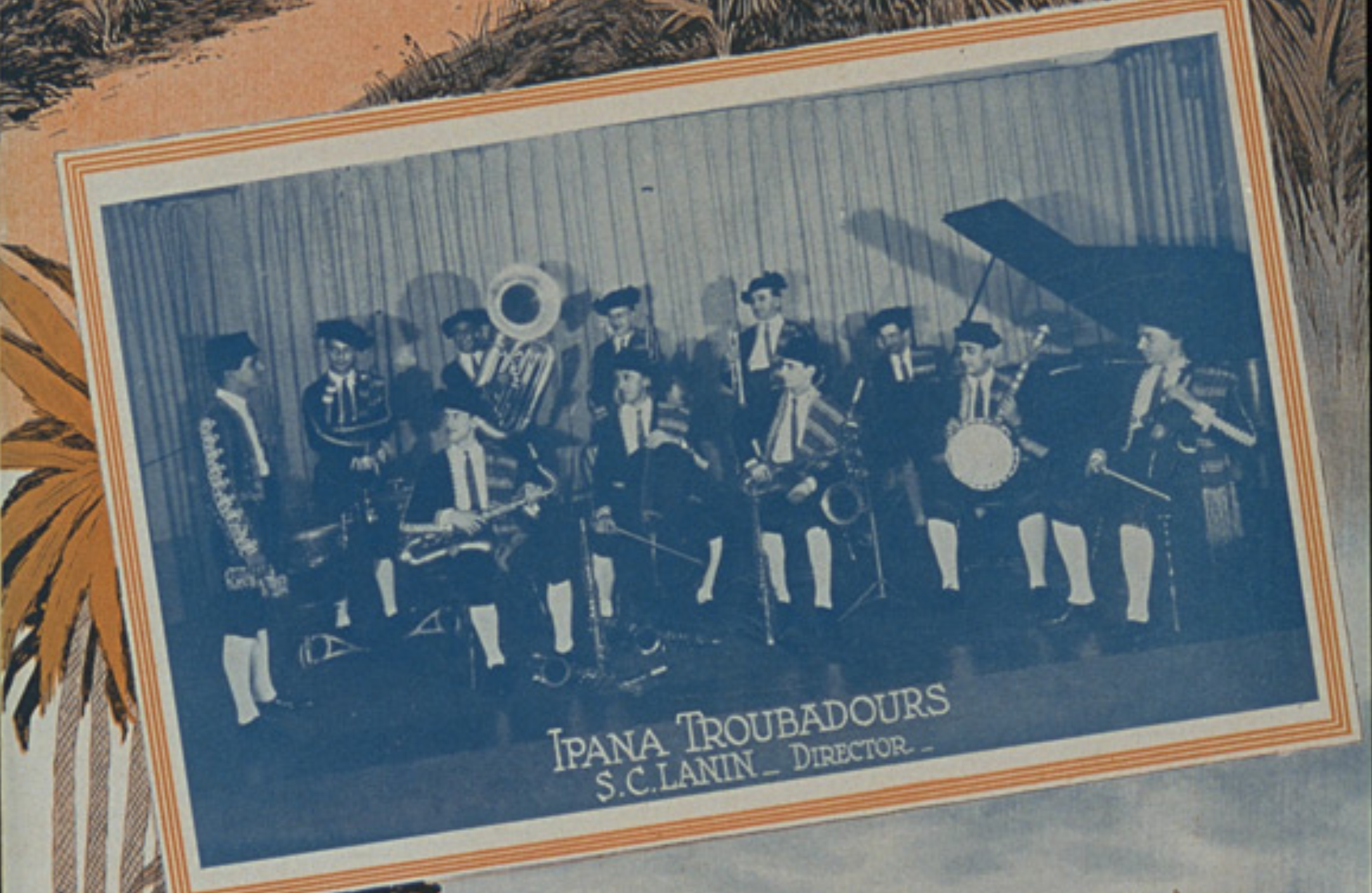
A photo of the Troubadours shows an unidentified player holding a cello with a saxophone at his feet. Section mates on either side of him hold their saxophones. But the cellist’s sax doesn’t even get a stand; it rests directly on the floor. If the reader didn’t know any better, they might assume that sax was just an occasional double.
From Radio Broadcast of September 1926 via worldradiohistory.com.
Of course, “Lucien Schmit” sounds like “Lucien Smith,” a name record collectors and hot dance aficionados likely recognize as one of the saxophonists on several recordings by Lanin and other bandleaders. It’s found next to more well-known names like Bennie Krueger, Miff Mole, Red Nichols, Harry Reser, and the Dorsey brothers in many discographies.
A 1931 radio listing makes the connection more explicit, but even the copywriter faces an identity problem with his subject:
Many performers know how to double in brass, but Lucien Smith will demonstrate the talent which permits him to triple in brass and strings. He will appear as soloist on piano, cello, and saxophone. Best known as a master of the cello, Mr. Schmithas won the praise of music critics for years…it was [conductor Eugene] Ormandy‘s idea to present him in the three phases of his artistic accomplishment.
Mistaking the saxophone as a member of the brass instrument family may be mere carelessness. But the switch between “Smith” and “Schmit” suggests which artistic phases are more or less important. Smith may play many instruments, but Schmit is the cello master earning critical praise.
In contemporary reports, saxophonist “Lucien Smith” didn’t get much attention. With just a couple of exceptions, that name is limited to discographies. For the sake of argument (and according to far more knowledgeable researchers than this writer), it’s safe to assume they were the same musician. And some cursory research shows he enjoyed a long and varied musical career spanning different instruments, repertoires, and artists.
Prodigy
Government records indicate that Lucien Alexander Schmit was born in Belgium on January 6 of either 1898 or 1899 (depending on which draft card). A New York Timesobituary from July 22, 1976, fills in the blanks and notes early talent:
Lucien S. Schmit, a cellist who first performed publicly at the age of seven in Paris and who became a member of the St. Louis Symphony Orchestra at 13…came to this country in 1909. He became first cellist in the New York Symphony Orchestra in 1921 under Walter Damrosch.
Still, there’s a big issue here. And it’s not just the middle initial, which was reprinted as “S” elsewhere. The obituary omits the subject’s many recordings as a reed player with several bands. It even ignores his extensive work as a cellist on recordings with everyone from Quincy Jones to David Sanborn.
This obituary doesn’t mention any ability—let alone talent—for playing saxophone. “Lucien Smith” got left out of the obituary for “Lucien Schmit.”
Symphony Cellist
Across multiple discographies, newspaper articles, radio listings, promotional materials, and other documents, the division between names and roles is surprisingly consistent. “Lucien Smith” plays reed instruments, mainly sax, and “Lucien Schmit” is a cellist. And, based on the amount of historical documentation, the cellist received a lot more press and promotion.
Conductor Walter Damrosch’s pick for principal cello was bound to get plenty of attention. Audiences and critics respected Damrosch for his musical direction, premiering new works, and educational efforts. Damrosch’s New York Symphony was a respected institution later incorporated to form the New York Philharmonic. He remains a well-known name to this day.
This writer cannot remember the source for this image.
Aside from brand recognition, a principal cellist would probably have handled most (if not all) of the solo parts for the orchestra. Several reviews talk about “Lucien Schmit” featured in works such as Saint-Saëns’s Cello Concerto in A Minor and cello pieces by Bach and Boccherini. One New York Times critic praised Schmit as a “graceful and fluent player” in a program of contemporary classical pieces. A writer for Etude magazine, years after hearing Schmit with the Lutèce Trio, recalled that an audience of about 5,000 people “thought him the star performer” despite playing on a mediocre instrument.
Schmit played under Damrosch for five seasons. Half a decade playing to critical acclaim with a renowned orchestra under an esteemed conductor casts a large shadow. At this time, many listeners were more likely to turn their noses up (in public, anyway) to jazz and popular music. Among self-identified “respectable” circles, European art music was the accepted social currency. It was bound to get more press in mainstream publications. It also seems like Lucien Smith, the saxophonist, was rarely featured as a soloist. In short, his dance band legacy might have suffered based on cultural associations and sheer audibility.
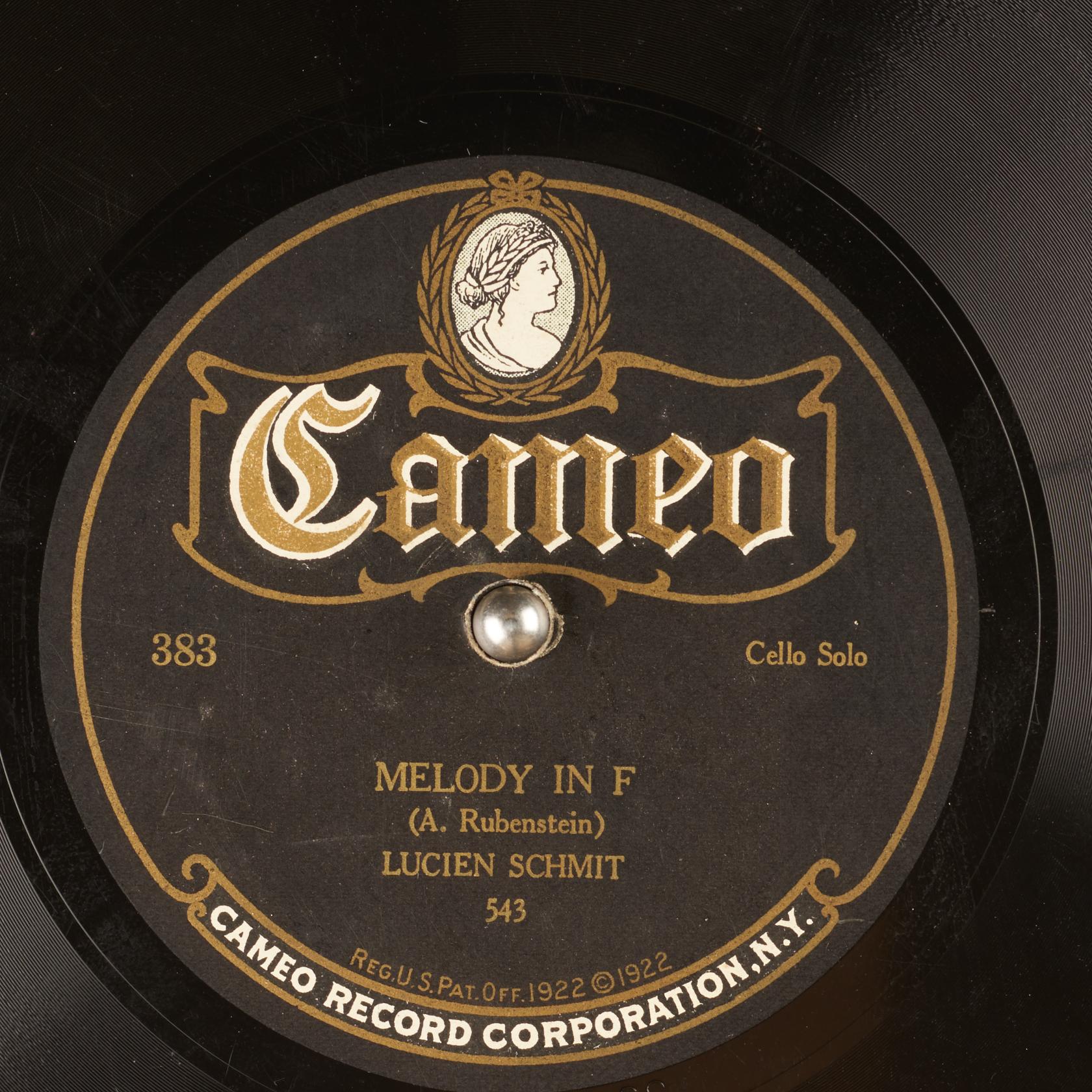
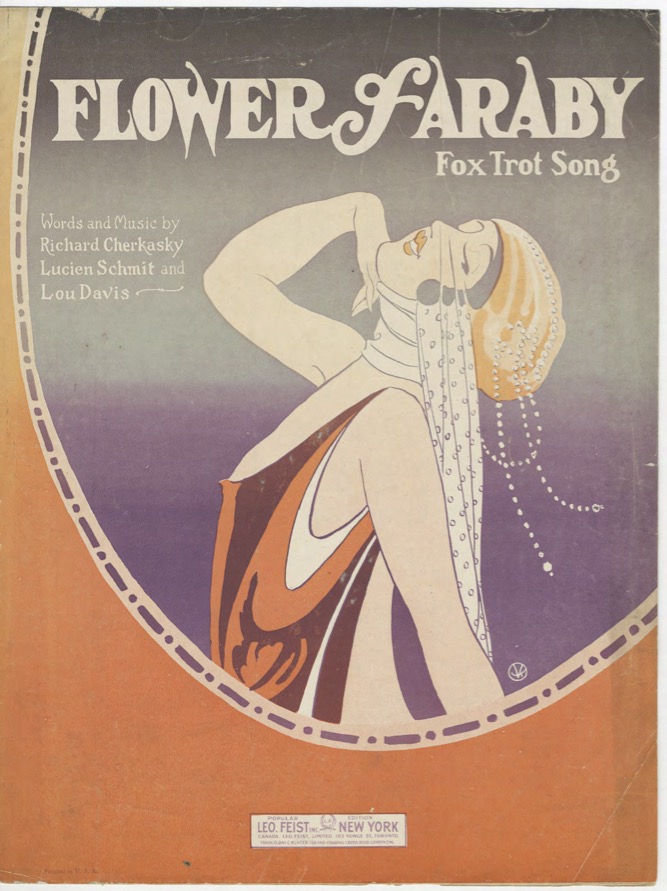
On June 30, 1923, Lucien Schmit, cellist, recorded Rubenstein’s Melody in F (mx. 0543)and “The Swans” from Saint-Saëns Carnival of Animals (matrix number 0544). Audio of each side follows. Images and audio fromInternet Archive.Published in 1922, “Flower of Araby” was recorded by several bands but it’s unclear if Schmit himself recorded the song. Image from IMSLP.
Saxophonist
It’s unclear when he began playing saxophone with dance bands. The earliest discographical entry (that the writer could find) for “Lucien Smith,” the reed player with Lanin and others, is a February 1922 session with Bailey’s Lucky Seven for the Gennett label. Smith is listed as playing tenor sax in the probable personnel. Yet at the time, he was still the principal cello under Damrosch. It’s also hard (for this writer) to single out a distinct tenor sax voice on “My Mammy Knows” or to identify the tenor lead “On the ‘Gin, ‘Gin, ‘Ginny Shore.”
His reasons for deciding to play saxophone professionally are beyond this writer’s research or qualifications. He may have wanted to try something new. Maybe the popularity of dance bands seemed financially promising or musically challenging. It was likely some combination of practical and personal reasons. Whatever the cause, saxophonist Lucien Smith doesn’t appear on another dance band date until August 1924.
From that point, he’s on plenty of great hot dance and jazz records! Discography entries that include “Lucien Smith” read like a who’s who of hot dance/jazz bands: Nathan Glantz, Dave Kaplan, Krueger, Lanin, and Ben Selvin are just a few of the names. Tom Lord’s online jazz discography lists Schmit on 85 sessions between 1922 and 1931—and that’s just what made it into the discography as “jazz.” He likely doubled multiple saxophones and clarinet as a working dance band musician. His substantial presence with these bands indicates significant skill, versatility, and reliability.
Despite the obvious talent, the last session listing Lucien Smith on reeds appears to be August 7, 1931, with violinist Billy Artz’s band. Artz and Lucien both played in B.A. Rolfe‘s famous orchestra, where Lucien is listed as doubling clarinet, tenor sax, and cello. The two likely forged a connection there. He may also be the hot tenor sax on “There’s A Time and Place for Everything.” But at this point, maybe regularly playing tenor was unneeded or less lucrative during the Great Depression.
Radio Cellist and More
Instead, cellist “Lucien Schmit”—who happened to also play saxophone and piano—resurfaces in the press and discographies. The New York Times obituary states that “During the 1930s, he was active in radio musical programs…musical director of ‘The Royal Typewriter Hour’ and for 20 years was featured on such programs as ‘The Telephone Hour,’ the Firestone Show, the Longines Symphonette program and ‘The Prudential Family Hour.'” But that obituary is entirely framed around his work as a cellist.
Some contemporary reports of “Lucien Schmit” reference work as a saxophonist and pianist, like this April 24, 1930 radio listing in the Hartford Courant:
Lucien Schmitt [sic], the violincellist of the Melody Moments orchestra and other concert orchestras on the networks, will demonstrate his ability to triple in brass and strings…He will contribute piano, cello, and saxophone solos to the concert.
In directories for the New York American Federation of Musicians, Local 802 (generously provided by Vince Giordano), there’s only “Lucien A. Schmit” listed in the “Cello” section. Whatever else he may have played on the radio, Schmit’s primary role was always as a cellist.
Over the next few decades, in addition to radio work, his cello as well as his violin and viola are listed in studio recordings with Kenny Burrell, Perry Como, Johnny Griffin, Coleman Hawkins, Artie Shaw, and Wes Montgomery, among others. Almost inevitably, it’s “Lucien Schmit” in the string section. Grammy-wining bandleader and hot music historian Vince Giordano explains that pianist Dick Hyman recalls “Lucien” coming to sessions carrying both reed instruments and his cello.
Along the way, he and his wife raised their only child (who went on to a respected career in engineering). Lucien passed away following a stroke on July 20, 1976, in a hospital near his Manhasset, Long Island home.
Musician
Depending on the area of his considerable experience, you might end up reading two different narratives. Almost all the discographies and press clippings that mention the cellist reference Schmidt, Schmit, or Schmitt. Except for very few contemporary articles, Lucien Smith, a saxophonist, is only found in discographies (though the prolific and knowledgeable discographer Javier Soria Laso gets a lot of credit for covering all the bases by referring to “Lucien Smith/Schmitt/Schmidt”).
There may be a better or more straightforward explanation for using different names. And wider research may show that the associations between the names weren’t as cut and dried. Maybe “Smith” was a deliberate alias or just a propagated typo. But just looking at (some) writings, you might think Lucien Smith’s saxophone was a temporary side hustle compared to Lucien Schmit’s cello.
That probably says more about audiences’ and reporters’ perceptions of “serious” and “popular” music during Lucien’s lifetime. His musical career makes for a single interesting story. You’d just better know who to look for.
From the sheet music for “Tamiami Trail,” published in 1927 by Jerome H. Remick & Co. Image retrieved online from Florida International University libraries.
Sources
American Federation of Musicians, directories from 1937, 1943, and 1958
American Dance Bands on Record and Film by Johnson and Shirley
ARSC Journal, vol. 24, no. 1: “Georges Barrere” by Susan Nelson
Many thanks to Vince Giordano for sharing his recollections, relevant newspaper articles, and 802 directories. Thanks also to Javier Soria Laso for his insights into the subject and meticulous discographies that first connected the names for me. Thank you, Aaron K., for your fine edits. And thanks to “P.C.” on Facebook.
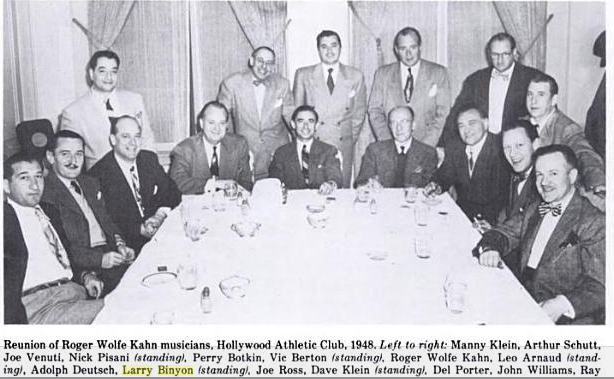
The following post first appeared in multiple parts on this blog, and I was asked to consolidate it into one single entry (and more than happy to oblige). Larry Binyon has been a personal favorite since I first started listening to jazz. Hopefully, this post will shed some light on his life and work, and perhaps inspire someone with better resources to research that life, and more importantly Binyon’s music, further. Either way, please enjoy!
Reality television notwithstanding, ubiquity and fame are two very different accomplishments. Just ask Larry Binyon. More practically, Google him: he appears on dozens of record dates (150 jazz sessions alone according to Tom Lord), usually listed alongside some legendary names. Yet that’s all most historians and musicologists have to say about him. Larry Binyon is all over jazz history but not a well-known part of it.
He must have been an impressive musician to get work so consistently, especially with the likes of Benny Goodman, Fats Waller, Red Nichols, the Boswell Sisters, the Dorsey Brothers, and other famous names. He also doubled several instruments, mostly playing tenor saxophone but contributing on flute when it was rarely heard in a jazz context. Binyon could also improvise in addition to read and double. Given the company he kept, he got to read and double far more often than he got to take a solo.
Years later and with very few solos on record, sidemen like Binyon can seem like historical packaging material. They surround the names we know best, provide musical as well as personnel background but otherwise end up padding the “real” artistic goods. After all, isn’t jazz “really” about improvisation? Weren’t there “better” improvisers around? Didn’t other musicians double? Couldn’t “anyone” have read the chart, as Binyon did?
Perhaps, but only from the luxury of listening decades later. To musicians, someone who could do all three (and maybe even show up on time and in uniform) would be a precious resource. There must have been a reason why Larry Binyon got to play so often. He also recorded quite a bit, even some of those improvised solos that jazz purists like to hunt down between all the written stuff, which Binyon also made possible. That sounds like far more than filler, and it definitely sounds like an important part of the music.
Chicago And Back Again: The Early Years
Lawrence “Larry” Fiffe Binyon was born in Illinois on September 16, 1908, the younger of Claude and Josephine Armstrong Binyon’s two children (their first child Hugh was born in 1905). Census records show the Binyon family renting one unit of a two-family home in Chicago’s twenty-seventh ward in 1910, with Claude Binyon listed as an unemployed funeral director and somehow still employing a live-in servant. By 1920 the family was renting a single home in the city of Urbana, about 150 miles south of Chicago. Claude now worked as a secretary for an oil company. Josephine was now also employed as a music teacher working out of the Binyon home, now servant-less.
Urbana was a much less densely populated city, and census records show more white-collar jobs among the Binyons’ neighbors in Urbana than those in Chicago. Perhaps the quality of life was a factor in their move. Maybe Urbana was simply where Claude could find another steady paycheck, albeit now supplemented with a second income. If there was financial hardship, it could have influenced Larry’s understanding of the value of a dollar. Claude’s death in 1924, when Larry was just sixteen years old, certainly would have put a financial strain on the family. Larry might have developed his later well-documented work ethic at an early age.
It’s unclear how early Larry Binyon started playing music, but safe to assume that his mother shared at least some of her musical knowledge. By age eighteen, Binyon was at the University of Illinois at Urbana-Champaign, listed on E flat (soprano) flute in the school’s concert band as well as (standard) flute and piccolo in its first regimental band during the 1926-27 school year.
Binyon would only spend one year at college. By 1927 he was already playing professionally in Chicago as part of Beasley Smith’s band, which also included drummer Ray McKinley and clarinetist Matty Matlock. Drummer and future swing era star Gene Krupa was playing across the street from Beasley in Joe Kayser’s band, and Binyon would have encountered an even wider pool of talent in the jazz mecca. Flute may have been Binyon’s first instrument, or at least his primary one at school, but tenor sax would have by now become his main horn for dance bands.
Later on that year, drummer, bandleader, and talent incubator Ben Pollack came back to Chicago after an unsuccessful gig at the Venice Ballroom in California. His third saxophonist and arranger Fud Livingston had left the band earlier that year (to work with conductor Nat Shilkret in New York City). It’s unclear exactly when or how Binyon hooked up with Pollack, but he was with the Pollack band on December 12, 1927, when it returned to the Victor’s Chicago studio after a five-month hiatus. He even got to solo!
On the final bridge of “Waitin’ For Katie,” Binyon stays pretty close to the melody on the first take and loosens up slightly for the second one. Both takes find Binyon jumping in on a break and ripping into the upper register (here is the issued first take):
Like many jazz musicians from this period, Binyon “routines” his solo but still has something unique to offer. His reedy tone and declaratory, trumpet-like phrasing are very different from Coleman Hawkins’s metal and rapid-fire arpeggios. Binyon has been compared to Bud Freeman, but Freeman generally played in a more agitated style at this time. Binyon sounds more relaxed even at faster tempos. Stated bluntly, he just played fewer notes than those guys.
Apparently, Pollack liked Binyon’s notes; his tenor saxophone gets another solo on the session’s other issued side, “Memphis Blues,” where Binyon once again varies things just slightly between two takes (the issued first take follows):
He sounds tentative playing counterpoint in the introduction, and his brief solo might not seem like a model of construction. Yet he doesn’t get much room to stretch out on the W.C. Handy standard. Fud Livingston’s arrangement inserts some snappy chord substitutions from the band into the middle of Binyon’s chorus, which Binyon leaps into with a beautiful, well-executed lick. His preceding improvisation/routine is closer to an earlier, pre-Armstrong tradition that emphasized variety over contiguity. It’s also the work of a nineteen-year-old cutting his first record. Better things were still to come but this was an admirable start.
Pollack’s band was filled with young talent, including eighteen-year-old Benny Goodman and twenty-year-old Jimmy McPartland. They usually got more solos, and have certainly received more ink since this session, but Binyon got to play alongside them and make the Pollack band possible. He must have been doing something worth talking about.
Making It Work: The Pollack Years
Much to Ben Pollack’s short-term benefit, his band and Larry Binyon parted ways following their December 7, 1927 recording session. Variety’s issue of January 25, 1928, reported that the band had already started a residency at the Club Bagdad in Chicago’s Pershing Hotel. By February 25 it had closed at the Bagdad and was onto New York City. Binyon might have played with the Pollack band during its remaining time in Chicago, but Pollack apparently had another saxophonist in mind for its next move.
Bud Freeman explains that Pollack first heard him play at a late-night jam session in Chicago, and was so impressed by the saxophonist’s solos with McKenzie and Condon’s Chicagoans that he asked Freeman to join the Pollack band in New York. These now-famous recordings are widely considered the birth of the “Chicago style.” Yet it’s hard to believe their loose format was a decisive factor in Pollack’s decision. Pollack was running a jazz-infused dance orchestra, not a jam-oriented jazz band. He needed musicians with the ability and discipline to read written arrangements as well as improvise solos. Freeman never hid his distaste for dance band work and didn’t like New York. Pollack fired Freeman after three months for clowning around on the bandstand and then rehired him for an Atlantic City engagement in July, only to have Freeman quit at the end of the month.
Pollack Reed Section c. 1927: Benny Goodman, Fud Livingston and Gil Rodin
After some traveling gigs and a brief dry spell, the Pollack band began a long-term engagement at the prestigious Park Central Hotel on September 28. Pollack already had Jimmy McPartland, Benny Goodman and Jack Teagarden (who had joined in June) to contribute hot solos. By this point, he was probably willing to sacrifice some improvisational fire for a third saxophonist who could, and would, do the job. That included doubling the numerous other reed instruments that Pollack, apparently inspired by bands such as Roger Wolfe Kahn’s, wanted to show off.
Binyon probably continued to work with Beasley Smith’s band or one of several bands in Chicago while Pollack was in New York. It’s uncertain when Binyon got to New York, whether Pollack sent for him or if he just happened to be one of the many musicians starting to move to the musical epicenter, but by October 1, 1928, Binyon was back on record with the Pollack band in New York.
With three powerful soloists and the band’s tendency to rely on written arrangements, Binyon didn’t get many solos on record with Pollack. With Benny Goodman frequently doubling alto and baritone saxes, he wasn’t even the only saxophone soloist. Pollack instead capitalized on Binyon’s strength as an ensemble player.
A lush waltz like “Forever” or the muted trumpets, violins, and (most likely Binyon’s) flute on “Let’s Sit And Talk About You” might not interest jazz listeners but the records work on strictly musical terms. Attention to dynamics, ensemble balance, and lyricism are fairly consistent through even the Pollack band’s most commercial dates. Its sax section of Binyon, Goodman, and lead alto Gil Rodin play with a bright, creamy blend, for example answering the full band on the Victor recording of “Futuristic Rhythm”:
or “From Now On,” on which they achieve an especially transparent sound, right down to Binyon’s purring tenor:
Talented musicians, a steady gig at a famous venue and sheer hustle helped the Pollack band grow incredibly popular, allowing them to move onto radio work, Broadway, various touring appearances, and a few short films. The band is featured exclusively on a Vitaphone film shot on July 29, 1929. Binyon is seen in the middle of the sax section, soprano sax, clarinet, and flute impressively displayed in front of him while he plays tenor throughout:
Pollack obviously liked Binyon; he appears on every title cut under Pollack’s name (save for one small group session by “Ben’s Bad Boys” in January 1929). Yet a dependable player from a well-known band who could read, double and improvise was bound to get additional offers. Based on his discography, Larry Binyon was more than happy to work on the side.
A Sideman Soloing On The Side
Larry Binyon was talented (and fortunate enough) to have joined the Ben Pollack band just in time for its peak of popularity. He appeared on nearly every title cut under Pollack’s name, but side dates with studio pickup groups let the tenor saxophonist stretch out as more than a section player. He gets to join in with Pollack’s favored soloists on “Whoopee Stomp” under Irving Mills’s leadership, kicking off a string of solos featuring Benny Goodman, Jack Teagarden, and Jimmy McPartland:
It’s tempting to compare Binyon with these now-marquee names in terms of relaxed phrasing, catchy licks, and bluesy inflection, but Binyon’s style works on different priorities. It doesn’t display the same technical confidence but remains driving and tense. Binyon rarely stays in one place, wriggling up and down phrases, emphasizing variety over linear continuity. Binyon played hot solos: no frills, high on energy and contrast yet very personal. Binyon pushes the beat but without the agitation and gritty tone of fellow tenor player Bud Freeman or his cohorts Eddie Miller and Babe Russin. Binyon’s approach is also far removed from the dense arpeggios and metallic tone of the Coleman Hawkins school.
Binyon’s tone—husky, reedy, and distinct—could be an asset unto itself. On “Wont’cha” with Pollack, Binyon gets a paraphrase (one of his few solos of any kind with Pollack) after the vocal that shows off his warm, centered sound:
It’s not an improvised solo but it is an effective orchestral voice, probably appreciated in a dance band setting. Twenties bandleaders would occasionally use a light-toned baritone sax in a melodic role, but it sounds like Binyon’s tenor providing the broad, cello-like lead on the transition to the last chorus of “A Japanese Dream” with Mills:
“Blue Little You” includes a similar voicing in its introduction and right after the vocal. Contrasted with the standard alto lead that immediately follows, it makes an especially colorful effect on what might otherwise be dismissed as a straight dance chart:
Binyon also tosses out an improvised bridge before the ensemble conclusion. His jagged lines come across as flip commentary on the vocalist’s elongated, slightly nasal delivery. Brief solo spots like this one allow Binyon a concentrated burst to say just enough in a few measures. He snaps into the final bridge of “Little Rose Covered Shack,” once again on McPartland’s heels, this time with snaking, clarinet-like lines along with his usual rich tone and tendency to begin phrases in the upper register:
He really cuts loose on one of the few mixed dates of the Jazz Age, a freewheeling session with no less than Fats Waller. With Waller as well as Teagarden, Red Allen, Albert Nicholas, Eddie Condon, and Gene Krupa on hand, it’s no surprise that Binyon sounds like he’s having fun. He wails and moans (showing he also listened to Hawkins) through both the introduction and one chorus of “Ridin’ But Walkin’”:
On “Won’t You Get Off It Please?” Binyon sticks to declaratory, at times trumpet-like exclamations, popping out high notes and plunging into the lower register for the release:
Binyon also seems to enjoy himself on “Shirt Tail Stomp,” one of the novelty tunes that “the Pollack band without Pollack” recorded to satisfy popular demand. His big tone stays intact through all of the mooing and whinnying:
Benny Goodman “created” this number after a recording engineer overheard his band mocking a cornball jazz act. Binyon has the perhaps dubious honor of appearing on three of its five versions on record. In addition to reading, doubling, and improvising, he was apparently also a capable musical clown.
Binyon could obviously fit into a variety of musical settings, from Pollack’s snappy dance band setting to looser blowing sessions and everything between; trumpeter and band organizer Red Nichols had even started hiring him on orchestral pop dates modeled after Paul Whiteman (though mostly doubling oboe and flute as well as tenor sax, with Babe Russin handling solos). He was nothing if not versatile, and a versatile musician was usually a busy one.
By the summer of 1929, Goodman and McPartland had left the Pollack band. They were more than capably replaced by Charlie Teagarden and Matty Matlock. Jack Teagarden would stay on for another three years. Yet Binyon may have seen Goodman and McPartland’s departure as a sign that the Pollack band had peaked. He might have been smarting under the same conditions that drove them out of the band; Pollack had fired two of his top soloists for showing up to work with scuffed shoes! A good reputation as a multitalented player in New York would have enabled Binyon to forego the life of a touring musician. It also would have provided more opportunities to perform in different settings.
Something convinced Binyon to leave his first regular employer and a still widely respected band. Binyon’s last session with Pollack was in January 1930. As usual, he didn’t get any solos. One of the two tunes recorded at that session, “I’m Following You” featured yet another one of the leader’s comically earnest vocals. Larry Binyon might have simply been ready for something different.
A Heavy Gig Bag And Phonebook: The Thirties
U.S. Census records state that in April 1930, Larry Binyon was renting a room in his hometown of Urbana, Illinois. Jazz discography shows that by this time, said “saxophonist” working in the industry of “orchestra” (a federal category, or Binyon’s own prestigious description?) was firmly settled in New York City.
Red Nichols (care of Stephen Hester)
Binyon had stopped recording with popular bandleader Ben Pollack by mid-January 1930, but his big sound is clearly audible in the sax section of Sam Lanin’s band on several dates from March through May of that year. A careless census taker may have counted Binyon while he was in town for his mother’s wedding to her second husband. It’s also possible that the twenty-two-year-old sideman simply neglected to change his address. He was certainly busy enough: his post-Pollack resume reads like a directory of the most popular names in jazz and popular music of the time. He was also working alongside the cream of New York’s musical crop. With Lanin alone, Binyon got to record with Tommy Dorsey, Miff Mole, Manny Klein, Leo McConville, and Al Duffy.
He was also part of the veritable all-star band that Red Nichols assembled for the Broadway musical “Girl Crazy.” Binyon had already worked with the trumpeter and booker on a few sessions, including large, symphonic jazz sessions where he doubled flute, oboe, and clarinet. Composer George Gershwin wanted a jazz band for “Girl Crazy.” Nichols assembled Pollack alumni Benny Goodman, Glenn Miller, Charlie and Jack Teagarden, and drummer Gene Krupa among others. Binyon isn’t usually mentioned as being part of the group, but neither are several other players needed to fill out the band. Binyon’s familiarity with the other players as well as his ability to read and double would have made him a welcome addition to this (or any other) pit.
“Girl Crazy” opened on October 14, 1930. Nine days later Nichols recorded two tunes from the show with several members of the band, including Binyon. Binyon doesn’t get to solo on “I Got Rhythm,” and “Embraceable You” doesn’t leave much room to distinguish any of the musicians. It’s unclear whether Binyon would have preferred more solo opportunities, but he must have been more than used to an ensemble role by this point.
Binyon continued recording with Nichols and Lanin as well as Benny Goodman on some of the clarinetist and future swing powerhouse’s earliest sessions leading a big band in 1931. Goodman assigns Binyon straight, almost dutiful melodic statements on both “I Don’t Know Why” and “Slow But Sure.” He also gets a flowery flute lead on “What Am I Gonna’ Do For Lovin’?” switching to tenor sax as well as a darker tone and more swinging approach for a duet with Goodman on the last chorus:
Given Goodman’s disagreements with Pollack while in his band, it may seem ironic that both bandleaders took a similar approach to Binyon’s role. Yet by the time Goodman began leading bands, that role may not have necessarily reflected Binyon’s abilities as a soloist. Solo space on jazz and dance records grew increasingly limited during the early thirties. Depression-era listeners preferred more sedate pop arrangements to driving hot jazz numbers. Even with the most exciting soloists on hand (Goodman’s 1931 bands included the likes of Bunny Berigan and Eddie Lang), many studio dates from this period stay fairly tame. Binyon may have had a varied toolkit, but his bosses may have needed one specific device.
The joy in listening to a sideman like Binyon is not just listening for when he pops up but what he gets to do. When a band did get to cut loose, for example Roger Wolfe Kahn’s orchestra performing “Shine On Your Shoes,” Binyon could throw down a hot solo on tenor sax:
or use his brawny sound to heat up even straight melodies like “Sweet And Hot” with Nichols:
Binyon’s flute could add the requisite touch of sweetness and refinement as needed. It could also bring an unusual color to up-tempo numbers like “Walkin’ My Baby Back Home” with the Charleston Chasers:
The combination of the Binyon’s flute with ensemble syncopations and Krupa’s drums points to more than just a sweet context. Musicologist and historian Gunther Schuller mentions Binyon’s flute as well as Glenn Miller’s arrangement as examples of a sound “well beyond the normal dividing lines between commercial dance music and late twenties jazz.”
Along with Albert Socarras (who had soloed on flute as early as 1929 on “Have You Ever Felt That Way?” with Clarence Williams) and Wayman Carver, Binyon was one of the first to bring the flute into a jazz context. His smoky introduction to the Boswell Sisters’ “Sentimental Gentleman From Georgia” must have made musicians and bandleaders reconsider the possibilities of this instrument in a jazz setting:
In addition to the Boswells, Binyon accompanied vocalists Grace Johnston, Phil Danenberg, Dick Robertson, Chick Bullock, Mildred Bailey, and Ethel Waters during the early thirties. He was usually backing these singers alongside members of the same circle of top-notch New York musician that he would have known very well by this point. He impressed Tommy and Jimmy Dorsey enough to land work with their band. At this point the Dorsey Brothers Orchestra was a smaller studio band, allowing Binyon room to solo on instrumentals such as “Mood Hollywood”:
and “Old Man Harlem”:
It’s unclear exactly what type of work Binyon landed outside of the studios during the early thirties. Arranger Don Walker recalls Binyon playing in the band for Hit Parade of 1933 as well as “first (legitimate) flute” in the 1935 musical Maywine. Walker and his copyist Romo Falk excitedly noted Binyon’s presence (expressing similar accolades for Binyon’s section mate, Artie Shaw).
Binyon played with Paul Whiteman’s orchestra for one month in 1936 before moving onto radio work, including jobs under Red Nichols’ direction, as well as other work outside of an expressly jazz context. It was around this time that Binyon also married his first wife, Polly. Seven years younger than Larry, she was born in Puerto Rico and living in Syracuse by 1935, before marrying Larry at some time before 1940. The steadier work and more regular hours of radio may have eased his transition to married life, or vice-versa. Binyon even had time for a trip to Bermuda (though it is unclear whether it was for work, honeymoon or one last bachelor outing).
Binyon also did sax section work on jazz dates with Frank Trumbauer, Joe Venuti, Bob Zurke, and Dick McDonough during the mid to late thirties. McDonough was an experienced, well-connected guitarist who had his pick of sidemen for the few sessions he ever directed during 1936 and 1937. Binyon was on hand for two of McDonough’s dates, getting in some paraphrases as well as a quick-fingered, slightly more modern solo on “He Ain’t Got Rhythm”:
At this stage, Binyon had the reputation as well as the chops to work in a variety of settings alongside some of the best players in New York. He even found the time to change his address: by 1940, one Larry Binyon, now a “musician” in the “orchestra” industry, was officially living in New York City.
Talent, Opportunity And Choice: Final Years and Legacy
The All Music Guidestates that Larry Binyon “needed someone to hold the door open for him when he arrived at a recording studio or radio broadcast date.” It’s an unsubstantiated anecdote but an accurate image. By the early thirties, Binyon was, in violinist Harry Hoffman’s words, one of New York’s “first-call” studio musicians who could “play anything.” With his move to full-time radio work in 1936, Binyon would have been playing his tenor sax, flute and oboe, probably clarinet (and possibly the “few fiddle credits” mentioned by AMG writer Eugene Chadbourne) in any number of musical settings.
While trombonist Larry Alpeter adds, “most of these [first-call] guys had fine jazz skills,” Binyon’s appearances on jazz records and already sparse solo spots dried up by the mid-forties. He is one of two tenors on Billie Holiday’s 1944 Decca sessions with Toots Camarata’s orchestra, but it’s unclear whether Binyon or Paul Ricci handle the few brief solos on these recordings. Binyon is strictly an ensemble player on his final jazz session, with Jess Stacy’s big band in June 1945.
After close to twenty years of having his hands literally and figuratively full in New York City, Binyon moved to Los Angeles in 1946. Binyon worked once again with Nichols in California, this time in Bobby Dolan’s orchestra on The Ford Show (starring Dinah Shore) from September 18, 1946, through June 11, 1947. Yet Binyon had also relocated to work as a recording contractor for the American Federation of Musicians.
If Binyon was looking to segue into a “behind-the-scenes” role, the paucity of documents from this period indicates that he got his wish. Drummer Johnny Blowers does recall a February 8, 1950 session with Phil Harris organized by Binyon, but Binyon’s activities as an organizer are otherwise largely unrecorded. A new home, warmer climate, and slower pace on the West Coast were probably a welcome change for him. It also would have allowed him more time with his son Claude (born in 1940 and named after Larry’s father). Blowers actually secured the Harris date when he ran into Binyon in New York, who was on a vacation of all things.
Blowers also notes that Binyon was still playing with West Coast bands, though it must have been less hectic than the New York scene. Binyon frequently worked with Phil Harris in Los Angeles, previously co-writing “Bump On The Head Brown” for the entertainer along with Chauncey Morehouse and Frank Signorelli (now that would have been a trio!).
Binyon worked the 1952 and 1953 seasons of the Phil Harris and Alice Faye radio show alongside Nichols in Walter Scharf and Skippy Martin’s bands, recorded five numbers with Harris on December 27, 1953, for RCA Victor, packed his gig bag(s) for a tour of Asia in the early fifties and booked sessions for fellow players: it all must have been a breeze for this seasoned musician.
He seems to have stopped playing completely by 1955. Based on Binyon’s track record, that must have been by choice rather than necessity. His story fades even further after that decision: marriage to a second wife in Nevada in 1962 and then a third wife in California in 1966, followed by a divorce two years later. Larry Binyon passed away on February 10, 1974 (followed by his brother Hugh in 1978 and then son Claude in 1999, both of whom died childless).
Other than personnel listings and occasional mention by his contemporaries, most of whom are now also gone, Larry Binyon has faded into the background behind more famous names. It’s easy to make a comparison between his legacy and his work, but that would dismiss the talent that earned Binyon such fast company in the first place. How else does one get to play with everyone from Tommy Dorsey to Benny Goodman to Billie Holiday and Fats Waller?
Binyon’s versatility and sheer ubiquity may have actually helped force him into the background. Had he stuck to one or even two instruments, it might have been easier for bandleaders and listeners to remember him. Yet jumping between dozens of dance bands, jazz groups, studio ensembles, and radio orchestras while covering a multiplicity of parts as the schedule demanded and always being on hand to make every arranger’s whim seem like an easy task, it was easy to see that Binyon was capable of anything but probably harder to associate him with one thing.
There are enough accolades to show that he wasn’t just any sideman, yet not enough solos to determine what kind of a jazz musician he was (in a world where “jazz” is synonymous with “soloist,” anyway). Depending on how one hears his music, Binyon either lacked the ability or opportunity to inspire followers (though musician and writer Digby Fairweather detects Binyon’s influence in Georgie Auld’s earliest performances). In the end, it’s hard to depict him as a “jazz artist” and inaccurate to dismiss him as some studio drone.
Depending on how one reads his story, Larry Binyon is either a neglected musician or a person who made a life’s work doing something he was very good at and presumably enjoyed very much. Whatever the interpretation, his ability as well as his impact on jazz and/or/a.k.a. American popular music is undeniable. He was right there next to some of music’s greatest names, as much by his choice as theirs. Maybe Larry Binyon was simply exactly where he wanted to be.




 The Pop of Yestercentury


