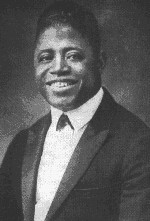
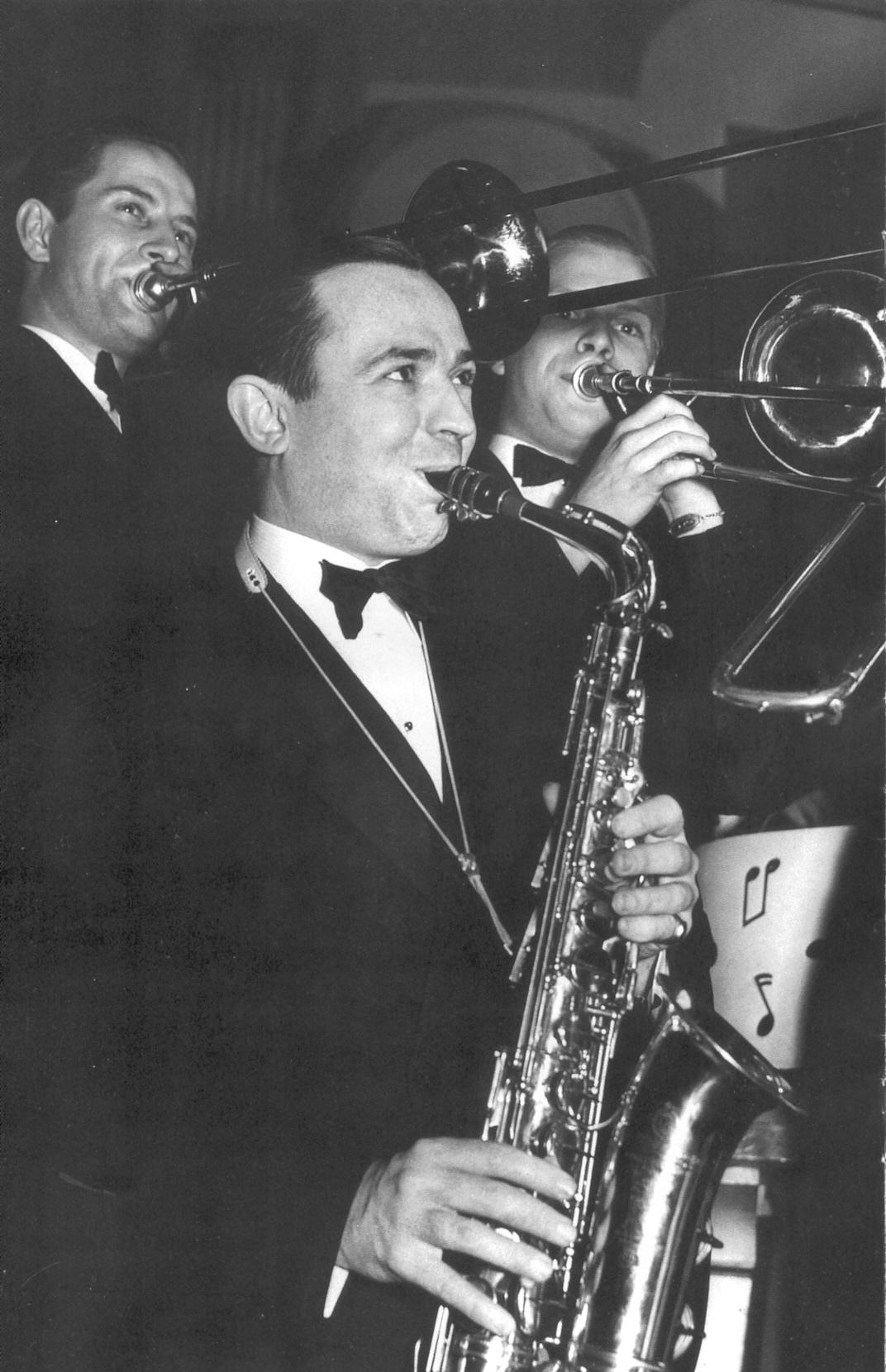
Vince Giordano, Josh Duffee, Fletcher Henderson and Jean Goldkette At BixFest

The Bix Beiderbecke Memorial Jazz Festival honors the brilliant, short-lived cornetist with four days of music, memorabilia, lectures and more music in Beiderbecke’s hometown of Davenport, IA.  Fans have posted a lot of great footage from this year’s festival online, but clips from the “battle” between Vince Giordano and Josh Duffee’s bands capture something truly special from an already unique gathering.

This double bill was inspired by a legendary battle of the bands on October 13, 1926, between Fletcher Henderson’s “home team” at New York’s Roseland Ballroom, and Jean Goldkette’s Detroit-based orchestra.  Contemporary musicians knew this was a gladiatorial occurrence, with Goldkette’s group of “tight assed white boys” and “hicks from the sticks” soundly whooping the venerated Henderson orchestra.

At Bix Bash on August 6, 2011, Vince Giordano’s New York based Nighthawks were the guests in town to play the Henderson book, with Duffee’s group on home turf in the Midwest playing the Goldkette charts. Just hearing these arrangements live and liberated from the constraints of twenties recordings techniques is an event. While it shouldn’t matter how old the charts are, in the age of disposable pop stars and last year’s songs making it onto the oldies station, their age makes this performance all the more miraculous.

Aside from the geographic reversal and the more playful nature of this “battle,” as soon as the Nighthawks light into “St. Louis Shuffle,” it’s obvious that the Roseland throw down is a source of inspiration, rather than recreation:

Giordano is a powerhouse player and erudite musician who illuminates gaps on record with historical knowledge and attention to period detail that are second to none.  Yet the tone, imagination and drive of the Nighthawks are entirely sui generis.  The Nighthawks also forego their usual practice of playing solos from original recordings; the soloists here are creating in the moment.

Recording techniques in the twenties prevent us from knowing what Kaiser Marshall’s full drum kit sounded like. Arnie Kinsella’s rolling snares on “Shanghai Shuffle” are no doubt historically informed, but more importantly they just get this band moving:

Josh Duffee’s band spends more time with the original solos on record, yet none of his guys or gals (another important difference with the original battle)  sacrifice their voice.  Jazz, “Jazz,” or “jass” has always been about making even a single note all one’s own.  It can be as subtle as the saxophonist playing Frankie Trumbauer’s original lines a touch more staccato, or the band accenting sections that were just an afterthought on the original recording of “Proud of a Baby Like You”:

On “Tiger Rag,” there is no recorded legacy to admire or compare.  Goldkette’s arrangement was never recorded (or at least never survived the judgment of a conservative A&R man).  The notes on the page are just that, aching for interpretation.  Duffee and his band respond with a double-barreled reading, with the leader’s splashing cymbals prominent behind roaring trombone, (sadly inaudible) banjo, and a mirthful chase between cornet and saxophone:

Scroll ahead to 5:35 for Duffee’s “Tiger Rag”

Musicians from the twenties recorded “Tiger Rag” and scores of contrafacts based off of its chord changes.  Duffee and his sidemen could have easily resorted to reusing these solos (though they do interpolate Jimmy Hartwell’s jittery clarinet chorus from Beiderbecke’s recording with the Wolverines).  Without hearing every single cover of “Tiger Rag” from the period, the Duffee band simply sound like they’re improvising.  Even if they’re not, that sense of spontaneity and wild abandon is the whole point.

People don’t cross miles or decades for slavish imitation.  Just ask the generations of listeners in the audience or across the Internet, or Bixophile Flemming Thorbye, who travelled from his native Denmark to shoot this footage.  All four bands on stage, Henderson, Goldkette, Giordano and Duffee, own this music as a communal experience.  Things like time, distance or death don’t stop artists from talking.

Special thanks to Flemming Thorbye and “Jazzman Joe” for posting these clips and so much other wonderful jazz on their YouTube channels.

Tagged , , , , , , , , , , , , , , , , , , , , ,

Favorite Fridays: Phil Napoleon Will Say “Anything”

According to pianist Marty Napoleon, when his uncle Phil asked the audience at a gig what he should play, they replied, “Play anything!”  Here is what “Anything” meant to Phil Napoleon:

For Napoleon, “Anything,” (either song title or aesthetic) signified beauty, warmth, and enough rhythm to keep things laidback but not directionless.  The tension and release between minor and major chords (at 0:01 and 0:06, respectively) also illustrates his ear for symmetry in “anything” he played.

Makes you wonder what Phil Napoleon could have come up with had listeners asked for “something special.”

Slack tempo and tender mood aside, this recording points to the power of musical paraphrase.  Napoleon’s glistening melody bears repeating, and his “Emperors” rely on recapitulation rather than deconstruction; variety and expression are as simple and infinite as the difference between two voices saying the same lines.

Trombonist Tommy Dorsey starts the side with his mellifluous air column, a preview of the smooth, legato style that would make his Swing Era ballads into the perfect soundtrack for necking.  Napoleon’s muted trumpet follows with a clear, unadorned statement of a second theme.  The contrast between Dorsey’s rhapsodizing in brass and Napoleon’s pinched “wah-wah” inflection actually offers the most interesting contrast.  The second theme just isn’t as memorable as the opening melody, and it’s only a few musical sighs short of smarmy.

Luckily, clarinetist Jimmy Dorsey takes us back to the original melody, with just the slightest variation in notes from his brother’s opening chorus.  A trombone and a clarinet naturally have very different sounds, but the difference between a trombone and a clarinet playing “Anything” is so much more than simple mechanics.  The repeated melody highlights those differences as distinct aural experiences.  Though he doesn’t depart very far from the melody, Dorsey’s reedy tone and liquid phrasing make what’s been said before into a whole new personal expression.

Eddie Lang says “Anything” with tight guitar plucks and a shade of the blues, before his musical twin Joe Venuti glides over the theme on his honeyed violin.  The theme we know so well by now moves from downhome to refined and then triumphant when Napoleon enters on open horn. We briefly expect a clarion, assertive cadence, but instead it’s right back to Dorsey’s clarinet, and a more reflective finale.

“Anything” turns out to be a perfectly descriptive title, and a reminder that jazz doesn’t always involve rifling through chord changes or improvising whole new compositions.  Jazz is originality and expression of self, no matter how many times a musician has played something (or an audience has heard it).  Along those lines, the musician truly can say “anything.”

Special thanks to “Atticus70” for this and all the other incredible music they share on YouTube, and for sharing with me Marty Napoleon’s terrific anecdote about his uncle came up with “Anything.”

Tagged , , , , , , , , , , ,

Jimmy Dorsey Tells His Story

In Lost Chords (Oxford, 2001), Richard M. Sudhalter describes a backstage scene from a 1976 Paul Whiteman commemoration that treads the line between heartfelt veneration and chest-beating swagger:

[S]axophonists Al Gallodoro (a Whiteman alumnus), Johnny Mince (soloist with Tommy Dorsey’s 1930s orchestra), and Eddie Barefield (star of the Cab Calloway and Chick Webb bands) astonished fellow-bandsmen by reeling off [Jimmy Dorsey’s full chorus solo from Whiteman’s 1927 “Sensation Stomp”] from memory, in faultless unison. “Why, of course everybody picked up on that one,” was Barefield’s explanation…”

Judging from Dorsey’s original solo [at about 1:27 on the following clip] “everyone” also had a razor sharp ear, not to mention several hours to practice.  This one couldn’t have been easy to transcribe:

Sudhalter goes on to describe Dorsey’s solo as “a model of fleet, assured playing, full of swooping, hill-and-dale phrases, nimble ‘false fingering,’ and other tricks of the saxophonist’s trade.”  Between the manic starts and stops and relentless instrumental shifts that comprise “Sensation Stomp,” unbridling Dorsey’s technique over a steady, racing tempo also provides the perfect sense of balance on this chart. For contemporary listeners, Dorsey’s creamy alto may sound quaint next to the tangier timbres of post-Bird saxophonists, and his jittery arpeggios point to the influence of Rudy Wiedoeft and other classically trained sax virtuosos from outside of jazz.

Did Lester Young seem like the type to get caught up in labels?

On the other hand the false fingerings that Dorsey uses at 1:35 would become a mainstay of tenor saxophonist and bop forefather Lester Young when he began to record in the early thirties.  By playing the same note but using different fingerings, saxophonists can alter the pitch of the note ever so slightly, causing it to wax and wane in the listener’s ear. Dorsey’s false fingering builds up tension until the release of a somersaulting break (that manages to work in still more false fingerings).

Young penned the phrase “tell a story” to describe the best improvisers, and Dorsey’s mix of speed and structure makes for a gripping narrative.  Yet we know that Dorsey worked out this solo in advance, first playing it on Red Nichols’ recording of “That’s No Bargain” the year before.  Putting aside the fact that many musicians from this time (including Louis Armstrong and Coleman Hawkins) similarly “routined” their solos, can we still classify Dorsey’s “party-piece” solo a work of jazz?

Gallodoro, Mince, Barefield and their Dorsey-loving colleagues didn’t seem to care either way.  Improvised or not, they were impressed enough to recall the solo several decades later.  Legendary saxophonist and bona fide jazz soloist Benny Carter didn’t seem to care when he “borrowed” Dorsey’s solo, note for note, on his 1936 recording of “Tiger Rag” with his Swing Quartet.  Several weeks ago I was blessed and blown away by the sound of Vince Giordano’s reed section bending and vaulting in unison over Dorsey’s solo, with the Nighthawk’s crisp beat booting Dorsey’s legacy into the next millennium.  Critics and academics can debate improvisation as a benchmark for jazz.  Apparently, the musicians made up their minds several years ago.

I haven’t done the research to confirm whether Jimmy Dorsey improvised his clarinet work on “Buddy’s Habits” with Red Nichols.  I did spend several hours trying to get his tumbling runs under my fingers.  Either way, I’ve remained hooked since I first heard this side:

Tagged , , , , , , , , , , , , , , , ,

Spelunking: Bix, Red and The Broadway Bellhops

Song titles such “Oh You Lulu Belle,”  “I Found A Round About Way To Heaven” or “There’s A Cradle In Caroline” don’t exactly scream “excitement” from the back of Vintage Music Productions’ CD of the Broadway Bellhops  (a similarly vanilla sounding name).  Even the double entendres of “Don’t Take That Black Bottom Away” or “Tonight’s My Night With Baby” evidence commercial dates, rather than spontaneous, artist-motivated jazz.  Yet after picking this disc up on a recent pilgrimage to J&R, I was still eager to fly home and discover what might pop out from underneath all this corn.   The cover’s promise of “Bix Beiderbecke, Red Nichols, Miff Mole and More” kept me on the edge of my seat, track listings aside.

Early jazz collectors accept the fact that their heroes were more likely to record popular fare, often with well-rehearsed dance bands, than to cut loose in the studio over “Tiger Rag,” “Royal Garden Blues” or other jazz warhorses.  We keep coming back for what those heroes accomplish with (or in spite of) the songs or bands.

For example, both the title and forgettable melody of “There Ain’t No Land Like Dixieland” portend an innocuous listening experience.  Thank goodness for Joe Venuti’s violin making a hot, bluesy mockery of the tune!  His between the beat phrasing makes the jerky interlude and bellowing vocalist that follow almost bearable, until they completely fade from memory next to Beiderbecke’s lyrical solo.  He squeezes and spikes the tune with unique melodic and harmonic nuances, while never completely throwing the tune away.  By contrast, saxophonist Frankie Trumbauer chooses abstraction rather than augmentation, paring the melody down to the bare essentials, making a ballet out of this square dance.

Venuti, Beiderbecke, Trumbauer and even journeyman trombonist Bill Rank put the arrangement and singer on “Dixieland” miles beside the point.  It’s similarly worth putting up with the  unimaginative score of “I Ain’t That Kind of Baby” to hear Red Nichols turns on the snark with some sarcastic scoops and bends, or sit through the plodding rhythm of “Don’t Take That Black Bottom Away” to hear the horns emerge with a tight, witty passage (not unlike the concertino soloists emerging from the orchestra in a concerto grosso).

Red Nichols & His Orchestra, 1933

Of course recordings such as “Collette” are pure market fodder.  It’s a shame that such a pretty title receives a squeezebox melody and vertical arrangement (while apparently getting recorded underwater with a frog vocalist’s imitation of Mario Lanza); on the other hand, perhaps the musicians ate a good lunch with that session’s paycheck.

Early jazz lovers are also used to bumping into pure, dated banality.  Yet even just a few bars of Beiderbecke’s spirit overcoming the collective, or Joe Tarto’s tuba pushing the beat, makes those encounters worthwhile.  Diamonds aren’t valuable because they fall from the sky or get plucked out of flowerbeds; they’re mined, and coal often makes them seem more brilliant.

Tagged , , , , , , , , , , , , , , , , , , ,

Phat Washboard


Let’s Jam.

Aside from the actual music on Frog’s new release of Clarence Williams’ washboard bands, John Collinson’s liner notes illustrate why these reissues are so important.  Collinson suggests  “the use of the washboard may have been an attempt to connect with the unsophisticated coloured migrants from the south [sic] who may have felt happier on hearing certain sounds they could relate to.” He also notes “The usual reason offered however is as substitute for an expensive drum kit.”  The possibility of artistic choice, rather than commercial or financial compromise, never enters the discussion.

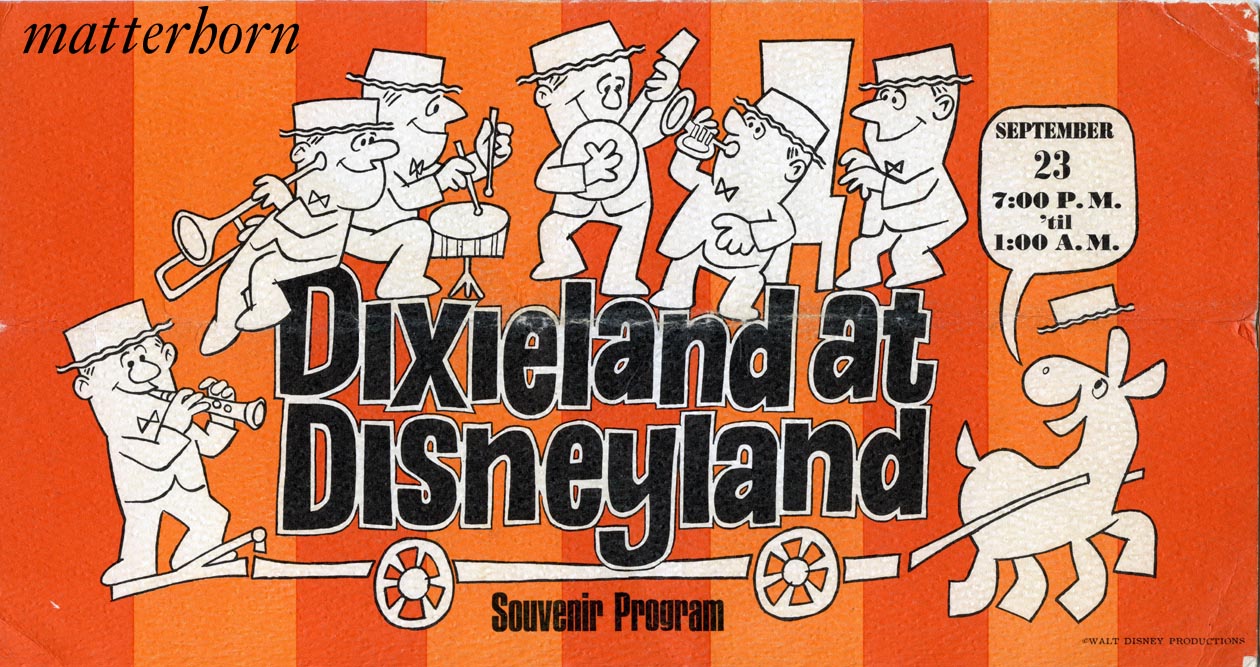
My first experience with a washboard band was on a high school trip to Disneyland (or was it Disney World?  Which one is really humid and looks like a five-year old child’s mind after they get into the medicine cabinet?).  Trumpet, trombone, clarinet and banjo sang and strummed to the heavens over the clang of stain-removing percussion.

Yes, They Might Just Be Playing This Music By Choice

Most of my fellow tourists viewed the group as either a colorful attraction or an annoyance, not unlike Mickey, Donald and those two destructive chipmunks.  Yet since that visit, I’ve continued to be impressed with the panoply of sounds a skilled washboard player can conjure from their washboard, including scrapes, taps, alternating downward and upward strokes, and through a variety of auxiliary percussion mounted with an engineer’s resourcefulness. During a trip to Prague two years ago, I was greeted and then dazzled by the miniature cymbals of a washboardist playing with a group of Dixieland-loving Czech musicians on the Charles Bridge.

Barring a large influx of Southern migrants (or time travellers from the pre-war era) crossing the bridge, these musicians were simply expressing themselves with an instrument they found inspiring. Hearing the instrument or style as “old-fashioned” or “primitive” is the listener’s issue, not theirs.

Yes, He Was Also The Grandfather and Guardian of Actor Clarence Williams III of The Mod Squad

As for Clarence Williams’ decision to use a washboard, even if it was based on calculation rather than preference, the sound of Floyd Casey, Bruce Johnson and Jasper Taylor is all we need. Rather than hearing Frog’s latest release as a record of earlier, simpler (read, simplistic) music making, we can listen to it as a unique artistic experience.  Not to disagree with Frog, but there will never be anything “vintage” about that.

As for the actual music on that CD, check out my review on All About Jazz.

Tagged , , , , , , , , , , , , , , ,

Favorite Fridays: Cab Calloway, “Jitterbug”

Cab Calloway was a musician who made “singer” and “bandleader” mean something.  That’s not always the case, as too often anyone who can warble some lyrics or wave their arms gets to claim those titles.  As “Jitterbug” from 1934 illustrates, Calloway had a superb command of his voice and an imaginative technique to go with it.  At the same time a musician (and businessman)’s ear for talent made sure his band was never just accompaniment.

The introductory sax soli makes it easy to imagine Cotton Club patrons dropping their jaws, putting down their drinks and mouthing “c’mon!” as they pulled their partners onto the dance floor.  It’s not just Al Morgan’s ground-shaking bass and Leroy Maxey’s powerhouse drums; the whole band swings with inviting intensity.  Slightly ragged saxes glow with the energy of four teammates, rather than the airtight, overly streamlined blend of many contemporary sax sections.  Biting yet warm brass declaim the opening chorus, and when Calloway enters, there’s no sense that this was just instrumental prelude before the vocal main event.

Calloway sings like an instrumentalist, sometimes a languorous sax (“grab a cup and start to toss…”), other times scatting like he’s back to his early days as a drummer (“BUTCH-ee, wutch-ee, time will tell…).” Louis Armstrong’s influence is prevalent in the relaxed delivery and elongated phrases, but the smooth timbre and sudden falsetto outbursts (“’git along!”) are sheer Calloway.

Signature humor also shapes each syllable into an event: a pattering, “His favorite jitter sauce is…” finishes with a drawn out, massaged “rye.” It’s the same use of contrasts that the best Rossini tenors capitalize on, and which made Calloway a dynamic stage presence at The Savoy, The Cotton Club and throughout a sixty-year career.

Like the best opera singers, surefire technique enhances Calloway’s theatrics: intonation and timekeeping never take a backseat to emotion.  That same technique also allows Calloway to lock in with a stream of exciting obbligati.  Full band, wry muted trumpet, swirling saxes, Harry White’s gutbucket trombone and Eddie Barefield’s winking alto all have their say alongside (never behind) Calloway as he shapes variation after variation on the same sixteen-bar theme.  What could have passed for a novelty paean to the joys of the bottle turns into a virtuosic jazz performance.

Calloway’s theatrical “All Bugs Out” makes musical sense when double-time sax figures segue into a call and response with the brass, followed by an agitated clarinet solo from Arville Harris.  By this point if you’re not dancing (on the floor or in your seat) you probably need your pulse checked. A syncopated brass break calls the final shout chorus to order, with some big-toned tenor exclamations by Walter “Foots” Thomas, until the rhythmic ante reaches its limit.

Just what the hell Calloway is saying as the record closes is a mystery to this writer, the best transcription being “how-some-dickie-in-som-mee-dips-a-mania.”  The singer and bandleader’s flair for onomatopoeic extemporization is fitting nonsense: words were just the beginning for Cab Calloway.

Tagged , , , , , , , , , , ,