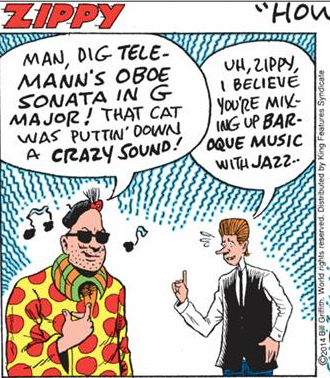
Instrumental virtuosity, expressiveness, interaction between a soloist or an ensemble and a rhythmic/harmonic support system, a steady, driving beat and musical lines snapping into play? Zippy gets it…
If he had a music blog, I would be nothing more than a copycat.
Thanks to Michael Steinman for sharing the comic strip from which I found this piece of wisdom. Now “dig” some Telemann…
Joe Venuti led several numbers in the studio but Richard Sudhalter singled out the violinist’s Blue Four sessions of the late twenties as “masterpieces, high points of New York chamber jazz ….a testament of excellence hard even to challenge, let alone surpass.” For me they stand out as ideal opportunities to hear Don Murray.
Jimmy Dorsey, Frank Trumbauer and Adrian Rollini joined Venuti, his right-hand man Eddie Lang on guitar and a revolving roster of pianists during this period (Justin Ring or Paul Grasselli also played percussion but their presence was slight enough for even the record label to classify this group as a quartet). Murray easily has the smallest recorded legacy of the Blue Four’s guest reeds, a consequence of his also having the shortest life.
Combined with the fact that Murray was usually buried in larger bands for most of his discography, these Blue Four sides become not just a boon for Murray fans but a valuable document of an under-recorded, apparently multifaceted musician. From his debut with the Blue Four, playing baritone saxophone and clarinet on “Penn Beach Blues,” he acts as soloist, reed section, bassist, color and contrast:
Moody and atmospheric, “Penn Beach Blues” alternates a harmonically arresting ensemble and a laidback blowing chorus. Murray adds a distinct sound from the outset, bottoming out the ensemble chords and adding ascending chromatic lines to connect them. His bright clarinet tone is instantly recognizable. So are the stacked arpeggios and loping eighth notes that characterized his playing regardless of instrument. He provides bass lines and syncopated rumbles for most of the reverse side but also earns two solo spots amidst this feature for the leader’s violin:
Murray’s first solo on “Four String Joe,” starts off uneasily, with a descending line that gains confidence and races towards a hot break and roaring finale. His clarinet is unusually and refreshingly spare, adding an attractive popping effect when it locks in with the rhythm section’s backbeat. Murray comes back on baritone for some moaning dialog with Venuti before switching back to clarinet and a unison tag with him, closing the performance with yet another unique sound.
The Blue Four’s variety of texture, form and mood belies any sense of there being “just” four players. They rarely rely upon the soloist plus rhythm, take-your-turn-improvising format. Instead, violin lead with guitar comping, guitar lead with violin harmony, guitar bass lines supporting soloist or ensemble, a capella piano, various combinations of call and response and other instrumental changeups make the quartet sound larger in terms of size as well as possibility. Apparently Okeh agreed: Venuti kept making Blue Four sides, even as jazz and dance bands had already started to grow much larger.
Venuti’s next session as a leader was another Blue Four date, with Murray back in the reed chair and Rube Bloom (in place of pianist Frank Signorelli) introducing a medium tempo “Dinah”:
Geoffrey Wheeler describes Murray’s baritone sax sound as a “medium-full, vibratoless sound that would have fit in well with the bop groups and big bands of the 1940s.” “Dinah” is a short but very revealing exploration of that sound. Murray’s tender introduction and verse, first solo then pared with Venuti’s double-stops, and his ability to accompany a small group of soft instruments without overwhelming them displays his versatility as well as his expressiveness. Murray could play hot but could also play, period.
Even on the second tune of the day, a breakneck feature for Venuti appropriately titled “The Wild Dog,” Murray makes an elegant (dare we say “Bixian?”) statement in halftime, built off of arching phrases, a bluesy break and light articulation. The record also begins with Murray arpeggiating the tense harmonies of the introduction, an instant touch of atmosphere:
Given that Murray was playing the first recording of this tune, his repeated note solo might have been a paraphrase of a melody co-written by Lang and Venuti. It’s easy to imagine Lang plucking something similar on his guitar. Yet the unissued take features a different solo using similar ideas, and a later record with Pete Pumiglio taking Murray’s place has an entirely different chorus. Murray may have been crafting just the right solo, as so many jazz musicians of the time also did to great effect. Either way, it’s a lyrical, well-conceived moment amidst Venuti’s virtuoso displays.
After two sessions leading big bands (both including Murray) and close to three months later, Venuti once again recorded with a Blue Four and brought Murray back for what would be his last appearance with the group. On baritone again for a fiery “The Man From The South,” he gets in a whirlwind of a solo, driving and dense, like a Bach invention soaked in gin, yet it’s his ensemble playing that nearly steals the show:
Murray’s darting phrases behind and between Venuti/Lang’s lead throughout the recording indicate how closely he may have been listening to bass saxophonist Adrian Rollini. Murray toys with the boundary between obbligato and bass lines in the same way that Rollini did when both played on the legendary Bix Beiderbecke and His Gang sessions. Murray makes the Blue Four sound fuller while adding momentum to it, splitting the difference between front line and rhythm section. The alternation between staccato and slurred phrases in the first chorus also shows Murray’s slick sense of detail.
Murray closes out his brilliant tenure with the Blue Four on “Pretty Trix” and two solos that resemble his work on “Four String Joe,” full of bright second and thirds and finger-twisting runs:
Don Murray. Photo courtesy of Storyville magazine.
His tone on the head’s ensemble counterpoint is light, nearly to the point of transparency, very different from the dark, cavernous sound of his baritone and bass sax-playing contemporaries. It lets Venuti’s passagework and Lang’s plucking peek through, allowing exactly the type of a “finely wrought musical miniatures, harmonically and texturally rich…yet [leaving] plenty of latitude for improvisation” praised by Sudhalter. New York had its share of excellent reed players, some at least as busy as Murray, but Venuti and Murray had known one another since their time in Jean Goldkette’s orchestra, if not earlier. Venuti was probably not one to mince words and no doubt knew what he wanted. Murray in turn must have found the time to join him.
Less than a month after his last session with the Blue Four, Murray had started as a regular player with Ted Lewis, a job that would keep him incredibly busy and take him on the road to California, where he suffered the fatal accident that would kill him less than a year later. It’s hard to hear Murray in the many reed sections he recorded with during his short but teasingly fruitful career and it never seems like he got enough solos. These Blue Four sessions, just six sides and one alternate take, are a small but incredibly revealing part of the Murray discography.
Jazz birthdays can be a bit inundating: there are so many to cover, and All About Jazz and Confetta Ras do that so well already. Yet today is Louis Armstrong’s birthday (one of them anyway); the Internet can afford some more kudos…
Chances are that anyone reading this blog has a favorite Armstrong recording, performance or “good old good one.” This “Tiger Rag,” live from Copenhagen in 1932 wasn’t my first experience listening to Armstrong but it was the first time I really heard him:
“Solo” implies part of a larger performance, a section that the collective designates for the individual. In jazz, it usually implies a relation to the tune, an outgrowth of the source material via the designated soloist. Yet Armstrong’s phrases are so abstract yet absolutely melodic, so grand and deeply personal yet approachable all at once, that he might as well be crafting a sculpture in the middle of the stage. This may have been a memorized “set piece” and listeners may or may not recognize “Tiger Rag,” but his performance could well be called Fantasia In G or simply Untitled, not because it needs the prestige of classical terminology but because that performance is an independent work in its own right. “Solo” just never really captured what Armstrong accomplishes in this clip (for me anyway).
As for the rest of this “Tiger,” for many listeners its manic opening probably sounds like a textbook illustration of the relaxation, confidence and poise that Armstrong brought to jazz and American popular music as a whole. On the other hand it may just be another side of jazz, one that Armstrong was smart enough to learn from even as he continued to appreciate it. Armstrong is one alternative among many in jazz but he is one hell of an option. So why not stop converting copies of The New Yorker to toilet paper for a while and celebrate that alternative?
“It’s Only V and I But I Like It, Like It, Yes I Do…”
Time was that professional musicians could deal with audience members, fans, armchair critics and others from outside the world of professional music in the same manner that the military handled civilians. Social media now allows everyone to interact, directly and regularly, even when someone can’t even define “enharmonic.”
I can only speak as a dilettante looking to learn more about music from musicians, but hopefully the following suggestions for musicians can foster pleasant, even constructive exchanges between those who have devoted their lives to music and those looking to understand la cosa musica…
Avoid Beginning Sentences With “It’s Just A…”
Imagine someone meeting your mother for the first time. You have introduced the two of them, they had some pleasant conversation and inevitably your mother mentions some childhood accomplishment near and dear to her heart to this other person. She does not claim you were the best spelling bee contestant or Pee Wee linebacker in history; she merely expresses that you are her special scholar/athlete.
To which your companion replies, “Millions of kids do spelling bees!” or “(S)he played football? B…F…D!” That’s the equivalent of telling someone that their favorite piece of music is “just a II-V-I” or “just a bunch of pentatonic runs.”
Chances are that if someone is describing a particular song, movement or solo, it animates something inside of them so powerfully that they want to share it with another human being (hopefully without gushing over it as some moms do). They may even be looking for a trained musician to offer some unique insight, without making them feel foolish because they didn’t know that even a first-year composition major can voice a triad in root position.
Most listeners, even the ones who might play an instrument, don’t encounter music for a fraction of the amount of time that formally trained, working musicians do. It’s why we get so excited over aspects of the music that professionals have probably heard ad nauseam. That excitement occasionally spills over into some odd or even rude behavior (can I assume that musicians don’t like people thronging them for autographs the moment they put down their horn?) Yet that excitement also makes what musicians do, even the simplest things they do, seem like magic. So the next time someone praises an inane pop song as though it were Starry Night or claps like a madman at that same riff you phone in every week at your wedding gig, try to remember your mother.
Along similar lines…
Keep In Mind That “Obvious” Is A Subjective Term
After reading an interview with Lee Konitz discussing intonation and specifically Jackie McLean playing sharp, I tweeted the following:
Two incredibly musically experienced, frighteningly well-listened musicians offered the following replies:
and
I have been listening to McLean for several years now but not nearly as long or as intently as these folks (one of whom has honesty been something of a role model for me, albeit in the same way that Joan Sutherland was probably a role model for Anna Russell). Present-day Andrew didn’t feel offended or condescended to just because they pointed out something that he already knew. Sixteen-year old Andrew on the other hand might have felt downright silly.
Band directors, clarinet teachers, critics and writers he would read for hours on end as well as other revered musical authorities had drummed into sixteen-year old Andrew’s head that musicians are supposed to play in tune (“…god damn it!” per his jazz band teacher). Sixteen-year old Andrew was just beginning to listen to Jackie McLean, whose name he pronounced “Mick-Leen and whose music didn’t yet explain why Mr. McLean was doing something that Andrew had been told was “wrong.” He simply had not learned what to listen for or how to listen. Present-day Andrew still has a lot to learn, but for young Andrew, there was nothing “obvious” about the music.
Those who can hang certainly don’t have to tailor their comments for amateurs or the uninitiated who come in all ages. Yet in light of conversations about “elitism” and “museumification” of all the music that doesn’t get into Billboard’s Top 1000, occasionally doing so may be more than a matter of avoiding bruised egos. Want to grow an audience? Describe the art form as an exciting learning opportunity, not a party at some club that only admits people who know the password.
Speaking of outreach…
Consider That While Words Might Not Be The Best Tools To Describe Music, Sometimes They’re All We’ve Got
“There are no words.”
“It really cannot be spoken of.”
“I won’t discuss the music because it’s all there in the notes.”
These and similar phrases have been used to explain why musicians will not, should not or even cannot describe the music they play, the music they enjoy, the music that influences them or music, period. Yet the same musicians often describe music as a “language,” which is a much less confusing and far more stimulating idea.
“I Bet He Even LIKED The Original Dixieland Jazz Band…”
Musicians have mastered communicating with one another through pitches, rhythms and other aspects of organized sound while the rest of the world more often uses words. We can debate whether that is a good or a bad thing (though Aristotle, Milton, a few Hindu priests and The Notorious B.I.G. might want to weigh in), but the fact is that most of us are “stuck” with words. If a music listener is trying to discuss what a music player does using words, or even asking that player for words about it, that’s not because the listener is insensitive to what the player does; it’s because they are trying to communicate too.
Yet if musicians are still unconvinced, to be safe they should avoid creating press releases about their next album, sharing positive reviews about their last show or doing interviews of any kind. Further to the slippery notion of talking about music…
Remember That People Other Than Barack Obama Discuss Politics
The statement “Unless you’re a musician, you’ll never understand” has explained so many aspects of music to an unmusical type like me that its occasional overreaches stick out like a sharp second alto.
There is no teacher like experience, but people still manage to make intelligent, objective, sincere statements about things they never went to school for and don’t do on a paid basis. It’s why musicians who never served as Congressional interns can offer penetrating political analyses, or why a nation not exclusively populated by lawyers or trained philosophers can still determine how its citizens should treat one another. Commentary from outside of a discipline isn’t always helpful, but that’s just a reason to encourage sharper discourse, not close off discussion, right?
Julius Caesar noted that “experience is the teacher of all things,” but experience also has a pretty tight schedule and not everyone is fortunate enough to learn from it. Julius Caesar also famously said, “Hey Brutus, what’s that in your hand?” Which leads me to my final and most personal suggestion:
Have A $@#!ing Sense of Humor…
…so that when some pseudo-intellectual internut who needs to transpose Mozart’s Clarinet Concerto to B-flat just to sputter and die before they even reach the first movement’s development section gives you advice, take it where it comes from. Louis Armstrong always had a sense of humor, and he did alright for himself. He even replied to his fan letters and talked about politics.
In jazz, “front line” usually means trumpet, trombone and clarinet weaving collectively improvised lines through multiple strains or, in its modern parlance, at least two horns blazing through “the head” in tight unison. Of course there are exceptions that prove the rule, such as a half-dozen of Clarence Williams’s washboard sessions, waxed during the first six months of 1926, using just cornet, clarinet, found percussion and the leader’s piano to defy conventional roles for non-rhythm section players.
Ed Allen often sticks to the strong, spare lead expected from the cornet yet clarinetist Bennie Morten’s thirds under and inside that lead on “You For Me, Me For You” are a surprising touch:
There is no trombone to form the standard New Orleans triumvirate but the pair doesn’t just interact like a reduced New Orleans front line. Listen to Morten on “Wait ‘Till You See My Baby Do The Charleston”:
back-to-back with Buster Bailey on clarinet for “Yama Yama Blues” on a different Williams date:
and the difference becomes more a matter of style rather than predetermined function. Bailey played with King Oliver and knew what was expected of NOLA ensemble clarinetists: decorous, penetrating lines mostly in the upper register, dovetailing with the lead but staying out of its way. Bailey’s playing on “Yama Yama” would fit perfectly with a trombone as well as a cornet in the mix. Morten on the other hand is not just sparer but closer to Allen in terms of dynamics as well as register. He accompanies the lead more than he ornaments it.
Harmonizing on top of Allen’s lead for “My Own Blues” (a technique that historian David Sagertraces back to the Wolverines), Morten splits the difference between duetting with Allen and the type of upper register obbligato that Oliver and his Crescent City colleagues might have expected:
After the vocal, when Morten does launch into highflying descant lines, they act as rhythmic impetus as well as another texture. There’s none of the occasional monotony brought on by multiple choruses of strictly defined polyphony, even as Allen maintains that lead. This loose, airy blend may or may not have been worked out in advance and might sound effortless, even unremarkable, but it creates a unique sound and feel for the group. It is difficult to imagine Bailey or Jimmie Noone’s prodigious technique, Johnny Dodds’s earthy sound or Sidney Bechet’s sheer personality (at this stage in their careers, anyway) forging the tender, restrained “Senorita Mine,” especially its second chorus with Allen’s muted horn behind Morten’s alto sax lead:
“Boodle-Am” (here the better recorded fourth take) has a big sound and infectious rhythm that completely jettisons ideas about what “standard instrumentation” may have offered in place of two well-paired horns and rhythm:
Morten complements Allen’s powerful lead with sustained ascending high notes followed by busier fills; tension and release, accompaniment but not background, simple but very effective. On the verse right before the vocal, Morten sticks to a simpler part and leaves Allen room to stretch out.
These sessions using just(?) four players with washboard instead of the pricier full drum kit may have been an attempt by Williams to cut overhead. Yet even if he wanted to do the record cheap, he wanted to make it right. Williams consistently hired Allen for his record dates, obviously appreciating the cornetist’s ability to play as powerfully, sensitively, bluesy, or clean as needed and remain recognizable. Bennie Morten a.k.a. Morton only seems to have participated on these few sessions with Williams. This blogger can’t find any other sessions that include Morten or biographical information about him (his name being very close to that of trombonist Benny Morton doesn’t make research any easier). Whoever Morten was, he obviously had a great ear and gift for ensemble playing. Williams not only found him but also sat him next to Ed Allen in a studio. It’s not the Creole Jazz Band or Bird and Dizzy, it’s all theirs.
Heading straight into a song sans introduction is one idea that earned postwar jazz musicians their revolutionary credit, yet here it is on the Dixie Daisies’ “Papa Blues” of 1923:
Composer and piano roll powerhouse Max Kortlander may have originally written “Papa Blues” for his instrument of choice; the tune’s built-in chromatic breaks sound very pianistic. The Daisies’ clarinetist takes them on to provide an instantly recognizable hook at the outset of the recording as well as textural and comic relief. The ex nihilo gong is also pretty funny, and the novelty works as a segue into Kortlander’s second strain, here clothed in faux-Eastern robes.
Nine decades of stylistic and cultural progress may make this section sound dated or even insensitive. From a strictly musical lens, the arrangement plays off a contrast between the down home major key and ragging trumpet of the first strain with the minor key exotica and nasal, almost-oboe like tone the trumpeter assumes in the second strain. The same goes for the succeeding chorus, which pits a straight saxophone lead against runaway double-time collective improvisation. The double-time sections are particularly ingenious: the trumpet and clarinet alter their tone as well as their rhythm so that the 78rpm record sounds like it’s being played on a 156rpm machine! The last chorus swaps the clarinet’s winding breaks for commentary from each of the players, offering further contrast as well as teasing at symmetry with the first chorus.
Dixie Daisies was one of the many aliases that record companies used for their studio bands, which could include now well-known names or players who remain anonymous. The Original Memphis Five often recorded under this pseudonym but this group doesn’t sound like the OM5 (who recorded the tune on multiple occasions in a very different arrangement.) This edition of the Daisies most likely included trumpeters Hymie Farberman and/or Jules Levy Jr. as well as trombonist Ephraim Hannaford, players in Joseph Samuels’s circle who got plenty of work but whose approach was based in one of American music’s vestigial limbs. The Daisies happened to have waxed “Papa Blues” in April of 1923, the same year and month that King Oliver brought his Creole Jazz Band with young Louis Armstrong into the recording studio for the first time, setting the stage for a major shift in the sound of American music. This music was made at nearly the same time as what many historians might consider the cause of its own obsolescence.
Whoever it was on the Cameo label’s “Papa Blues,” they were there to feed a dance-greedy public with records intended as disposable commercial products. Even an intricate chart like this one was all in a day’s work for them. Past those initial expectations and beyond temporal prejudices, there’s a smart piece of music at work here. Maybe it’s even smart enough to be “jazz.”
Columbians Dance Orchestra in 1921 with Farberman and Hannaford marked. Photo from Mark Berresford.
Here is Louis Armstrong’s first recorded solo, in 1923:
Here is Gunther Schuller, describing Louis Armstrong’s first recorded solo, in 1968: [It] is a solo only in the sense that it takes place alone; it is not yet fully a solo in character and conception. It might easily have been one part of a collectively improvised chorus lifted from its background.
Here is Thomas Brothers, discussing Louis Armstrong’s first recorded solo and apparently expanding upon Schuller’s point, in 2014: “Where’s that lead?” Armstrong heard [mentor and boss King Oliver] say…and that admonition was still ringing in his ears when he soloed on “Chimes Blues”…
Here is Bob Wilber’s Wildcats, playing Louis Armstrong’s first recorded solo, in 1947:
Things really pick up after that Armstrong homage, with the whole performance taking on newfound energy and cohesion. In other words, Armstrong’s “twenty-four bars of magic” work well as a lead. Yet Wilber, pianist Dick Wellstood and the other musicians knew that, didn’t they? We are fortunate to have a variety of thinkers from a variety of perspectives, and eras, sharing their insights. Yet that band did beat those scholars to this musicological punch!
(Incidentally, “magic” is an inspired description: an incredible thing that can be analyzed and perhaps even demystified, or something that we can explain even as it continues to stupefy us. Keep listening, and for goodness sake keep talking about what you hear.)
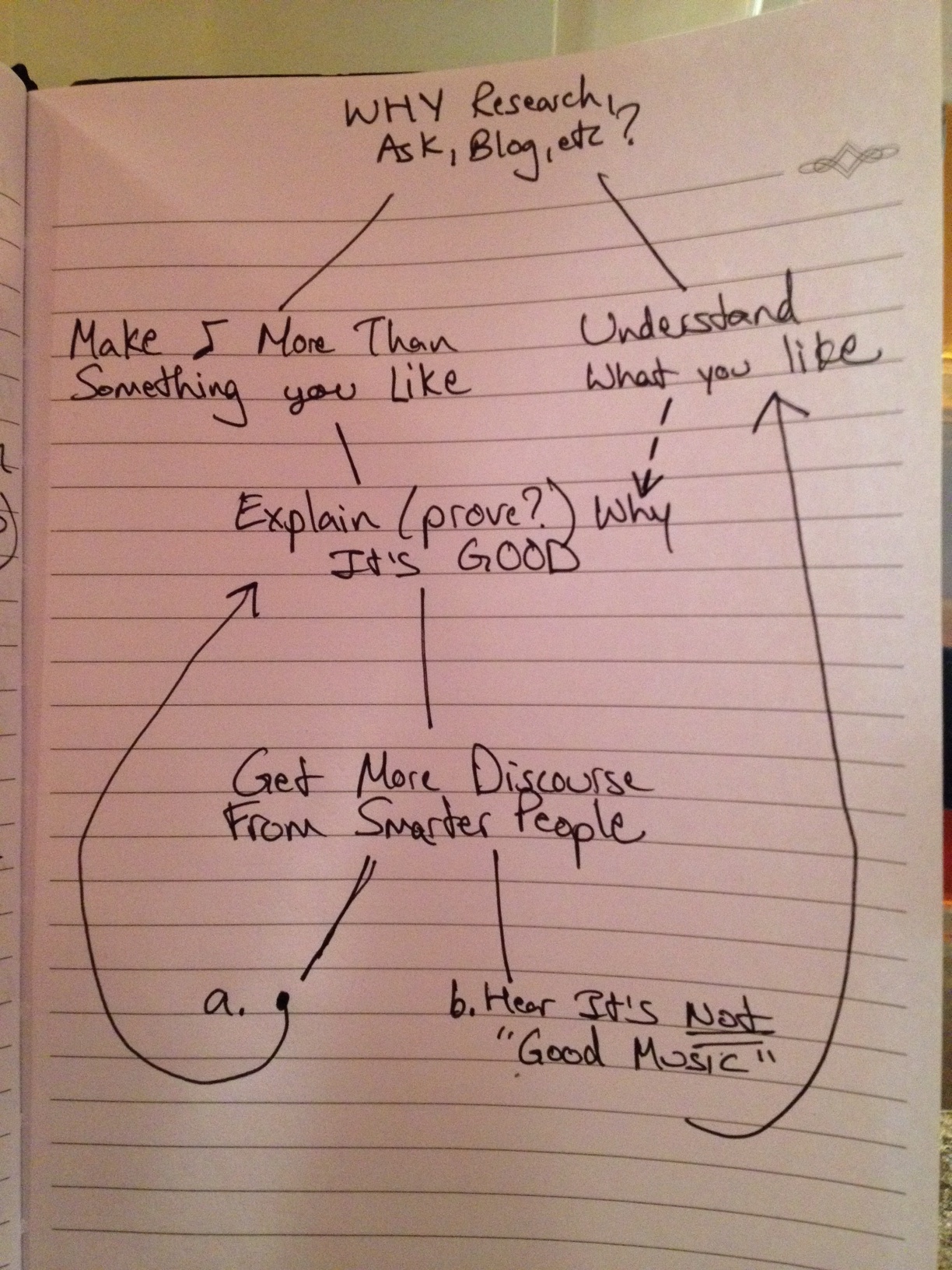
A meandering thought from a coffee shop (not a bar) that turned into a helpful realization:
Thank you for your indulgence, whoever is out there reading this post.
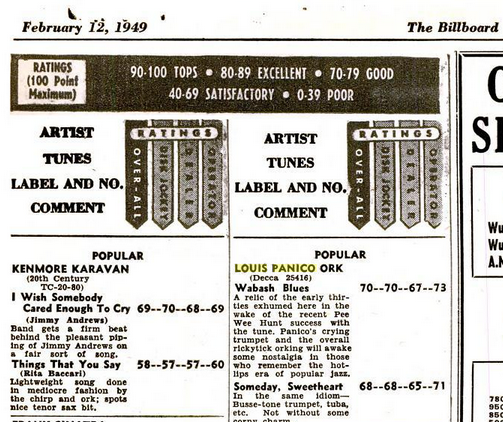
“Panico made this record fifteen years ago? But I’m writing now!”
With terms like “relic, exhumed” and “corny” as well as the handy rating system, the only difference is sixty-five years (or maybe characters).
For a more nuanced i.e. lengthier portrait of Louis Panico (including several admiring comments by fellow musicians), read more here.
For what the fuss is about, check out Panico’s strong lead, clean breaks, keen sense of ensemble balance, smart use of mutes to vary his sound and understated but spurring variations on “Hula Lou” with Isham Jones’s band:







 The Pop of Yestercentury
