Unsurprisingly, I received great feedback about Phil Melick’s guest post on the mellophone. Readers hypothesized about the music and expressed further curiosity about the instrument. So here is more from Phil about this little-known, often misunderstood, and thoroughly fascinating instrument…
Before listening to more records, some technical information about the mellophone may help you hear it.
Most brass instruments in American popular music are pitched in B flat: that’s the note emitted when a brass player’s relaxed embouchure is buzzed in the mouthpiece without pressing valves or extending a slide. Tube length determines frequency, so cornets, trumpets, and flugelhorns have the same pitch of B flat. The trombone is twice as long so its B flat is one octave lower. The B flat tuba, twice the length of the trombone, is another octave down from the trombone.
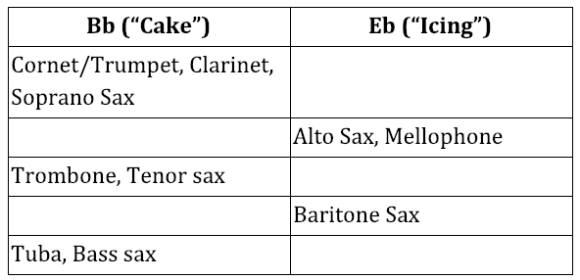
B flat instruments are often complemented with several others pitched in E flat that add body to the ensemble. Many E flat instruments, such as the mellophone, have a tangy or nasal tone compared to their B flat cousins. If the B flat instruments make the cake, then E flat ones provide the icing. Here are the wind instruments in a typical 1928 dance band, from highest to lowest:
The mellophone is a freak among other brass instruments. It sounds like it has a cold. Mellophonists often need sheet music transposed for alto or baritone saxophone. Reed sections often included someone who could play passable mellophone, but the soloists usually came from the brass section.
Pictures of Fletcher Henderson’s band include mellophones but records feature few recorded examples. The full-bodied solo after the vocal on “Sweet Thing” sounds like Joe Smith:
Cornetist Max Goldberg reportedly started on mellophone, which sounds just right given his clear tone and solid intonation on the instrument near the end of “Wake Up! Chillun’, Wake Up!” with Ray Starita:
“Goody Goody” by Johnny Johnson’s band includes a relatively late example of the mellophone, from 1936, by trombonist Al Jennings (and a nice fiddle bridge):
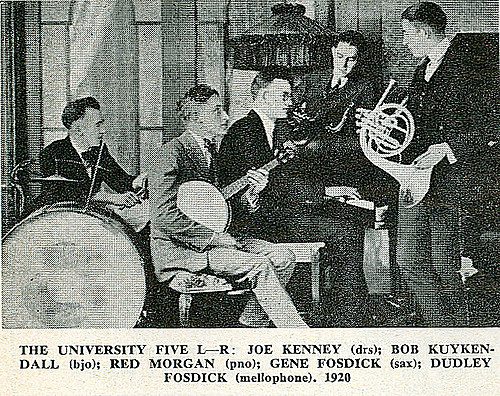
When listening to these records, bear in mind that dedicated mellophonists such as Dudley Fosdick were the exception. Trombonists doubling mellophone had to contend with a smaller mouthpiece that made higher notes especially difficult. Doubling cornetists sometimes overblew after failing to generate adequate airstream on the relatively larger horn. Given those challenges, musicians grabbing a second instrument to make good music on recordings left to posterity deserve more attention and respect.
Thanks, Phil, for helping to give those players that respect!
Prior to recording some of the big band era’s most swinging music, Cab Calloway’s band recorded some of the most stomping jazz as “The Missourians.” Yet even earlier, the group operated as “The Cotton Club Orchestra,” the first house band at the legendary venue. That earlier incarnation is often overshadowed by later versions.
Compared to the Calloway orchestra or The Missourians, and despite mostly static personnel, the CCO might sound restrained, perhaps indistinct. Yet instead of hearing just an earlier, milder version of a familiar group, experiencing its music as the work of the inaugural band for the swankiest club in New York City opens up both its style and excitement.
If the Calloway orchestra swung, and the Missourians stomped, the CCO strutted. It played music for rich patrons who wanted a lowdown good time uptown. The music was bluesily highfalutin, not too clean, not too dirty. On its first recording, the CCO sells “Down And Out Blues” with a blend of energetically straight, cleanly-declaimed section leads and cultivatedly-hot solos over a pounding bass:
Here, “sweet and hot” are more matters of degree than clearcut contrast. “Snag ‘Em Blues” starts off with a showy introduction right out of a Broadway revue before plunging into a downhome hot trumpet chorus, with some slap-tongue baritone sax adding more chug later on:
“Original Two-Time Man” and “Riverboat Shuffle” first come off as peppy but relatively straightforward dance records. On “Charleston Ball,” the CCO’s bright, transparent sax section playing against the brass makes it sound like Fletcher Henderson’s band. Yet the style is in the details:
The fancy trumpet parts on “Riverboat Shuffle” are technically impressive, while DePriest Wheeler’s trombone slurring and barking over Earl Prince’s piano takes the glitzy clientele lowdown. The Hendersonian “Charleston Ball” emphasizes a star trumpeter, in this case Sidney DeParis’s tense muted expositions rather than Louis Armstrong’s instrumental arias. The CCO understood the musical conventions of its time well enough to make those conventions their own yet still recognizable.
A band doesn’t need to be innovative to be original. “Everybody Stomp” makes the uniquely busy, sometimes “over-arranged” quality of twenties orchestration into a tour-de-force:
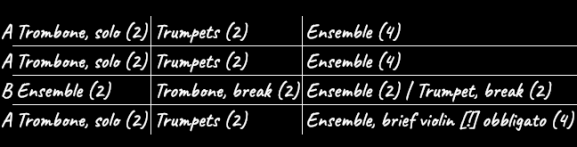
The second chorus keeps changing the lead in continuous two and four-bar increments; reversing the order for the bridge is another nice touch:
A Redmanesque clarinet trio is followed by a tightly-muted, staccato trumpet. A burbling bass clarinet is followed by a hot squawking trumpet. This side crams so many instrumental combinations into just under three minutes it’s like a hot Brandenburg concerto.
The group’s final recording as the CCO emphasizes soloists and a slightly more even rhythm. Instead of the ensemble introducing the melody on “I’ve Found A New Baby,” trumpet soloist Roger Dickerson gets the honor over a steady 4/4 rhythm. Later on, tenorist Andrew Brown gets a whole solo chorus without an alternating instrument for the bridge. These ideas point ahead to more sophisticated big band charts and the emergence of the soloist as the prime mover in jazz:
At the same time the sax section chorus, with its inner parts moving in contrary motion, points to the contrapuntal sound of the twenties. The soloists themselves are also their own men, confidently of their time. Brown plays a heavy, choppy tenor. Dickerson sounds proud of his instrument’s military origins, striking his notes cleanly, with a slight scoop adding tension. His work also has a touch society band-restraint, especially compared to his fiery outbursts with The Missourians two years later. Here, he comes across like a dicty Bubber Miley. The whole band plays with a refined intensity unique among records from this era.
Dickerson, Wheeler, Brown, Prince, banjoist Charlie Stamps, tubaist Jimmy Smith and drummer Leroy Maxey all stayed in the band through the early thirties, when Calloway began replacing Missourians. That core membership goes back to violinist Wilson Robinson organizing Robinson’s Syncopators back in St. Louis. That’s four names in roughly a decade (five counting a record with nominal leader Andy Preer listed), each reflecting different musical priorities, ranging from Manhattan via Harlem chic through roaring blues to slick but sincere backing for one of popular music’s largest personalities. All bands have a history. This one has archaeology.
I’m thrilled and grateful for the following guest post from prewar jazz aficionado Phil Melick. Among other interests, Phil has spent years giving a lesser-known but colorful instrument its due.
Courtesy of “Mellocast” on Flickr.
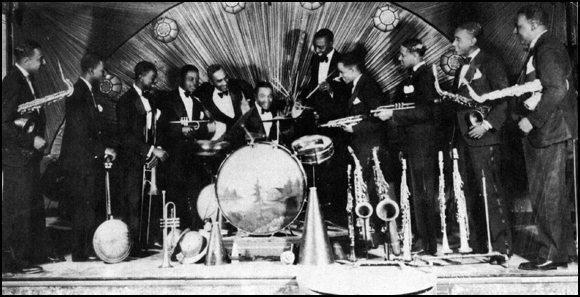
What’s the most important and now misattributed instrument on jazz and dance band records before 1935? Hands down, it’s the Eb mellophone, that instrument in many band photos that looks like a French horn with piston valves played with the right hand and its bell facing left. They’re usually seen on the floor because most players were doubling trombonists, cornetists, or occasionally even saxophonists.
For decades, dozens of mellophones on record have been misidentified as trombones, disregarding the musicians who played them well (or not). The instruments were often cheaply produced, notoriously hard to tune, and produced a puny, sour tone when a forced embouchure was substituted for the full airstream of solid brass playing. But when played well, mellophones added a piquant solo voice, and the best arrangers used them to complement both brass and woodwinds.
Musicians who mastered the mellophone were given more of their due in the twenties and thirties, when enthusiasts still had live bands in front of their eyes as well as their ears. By the time records became the only connection to the actual sound of the period, many of us “saw” the trombone, which has led to lots of discographapocrypha. I’ve kept a list for about fifteen years now, and it’s still growing.
Have even more fun with records by training your ear and digging in–these guys have been waiting for you! You can start with two sides recorded on September 10, 1927 by Don Voorhees on Columbia:
Can you spot the mellophone(s)? Let Andrew know in the comments, and tell him if you want to read and hear more!
Thanks to Phil for his introduction to this Cinderella of a horn! If readers are passing through Charleston, West Virginia, be sure to visit Phil at Elk City Records, his beautiful, family-owned and operated record store.
Like Louis Armstrong with the Hot Five, for many listeners Sidney Bechet is the main—or sole—event with Clarence Williams’s Blue Five. Bechet remains one of the most important soloists in jazz’s early days. His technical brilliance, invention and sheer power made him a dominating presence with any ensemble. Close to a century later, Bechet still makes it easy to overlook the musicians around him. Yet he doesn’t always make it necessary.
“Wild Cat Blues” is the first and best-known of Bechet’s sides with the Blue Five, effectively an aria for his soprano saxophone. He likewise stalks over “Kansas City Man Blues” but there is also a cooperative element at work behind him when Tom Morris mutes his cornet:
Morris’s interjections were already tasteful and well-timed. With that soft, vocalistic muted tone, his spare comments now come across like talking drums. It creates a subtle but charming texture and shows an ensemble concept of the music, even if this is still Bechet’s show.
Morris gets more room on “‘Tain’t Nobody’s Business If I Do,” actually playing lead and pulling out his specialty of contrasting an embellished melody on open horn with muted improvisation:
Morris’s entrance on mute is delightfully agitated, reveling in shades and growls. This man could play hot. The annals of jazz frequently describe Morris’s playing as “primitive, limited” and “old-fashioned.” It seems Morris was outmoded by the time he began to play on record, but close to a century later his simple but direct style and tense rhythmic concept are so retrograde they sound avant-garde. The music is “new-to-you” and won’t conk out (as long as it’s not loaded down with anachronistic hierarchies).
Even with Bechet back on lead for “New Orleans Hop Scop Blues,” Morris gets a passionate muted solo and trombonist Charlie Irvis also gets some spotlight:
Another New York jazz musician from before the southern musical invasion, Irvis was one of Duke Ellington’s earliest trombonists, a respected blues player and an originator of muted techniques with a major influence on Tricky Sam Nanton. Ellington praised Irvis’s “great, big, fat sound at the bottom of the trombone [that was] melodic, masculine [and] full of tremendous authority.” The rolling boogie-woogie underneath Irvis on “New Orleans Hop Scop Blues” complements that sound and his long, arching phrases. Rather than melodic embellishment or harmonic deconstruction of the tune, Irvis reincarnates it using just timbre.
Irvis’s melody chorus on “Oh Daddy! Blues,” with its sardonic tone and exaggerated legato, add another layer of color as well as irony, in turn picked up by Bechet for his chirping verse:
Morris is earnest by contrast until his break, which seems to say “not so much” to all the sentimentalism.
A simple melodic lead could be just as personal as an improvised solo. Morris makes “Shreveport Blues” his own with relaxed, powerful vocalizing as well as easygoing, well-constructed dialog with Bechet:
“Old Fashioned Love” features a more pacific Irvis and Bechet dancing around him:
Mark Berresford notes that recording engineers were subduing Bechet’s considerable audio presence as these sessions progressed, which may have made Bechet take his own playing down a notch. Bechet actually reveals himself as an inventive and stirring accompanist, even if the loud, broad sound of his soprano sax and his force of personality never stay entirely in the background. Throughout these sessions, Buddy Christian’s banjo is the rock of the rhythm section, and Clarence Williams’s self-effacing piano sometimes peeks in for a brief effect.
Louis Armstrong would eventually replace Tom Morris. These are the most well-known of the Blue Five sessions due to the gladiatorial exchanges between Armstrong and Bechet on tunes like “Texas Moaner Blues” and multiple takes of “Cake Walking Babies.” Yet these earlier Blue Five sides reveal wonderful ensemble details behind their star soloist. This is jazz made by sidemen rather than soloists, maybe not “artists” but certainly proud craftsmen. Musicians like Tom Morris and Charlie Irvis may have known who was in charge but apparently they did not see their role as perfunctory. They were professionals, after all.
There are many “Best of 2018” lists out there yet most of the music I heard this year debuted closer to 1718 than 2018. My list is going to split the difference and only go back one century. Please enjoy it.
James P. Johnson, “Carolina Shout”
Jazz anthologies are more likely to include Johnson’s actual recording of this tune from 1921 than the piano roll heard here. Maybe it’s the sound of a live piano or clever edits to the roll after Johnson cut it, but this version has a grandeur as well as a Victorian lilt that makes it sound refreshingly dated.
Earl Fuller, “I’m Sorry I Made You Cry”
Earl Fuller’s band, featuring Ted Lewis’s nascent wail, is now often dismissed as—at best—a group of clueless imitators. Yet Lewis’s breaks on this track are melodic in a chant-like way, showing the influence of klezmer often pointed to by contemporary commentators). His smears contrast well with the record’s incessant staccato tunefulness. There is also a subversively comic aspect to the band having their way with this sentimental World War I number.
Original Dixieland Jazz Band, “Ostrich Walk”
The ODJB effectively wrote the Dixieland book with their barreling song debuts yet their perfectly paced, cleverly arranged and simply riveting premier of “Ostrich Walk” remains my favorite recording of this warhorse. The introduction roars into a sense of suspense over Eddie Edwards’s glissandi before the chorus opens up into Larry Shields’s downright songlike breaks. Does anyone really still care whether they completely improvised this performance?
This is another example of music occasionally dismissed as mere imitation of the ODJB, but Sweatman’s forays into the ODJB style with his Original Jass (sic) Band for Columbia have always sounded distinct to me. The tuba and drums give it a high-stepping parade feel and Sweatman’s clarinet dominates for a unique take on New Orleans collective improvisation.
Original New Orleans Jazz Band, “Ja-Da”
Unsurprisingly, this one appears in a lot of jazz history anthologies. Besides being one of the first recorded examples of a racially mixed band, its warm, soft edges are balanced by an easy yet infectious rhythm and beautiful collective interplay.
Savoy Quartet, “The Darktown Strutter’s Ball”
One YouTuber described this group as “not jazz and yet not quite ragtime” and I thought it was a lovely compliment. Whatever this little group in England was doing, it was their own thing, and that has always counted for something in the jazz tradition even when it’s not jazz per se. I’ve also always been a sucker for Alec Wilder’s clicking, zipping and clanging percussion, laying down much more than a beat like some World War I Tony Williams. Twin drumming banjos add another layer of pop and color.
Eubie Blake, “Somebody’s Done Me Wrong”
More music from outside the strict parameters of jazz (whatever they are are at the moment). Blake’s piano has always seemed like neo-ragtime or proto-stride to my ears. Like Bach’s son Carl Philip Emanuel (who died today in 1788), Blake heard a lot of changes in the music around him and was too creative to sit on either side of tradition. Blake’s reharmonizations, three-over-two rhythms and stop/start on a dime tempos never obscure the tune but do make it more than a song.
Louisiana Five, “A Good Man Is Hard To Find”
This earnestly swinging ensemble is sometimes dismissed for a homogeneity of sound due to its seemingly simple format of clarinet lead with trombone counterpoint over the rhythm section. Close listening reveals a variety of textural and rhythmic variety, from the slight backbeat on “Church Street Sobbin’ Blue, shifting rhythmic stresses on “Rainy Day Blues,” a more even 4/4 shuffle for “Dixie Blues” and a near-Latin feel on the minor key verse of “Heart Sickness Blues.” This track shows the group’s unique approach to a pop song as well as clarinetist Alcide Nunez’s subtle approach to improvisation at around 2:30, doubling notes, adding slight ornaments and making the melody his own while never losing sight of that lead. The L5 is just begging for a high-quality, lovingly engineered reissue (and I’m looking at you, Doug Benson and David Sager).
From the website… This video is part of a collection of videos which Frans Elsen recorded during workshops that Barry Harris gave at the Royal Conservatory in The Hague between 1989 and 1998. Frans Elsen was a very important Dutch pianist, arranger and educator of Jazz. He and Barry shared a mutual appreciation of each other’s music and were close friends. This material has been edited and selected by Frans himself. It gives a unique insight into Barry’s wonderful ways of teaching and his extraordinary musicianship.
The Broadway Bellhops were far from the hottest act of the twenties. One of many recording bands in New York City, bandleader Sam Lanin gathered the leading jazz players of the time to diligently read arrangements of the latest popular songs. This music set out to deliver a tune rather than showcase musicians.
Those musicians, however, performed with assembly line efficiency and concert virtuoso polish. Improvisation and rhythmic intensity were cleverly stitched into a larger musical whole. The trombone chorus starting “I Don’t Believe You” sticks to the melody but is far from faceless: melodic, masculine, not “swinging” but still rhythmically sharp, it’s like an actor giving life to their lines:
[The music is hyperlinked above but please share a video if you have one!]
In the last chorus, a three-part, collectively improvised frontline opens a hot concerto grosso, the trombonist returns for the final bridge and sweet collides with hot as a clarinet pipes over the big theatrical finale.
Somehow, though, the piano accompaniment behind Charles Hart’s vocal is the most interesting part, due to its subtlety. The accompaniment is halfway between song-plugger style and rag-a-jazz, ever so slightly at odds with Hart’s approach. There’s a tension at work that even fans used to these juxtapositions would have noticed, though not balked over.
Time has not been kind to Hart, Irving Kaufman, Scrappy Lambert and others singing with the Bellhops. Their sound now inspires a wide variety of judgments. Depending on one’s opinion, the instrumental obbligatos behind their vocals are either novel contrasts or pure subterfuge. The clarinetist on “Away Down South In Heaven” pushes and pulls at Kaufman’s downbeat while still harmonizing with the lead and never distracting from the vocal. These were professionals. They may not have been making art but they never sounded sloppy or unconvincing.
Two takes of “Get Out And Get Under The Moon” show the thought behind these products, first trying a restrained piano behind Lambert and then well-timed, charming saxophone licks:
Ensemble effects such as the upper-register clarinet with muted trumpet on “Don’t Take That Black Bottom Away” and “I’d Rather Cry Over You” recall the orchestrated Dixieland sound described by David Sager in his liner notes for Off The Record’s reissue of The Wolverines:
That voicing resembles Sager’s description of “the first available harmony line below the cornet lead, while the clarinet took the first available harmony above the lead.” This was a “standard voicing” of the time, so it was likely a well-known device for enhancing stock arrangements. Similar ideas pop up on “Mary Ann” under Lanin’s name or Lanin d.b.a. Billy Hays on “I’d Rather Cry Over You.”
This band-within-a-band sound and allusion to small group jazz in an arranged setting exemplify the style-splitting popular music of that time. That context is sometimes lost when fast-forwarding to the solos.
Solos like those of Tommy Gott on “Our Bungalow of Dreams,” Red Nichols on “Collette” or Bix, Tram and Don on the Bellhops’ most well-known session are worthy of attention. They defamiliarize the hot/sweet dichotomy and an extra eight bars would have been welcome:
Yet there is much to admire on these sides even without improvisation. Who else could pull off a soprano-sax led soli like the one on “There’s Everything Nice About You” not to mention the tight brass section of just three players sounding like six?
“She’s A Great, Great Girl” features brilliant lead playing by Larry Abbott on lead alto and Gott on first trumpet. Abbott does cover up the rest of the section, effectively making this his moment. He plays with an unabashedly syrupy tone and varied phrasing, digging in at times, creamy at others:
His lead is more transparent after the vocal, another contrast as well as an indication of deliberate design. The side ends with a half-chorus of piano and soft-shoeing cymbals, adding still more structural, dynamic and textural flavor. Details like these are why this music still resounds as flesh and blood performances, rather than disposable pop artifacts or nostalgia.
If you have your own favorite finds from the Broadway Bellhops, please share them in the comments!
A post about Seymour Irick probably seems fairly obscure so another one may cause retinal detachment. There is so little on record and in the records about this rag-a-jazz trumpeter. Yet four sides, the last he left to posterity, show a distinct musical personality.
Garvin Bushell described Irick as “immaculate…kept himself clean [and] dressed well.” Not to psychoanalyze the dead or their music, but those phrases describe Irick’s work on “Charleston Geechie Dance” well:
Irick’s trumpet is neat and stylish, playful in a somewhat finicky way. His style comes out of a pre-Armstrong improvisatory idiom, emphasizing melodic embellishment, textural variety and tense syncopation (rather than harmonic exploration or rhythmic ease). Irick is like a cat batting away at a toy, never letting it out of his sight and certainly not trying to break it. It’s easy to hear why this style was “hot.” Its precise attack, combined with accents on the offbeat, builds up staccato intensity against the regular beat of the rhythm section.
Bushell also notes that Irick was a “Geechie,” a member of a rich and distinct African American culture in parts of South Carolina as well as Georgia. Seymour Izell Irick was born February 1899 in Summerville, South Carolina, Dorchester County, one of the South Carolina “low country” areas inhabited by Geechie communities. Tom Delaney (of “Jazz Me Blues” fame) is listed as the composer for “Charleston Geechie Dance,” perhaps an overt homage to his own Geechie birthplace in Charleston, South Carolina. Charleston was also home of The Jenkins Orphanage, an incubator for jazz talents such as Gus Aiken (trumpeter), Cat Anderson (another trumpeter) and Jabbo Smith (ditto). Irick never developed an eighth of the discography or reputation of those others, so any linkages are unknown at this point, but Irick did belong to this distinct group of expatriates living in New York City during the Jazz Age.
It is fun to imagine Irick getting a kick out of the title of the song. On record, he certainly seems to be enjoying himself, but that could just be the mark of a passionate professional. He’s just as energetic on “Shake That Thing” from the same session. Listening past the surface noise and a few stylistic revolutions, this record becomes a master class in subtle rag-a-jazz theme/variation:
Solos as well as unison and harmonized sections with Percy Glascoe’s reeds squeeze a lot of variety into a three-minute quartet side. Irick’s tight mute adds new color to the melody. He plays clipped, heavily syncopated allusions to the theme, at times like he’s playing the harmony part without the lead. Irick’s third solo varies each phrase ending ever so slightly, an attention to detail like the cuffs on a dress shirt. His banter with Glascoe is cute and clever without degenerating into hokum.
Garvin Bushell provides a musical description of Irick by way of Bunk Johnson. He notes that
“[Johnson] didn’t play the New Orleans style I expected to hear. He played the way they used to all up and down on the East Coast, in New York, or even in Springfield[, Ohio]–he sounded more like Jack Hatton or Seymour Irick. It was a ragtime style of trumpet.” Bushell’s comments point out the uniqueness of regional styles in jazz’s earliest days and indicate that New Orleans musicians themselves were not a monolith.
The “ragtime style of trumpet” or “old-time pit orchestra” sound is on display for the bulk of Irick’s recorded output. His earliest sides with the backing band for blues singer Lucille Hegamin are mostly show music, orchestrated in a lilting but somewhat faceless manner. Yet Irick’s lead crackles through “Mama Whip! Mama Spank!”:
Lord’s discography lists either Irick or Wesley Johnson on these sessions with Hegamin. Contemporaneous newspaper articles mention Irick as a member of the band at the Shuffle Inn of Harlem with Hegamin as the headliner. That doesn’t necessarily clinch his presence on these sides but does provide another link. Maybe Irick got the job done live and earned his spot in the recording studio.
Radio program guides from the time also show Irick in William West’s Colored Syncopators of New York, a 35-piece group playing dance music on WJZ out of Newark, New Jersey. Irick was likely a “reading musician” (like Johnson) who could be counted on for a solid lead. He doesn’t show up on record for a few years until a session with gas pipe clarinetist George McClennon. His presence is there also uncertain. If it is Irick, he is there to once again lay down a solid lead, allowing New Orleans trombonist John Lindsay and a completely unknown but highly extroverted alto saxophonist to dance over the simple ascending riff-like theme of “New Orleans Wiggle”:
KB Rau (whose extraordinarily annotated discographies and essays are an object of awe for this writer) notes that the “fine” trumpeter on this side is not as “stiff” and “ragtime derived” as Irick. Irick might have just been developing as a stylist. The slightly raspy but overall clean muted tone and clear articulation on “New Orleans Wiggle” (to my ears) point to Irick (no disrespect to Mr. Rau). On “Michigan Water Blues,” the muted wah-wah trumpet solo is more about the sound superimposed on the melody rather than rhapsodizing the tune, which also sounds like Irick. Less than a year later, he was in the studio confidently waxing “Shake That Thing” and “Charleston Geechie Dance.”
Four days later, he recorded with another Lem Fowler quartet, this time in pristine Columbia sound, making pellet-like variations and then joining Glascoe for some contrasting legato statements on “Florida Stomp”:
“Florida Stomp” and “Salty Dog” are both reminders of jazz’s role as dance music, rhythm machines not just keeping a beat but making bodies move on dance floors as well as in homes. These records probably made many people move the furniture and roll up the carpets.
From there, Irick’s musical trail stops. Lord’s lists either Irick or Bubber Miley accompanying blues singer Martha Copeland, but an extensive Miley discography compiled by Swedish researchers (no longer available online) says it is definitely Miley.
By February 1929, four years after his last recording and within weeks of his thirtieth birthday, Irick was living in a newly built home on Fish Avenue in the Bronx. He was renting from entertainer Johnny Hudgins and living with twenty-year-old Mary Schnepps, who he had met while she was hostessing at a dance hall. Records show he had married one Luella Clemons in 1923 but apparently that relationship had already dissolved one way or another. Schnepps would later describe Irick making good money as a musician, the two of them going out all night to various clubs in a fancy new car. Her description of Irick is at odds with Bushell’s recollection of him as a “pinchpenny.”
Bushell’s other term for Irick, “erratic,” must have taken on strange overtones in light of news of his being shot dead by Schnepps. She claimed self-defense during a struggle following an argument about her supposedly flirting with other men, and was later acquitted of manslaughter charges. Newspaper coverage concentrated on a white woman living with an African American man, not even getting Irick’s instrument correct.
Irick’s body was remanded to his father William back home. His military-issued tombstone proudly states his rank of “Mess Attendant” with the United States Navy, a reminder of his service aboard several ships during World War One. Even in death, Irick’s musical career didn’t seem to make much of an impact. Still, there are those four sides, less than fifteen minutes of music hinting at a larger musical presence and a complicated person. What is left to say?
I was sharing unpopular opinions about jazz before it was cool… I’ll see your Keith Jarrett and raise you Ted Lewis, whose singing I absolutely and unironically enjoy very much. King Oliver’s Dixie Syncopators is even more “dope” than his Creole Jazz Band. The clarinet never needed a comeback, because it never went away, but wait until bands go back to brass basses instead of string ones.
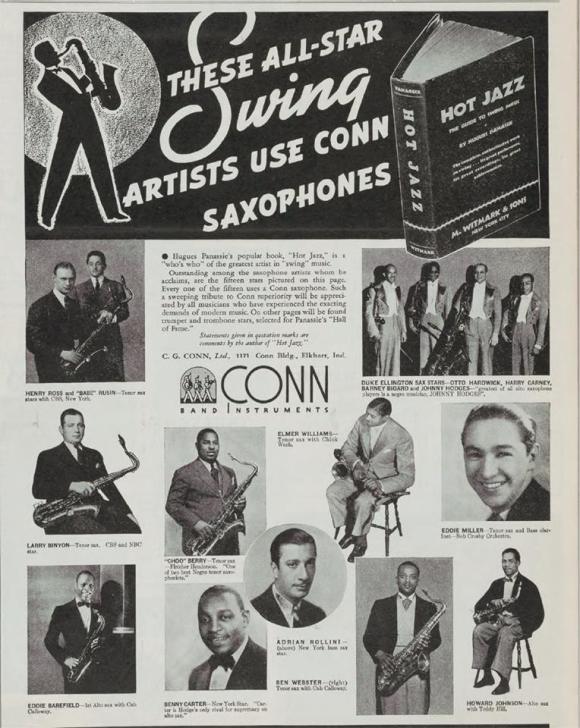
Many thanks to Loren Schoenberg for posting the following star-studded advertisement for Conn saxophones from the November 1936 issue of DownBeat magazine and further gratitude to my friend Michael Steinman for sharing it with me.
This writer tries not to nerd out on nostalgia too often, but look at that shot of Larry Binyon!Compared with smiling Benny Carter, modest Adrian Rollini or downright beaming Eddie Miller, Binyon looks more like a man at work than a cat at a gig, and nothing like an artist probing the depths of their soul.
That look could be an autobiography: his career was a nonstop job, playing for the likes of Benny Goodman, Red Nichols, Ben Pollack and Fats Waller as well as many studio groups and pickup bands. He was a multi-instrumentalist, sideman with the stars and studio warhorse who kept some impressive company back in the day, enough to earn him a place alongside the legends-in-the-making shown here. Conn wasn’t just trying to pad their copy with endorsements; Binyon was simply that well-respected (even if he never seems to have improvised a full chorus on record).
You can read more about Larry Binyon’s career here. While you’re at it, and on the subject of studio players, check out the above-pictured Hank Ross with one of the many recording bands lucky enough to have him on board:



 The Pop of Yestercentury