It was a pleasure to research the life and music of Prince Robinson. Everyone from Louis Armstrong to Duke Ellington revered the clarinetist and tenor saxophonist! For more about this fascinating musician, please see my article in The Syncopated Times—which was kind enough to give me an opportunity to share his story.
Elmer Snowden’s Nest Club Orchestra in 1925. Photo from Jazz Information on August 9, 1940.
Paul Whiteman is not a universally admired figure in jazz history.
That’s about as neutral a way to put it without rehashing arguments about the popular bandleader being called “the king of jazz” or the ratio of jazz content to symphonic or popular elements in his music. Suffice it to say that much of Whiteman’s extensive recorded work is not listed in discographies focusing on jazz.
Still, here’s an interesting record that does not appear to have made the cut:
The gliding full-chorus trombone and growling muted trumpet take up a good portion of the side. Yet even without the ample solo space that defines jazz for many listeners, as an experiment in the wonders of so-called “two-beat jazz,” tap a steady two-beat pulse along with this record. See if your finger, foot, head, etc., is hitting at the same time as the band’s feel. Try to stick to just two steady beats. There’s a lot more going on here rhythmically, even without improvisation.
The first 20 seconds of the record alone are a buffet of syncopation: the intro bouncing between the trombone’s jabbing lead and the band’s upswing; the verse hinting at a bouncing duple even as the sax section’s responses pull at the pulse, and then the chorus hammering the downbeat while the brass lifts the upbeat (and likely dancers’ feet). Even the winding oboe obbligato in the middle of the trombone solo has its own little lilt—not to mention creating an interesting texture.
Whiteman is now associated with texture and symphonic heft, but other than the dramatic interlude between the soloists, this side focuses on rhythm and melodic clarity. It was waxed in October of 1923, around the same time King Oliver and His Creole Jazz Band were recording in the Gennett, Okeh, and Columbia studios.
What a fascinating coupling of bands this must have been to pick up at your local record vendor and appreciate back-to-back at home! Imagine contemporary jazz appreciation being as catholic as pre-war music consumption!
Selecting your favorite sides from Nathan Glantz’s discography is like choosing the best slices from Brooklyn’s pizzerias: there are always more to try, and even the average example is satisfying. As Johnson and Shirley’s American Dance Bands on Record and Film explains, Glantz was a “pioneer recording session musician who played alto and tenor saxophone as soloist, sideman, or nominal leader on literally thousands of records during the 1920s.” When it comes to a legacy like that, you just rely on what you’ve sampled so far.
I spent some time listening to music attributed to Glantz, found a few sides that stood out to me, discovered that a few of them weren’t even made by Glantz, and want to share some of this great music.
In addition to being well-executed, these records are melodic, frequently rhythmic in a peppy if not driving manner, and often sported some refreshing orchestrations. “Sittin’ In A Corner” starts with a two-beat strut followed by the leader’s lush alto sax intoning the chorus.
The clarinetist resembles a more sparkling Ted Lewis. The ragtime xylophone conveys a touch of novelty music, but those same lines on a clarinet or a piano might simply sound hot.
Not all of this music sounds as overtly influenced by the burgeoning sound of jazz. While they never pretended to sound like a band from New Orleans or Chicago, based on these sides, Glantz and his fellow New Yorkers still added plenty of rhythm and inflection in their fashion.
The drawling, swaying saxes on “Hula Lou” seem all the more remarkable when considering these sides were probably cut with assembly-line efficiency.
The soprano sax hooting against the brass’s “Aloha ‘Oe” quote is another novel touch, but it’s followed by a trumpet solo over a more spacious, harder-hitting rhythm section.
This solo approach—a a freer variation of the melody over a heavily accented backbeat—resembles the format (not the feel) of Louis Armstrong’s recordings with Fletcher Henderson from around the same time. Cornetist Rex Stewart said playing this was called “taking a Boston.” He also noted that it was a new sound on the New York scene brought by Armstrong and his fellow Southerners. Musicians like Glantz and his sidemen must’ve kept their ears open but applied what they heard on their terms.
Glantz likely got to cut loose based on company edict rather than artistic whim. The minor key and fast tempo on “San” make it a pretty hot number on its own. Still, that opening trumpet curls around the pressing rhythm. Even the tight saxophone parts and syncopated brass hits make this sound like more than dutifully reading a chart.
Glantz’s brand of hot seemed as driven by humor as intensity. There’s a hard-edged trombone solo on “San,” but the clarinet switches from hoedown to gas pipe—with the bass clarinet throwing down licks in the middle! The snappy coda ends the side with a shrug.
“Oh That Sweet in Suite 16” increases the temperature further while staying within a lyrical dance band aesthetic. On clarinets, the reed trio gently pushes the trombone and gets in a rhythmic break.
Switching to saxophones, the parts lock in underneath the quacking sound. Replace the wacky noise with an obbligato instrument, and this would be a proud big band moment. Even the drummer gets to show off their rudiments on the snare. This one turned out to be by Ben Selvin, but any band capable of work like this should be praised.
Unsurprisingly, “Sweet Georgia Brown” and “Charleston” offer what I thought were the Glantz band’s most unbuttoned moments. For years, listeners like me assumed it was Glantz and company having a ball with these hot instrumentals based on an identifications appearing in well-known discographies. But, it turns out to be William Conrad Polla’s Clover Gardens band. See comments below. The brass in the first chorus of “Sweet Georgia Brown” sound like a three-way ad lib rather than a finely drilled routine, while the tight saxes create a foil in terms of instrumentation and phrasing.
The alto saxophonist even ventures a hot solo on both sides. His coy single notes in stop time on “Charleston” are like initials in a letter to the listener. These are both sides that I came to out of curiosity about Glantz, and which I had always assume demonstrated an incredible degree of stylistic versatility. I’m glad I found them regardless of the author!
Occasionally maligned but nevertheless distinct, Glantz’s alto sax is a frequent and instantly recognizable part of his records. Collectors and dance band aficionados spot it immediately. That type of individuality is no mean task across hundreds of records and a bewildering array of pseudonyms across different labels. It’s plump enough to remind some of all the gooey cheese referenced earlier. The saxophone is now heard strictly as a jazz instrument, but these sides treat it as a concert band or even orchestral voice, opting for a lush, romantic tone rather than a hot agile one.
Glantz’s records were probably a godsend for audiences who wanted to hear the song and find the beat. It’s easy to malign such tastes as pedestrian, but his insistence on tunefulness offer hummable (if not heart-rending) melodies in some interesting settings, like the tenor lead with Harry Reser’s biting banjo and slick syncopated saxes against brass on “Sweet Man.”
“Say It Again” was also attributed to Glantz, but it was actually recorded by Adrian Schubert’s great band and features fat trumpet, biting saxes, and country fiddling on :
Like his fellow prolific bandleaders of the Jazz Age, Glantz surrounded himself with an acoustic era wrecking crew of topnotch studio musicians who could play sweet, hot, and everything in-between. Most of the names are a mystery in the ABDRF book, but there has been more research since then. (Just see the comments!) Red Nichols and Earl Oliver pop up on trumpet, but scanning the ADBRF book seems to show even more unknown personnel than usual with these twenties studio bands.
Whoever they were, and whatever band they played for, the reed players steal the show on “Ms. Annabelle Lee.” It starts with a hot clarinet intro that segues into lyrical saxes against a slashing trumpet. The hot descending ensemble break would fit right in on a Motown record, and the clarinets create a smooth glaze behind the vocal.
The fascinating clarinet trio, where they question and answer themselves in different registers, must have been a pleasure to pull off. The rhythmic shout chorus, with brass hits over a carpet of saxes, must’ve been a pleasure to dance to.
Of course, this is a ludicrously small sample of music when discussing Glantz. My scribbling is not intended to be an exhaustive dive into Glantz’s music—certainly not into his life. In fairness, I know far more about pizza back home than Glantz’s discography or biography, so please feel free to share your favorites and facts in the comments (and be sure to read them to get the full scoop on this music). This was a rewarding little trip and I learned a lot from these records (and the commenters).
Here’s a fascinating photo collage of Glantz…
This post began with listening based on curiosity and note-taking to track what I was hearing. The array of names and labels these recordings were released under is a testament to their popularity, but it makes for an occasionally bewildering experience just to track down a record. Here are my notes based on the ADBRF, Tom Lord’s online jazz discography, and The Online Discographical Project. One knowledgeable reader has updated these, so please check out those comments below!
“Sittin’ In A Corner” recorded on October 24, 1923 (mx. 9221-A-B-C)
Edison 51265 as Nathan Glantz and His Orchestra
“Hula Lou” recorded on January 17, 1924 (mx. 9335-A-C)
Edison 51297 and BA 4859 at Nathan Glantz and His Orchestra
“San” recorded on July 31, 1924 (mx. 5585-3)
Apex 8242 as The Master Players
Banner 1399 as Missouri Jazz Band
Bell P-298 as Orpheum Melody Masters
Domino 378 as Lucky Strike Dance Orchestra
Oriole 256 as Baltimore Society Orchestra
Regal 9695 as Six Black Diamonds
“Somebody Loves Me” recorded on October 3, 1924 (mx. 9770-B)
Edison 51418 as Nathan Glantz and His Orchestra
“Oh That Sweet In Suite 16” recorded on April 6, 1925 (mx. 5946-1)
Apex 8343 as Nathan Glantz and His Orchestra
Apex 8430 as Rex Battle and His Mount Royal Orchestra
Bell 345 as Frank Dailey’s Meadowbrooks
Domino 21109 as Rex Battle and His Mount Royal Orchestra
Leonora 10091 as Rex Battle and His Mount Royal Orchestra
Oriole 467 as Dixie Jazz Band
Pathe Actuelle 036253 as Southampton Society Orchestra
Perfect 14434 as Southampton Society Orchestra
Starr 1006 and 10091 as Rex Battle and His Mount Royal Orchestra
“Sweet Georgia Brown” recorded on May 5, 1925 (mx. 106007)
Harmograph 1043 as Texas Ten
Pathe Actuelle 10901 as Texas Ten
Pathe Actuelle 036247 as Westchester Biltmore Orchestra
Perfect 14428 as The Blues Chasers
“Charleston” recorded on May 5, 1925 (mx. 106008)
Salbert 148, X-6022, and P6823 as Charleston Rhythm Clover Garden
Pathe Actuelle 10901 as Texas Ten
Pathe Actuelle 036251 as Westchester Biltmore Orchestra
“Sweet Man” recorded on December 31, 1925 (mx. 2361-1)
Maxsa 1556, Pathe Actuelle 20429, Puritan 11429, and Silvertone 3503 as Nathan Glantz and His Orchestra
“Say It Again” recorded on February 19, 1926 (mx. 6454,2,3)
Apex 8471, Banner 1709, Bell 400, Domino 3684 and 21144, Leonora 10135 and 10151, and Starr 10135 as Hollywood Dance Orchestra
Imperial 1624 (take 3) as Imperial Dance Orchestra
Oriole 589 as Billy James Orchestra
Regal 8020 as Missouri Jazz Band
“Miss Annabelle Lee” recorded on July 8, 1927 (mx. 7385-2?)
Apex 8657 and 8660, Broadway 1091, Domino 3995 and 21311, Edison Bell Winner 4831, Lucky Strike 24119, Microphone 22196, Regal 8356, Silvertone 1511 and 21511, Starr 10280 and 10282 as Hollywood Dance Orchestra
Banner 6031 as Missouri Jazz Band
Bell 528 as Imperial Dance Orchestra
Imperial 1822 as Fred Rich’s Dance Orchestra
Imperial 1908 as Imperial Dance Orchestra
Oriole 954 as Roy Collins Dance Orchestra or Ted White’s Collegians
Beltona 1386, Romeo 441, and Kristall 4011 as Nathan Glantz and His Orchestra
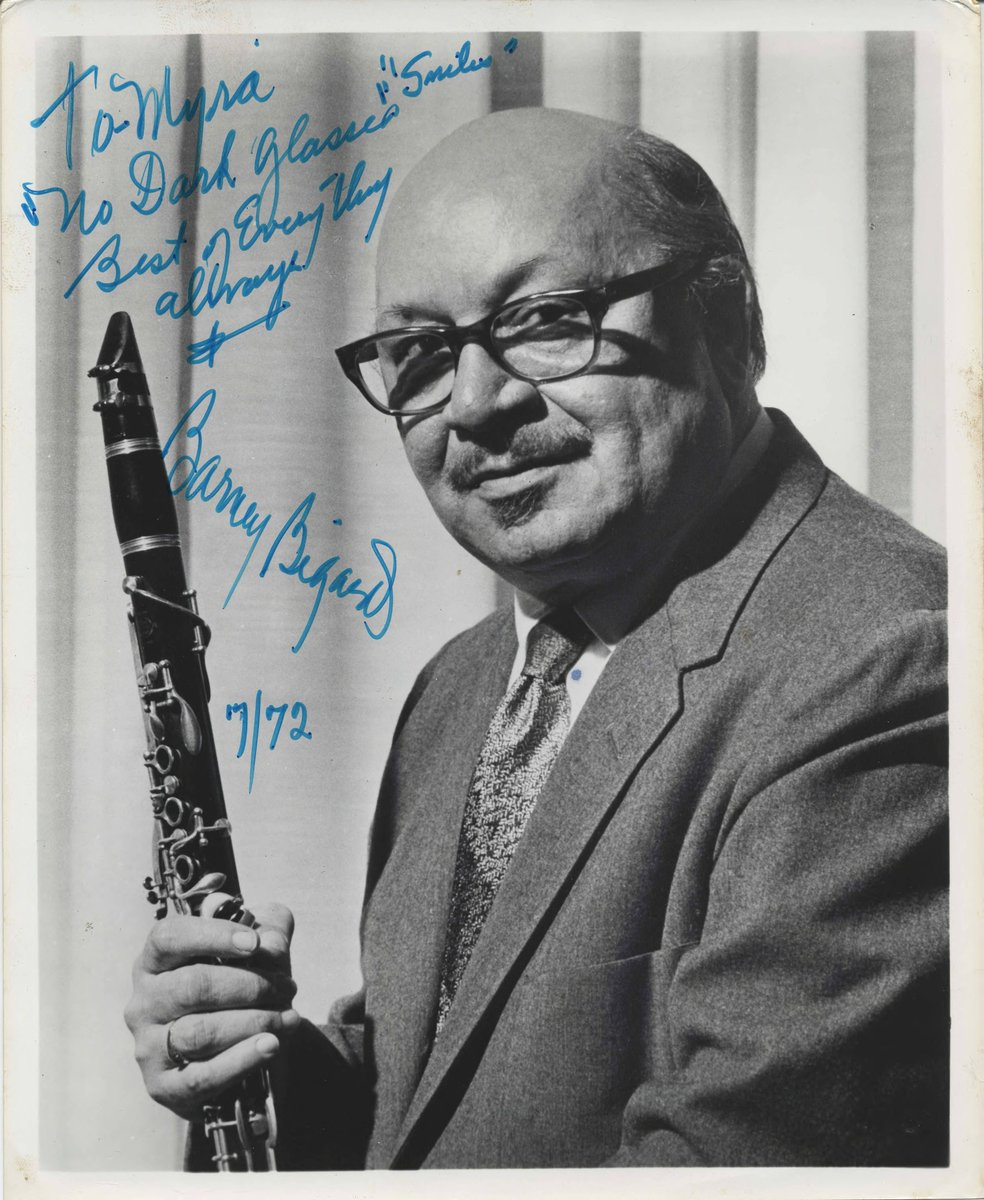
While he’s now famous for playing clarinet with Duke Ellington, Barney Bigard’s first break was playing tenor saxophone for King Oliver. Bigard recalled “When I went to Chicago and joined King Oliver’s band, he had two good clarinetists in Albert Nicholas and Darnell Howard. I wouldn’t even pick up the clarinet at that time.”
Records made with other bands from this period also find Bigard sticking to tenor sax (with some spots of soprano sax). Yet Bigard had studied hard to master the clarinet as a youngster in his New Orleans hometown, including lessons with the legendary teacher Lorenzo Tio, Jr. During one interview, Bigard said he found it “funny” that he started as a saxophone specialist:
All the studying I had done to master the clarinet, yet I hadn’t really played it so much since I left New Orleans…I was self-taught on tenor and yet here I was making all my living on tenor and not on clarinet.
This comment may be just self-restraint on his part. Tenor titan Ben Webster offered that “Barney Bigard played tenor [in Ellington’s band], but he hated it, he just wanted to play the clarinet, so I think Barney became really glad when I joined the band.” Even Metronome magazine introduced Bigard as someone who “hates playing tenor but dotes on clarinet.”
For an autodidact doing something he never intended to and apparently abhorred doing, Bigard was a fascinating tenor player. His legacy as a clarinetist casts a long, well-deserved shadow. No one likes to hear about people—especially creative people—hating what they do. So, history has not been kind to this part of Bigard’s discography. Still, listening to the music reveals an always capable, often exciting, and surprisingly multifaceted saxophonist.
His ensemble playing alone—often alongside just one alto saxophonist—reveals a surprising number of textures and rhythmic tattoos. Bigard took pride in the “whole load of tight breaks” that he and Albert Nicholas worked out as youngsters playing at Tom Anderson’s New Orleans club. He goes as far as to say that they were “the only group in town with the instrumentation of two saxes” around 1923/24. This may be a stretch, but it’s reasonable to assume some of these routines appeared on records with the Nicholas/Bigard sax duo. It’s even safer to say that live listeners must have been impressed if the routines resembled their work on recordings.
The two saxophones respond like a Greek chorus to Thelma La Vizzo’s lyrics of lovers’ rejections and other amorous dead-ends on “New Orleans Gofer Dust Blues”: stomping away from her in lockstep double-time, “going cold” in humorous full-stop cadences, and crying like a half-sympathetic, half-mocking friend who’s heard this lament before.
With Luis Russell’s Hot Six backing Ada Brown, the saxes imitate the train in burnished metallic pops and Bigard’s firm voice bottoming things out.
His dark sound opens the first chorus of Oliver’s “Deep Henderson” and crafts an instantly memorable texture.
Playing the loping country bass line at the beginning of Oliver’s Brunswick-issued “Snag It,” Bigard’s rich tone offers a good explanation as to why Oliver didn’t seem to need a baritone sax in his reed section.
Bigard displays several different approaches on tenor as a soloist and even as an ensemble player. On “Plantation Joys” with Luis Russell’s Heebie Jeebie Stompers, he plays the saxophone like it’s a big metal bass clarinet. Bigard mentioned that he got ideas from playing saxophone when he started playing clarinet in King Oliver’s band. On this record, the reverse seems to be the case: the clarinet’s dense scampering phrases are now transplanted to the bigger horn’s coppery tone and booming volume with no loss of agility.
For “Every Tub,” Bigard fashions a paper-thin upper register as a foil to Omer Simeon’s soprano in Oliver’s band.
He answers Oliver’s cornet and trombonist Kid Ory in faint sinewy affirmations throughout “Black Snake Blues.”
On “Melancholy,” with Johnny Dodds’s Black Bottom Stompers, Bigard’s vibrato-laden, sentimental straight lead may seem lackluster. But in a band with such gifted and energetic improvisers as Louis Armstrong, Dodds, and Earl Hines, a chance to hear this rather pretty melody unadorned offers contrast.
Dodds’s work with this impromptu all-star band is noteworthy for what he does and does not choose to play. Armstrong plays a beautiful, virtuosic lead, and Dodds was an energetic obbligato player. As Jan Evensmo puts it, Bigard “has to step aside for Armstrong and Dodds” as well as Hines. Simple but effective whole notes in the ensemble add body. The tenor’s drones fill out and pump up the band after the trumpet break in “Weary Blues.” Bigard could pull off some ideal ad-lib orchestration.
At the same time, the solo on “New Orleans Stomp” with this group shows a sense of humor. Barking like a heckler at one of the seedier clubs he’s played, Bigard seems to parody the tune and offer more release against the tension.
Tenor breaks open and close Oliver’s “Dr. Jazz.” The double-time phrases display fancy licks, but they’re answered by deadpan belly notes, another witty and musical moment.
For better or worse, as a tenor player, Bigard is most often associated with the slap tongue sound. Discussing his history with this technique/trick, Bigard remembered that:
On my feature numbers [with Charles Elgar], I would take the sax and slap tongue the hell out of it. Many years before, in New Orleans, [A.J.] Piron’s old alto player, Louis Warneke, had shown me how to get that sound like knocking on wood…A lot of those gimmicks, or tricks, in music originated with the old-timers in New Orleans….I was the slap tongue king in those days with the tenor because my tongue was so strong. What caused me to quit all that was that I broke so many reeds.
He goes on to discuss the cost of a box of reeds and the involved process of finding the right one. He doesn’t say much about his getting sick of playing this way or of changing audience tastes. It all comes across like a business decision.
Slap tongue has become one of the more hated artifacts of twenties music. It’s now dismissed as a corny fad aimed at entertainment rather than art. Nearly a century later, hearing slap tongue as a compromise between camp and avant-garde opens up some possibilities for appreciation. Bigard’s slap tongue has a few layers to it. Sometimes, he plays more like a percussionist whipping up rhythmic tension rather than a horn crafting melodies, as on “Too Bad.”
Over the band’s syncopated hits and combined with some well-timed honks, the heavy slap tongue on “Sweet Mumtaz” with Russell comes across like a hypnotic drum beat. Later on, he shows off a pliant middle register decorating the melody while Darnell Howard’s alto plays obbligato.
Then, there’s the aggressive, humorous, and slightly defiant reed popping exposition on “That Creole Band.” It’s a lot of fun, but if that’s not good enough, there’s also the simple fact that Bigard doesn’t squeak once while turning his reed to toothpicks for the sake of a 20-bar solo.
None of these recordings show someone struggling through their distaste to play tenor sax or bandleaders hiding a reluctant player. Bigard may not have liked playing this instrument, but that didn’t stop him from playing it well! Still, when Nicholas and Howard left King Oliver’s band, Bigard took over as clarinet soloist, and he “lost all interest in saxophone.” Ben Webster joining the Ellington’s band sealed the tenor’s fate when it came to Bigard. Supposedly, if you love what you do, you’ll never work a day in your life. I’m glad Barney Bigard had to work as long as he did.
For most dance bands—orchestras of reed, trumpet, trombone, and rhythm sections playing fast numbers, ballads, and whatever else dance-loving general audiences craved—improvisation was another device rather than the whole toolbox. Yet, at some point, solo-hunting became the norm when appreciating their recorded legacy. Straight melody statements, arranged ensembles, and (most of all) vocals were now filler between eight bars of up-tempo improvisation or a faint obbligato. Supposedly, those few precious moments showed the musician breaking through written charts and mass appeal to play something unique from their heart.
Whether it came out of professional obligation or a creative outburst, Larry Abbott’s lead alto on “Milwaukee Walk” with an Irving Mills group leaped out at me despite my being less than attentive. The saxes get the first chorus after the verse introduces Andy Razaf and James P. Johnson’s tune, and even without improvising, Abbott’s sound made me stop the car to find the personnel.
One of the joys of these twenties tentets and similarly sized big(ger) bands, with their brass and reed trios prefiguring the four-to-five-person trumpet, trombone, and saxophone sections of later big bands—is their transparency. It’s not just their smaller size leaving room for each player’s voice. Lead altos like Abbott, Chester Hazlett, and Benny Carter played with a lusher, more rounded, and more enveloping—as opposed to penetrating—timbre that didn’t have to compete with four other players in the section and up to ten brass players. This isn’t a criticism of any approach or an attempt to paint things too broadly. It’s a beautiful example of difference as opposed to hierarchy and degrees rather than extremes. In this case, it created a unique space to savor Abbott’s sound.
Along with a bright buttery tone, Abbott exemplifies melodicism and practicality. Record dates were usually intended to popularize a tune. The lead alto carries the main theme here, so Abbott keeps his sax prominent and “sings” that melody. The harmonies from the second alto and tenor still add body, but they emerge more like a decorative lattice than a reinforcing fence. Abbott’s slight anticipation of the beat on this blue note-inflected melody makes the tune dance. His phrasing demonstrates rhythmic responsibility beyond just reading a chart.
The incredibly knowledgeable Javier Soria Laso shared some biographical information about Abbott, including prolific bandleader Sam Lanin having “discovered” him. Abbott’s range (and presumably his professionalism in terms of efficiency, reliability, and demeanor) earned him gigs with other popular bandleaders such as Bob Haring and Adrian Schubert and sax pioneer Bennie Krueger. He had plenty of other work with dance bands, film orchestras, and anywhere else that valued musical proficiency. Abbott’s reed portfolio included lead alto; hot solos on soprano, alto, tenor, and baritone saxes and clarinet; and filling the need for bass clarinet and flute.
If this was a day’s work, how bad could it have been? Of course, we have no idea how Abbott felt as a soloist, section player, creative artist, or commercial musician. A few erudite readers have pointed out that applying hard-earned musical skills to make a fair wage playing pleasant music may have been quite satisfying for these musicians. I sometimes even wonder if the phrase, “If I have to play one more hot solo today…” was ever uttered in the studio.
Larry Abbott, seated second in the first row, with Vincent Lopez in 1926. Photo courtesy of worcestersongs.blogspot.com with thanks to Javier Soria Laso for directing me to it.
These are frightening and frustrating times. Many of us now likely feel uncertainty and powerlessness amidst an unending news cycle of mortal import. We’re forced to stock up, hunker down, and seal ourselves off. Yet technology allows us some connection. It used to seem like a convenience that cuts people off from one another; it’s quickly becoming a necessity just to stay in touch.
The virtual millimeter of technology before you doesn’t usually broach such somber topics. When I started this blog, it was a way to find likeminded listeners, share my thoughts with them, and learn from people who had been listening longer and deeper than me. At some point, “sharing my thoughts” began to seem more like a statement of vanity than a reflection of curiosity. I tried to be modest when offering my opinions as well as accurate when providing information. Still, at some point, just putting my thoughts out there began to feel self-indulgent. Combined with other responsibilities vying for my time, updating this blog fell away.
Choosing a global pandemic as the time to be this publicly self-focused might be an irony bordering on insensitivity. Yet this time also forces us to suspend our routines. Pauses often lead to perspective. In my case, this blog now seems like a wonderful opportunity to connect with people. I’ve been introduced to intelligent, thoughtful, and kind individuals from around the world I probably would have never otherwise encountered. I sometimes feel embarrassed that it was merely due to my own subjective two cents. The internet often feels like a bottomless swear jar that doesn’t need more spare change. Nowadays, my two cents seems like a small price to pay. Communication means life, life means possibility, and possibility is where everything has to start.
If you are reading this, it probably means you are healthy and safe enough to sit down with my words on a cold lit screen. That possibility comforts me, so I want to thank you and wish you continued health, security, and hope. The usual subject matter here is of interest to such a small percentage of the global population. That population is now facing even more than the standard colossal share. Yet if you are able to grab a few moments of interest or joy anywhere, even my little blog, it means you are one of the fortunate ones.
To expand on a friend’s favorite phrase, “may your happiness increase,” because it can be such a rare commodity.
Jazz history is often written as a sequence of decades described by each period’s instrumentation, rhythm, and harmonic derring-do. Combined with the human tendency to treat the present as preferable to the past, more recent styles that built and expanded on earlier ones tend to be positioned as the more complex and therefore “advanced” music. Jazz is hardly the only site of such temporal prejudice; just ask nine out of ten classical critics whether Vivaldi or Brahms was the better composer or a record store owner whether Elvis Presley wrote better love songs than The Beatles.
For many of the most passionate listeners in any genre, some sounds are just doomed. At best, stylistically outmoded music earns the label “of historical value,” the aesthetic equivalent of saying a neighborhood is nice because it’s near a train station.
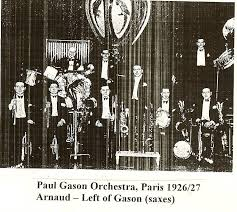
That’s why a recording as Platonically outdated as Pail Gason’s “Steamboat Sal” is something of a miracle. It’s a compendium of pre-Armstrong, para-Ted Lewis techniques and textures. There’s a squawk trumpet that owes more to Earl Oliver than King Oliver, a wah-wah trombone closer to the barnyard than Basin Street, a deliciously reedy sax section, a tenor with neither the brawny finesse of Coleman Hawkins nor fleet introspection of Lester Young, and a proudly nasal soprano sax crying over the ensemble.
The feel is tense nearly to the point of discomforting; things race ahead over a two-beat rhythm that either impressed or scandalized contemporary brass bands. There isn’t a hint of the relaxation that would start to define jazz from less than ten years after this recording. Even at their most driving, Kansas City groups still seem to sail. Gason’s band moves like a kid splashing puddles. They shout with the happiness and pride of the present and none of the future’s judgments.
Paris-based alto saxophonist Gason and his band of French and Belgian musicians toured throughout Europe. They made just thirteen sides over five sessions in October 1924. The only known remaining copy of “Steamboat Sal” was discovered in 1999. That’s quite a discovery for record collectors. As a sonic artifact, the record is like jazz from a parallel universe.
It embeds itself so definitively in a time that it now seems like an overt rejection of jazz’s sleek textures, complex rhythms, and experimental dissonances. The past has become its own avant-garde. Imagine listening to this record as anything other than something that happened before musicians knew better? If the present wasn’t a higher peak and was just another hill, could anyone still call this style “outdated, corny” or other labels still accepted as historical or critical terms?
Image courtesy of Dr. Karl Koenig’s website basinstreet.com.
For the record, in many cases, the present simply is preferable to the past. Try treating an infection with medieval medicine and you’re bound to be disappointed. Romanticized historical fiction falls apart if you consider it from the perspective of anyone who needed a law passed to ensure they don’t get fired or literally set on fire because of who they are. Yet creative products don’t have the same impact. Preferring Mitch Miller to Beethoven just won’t affect your life or liberty. As for the pursuit of happiness, it depends on which message boards you frequent.
These are deeply unnerving times. Anything that even briefly leaps out with pleasant unpredictability—as opposed to the unexpected worse news—provides a welcome release.
For example, the trombone I hear at the start of Bessie Smith’s “Young Woman’s Blues” always surprises me. A trombone rather than a trumpet taking the lead on a blues side from this period is interesting enough. Yet this particular horn is a real find. The tone is dark yet creamy. The articulation is clean and smooth. Phrases hover close to the same bottom tone, like it’s a hard-fought and now insistent truth.
Seconds later, I always realize (not just remember) that it’s actually a trumpet. Joe Smith fools me every time!
Aside from rhythm, tone is perhaps the most immediately gripping aspect of a musical performance. “Young Woman’s Blues” shows the beauty of Smith’s sound in the sadly neglected lower register of the trumpet. He soon climbs outs of it and gracefully slurs up to a clarion middle register phrase, ending the side’s introduction on a valedictory air.
He answers Bessie Smith’s statements with other firmly centered and gut-shaking descents, including a particularly solid one executed softly but firmly behind the words “settle down.” Joe seconds “I’m as good as any woman in your town” with a muttering declaration. It’s not predictably dirty. There’s no growl or gutbucket inflection. Instead, Smith is subtler and more artful in his carnal imagery. Following “I’m a deep killer of brown,” he tosses off a staccato bugle, proud and dangerous, as a warning to those around him. Smith’s broad final tone comes off like a soprano tuba.
At the time this side was made, Louis Armstrong was introducing higher and faster trumpeting that would become the standard in jazz circles. Smith, meanwhile, is often remembered as the straight(er) foil to young Louis Armstrong’s hot innovations. He could read a written part, provide a brilliant straight lead, and improvise a solo. That versatility, in fact, made him the preferred choice for bandleader Fletcher Henderson when he needed a jazz trumpet soloist. Yet Smith was plenty hot in his own right. He just simmered rather than boiled. Henderson eventually “settled” for Armstrong, and the rest was history.
Of course, trumpeters never stopped playing in the middle and lower registers; Bix Beiderbecke, Bobby Hackett, Ruby Braff, and Terrell Stafford among others come to mind. Still, the term “jazz trumpet” doesn’t usually inspire mental echoes of pedal points. So, I’m glad to be repeatedly wrong for a few seconds. Maybe it is my recalcitrant ears, or perhaps my subconscious is letting me appreciate Joe Smith over and over again.
…the fascinating story of the self-destructively humorous virtuoso pop violinist Nat Brusiloff, with commentary by historian David Sager and a red hot sonata on “Happy Feet.”