Saxophones are rare in European classical music, but when two esteemed conductors needed the job done, they called the “inventor of the laughing saxophone.”
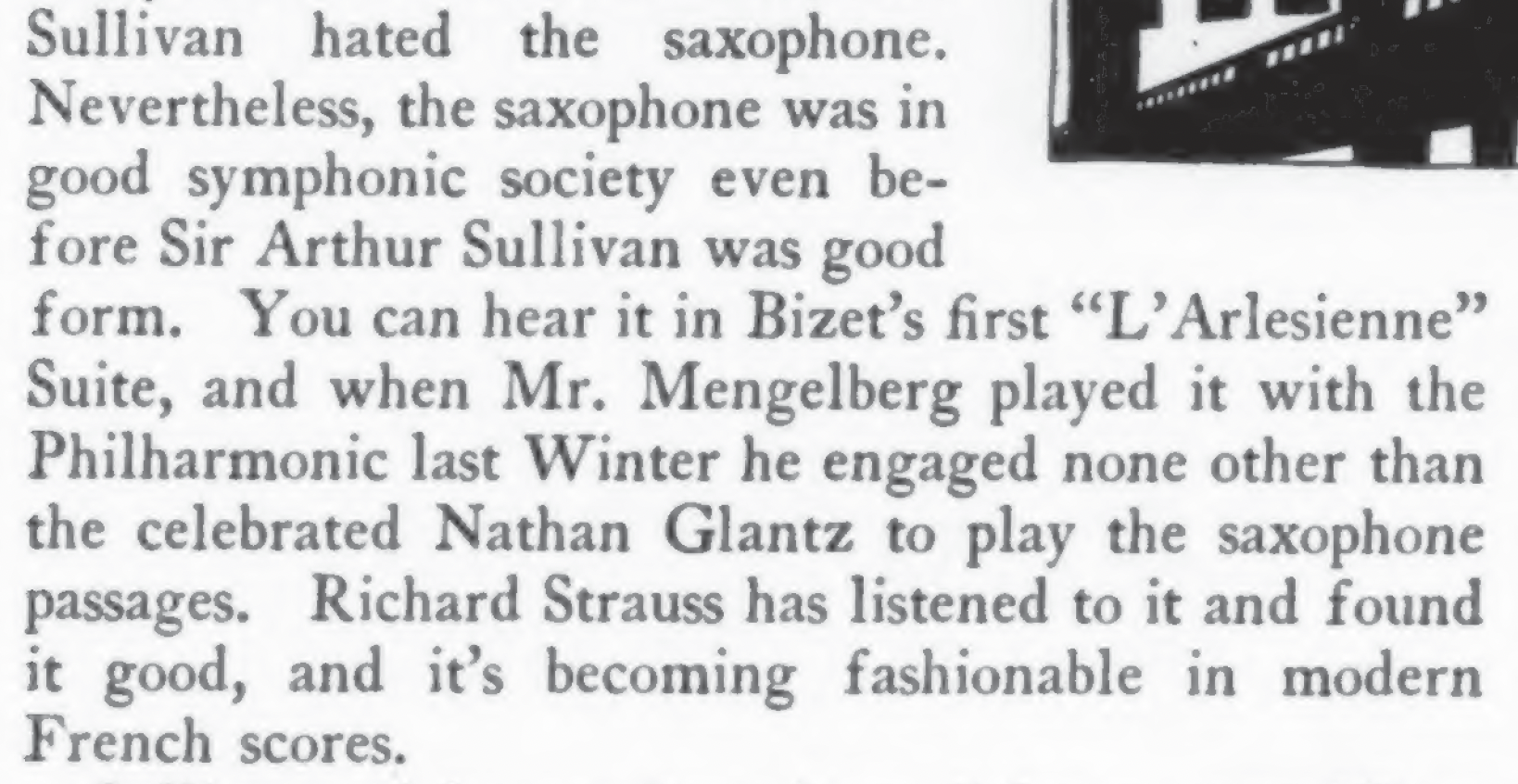
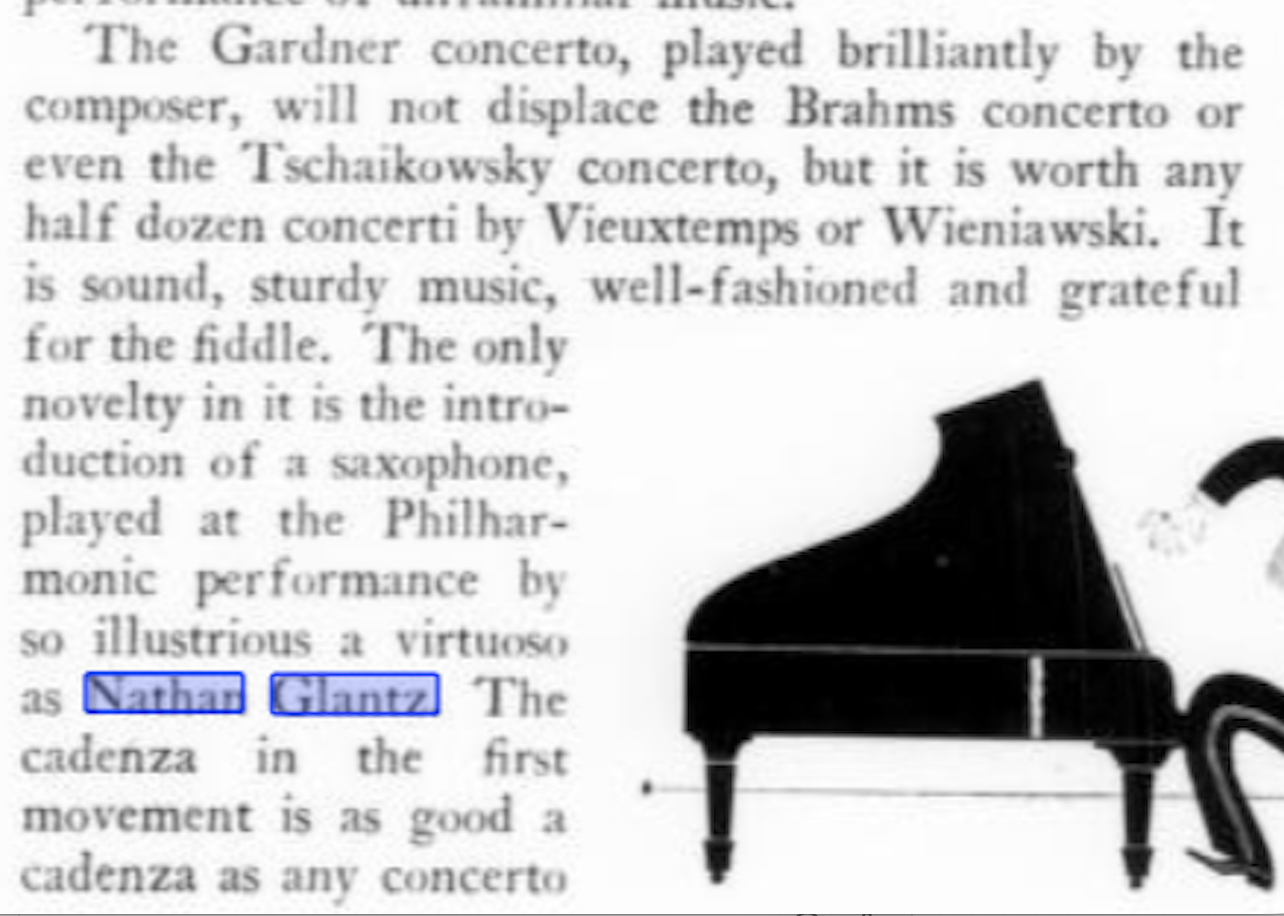
Nathan Glantz was a huge radio and recording artist during the twenties. He cut thousands of sides ranging from hot to sentimental to intentionally hokey. But he also moonlighted with the New York Philharmonic under both Arturo Toscanini and William Mengelberg on several occasions. His Carnegie Hall gigs included the sax solos for the United States premiere of Ravel’s Bolero and sitting in with the orchestra’s clarinet section during at least one concert.
Harry Glantz, Nathan’s nephew and the orchestra’s principal trumpet, may have introduced his uncle to the organization. Yet Toscanini and Mengelberg were demanding conductors. Trumpeter Henry “Hot Lips” Levine told historian Mark Berresford that classical musicians knew and respected Glantz’s work in that repertoire. Glantz must have had the chops and professionalism to keep getting brought back, including for multiple Boleros.
Glantz came to the United States from Russia in 1904, but his early life and musical background are otherwise sketchy. Several collectors have speculated about conservatory training. Europe was the birthplace of the modern conservatory. It boasts a longer tradition and a greater number of these institutions. Coming from “the old country,” Glantz may have been more likely to have attended a conservatory. His facility with the classical repertoire further suggests the possibility. At this time, confirming his enrollment through official channels is difficult.
On the other hand, Glantz was around during a pivotal time for music education in Russia. Its culture looked even “older” than that of the rest of Europe, even as the empire struggled to modernize. As a Jewish subject, Glantz occupied a complicated, often dangerous social position. Access to the conservatory wasn’t out of the question, but it was far more difficult and not necessarily worth the effort.
The Novelty of a Conservatory
By 1878, the year Glantz was born, the conservatory itself was still a new institution in Russia. The state only abolished serfdom in 1861. Up to that point, dedicated musical performers were often traveling virtuosos from outside Russia or serfs playing at the whims of the aristocracy. Amateur (i.e., unpaid) players from the nobility might be extremely talented, study at Italian conservatories, and play for large crowds in private salons or local theaters. But they ultimately pursued music between other responsibilities. Rural communities had robust musical traditions, but even most klezmer musicians made ends meet through other means.
A “professional musician,” someone with advanced training who made music their full-time livelihood, was a revolutionary idea. The empire’s first conservatory, St. Petersburg, opened in 1862 (almost coinciding with the end of serfdom), followed by the Moscow Conservatory four years later. Until the opening of the Saratov Conservatory in 1912, St. Petersburg and Moscow were the only institutions officially recognized as “conservatories” in the empire.
The idea of music as a credentialed vocation requiring higher education remained controversial through the turn of the century. Nationalists criticized the intrusion of the “pedantic” German conservatory model. The nobility defended music as a gentlemanly endeavor against turning it into a mere trade to earn money. State officials were divided about the rights that professional status would bring, including for musicians from lower social estates and marginalized people, especially Jewish subjects.
By the turn of the century, as social historian Lynn M. Sargeant notes, “for music students of any faith, the St. Petersburg Conservatory represented the pinnacle of success.” Yet she also documents the long, gradual struggle to earn that reputation. Even after the conservatories’ founding, school officials fought for decades to secure privileges for their graduates and professional musicians.
These considerations don’t disqualify the possibility that Glantz attended a conservatory. They explain why he might not have cared about attending one. Uncertainty that he could enjoy the practical benefits of a diploma, entrenched attitudes toward new ideas about formal education, and perhaps no interest in formal training: Glantz might not have even had a reason to audition.
Distance to the Conservatory
The conservatory was also a long way from home for Glantz, literally and figuratively. The Moscow Conservatory was about 1,200 kilometers (750 miles) from the provincial town of Proskurov, Glantz’s home (now Khmelnytsky in modern-day Ukraine). That’s directly northeast as the crow flies, not accounting for actual routes between the two locations. St. Petersburg was even farther by about 200 kilometers.
Besides the long distance, local authorities in Moscow forced the conservatory to restrict Jewish enrollment “off the books.” Unfortunately, the situation in Moscow was one of many examples of antisemitism, both institutional and unofficial, that Jews like Glantz faced throughout the Russian empire. During the 1890s, Moscow enforced a massive purge and segregation of Jewish military reservists previously granted permission to live there. Proskurov, Glantz’s home, is now synonymous with its 1919 pogrom, one of the most violent in recorded history.
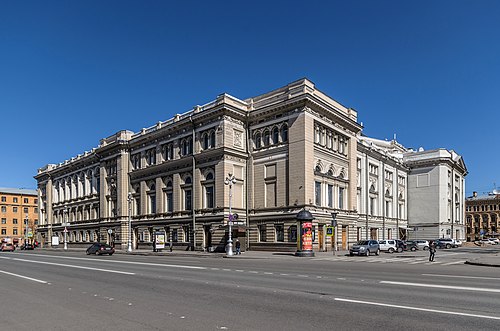
Jews were otherwise barred from living in Moscow, St. Petersburg, and anywhere else outside the Pale of Settlement, the western region of Russia that Jews were restricted to live inside. But conservatory students could receive an exemption, and St. Petersburg didn’t face the same pressures as Moscow. By the first decade of the 1900s, the St. Petersburg Conservatory was both a safe environment for the large number of Jewish musicians studying under the likes of the renowned Russian composer Rimsky-Korsakov and the target of anti-Semitic smears for that role.
The city of St. Petersburg was also the cultural center for music in Russia during the first half of the nineteenth century. A school welcoming all faiths in a cosmopolitan city may seem ideal. But St. Petersburg probably seemed like another world to Glantz for several reasons. While industrial growth following the abolition of serfdom made Proskurov an urban industrial center, it doesn’t appear to have had an especially rich cultural scene (unlike its neighbors in the Ukrainian region such as Berdychiv and Odesa).
Admission to the conservatory also required literacy in Russian rather than Yiddish, the primary and often sole language of many Russian Jews at the time. By one estimate, in 1897, Yiddish was the first language for 97% of Russian Jews. Even accounting for other Jewish students in his courses, Glantz would have likely been speaking a second language while away at school. Jewish residents made up half of Proskurov’s population that year. Like many urban centers in the region, Proskurov’s streets, schools, markets, and hospitals as well as its houses of worship were split along religious lines.
Regardless of geographic distance, cultural familiarity, or local tolerance, one basic issue might have made up Glantz’s mind about the conservatory: paying for tuition, room, and board in the likely pricey imperial metropolis. His financial situation in Russia is unclear. According to passenger manifests, when he immigrated to the United States in 1904, he arrived with approximately $1,300 in 2026 dollars. That would have been all the money Glantz had (on record) to start a new life in another country, secure passage for his wife and daughter from Russia via England, and support them when they arrived, almost a year to the day later. His older brother, Pincus, immigrated four years before Nathan and lived in modest circumstances during his early years in the U.S.
These numbers only hint at the brothers’ financial situation years after they left home. Earlier, in Russia, the Glantz family may have had the money to send Nathan to the conservatory. Whether they felt it was a good use of their money or felt comfortable letting him leave home is an even greyer area.
Glantz would have been leaving his family and a tight-knit Jewish community in Proskurov. Life in St. Petersburg would likely have felt odd to a young man from a shtetl, especially as debates over nationalism and terms like “true Russians” grew wider and louder. Many Jews in Russia dreamed of the city and the conservatory, but we’ll never know if these Jews had the same vision.
Other Ways to Get to Carnegie Hall
None of these obstacles are insurmountable, but many young people would be uncomfortable with them, especially for the sake of a still-debatable educational credential without guaranteed privileges. They don’t rule out Glantz attending a conservatory in Russia or anywhere else in Europe. They just complicate its likelihood.
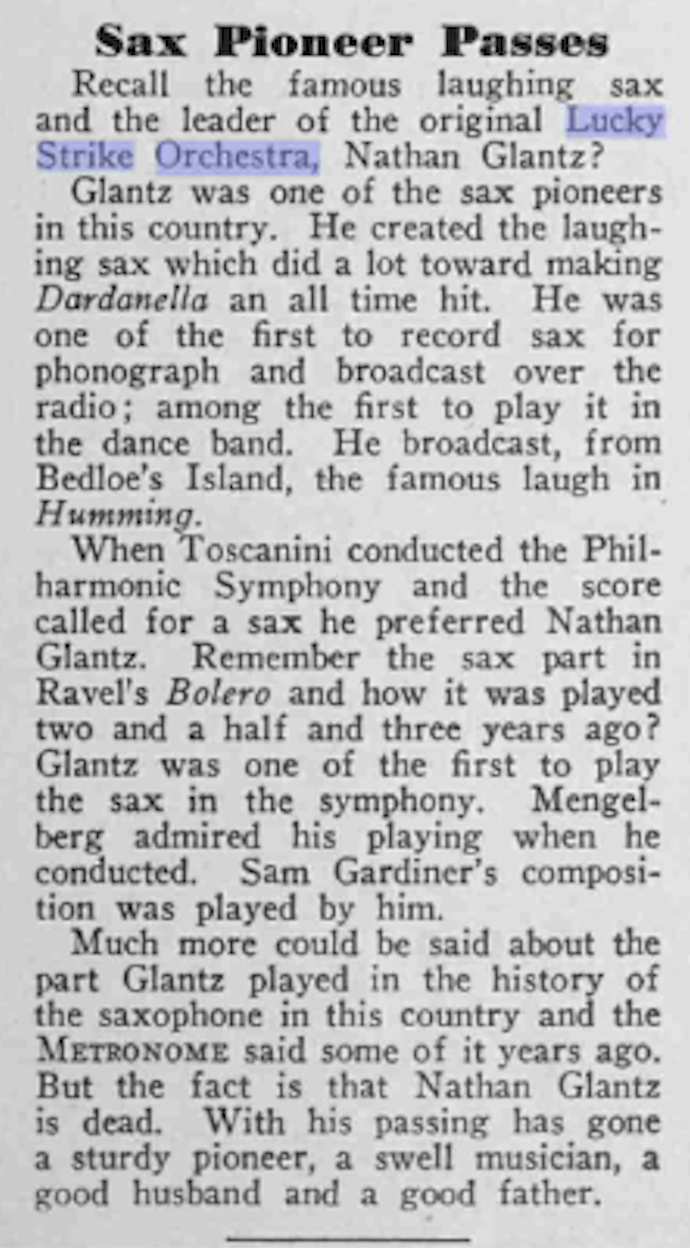
At the same time, they highlight the challenges he faced and some incredible possibilities. Admission to a conservatory is an accomplishment, even without considering whether the student has the practical means to attend or comes from the “right” demographic to get there. If Nathan Glantz did attend a conservatory, it’d be a remarkable accomplishment even if he never got to play with Toscanini. Another possibility is that Glantz didn’t even need a conservatory to earn the respect of the Buddy Rich of opera. Behind the chuckling sax and monochromatic photographs, there was quite a musician.
They also point to some other possibilities to explain his musical experience, including formal training without the conservatory in Russia or the variety of vernacular musical traditions likely found in his community. There’s still more to his story.
Abbreviated Bibliography
- Nathaniel Deutsch, The Jewish Dark Continent: Life and Death in the Russian Pale of Settlement (2011)
- Niels Falch, From Oy to Joy: Jewish Musical Style in American Popular Songs 1892–1945 (2020)
- Gershon Swet, “Russian Jews in Music” in Russian Jewry, 1860–1917, ed. Frumkin et al (1996)
- James Loeffler, The Most Musical Nation: Jews and Culture in the Late Russian Empire (2010)
- Mannherz, Julia. “Nationalism, Imperialism, and Cosmopolitanism in Russian Nineteenth-Century Provincial Amateur Music-Making” in The Slavonic and East European Review (95, no. 2, 2017)
- Henry Sapoznik, Klezmer: Jewish Music from Old World to Our World (1999)
- —”Jews and Jazz: Before the Beginning” lecture presented by Yiddish Book Center (2021)
- Lynn M. Sergeant, Harmony and Discord: Music and the Transformation of Russian Cultural Life (2011)
- —”A New Class of People: The Conservatoire and Musical Professionalization in Russia, 1861-1917” in Music & Letters (85, no. 1, 2004)
- Jeffrey Veidlinger, Jewish Public Culture in the Late Russian Empire (2009)
- Diana Voskoboynik, “The History of the Jews in Proskurov, Ukraine,” honors thesis (2002)
- Jeffrey Wollock, “Historic Records as Historical Records: Hersh Gross and His Boiberiker Kapelye” in ARSC Journal (2007)
- Miscellaneous entries in YIVO Encyclopedia of Jews in Eastern Europe (online)
- I.I. Yugan, “History of the Establishment of Military Orchestras and Their Role in the State of Russia” in History of Pedagogy and Education Professional Journal of the fourth Community (2018, translated from Russian via Google Translate)
- Miscellaneous records online including ancestry.com, the New York Philharmonic, and Ellis Island
*Thanks to Mark Berresford for sharing his conversation with Hot Lips Levine!

