All About Jazz has been very supportive of prewar jazz coverage, so I’m thrilled to see my column published on their website. In its latest article, I discuss some of the perceptions that make the music’s early sounds seem so removed from the jazz continuum. Hopefully it’ll inspire some open ears, and maybe a few stuffed stockings.
I also hope you’ll give it a read, right here. Thank you!
Regular readers of Aesthetic, Not Anesthetic know that Buster Bailey and Don Murray are two of its favorite subjects. Both were simply amazing clarinetists, gifted with a bright tone and a beautifully busy style, equally effective in solos, breaks and high-flying lines behind ensembles. Benny Goodman admired the two of them and even shared a teacher with Buster Bailey. Unfortunately Bailey and Murray remain amazingly underrated footnotes in jazz history.
Now, for some further critical vindication, here’s Ellington sax section anchor and baritone sax pioneer Harry Carney‘s thoughts on these musicians:
My first influences [on clarinet] were Buster Bailey with Fletcher Henderson, and Don Murray with Jean Goldkette. As a brash kid, I always wanted to play faster than anyone on clarinet, and both Buster and Don Murray were great technicians. Too bad I didn’t stick with them! Perhaps I’d be a clarinetist today. Buster has always sounded to me like a perfect man for the symphony, and on those up-tempo numbers with Fletcher Henderson he always showed what a well-schooled musician he was.
Apparently this blog keeps some sharp company in terms of taste! More importantly, Carney reminds all of us to stay positive and to not be bashful with sincere compliments. One never knows who, or when, someone is listening.
The music business is difficult, but music history can be murder. Just ask any of a hundred composers laying dead and buried under the immortality of Bach, Mozart and other innovators. In case they’re not around, give Cab Calloway a read:
You hear about the Duke Ellingtons, the Jimmie Luncefords, and the Fletcher Hendersons, but people sometimes forget that jazz was not only built in the minds of the great ones, but on the backs of the ordinary ones.
Sour grapes? Perhaps, but the fact remains that history books don’t pay as much attention to the artists who did what they did well without breaking barriers or spawning a school of influence. Unfortunately Calloway‘s energetic singing and swinging bands were “merely” exciting music that was played incredibly, but which didn’t build the foundations of big band jazz like Henderson, reinvent jazz orchestration along the lines of Ellington or even define an iconic rhythm a la Lunceford.
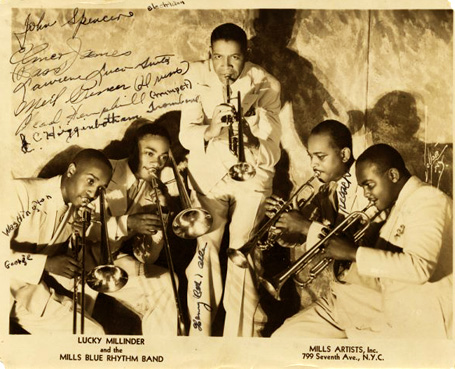
Yet even Calloway has enjoyed a modest degree of historical attention compared to many of his other Swing Era colleagues. If Calloway’s back and Ellington’s mind helped build the house of jazz, they did so with the Mills Blue Rhythm Band’s legs running to all the gigs they couldn’t make.
Managed by impresario Irving Mills, the Mills Blue Rhythm Band was a New York based outfit designed as a third tier cash cow underneath Mills’ other two clients, Duke Ellington and Cab Calloway. The Blue Rhythm Band would cover Ellington/Calloway fare such as “Minnie the Moocher” and “Black and Tan Fantasy” along with their own swinging originals, without ever being allowed to compete with Mills’ star operations. What short shrift the MBRB does receive in jazz history texts frequently reiterates that given a revolving door of musicians fronting the band, and absent a distinct book, the band was never able to establish a singular identity or distinguish itself from other swing groups.
The group’s discography reveals a variety of big band sonorities, roof-raising soloists (many drawn from the star-studded ranks of Fletcher Henderson’s band after it folded) and the type of innately danceable rhythm that defined “swing” as a musical adjective, verb and noun during the thirties.
“Harlem Heat” pulls all of these elements together. The cut opens with Edgar Hayes’ crystalline piano wrapping around a trio of baritone, tenor and bass saxes, followed by JC Higginbotham punching into his trombone’s upper register and Buster Bailey’s deliciously tinny clarinet acrobatics. Between it all there’s an assortment of simple, infectious riffs:
“Dancing Dogs” intersperses the brass barking thoroughly modernistic chords between Gene Mikell’s soprano sax, Red Allen‘s vicious trumpet growls, Joe Garland (of “In the Mood” infamy) on husky tenor, Buster Bailey’s reed seesaws and and more great piano from Edgar Hayes. Five soloists, a world of contrasts and less than three minutes in hot music heaven [just follow the arrow to listen]:
Here’s the band under Baron Lee’s banner and vocals, in a stoner-iffic number made popular by Calloway. Potential identity crises aside, they sound like they’re having a ball. Their snappy rhythm and Harry White’s snarling trombone more than compensate for some comedic misfires:
The rhythm is a little chunky but not stiff, and it rides forward, never up and down. Pianist Hayes, along with bassist (and future Ellington alumnus) Hayes Alvis and drummer O’Neil Spencer aren’t doing anything groundbreaking as a rhythm section, just laying down an addictively steady beat in solid four. There’s none of the percussive color of Sonny Greer, the dynamic technique of Jimmy Blanton or the world-altering glide of the Basie rhythm section. Like Al Morgan and Leroy Maxey, Cab Calloway’s bass and drum team, the MRBB’s rhythm section provided an assembly line of groove: steady, reliable, and easy to take for granted. Calloway’s back may have been sore by the end of his career, but the Mills Blue Rhythm Band needed corrective surgery.
Irving Mills has been discussed, debated and demonized, but there’s no denying he had an impressive portfolio of talent under his wing. Here’s some footage of Irving promoting all three of the bands mentioned above, with period marketing rhetoric and an accent not unlike a few of my uncles:
Nicholas Payton Hates the Word “Jazz” Applied to His Music, and So Did Paul Whiteman
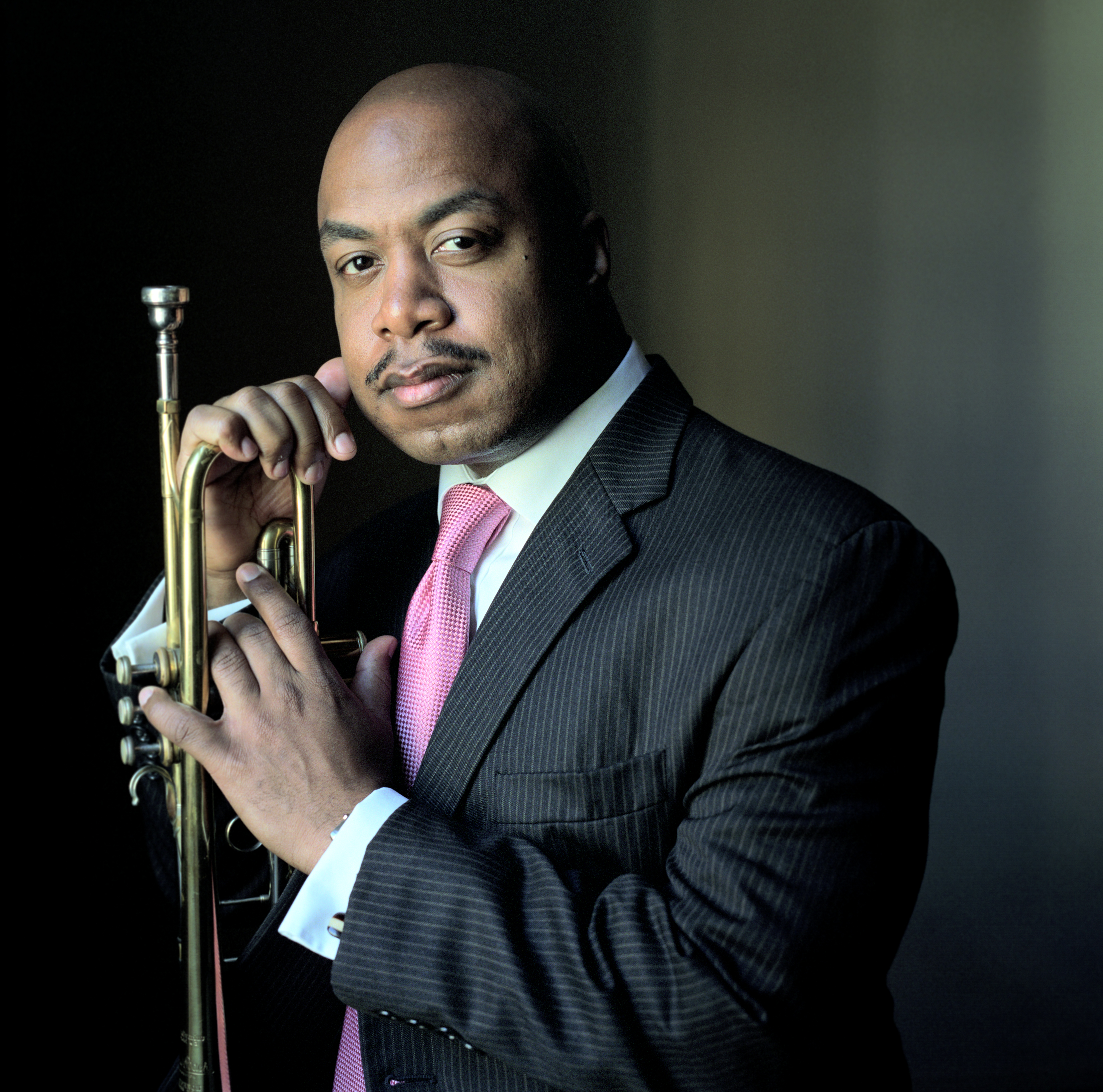
Trumpeter/bandleader/composer Nicholas Payton lit a cyber bonfire recently when he judged “jazz” to be a narrow, outdated, and even racist term. With so many artists, jazz journalists, “jazz” defenders, label haters and twit heads out there weighing in, I’m going to avoid discussing whether Payton is “Right” or “Wrong.” He has inspired plenty of thoughts and feelings though, and that’s vastly more important than any value judgments that will come out of this debate.
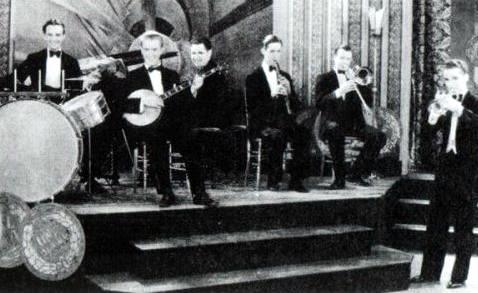
Most of the discussion hinges upon one very specific word (but given Payton’s commentary on race in America, it’s become just part of the argument). Payton insists that he is “…not dissing an art form. [He is] dissing the name [emphasis mine], Jazz.” Criticizing “jazz” (but not jazz) is a fascinating proposition since this blog spends so much time reconsidering a lot of music that is denied “jazz”/jazz’s street cred. Many historians and critics don’t know what to call the music of the early Fletcher Henderson band, Red Nichols’ various ensembles, forgotten twenties dance orchestras and musicians such as Buster Bailey, Don Murray and Adrian Rollini. Letting them all into the proud family tree of “jazz” has proven tricky.
Sorry Red, Hugues Panassie Says You Can’t Be Filed Under “Jazz”
Yet the people who enjoy and care about vintage jazz and early American pop have been eager to extend a branch to their heroes. For many people (excluding Payton, of course) “jazz” denotes something perennially hip, music requiring flawless technique and a unique voice. It has a rich history, yet it continuously evolves. It’s also a proudly American invention, fed from the blues, rhythmic nuances and vocal inflections that could only have appeared in this country with its complex, often troubling cultural and ethnic history (I’ll leave it up to Payton and his interlocutors to discuss where those elements came from and how they define the music).
Adrian Rollini’s Bass Sax Has Found Equal Difficulty Getting Through Doorways and Jazz History Books
Best of all, “jazz” gets played in swank nightclubs, fancy concert halls and prestigious college campuses. “Jazz” is a passionate, sincere and intelligent “art form,” a much more impressive name than “old pop,” “syncopated concert music” or other sobriquets given to piles of 78rpm explorations. “Jazz” is respectable, and it’s cool. It’s no wonder fans want their favorites to get on the tree, even on some obscure branch that never bore fruit.
Yet here’s Nicholas Payton, asserting that “jazz” itself is a rotten root! According to him, “jazz” died in 1959, and it’s way too limited and self-conscious to be considered “cool” anymore. Payton also describes the word as an external imposition on the actual music and its voices (who Payton has always expressed vast admiration for, in both words and discography). Based on Payton’s description, “jazz” doesn’t even seem like it’s worth the fight.
Maybe giving up that fight is what all that old music needs.
Payton’s politics and occasionally confrontational tone aside, what if all us trad fans, moldy figs and hep cats of latter day swing took his suggestion to heart? What if we simply stopped using the word “jazz?”
Aside from making it much harder to organize our record collections, it might excuse a lot of music we love from taking a stylistic blood test. Couldn’t we do without yet another debate on whether Bix Beiderbecke and Benny Goodman are “jazz?” Wouldn’t Gunther Schuller’s verdicts about which bands are not “jazz” seem much less damning? And whatever it is that Fletcher Henderson, Duke Ellington and so many original New Orleans musicians were doing before they “learned how to swing” might even be respected on its own musical terms, not just some stepping stone to the title of “jazz” bestowed by critics and scholars.
If I’m hijacking Nicholas Payton’s ideas for other ends than he assumed, it demonstrates how powerful those ideas are, but also how simple they turn out to be. Not to deflate the scope of Payton’s ideas, and the anger and attacks of his critics notwithstanding, all he is doing is criticizing a word; he’s protesting a label. He’s not even the first artist to do so. As he points out, Duke Ellington and Miles Davis, not to mention Charlie Parker and Eddie Condon among many others, have expressed varying degrees of reticence about “jazz” and other labels. Judging from Payton’s commentators, he won’t be the last to get the word out about putting “jazz” out to pasture.
Speaking of which, maybe the pop of yester-century can stay just as exciting and intelligent without having the title “jazz.” Maybe “jazz” needs to be as open about its past as it does its future. Or maybe “jazz” is simply as limited as Payton describes. Words are as powerless or as powerful as we make them. Nicholas Payton merely points out how powerful we have made one word.
And if he’s reading this he may or may not appreciate my posting a ten year old clip, but good music has no expiration date here. Here’s Nicholas Payton scorching “Tiger Rag” with ample ‘postmodern’ swagger:



 The Pop of Yestercentury