From roughly the end of World War I through the post-WWII era in the United States, if you enjoyed music, chances are you went to hear it live and dancing was a big part of your social life. That meant relying on the presence of a band ready to play the newest music and your old favorites. To satisfy that demand, publishers supplied commercially available scores, orchestrating the latest hits so the average working band could play them with minimal instrumentation and without needing virtuoso players.
Countless bands relied on this sheet music across decades. Some of the most exciting and beautiful music on record was the result of musicians sticking to or “doctoring” these creations. The Jazz Age, syncopated music, the Swing Era, the big bands, traditional pop: whatever it’s called, it owes a lot to “stock arrangements.” Yet the term may now get the qualifier “just a.”
Mention a favorite recording, and someone might note its use of a stock arrangement the same way they mention that your beloved family heirloom was factory-made. ”Mass-produced” means “generic,” and “commercial” is mutually exclusive of “creative.”
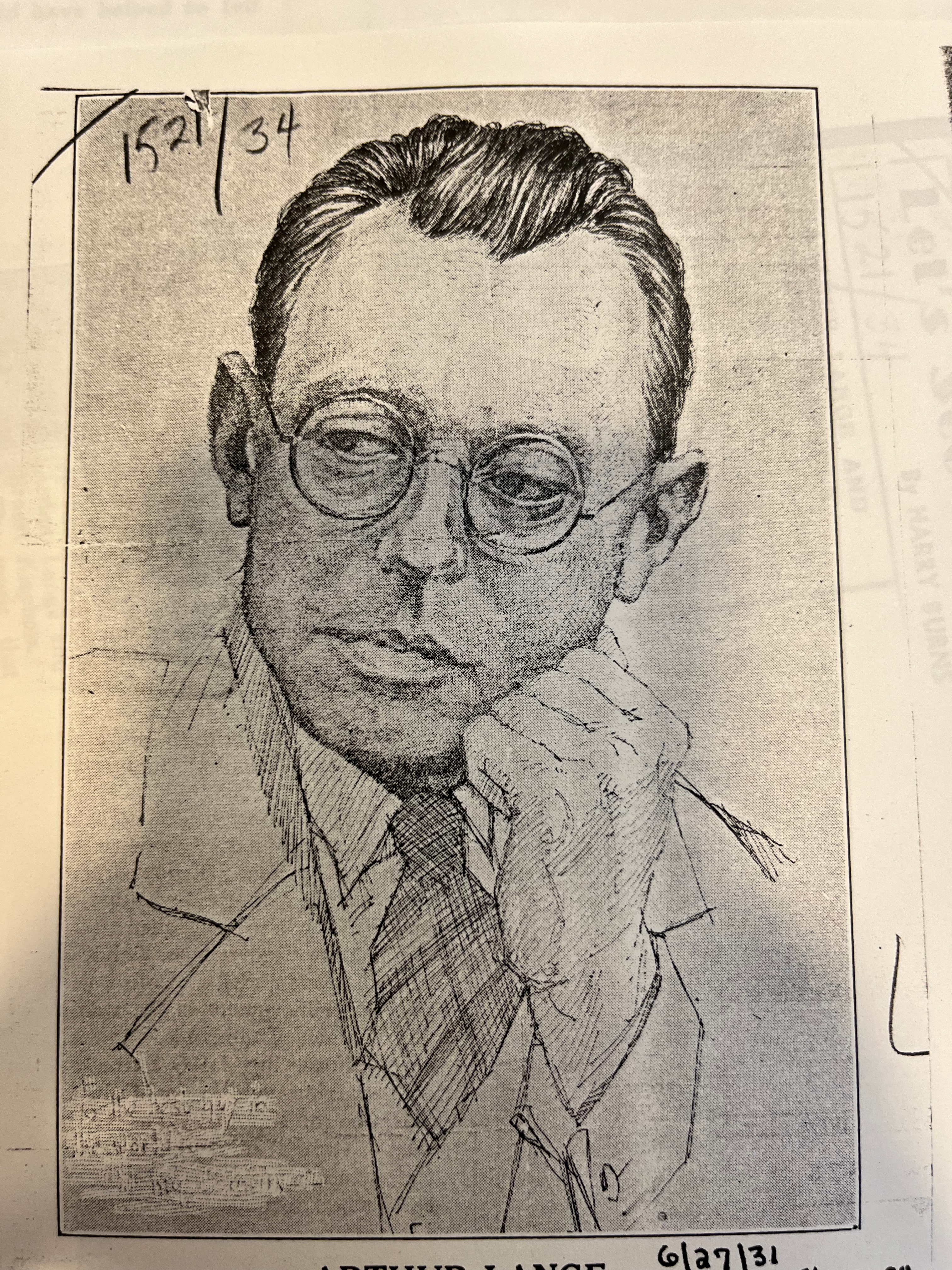
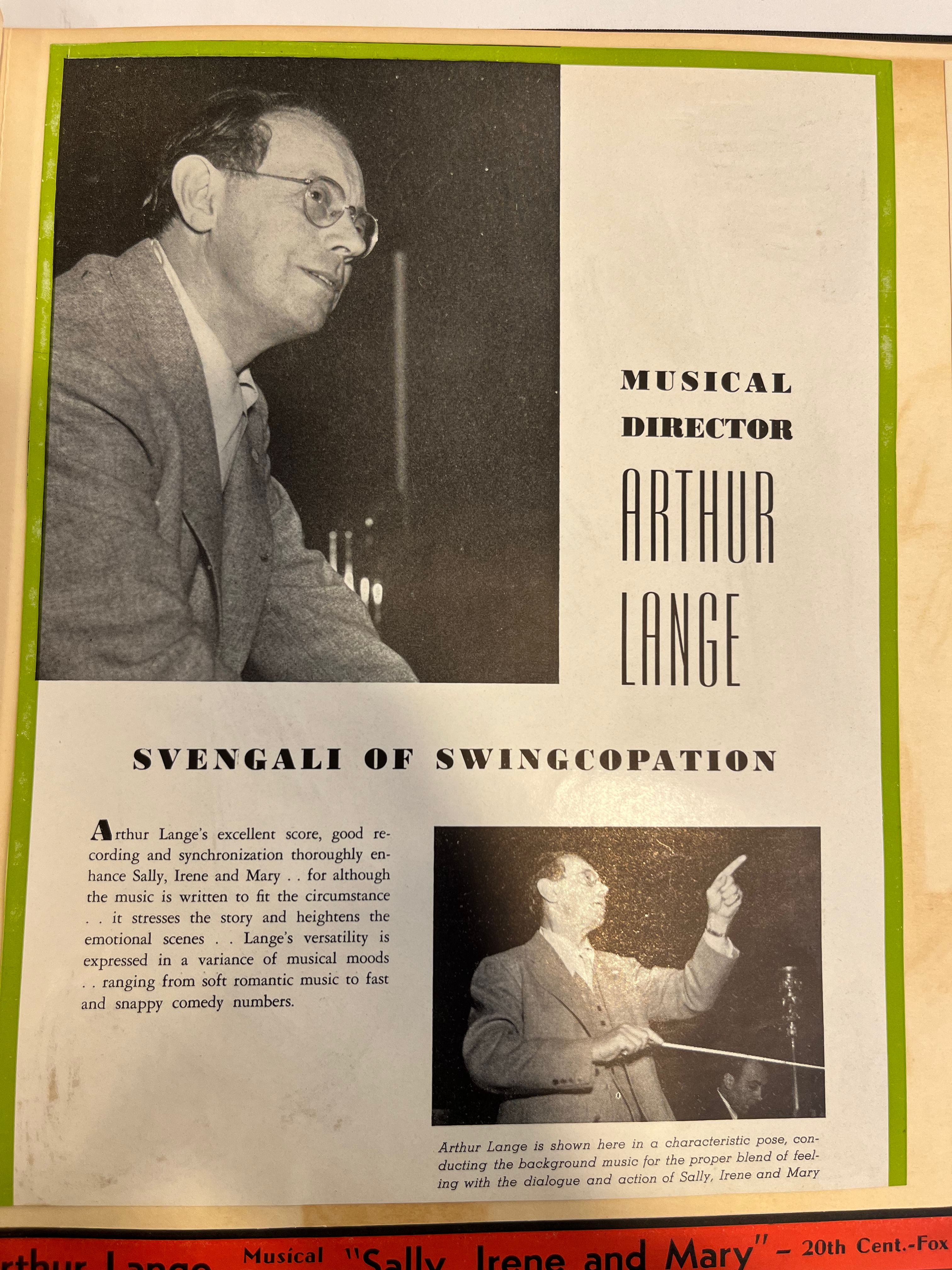
Then, there’s Arthur Lange. He was one of the most prolific and commercially successful stock arrangement writers of the twenties. Every band at that time likely played at least one of his charts. Every arranger probably read his book on the subject. He made plenty of money, and he may not have even considered the work his highest artistic calling. But he was also one of the most inventive and thoughtful musicians in the music business. He had strong opinions and stronger standards when it came to music, even music designed for maximum accessibility.
Not Quite Ready for Classical
Born in 1889 in Philadelphia, Lange got an early start in music, but his rise to the top was not a foregone conclusion. His mother was a classically trained pianist with familial connections to a conservatory in her hometown of Breslau, Poland. His father was a professional brushmaker who played drums on the side since immigrating from Germany. Lange was repeating the exercises he heard his mother’s piano students playing by ear at the age of five. But he lost interest in music by age eight and didn’t play much until picking up the violin two years later. Even then, in his words, he was “a rotten violin player.” Apparently, he was good enough to play in and help lead a youth orchestra organized by Philadelphia’s well-known department store, Wanamaker’s. Playing the violin led Lange back to the piano. Copying instrumental parts from piano scores sparked an interest in orchestration.
Lange mostly grew up on classical music, and the popular music of the time didn’t impress him. “There wasn’t enough pop music to get excited about,” Lange recalled, “or to be a temptation for the student to forsake classical music.” Lange and most of the music students around him wanted to be concert performers or composers (not commercial musicians). He didn’t develop an interest in popular music until age 15, when he realized his instrumental talent was insufficient to become a concert artist. He decided to pursue popular music professionally while continuing to study and compose classical music, “daydreaming” about conducting his own symphonies, or at the very least, operettas. Any of those paths, to Lange, would have been “something better than the pop field offered.” He felt competent enough for popular music, though.
By this point, his mother’s illness—not some innate desire to pursue music—forced him to live with his father (and his father’s mistress) in the nation’s musical capital, New York City. For what sounds like a compromise, Lange threw himself into his chosen musical path. He initiated a letter-writing campaign to dozens of publishing firms, essentially “cold-calling” for work until he landed a job at the publishing house owned by Charles K. Harris. Harris wrote of one of the first blockbuster popular songs, “After the Ball.” Working for him was the first fortuitous step in Lange’s second-place career choice.
A Sponge for the Craft
Lange was just 16 when he joined Harris’s company, mostly doing office work and gaining some musical experience before getting fired for writing his music on company time. He quickly landed on his feet, getting a job as an arranger for Joseph W. Stern & Co. At this stage, Lange seemed more focused on gaining experience and earning income in the music business rather than mastering a specific craft. Working as an arranger and orchestrator still allowed him to develop his creative voice.
An orchestrator writes instrumental parts based on pre-existing material, such as a piano score. The job requires understanding everything from transposing within the key and range of each instrument to familiarity with the conventions for instrumental roles (lead, harmony, etc.), down to knowing when to avoid open strings on the violin, which Lange learned the hard way when he asked an arranger he looked up to review one of his earliest scores. Orchestration is an important role, but Lange was clear that it was different from arrangement.
An arranger, as Lange explained, turns notes into a song. The arranger transcribes the songwriter’s music—sometimes just from them humming a tune—and, “as a rule,” writes the underlying harmonies and rhythmic accompaniment. Before the explosion of dance tunes, arrangers created dance versions of music not intended for dancing: resetting the rhythmic structure (e.g., turning ballads into waltzes or marches into two-steps), adding a rhythmic accompaniment, and writing music to fill out those long notes that sound beautiful in a ballad but just kind of hang there in a dance number.
From the start of his career, Lange paid special attention to “figuration,” the phrases and decorations an arranger adds under and alongside the melody. Lange especially admired Frank Saddler’s figuration among other aspects of his work. As Eric Davis explains in his doctoral dissertation on Saddler, he was the most in-demand Broadway arranger from 1909 until his death in 1921, “scor[ing] more than 60 shows—an unprecedented accomplishment that has never been repeated, and the anecdotal record suggests that he may have been involved in creating orchestrations for many more productions.” Lange’s description of Saddler summarizes the arranger’s art at its best:
His approach was entirely fresh and different…he would incorporate novel effects in his orchestrations…In many cases, they were greatly responsible for the success of the shows…[It was] an unusual approach and technique for which Saddler was both admired and envied.
Writing his memoirs decades later and well into his own career, Lange still admired Saddler’s contrapuntal lines in the piano accompaniment to Harris’s 1906 song “Somewhere.” It’s an interesting look at what catches a musician’s ear and the influences in Lange’s work.
Already taking inspiration from his role models, Lange’s first arrangement for Stern—Tom Kelly and Earl Jones’s “I Like a Little Lovin’ Now and Then”— included original ideas that resulted in what he described as the first “modern number for a music publisher.” Writing a piano arrangement of the waltz from Lehar’s then-popular operetta The Merry Widow, Lange contributed an original harmonization (later admiring his younger self’s brashness while still judging it “in bad taste”). Among other assignments, Lange arranged “Marie from Sunny Italy,” Irving Berlin’s first published song.
After losing his job at Stern, Lange moved to Rose and Snyder Company and then to Joe Morris from 1913 to 1918, hired as a songwriter but responsible for arranging his own tunes. Along the way, he also played piano in movie theaters, conducted theater shows, and worked as a freelance pianist and arranger for various orchestras. His published work from this period attests to the wide range of music he played and heard, ranging from patriotic tear-jerkers to more ribald popular numbers and a fair amount of ragtime.
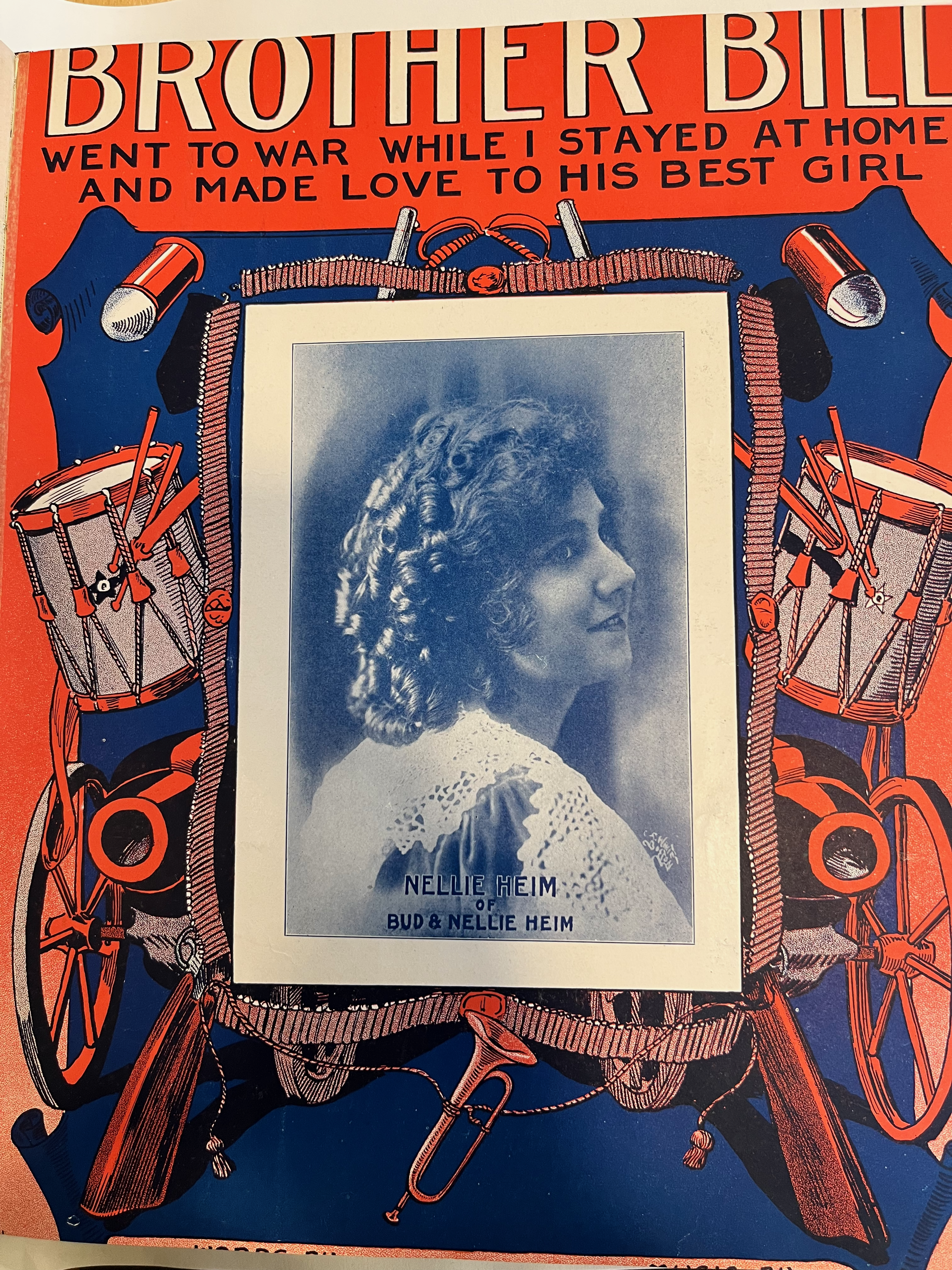
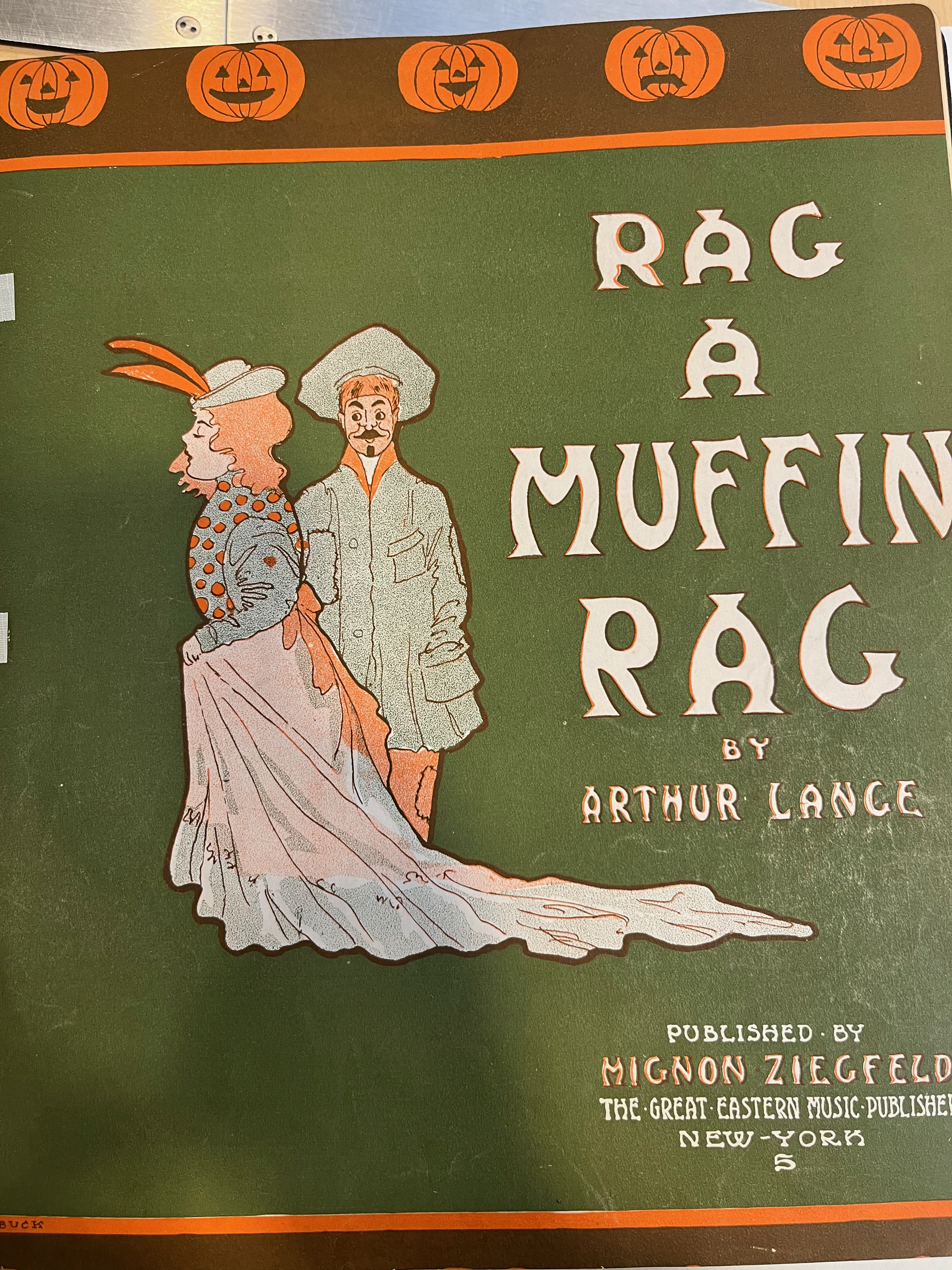
In 1918, as Lange described it, “the songwriting business goes to Hell [due to] prices, dime stores, competition, paying the acts.” The always-practical Lange returned to full-time arranging, including work outside song publishing. When Lange “ghostwrote” the arrangements for Silvio Hein‘s latest musical, the venerated Broadway songwriter and producer could hear his contracted arranger hired a sub; the scores sounded too good. Lange now had newfound confidence in his arranging ability. He took his next job as an arranger, now with Fred Fisher, where he also met his longtime business partner, Ernest Klapholz.
A Composer’s Arranger
Lange thought that songwriting experience gave him insights into the process that endeared him to Fisher’s songwriters. Even with the pressure of deadlines, Lange insisted that, before he could start an arrangement, he had to “live” with a tune until he felt like he had written it. When Lange said that “a good arranger is a natural composer regardless of whether he ever composes anything,” he was likely referring to the composer’s mindset as well as the act of composition. Lange would add his own harmonic ideas and figuration, but he worked hard to understand each songwriter’s style. Lange’s goal was for the final product to “sound as if the composer himself had arranged it.”
To Lange, a good tune didn’t need much input from an arranger, but the right arrangement could make a poor tune into a hit. “The arranger today is just as important in the success of a tune as the composer” for Lange, who added that “some melodies would never get anywhere without a first-class arrangement.”
Lange felt that his own songs of “the banal variety,” as opposed to his “musicianly [sic]” tunes, became the hits. This might be an example of the artist being their own worst critic. Lange may have simply had a knack for what appealed to many people at the time—even if what appealed to them struck him as “banal.” It’s still popular to joke that the cream rarely rises to the top in popular music, but does the majority prefer “bad” work, or is the work deemed “bad” because they prefer it?
The flip side of Lange’s aesthetic hierarchy was a commitment to excellence in his own work. He admitted to an “inner urge to rise above mediocracy [sic?]” driving him to “do a more artistic job than the other guy.” From the outset, Lange was determined to create something original and creative—even if he was pursuing popular orchestration strictly for what he called “do-re-mi [i.e., “dough” or money].”
Lange’s arrangement of “Dardanella” was his ideal of a “compromise between the banal and the artistic.” It was also responsible for his breakout success, but Lange had a comically nonchalant recollection of how he first heard the song and created its signature touch. It began with Felix Bernard submitting the song to Fisher’s company as an untitled instrumental in 1918. Alfred Bryan provided the title and lyrics, and then Lange got to work:
When I first heard “Dardanella” as played by Felix Bernard, the bass wasn’t as jet clarifide [sic] as it stands today. Bernard had no doubt heard a rumbling bass figuration in his travels and visits to places of ill repute where the piano player played by ear and always had a cigarette hanging from his mouth…This sort of rumbling bass was very unpractical for commercial purposes, so Fred Fisher asked me to see what I could do with it. In other words, I was asked to civilize this rumbling bass.
Joseph Knecht’s band at the posh Waldorf-Astoria auditioned Lange’s arrangement for the publishing firm, and everyone knew they had a hit—except Fisher. He thought the bass was too difficult to play and shelved “Dardanella.” Six months later, Lange was at Leo Feist’s company, but Fisher’s staff had gone over their boss’s head and distributed copies of the arrangement. In Lange’s words, “some unbelievable power of justice” prompted Ben Selvin to actually record the number.
“Dardanella” became a record-breaking seller in 1919, everyone in the music business learned Lange’s name, he became swamped with work, and that bass ostinato still sticks to people’s ears.
After Feist, in 1922, Lange took a job as an arranger at Waterson, Berlin, & Snyder while also freelancing for other publishing firms. Stock arrangement would have kept him busy enough, but Waterson and multiple other companies also contracted Lange to write “special” arrangements outside the mass-published scores for multiple firms. Fortunately, Lange had a solid work ethic and a knack for working fast while staying inventive (for example, converting Irving Berlin’s “Remember” from a waltz to a fox trot by dropping the verse while incorporating parts of it into the chorus).
Lange was one of the first composers to arrange classical works for the dance orchestra (a trend of the twenties that met with a range of reactions). He claims that his stock arrangement for “Yearning” was the first to have an independent clarinet part.
Lange also mentioned “Jealous” as the first dance tune issued without a verse. Less than a year earlier, in the January 27, 1923 issue of Music Trades magazine, one business editorial observed that “the verse doesn’t usually mean a thing [and is] something to get over with in a hurry.” Lange may have been codifying public taste rather than initiating a trend, and it’s sometimes difficult to confirm “firsts” in music. Either way, it shows a musical awareness of where popular taste was headed.
Lange said that a key part of being a successful arranger was always knowing “the many professional tricks and customs” popular in arrangements at any time. His advice may seem like calculated trend-hopping. The word “tricks” might seem reductive, but it was a common enough and neutral phrase at the time. His first arrangement included what Lange proudly called his “tricks” that became part of the song. James P. Johnson, just five years younger than Lange, used “tricks” to describe his own musical ideas. Lange’s advice also has the air of a craftsman always expanding his skills. Original creation is one tool, but it’s not the only thing in the box.
Lange’s Style on Record
The Waterson firm also owned the Cameo Record Corporation. Lange would make some of his first recordings as a bandleader on that label. In the days when labels released music under multiple band aliases without personnel attributions, recordings issued under “Arthur Lange and His Orchestra” and presumably using his charts are a welcome opportunity to zero in on Lange’s style. He had been directing a dance band since at least 1921 to rave reviews at venues in Brooklyn, Long Island, and Manhattan. It was yet another tool in his professional kit. Also, a band under his leadership was probably a convenient lab for experimenting with scores.
Lange thought of the dance orchestra as “essentially a wind band augmented by certain other instruments such as the violin, piano, banjo, and drums.” The three-piece saxophone section is its “backbone,” which is then “reinforced by brass.” The “wind band” (i.e., the brass and saxes) remains the “foundation,” and the rhythm section is there to “augment” it. While giving the rhythm section an auxiliary role, Lange said that rhythm was crucial to music in the United States since he thought that Americans “listen with their feet.” From this perspective, the arranger must ensure the melodic instruments rock and swing as much as they sing and provide color.
That’s probably why many of his best sides for Cameo stand out as much for their syncopation as their orchestral details. For example, there’s the catchy saxophone section phrases responding to the brass on “I’ll Be In My Dixie Home Again Tomorrow”:
The suspensions in the introduction and the sax section’s counterpoint in the first chorus on an otherwise romping “Carolina in the Morning”:
Or the sheer stomp of “Big Boy,” aided by the score’s brass accents and the band’s playing:
These sides feature first-call dance band pros like Gene Fosdick, Tommy Gott, Earle Oliver, and Lou Raderman. Many of them played on Cameo sides contracted by Lange’s colleague at Cameo, Bob Haring, and issued as the Dixie Daisies. They incorporate more overt jazz influences, such as collective improvisation and more pronounced rhythmic inflection. At the same time, they alternate New Orleans-style polyphony, still popular at the time, with the arranged hot dance style that musicians like Lange were developing.
Lange and Haring likely swapped musicians and arrangements and may have shared aliases on records like the “Velvetone Dance Orchestra” sides. To my ears, Haring’s arrangements use tighter section voicings and more lyrical figures, versus the split sax section writing and punchier lines in Lange’s charts. Haring’s writing, to me, more often seems to assign the lead to solo instruments, including baritone sax and guitar, and to the strings.
Success Through High Standards
After a short hiatus, likely due to a packed work schedule, Lange returned to public bandleading in September 1923 with a bang as the Cinderella Ballroom’s inaugural act. Then, in February 1924, trade publications reported that Lange ceded leadership of his band to the teenage bandleading prodigy Roger Wolfe Kahn while continuing to arrange for and rehearse the group. But by June, Lange was leading a band the press described as “unknowns” at New York’s Fay Follies club and the Strand Theatre, among other venues.
Somehow, he also found time to rehearse Irving Aaronson’s band at the Hofbrau and briefly manage Peter Van Steeden’s band. He parted with Kahn for good in September. By September 1925, Lange reported giving up his dance band to focus exclusively on arranging, but he never seems to have stopped leading studio sessions for Cameo. By mid-1926, he was leading a band for the show Honeymoon Trail and briefly at the Monte Carlo before finally stepping away. He told reporters he simply didn’t like directing a jazz band.
Even with the quality of his records and positive reviews at the time, Lange seemed ambivalent about bandleading. He may have simply preferred to work behind the scenes. He could still play a key role in shaping a band’s sound. He could also enforce rigorous standards. Under Lange’s coaching, for example, Kahn’s musicians had to memorize their parts (rather than use sheet music) on jobs.
Lange was also unequivocal about the superiority of European orchestras. Those musicians were more likely to have received formal training from conservatories, while American musicians could “just pick up an instrument and enter an orchestra.” Fortunately, for Lange, the arranger’s “ingenuity for obtaining beautiful results for small orchestra” could “overcome” the “shortcomings of the American musician” and “lack of individual perfectness [sic].” This from someone who had worked with some of the top studio musicians in the country!
These remarks again point to a discernment that approaches elitism. On the other hand, these high standards had brought Lange far. He may have started writing arrangements because he couldn’t compose symphonies professionally, but it paid off literally and figuratively. By 1926, he received $150 per chart, the highest rate for any arranger. He signed exclusively with Shapiro, Bernstein, & Co. for a two-year, $50K contract (about $450K in 2025), a new record for arrangers. Press coverage from the time liked to repeat the phrase, “If it’s a Lange arrangement, it’s okay without seeing it.”
The same year, Lange literally wrote the book on arranging for dance bands. 1926’s Arranging for the Modern Dance Orchestra was the first comprehensive guide to writing for a popular instrumental ensemble. In Dance Band Arrangers, 1900–1960, Keith Robinson highlights Lange’s “originality in thinking about orchestration and how homogeneity of sound could be obtained with such a limited group of instruments.” Examples include Lange’s insights into the use of mutes, novel roles for rhythm-section instruments like the banjo, and his division of instrumental tonal groups. Lange offered an extensive list of instrumental combinations, classified as “open, piercing, etc.,” to achieve a variety of textures. He also spent whole chapters on writing duets and trios, skills he shows off in his own charts. David Chevan, in his dissertation Written Music in Early Jazz, explains that a large number of stock arrangements in the twenties increasingly employed these techniques, pointing to the surprising complexity of many stocks (versus some historians’ stereotyping of them as simplistically functional).
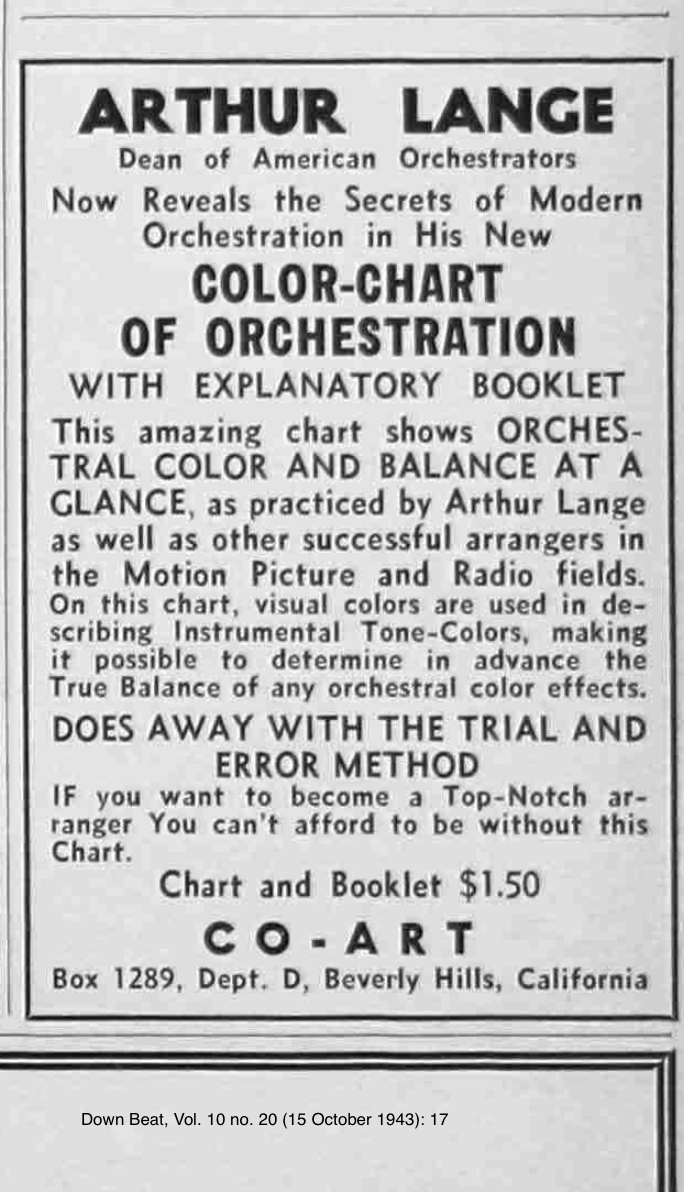
Whatever else Lange may have thought about the cultural value of popular music versus other musical traditions, he understood that popular music had its own possibilities and standards of excellence. His introduction to the book states outright that “the problem of arranging for dance orchestra is entirely different from that of scoring for the symphony or concert orchestra and must be attacked in a different way.” It codified existing arrangement practices of the time in the context of popular music. Many contemporary readers said it was also easy to understand.
As a contemporary reviewer observed, Lange’s book put the practice of dance band arrangement into overarching conceptual terms, pointing to a distinct musical discipline. The book remained hugely influential even decades after its publication. Lange was now definitely able to write his own ticket. It was an impressive accomplishment for a former “rotten violinist” who didn’t think much of popular music.
Serious Music
By 1928, Lange had negotiated a contract with MGM, moving to Hollywood the following year and becoming its musical director for all recordings. He went on to earn several Oscar nominations and other honors for his film work. He was just as hardworking and thoughtful in his film work. Several editorials from the thirties and forties show him reflecting on the industry’s state and his aspirations for the medium.
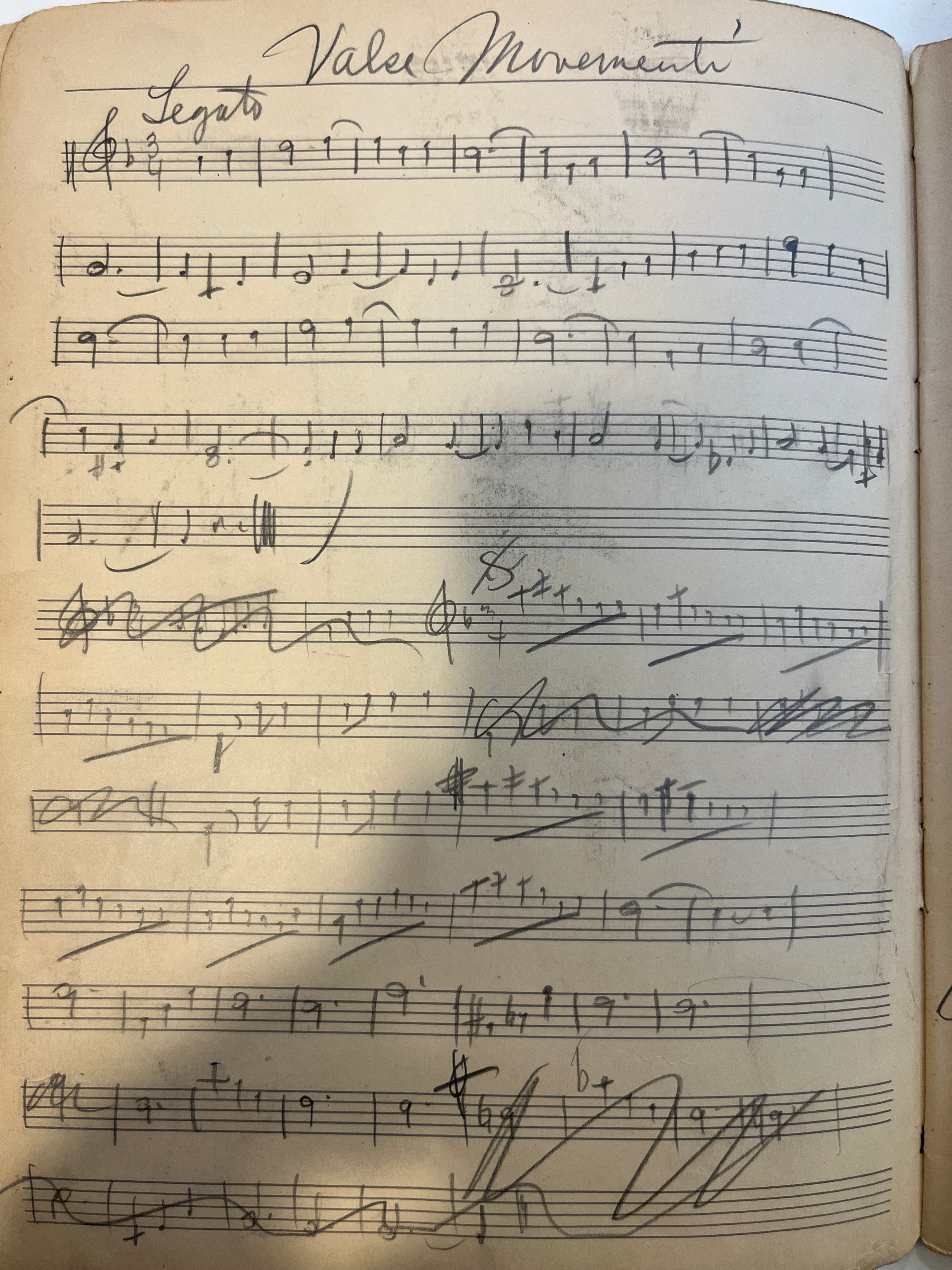
Scrapbooks show Lange had been working on solo piano works and chamber pieces since at least the 20s. But his papers marked 1928 as the year he “begins serious musical composition.” If Lange was ambivalent about leading dance bands, he was clearly passionate about conducting concert orchestras:
When I am in front of an orchestra, I feel like a king in my own domain. However, not in the sense of superiority. I merely get a sense of the supreme control of the work that is to be done. I feel separated from all the small things in life. In other words, I am alone at home in my own world. I get great satisfaction from working out delicate balance and effects which are in the score. I get a chance to express the emotional side of me. It is the language in which I can speak the best…I take great delight in working out any score that has never been played before, especially if it is well-orchestrated and the composition has a genuine emotional quality.
Despite not having as much interest in jazz, especially as it’s now understood, these comments show a musician who didn’t need improvisation for self-expression, to feel “at home” in an aesthetic element, or for the excitement of discovery. By 1939, he had founded Co-Art Records, a label devoted to contemporary American composers—like him. He earned critical acclaim both as the founder of the Santa Monica Symphony in 1947 and as a conductor of his own works with that orchestra. Golden State University awarded Lange an honorary doctorate in 1956. He passed away that December.
Lange’s comments about “serious musical composition” and other judgments might seem unusual to those who enjoy his work for dance bands. “Serious music” may have denoted “European classical music.” Yet Lange still treated “popular, syncopated, dance, jazz, etc.” music for a mass market as something to be done seriously. He had practical motives for being good at his job:
I’ve been active in every branch of the music business…My musical career is so checkered that it sometimes becomes difficult for others, as well as myself, to associate my activities in any one specific category. What am I? I’m a musician, a general practitioner in music who has, through circumstance, been required to scatter his talents in all directions. Sometimes for money, sometimes not, depending on whether my artistic nature has come to the fore, or whether common sense tells me that I must pay my bills.
But paying the bills was never an excuse for Lange to forget his musical personality:
What is an arranger? Isn’t he, too, a composer? If he is to be considered a fine arranger, doesn’t he contribute his own creative ideas? I never am satisfied with musical material in the raw. I just can’t help giving up part of myself when making an arrangement. I did this back.
As his music and recollections show, Lange recognized that what he did was work while insisting on the dignity of that labor. He was neither a tortured artist reluctantly ignoring his muse nor a relentlessly profit-driven industry insider kowtowing to ephemeral trends. He does offer a good example of commercial success and individual creativity going hand in hand. It was not an unbridled, unbounded creativity beyond the concerns of filthy lucre, but if we only judged music by that rubric, how much would be left?
Thanks
Vince Giordano, Colin Hancock, and Gavin Rice continue to shed light on the arrangements and broader musical and cultural context of this period. Thanks so much to these knowledgeable and passionate musicians for their generosity of time and for sharing their insights into this music, even while they’re among the busiest musicians in hot music today.
Sources
- Arthur Lange, “I Grew Up in Tin Pan Alley” for Turntable (undated)
- —Arranging for the Modern Dance Orchestra (self-published, 1926)
- —Lange, papers at the New York Public Library for the Performing Arts (various undated)
- Scott E. Brown, Speakeasies to Symphonies: The Jazz Genius of James P. Johnson (Univ. of Mississippi Press, 2026)
- David Chevan, Written Music in Early Jazz (PhD dissertation for City Univ. of New York, 1997)
- Eric Davis, The Contribution of Frank Saddler to the Art of Orchestration for the American Musical Theatre (PhD dissertation for Univ. of South Carolina, 2018)
- Richard DuPage, “More About Fud” for Record Research, Vol. 0, no. 25 (November–December, 1959)
- Javier Soria Laso, multiple personal conversations and communications about discography and personnel
- Keith Robinson, Dance Band Arrangers 1900–1960 (self-published, 2023)
- Ralph Wondrascheck with additions by Randy Skretvedt and Bryan S.Wright, liner notes to Dixie Daisies: Hotsy Totsy Town, 1922–23 (Rivermont BSW-1172, 2021)
- Various articles from Billboard, Down Beat, Hollywood Filmograph, Jacobs’ Band Monthly, Metronome, Music Trades, Sunday Starr (DC), Times (LA), and Variety, among others
Note: Copyrighted material is used under the Section 107 “Fair Use” doctrine of the 1976 Copyright Act for purposes such as criticism, comment, news reporting, teaching, scholarship, or research. No copyright infringement is intended. Ownership remains with the original creators. Copyright holder(s) may request removal of any images by leaving a comment.
 The Pop of Yestercentury
Hello Andrew,
What’s with “Dance Band Arrangers 1900-1960”. (Paperback)
Author: Keith Robinson. Lulu Press? https://lulupublishingsinc.com/book-publishing-support/?utm_source=google&utm_medium=cpc&utm_campaignid=23156359652&&utm_device=c&gad_source=1&gad_campaignid=23156359652&gbraid=0AAAABA6b9n7r0Fe61b2uLZUudDkFH1x8Y&gclid=Cj0KCQiA8KTNBhD_ARIsAOvp6DIa0kEBDUbiQTOeGhpjn7h6qcKeJZmSzNoPF2bTcOA8cO03Kn7QHlMaAlEPEALw_wcB
Is this a document compiled by Google Search or AI? Amazon doesn’t list it. Who is Keith Robinson? What are his credentials?
https://www.facebook.com/groups/282519584859/user/100003015229619
An interesting page of documents – You need to be a member of this group to see-it –
Cheers, Andrew https://www.facebook.com/groups/282519584859/files/files
>
Hi, Andrew. Thanks for reading and commenting.
From the book’s bio, “Keith Robinson studied at the Northern School of Music, Manchester, and then was Head of Music at Wade Deacon High School [Widnes, England] for over 30 years.” He’s also a composer. The book discusses 14 different arrangers through their books on arranging, from Lange to Russell Garcia in 1956. He self-published this book in 2023. If it’s not on Amazon, it may be because the book was on a limited print. I had to purchase it used through a third party. It seems like the profile you linked is a different person with the same name (at least based on my comparison with the author’s LinkedIn page).
I couldn’t open the other link you shared.
Many thanks for the details. Shipping to Canada costs more than the book ~~~Cheers – Andrew