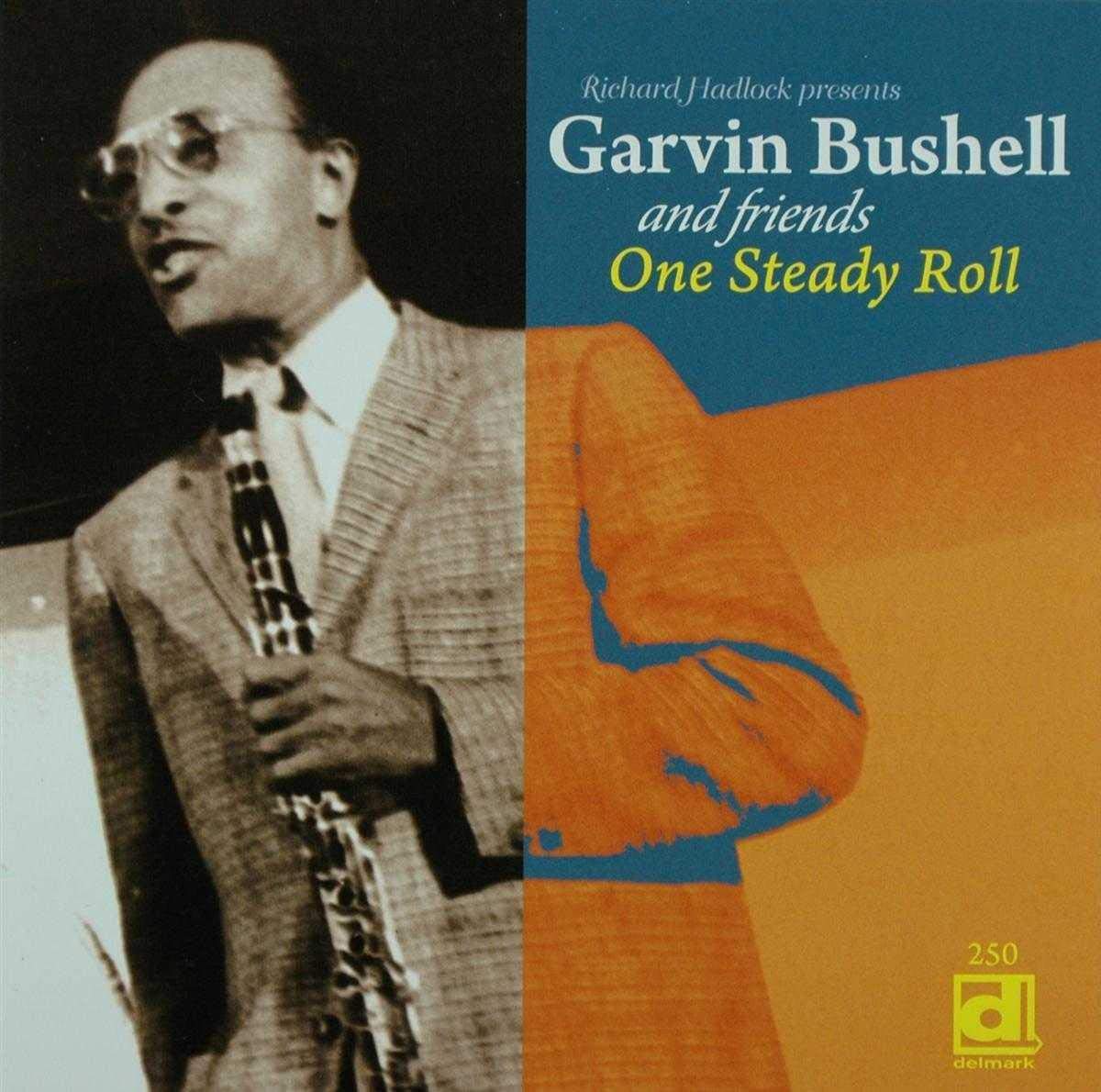
Reed player Garvin Bushell began his career accompanying vocalists in the early 20s:
He played with some of the greatest names in jazz, even providing some of the earliest recorded examples of jazz bassoon:
Bushell moved on to playing lead alto for Cab Calloway and Chick Webb during the swing era:
He was still playing during the so-called “Dixieland revival”:
But he also performed with ultra-moderns like John Coltrane and Eric Dolphy:
Bushell heard and played a lot of music. His autobiography was bound to have great stories and insights into jazz history. But he was just as fascinating when it came to describing the sound of jazz across six decades: regional styles, different approaches to blues, the links and distinctions between ragtime and jazz, musical cross-pollination between cultures, and more.
His references to two- and four-beat styles in early jazz are especially intriguing. This is a popular topic among historians and musicians. It’s safe to say that the recollections of an ear witness published in 1988 are now part of the discourse. But even on their own, Bushell’s comments remain an insightful travelogue and a peek into unexplored routes in jazz history.
Rhythms and Regions
Bushell’s autobiography, Jazz from the Beginning, was first published in 1988 with a revised edition in 1998. It expands on (and corrects) a lot of material from an article published in three parts for The Jazz Review in 1959, “Garvin Bushell and New York Jazz in the 1920s.” Nat Hentoff gets the byline, but it’s mostly Bushell’s words. It’s telling that Bushell’s autobiography incorporates a large chunk of a regional exploration. Geography is a significant part of his musical accounts as well as his personal journey. He traveled extensively, starting when he was barely into his teens, amidst a lot of exciting changes in American popular music.
Bushell first left his hometown of Springfield, Ohio, in 1916 as part of a traveling circus band. The group played in Florida and “parts of the South” as well as Indiana, Illinois, and Kentucky. The music, as well as the experience, left a deep impression. Decades later, alongside remembrances of long hours and lowered standards of hygiene, he recalled the circus band’s repertoire and rhythmic feel:
“…we’d ride on a wagon for the parade and play ‘Beale Street Blues’ or ‘The Memphis Blues’ or ‘The Entertainer’ in fast tempo, or else some old military marches. Other bands played them two to the bar, [but] we’d play them four to the bar.”
Bushell’s bandmates were from Florida, Georgia, and Tennessee, but he grew up hearing bands play in four. He points out that “the jazz bands, however, that I’d heard in Springfield or had heard about [e.g., Freddie Keppard’s Original Creole Orchestra from New Orleans] played in four.” He also notes that among early vaudeville musicians, circa 1920–21, “everybody played four beats.”
Bushell associated the “‘two’ tempo” with ragtime and four with jazz, going back to his earliest music lessons:
“Ragtime, as it was called then, had the technical essence that was later required in jazz. While ragtime was always played in a moderate or fast ‘two’ tempo, jazz merely slowed it down to a fast or medium ‘four.’ Most of all, the old rags had a melodic pattern. Therefore, I began to study rags on piano and omit the melodic pattern, just improvising on the harmonic pattern.”
When Bushell moved to New York City in 1919, he heard that “Negro dance bands in New York played fox trot rhythm and still adhered to the two-beat rhythmic feel.” He does mention “dance bands” here, as opposed to the “jazz bands” he heard playing in four. While the two terms were often interchangeable in American popular music after World War I, Bushell’s usage seems intentional.

In the same passage, he singles out Tony Sbarbro, drummer for the ODJB, as “about the only jazz [emphasis mine] player I heard doing it in two.” Bushell is writing about jazz going back to years before the ODJB released what many consider the first jazz record. Harsh critics depict two-beat jazz as already outdated by the middle of the twenties. Maybe some listeners accustomed to jazz in four heard what the ODJB was doing in the late teens and thought they were rebels!
Who Played How, Where, and When?
Later commentators usually discuss the comparatively looser four-beat feel as a Southern influence during jazz’s development. Some narratives treat the two-beat style as a relic of an archaic eastern style supplanted by the migration of Southern musicians, especially New Orleanians in Chicago. It can seem like the twenties started in two and ended in four. But one of the earliest working jazz musicians tells us that, by the start of the decade, playing in two was rare.
Most of Bushell’s colleagues in the circus band were from lower Southern states. Ohio is a smaller midwestern state that borders two Southern states, so the shared rhythmic approach may not be surprising. Vaudeville, on the other hand, was a popular nationwide entertainment by the turn of the century. Bushell tells us that most, if not all, of the musicians on the circuits played in four. That indicates an early and widespread adoption, suggesting perhaps that:
- The majority of vaudeville musicians were of Southern or Southern-adjacent origin.
- Southern musicians were already a well-established influence.
- Different musical communities across the country shared parallel tendencies.
- Professional musicians in this part of the industry were developing common repertoire and musical practices.
- It was all mere coincidence.
Jazz scholars can offer better hypotheses. I’m comfortable ruling out essentialist explanations. Bushell’s remarks remind us that there were multiple musical communities reflecting a range of cultural and musical identities. Saxophonist, composer, and music historian Allen Lowe often discusses the excitingly messy, non-linear path of American music and how Black culture in particular was not a monolith. Regions, class, and many other distinctions shaped different perspectives and aesthetics, even as individuals, communities, and styles bridged and influenced each other.
In New York City, for example, musicians born there or who “had been in the city so long they were fully acclimated” were, by Bushell’s account, trying to forget Southern traditions, including playing blues and other “low element” music.” Nonetheless, Bushell still talks about jazz bands in the Big Apple, groups who “improvised in the cabarets” with “a different timbre from the big dance [emphasis mine] bands.”
He describes a distinct form of jazz that “leaned to ragtime conception—a lot of notes” without a blues sensibility. “There wasn’t an Eastern performer who could really play the blues,” admits Bushell. “We later absorbed it from the Southern musicians we heard, but it wasn’t original with us.”
This vestigial branch of the jazz history tree is not as well-documented as other styles. By 1922, Bushell says he and fellow eastern musicians “were certainly influenced by New Orleans jazz.” Southern musicians, for example, from Louisiana and Texas, were also influencing players in the Midwest. That means he was a witness to a brief but fascinating and often unexplored chapter in jazz history.
Musician, Witness, and Historian
Of course, these are excerpts from a single musician’s observations made decades later. Bushell also makes a lot of associations about parts of the U.S. regarding how musicians played (as well as some comments about how well they played it). Like most generalizations, attributing a particular musical style to a specific region can get tricky.
But this is what Bushell heard, and he was far from an ordinary witness. He was also able to recall and document what he heard, which isn’t always a given. I’m not a creative or a psychologist, so I won’t analyze professional musicians. But I believe that deeply rooted practices don’t always lend themselves to self-conscious analysis or precise linguistic description. Most musicians were probably too busy playing music to take notes on music history. They were participants, not chroniclers. This is not a criticism. Bushell doubled as history maker and chronicler as well as obbligato clarinet, lead alto, bassoonist, and whatever else the music demanded.
Here’s six minutes of Bushell’s smart, vivid spoken soundography:
 The Pop of Yestercentury