Saying “improvisation is common in jazz” may resemble observing how “stand-up comics often tell jokes.” It might even seem like stating “water usually contains two parts hydrogen to one part oxygen.” For many people, improvisation is a defining aspect of jazz. It may even be the defining feature. Jazz doesn’t simply include improvisation in a unique way; it approaches improvisation unlike any other art form and explores its formal, technical, and expressive potential. Maybe that’s why jazz history seems framed around it. The music’s important composers and arrangers stand out as unique practitioners in a tradition centered on improvising instrumental and vocal performers.
Prepared music—written, memorized or otherwise planned before performance—settles into a complicated position in jazz. Based on a lot of conversations and readings, prepared music might be a silent partner, an active participant, a springboard, an afterthought, a crutch, or a barrier to jazz. Abbey “Chinee” Foster makes it sound like a contradiction. At one point in an interview for Tulane University’s Hogan Archive of New Orleans Jazz Oral History and included in Archeophone’s Cabaret Echoes compilation, the New Orleans-based drummer exclaims that “There’s no music for jazz! There’s no writing for jazz; jazz comes out [of] your head. You never know what you’re going to do until you stumble upon it.”
Foster’s fellow New Orleanian Sidney Bechet expands on this position throughout his autobiography. Treat It Gentle gradually reveals a complicated but overall skeptical view of written music in jazz (what Bechet also refers to as “ragtime” in the book). For example, he tells the reader that “no one can write down for you what you need to know to make the music over again…no one can write down the feeling you have to have. That’s from inside yourself, and you can’t play note by note like something written down.”
Bechet also explains that “we had arrangers back in New Orleans” but advises “you don’t play just because there’s an arranger. He isn’t going to be able to show you how to play…not if you know inside yourself where it is the music has to go.” It sounds like an open-minded and even common-sense point about bringing life to all music, but it follows criticism of the rise of big bands and orchestration:
these [recording] companies got to adding all sorts of instruments. They began adding saxophone in bands: there’d never been a saxophone when we played. About 1921 they even took out the clarinet. And they began having three, four saxophones. And they got arrangers to arrange all these pieces for things like that.
At another point, Bechet implies that written music opens itself up to inauthenticity:
…once you had a thing arranged and down like that, you got to owning it. You could put your name on it and almost believe it really was yours. But you can’t own a thing like that unless you understand a lot more about it than just repeating what’s written down.
Bechet is not saying that every use of prepared music is simply “repeating what’s written down.” But he does imply that written music lends itself to unimaginative or derivative music-making.
The insistence on improvisation as more than an alternative, as an integral conduit to something authentic, becomes both an uplifting call to creative autonomy and a partial dismissal of the expressive potential of prepared music. Even the best transcriber can’t notate feeling, but a skilled musician makes written music moving, individual, and even surprising. Some improvised solos can be predictable, and the best symphonic performances inspire and even surprise audiences. The player, not the thing being played, might be decisive here.
Of course, Foster and Bechet probably weren’t being literal. Bechet even references positive experiences with orchestrated music during his time with Duke Ellington (though he prefers a collective approach where notation follows rehearsal, not the other way around). Even purist musicians and listeners allow some written or rehearsed music.
In a review of McKinney’s Cotton Pickers from the December 1933 issue of Jazz Tango Dancing magazine, critic George Frazier implies a more moderate position. He describes leader and arranger Don Redman’s writing as “over-arranged,” which still makes room for some degree of arrangement. But it better be the right amount of written music.
Frazier unequivocally states that “there is no greater barrier to attaining the true hot than arrangements that are too elaborate. They create a stiffness that is alien to improvisation.” In other words, if you pass a threshold of arranged material, you stifle the potential for improvisation, so intricate scores are anathema to real jazz. He suggests some specific proportion of arrangement to improvisation before a piece of music lost its authorization as jazz. It would have been fascinating to overhear Frazier and Don Redman compare ratios! But the issue here is once again with the written music (and not the musician playing the chart). Written music just impedes the musician’s flow of spontaneously generated music.
Frazier and other purists obviously had a deep aesthetic commitment to the centrality of improvisation in jazz. They had also seen promoters, fans, journalists, and even musicians label almost any form of upbeat popular music as “jazz.” By 1933, maybe enough was enough. For prophets of the “true hot” like Frazier, the insistence on improvisation was one way to kick the pop merchants out of the temple of jazz (even as they also understood that jazz meant more than improvisation).
“Jazz” and Creativity
It’s tempting to associate Frazier and the focus on improvisation as upholding creativity against the crass commercialism of the music business. But if a threshold for written music in jazz seems subjective, so was the word “jazz,” and not just for profiteers. Just as Frazier’s artistic critique may be countering commercial encroachment, the supposedly inauthentic music called “jazz” might have had an aesthetic dimension. There were numerous designs for “jazz” as a commercial product, and there were also ideas about this developing music—including how “jazz and improvisation” was not an inevitability.

In hindsight, categorizing the music of Paul Whiteman, Vincent Lopez, Nathan Glantz, hot dance bands, novelty groups, symphonic jazz orchestras, popular singers, and others as “jazz” might seem funny or frustrating (while reading about Duke Ellington’s “dance band” may seem reductionist). Yet taking these retroactive misapplications at face value creates an interesting parallel history. They contextualize music once referred to as “jazz.” Some will argue it was never anything near jazz, but it does still remain music. This music sheds light on a different aesthetic and things that never left jazz but were redistributed based on different musical priorities in all that jazz-that’s-not-jazz. They also show us the tastes and prejudices—musical or otherwise—of listeners who didn’t think “jazz” needed to concentrate on or even include improvisation.
“Jazz” Doesn’t Need Improvisation
Take George Hahn, writing for Jacobs’ Band Monthly of September 1923 (generously provided by Ralph Wondraschek), who describes how post-World War I-era jazz had too much collective “filling in” (i.e., improvisation or variation of the tune). Thankfully, for Hahn:
…able musicians tamed down [filling in] to one instrument at a time, until today we have it really being done artistically and according to rule…the erstwhile blatant jazz has given way to smoothly flowing beautifully voiced harmony and rhythm…arrangers and directors who took the raw jazz as it came from New Orleans and change it into the aristocratic variety we have today…If jazz was the essence of the noise we experienced in some popular types of music four or five years ago, then we have very little jazz left, as it can be proved with anyone’s ears that noise minus reason is virtually absent in our good orchestras of today.
The class-centric and racially coded language, the reduction of so much music to disorganized “noise,” and Hahn’s condescending approval capture the perfect balance between infuriatingly elitist and comically superficial. Still, in his own way, Hahn was forward-thinking, preferring solo improvisation (i.e., a single player “filling in” at a time) to the collective stuff!
For Hahn, harmony, the orchestrated combination of multiple players presumably based in European classical techniques, stands right next to rhythm in “jazz.” The music only reaches its true potential through scored music. He also singles out the efforts of arrangers and band leaders—the forces some consider responsible for watering down jazz into a mass-produced commodity. It’s like jazz history from an alternate universe.
Many academic jazz histories and mainstream criticisms treat the move toward greater arrangement strictly as a calculation to cash in on the “jazz” craze. But this denies the possibility that some of this music could have been both a commercial and an aesthetic object. For listeners like Hahn, even if we no longer call it jazz, “jazz” was more than just an ephemeral mass product aimed at making a buck.
Don Knowlton’s essay “The Anatomy of Jazz” (from Harper’s Magazine of April 1926) damns “jazz” with faint praise, complimenting the music’s variety within the “simplicity” and “prescribed limitations” in terms of form and emotion. Like Hahn and many other commentators at the time, whatever “jazz” was or would come to be, improvisation was beside the point. In fact, it might just get in the way:
It is the arranger who provides life and color and contrasts and lively dissonances and blasts of indigo harmony and contrapuntal runs…The arranger, while adhering to the formal limitations of jazz, employs in its decoration all of the devices which he can steal from classical music…The ingenuity of the arranger is amazing. For the orchestra, the simplest piece is built up with the utmost care, and jazz orchestrations are as correctly done, as well balanced, and as effective in rendition as are those produced for our symphony orchestras. The days of playing by ear are rapidly passing. Each man must play his part as written, for it has been carefully calculated with respect to every other part…
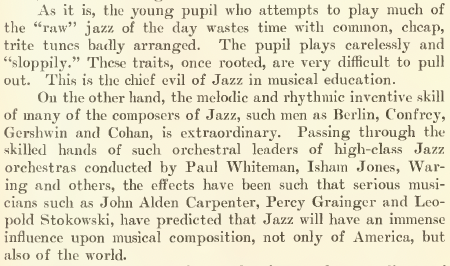
Faithfulness to the score, meticulous rehearsal, arrangers, and bandleaders (not soloists) were finally allowing “jazz” to realize its potential. Instead of hit-or-miss playing by ear, harmony and counterpoint allow jazz to borrow from and compare with symphonic music. In fact, for Knowlton, “jazz’s” true potential was as a road to appreciating European classical music:
The encouraging thing about jazz is that, in its orchestrations, it is initiating countless thousands into sound principles of harmony and counterpoint, and thus definitely raising the average level of musical intelligence. Snort if you will, but the fact remains that the shop girl who has heard Paul Whiteman has taken a step toward appreciation of Beethoven’s Seventh Symphony.
Knowlton makes jazz into homeopathic music appreciation. Eventually, the mature listener will learn to appreciate the indisputable quality of the great European masters (i.e., the handful of German classical composers Knowlton probably swore by).
Paul Whiteman: Musician and Populist
Nearly a century later, using Paul Whiteman as an example may seem hilariously on-the-nose. Whiteman was one of the most commercially successful popular musicians in history based on his work in “symphonic jazz” with its intricate scores, tight ensemble performance, and incorporations of classical techniques and allusions.
Whiteman is still damned with faint praise himself when contemporary historians aren’t outright declaring his work pretentious, shamefully commercial, and racist. In hindsight, his goal of making “a lady out of jazz” seems presumptuous and insensitive. But taking Whiteman’s other comments at face value, he did have an aesthetic mission and creative goals alongside commercial strategies and problematic opinions.
While he may not have liked being called “the king of jazz,” Whiteman confidently called the music he played “jazz.” He collected his views in a 1926 book of the same name. Whiteman highlights the music’s unique rhythmic flexibility by contrasting it with ragtime, explaining that “To rag a melody, one threw the rhythm out of joint, making syncopation. Jazz goes further, ‘marking’ the broken rhythm unmistakably.”
He adds how “jazz” goes even further as combining blues and ragtime “with a certain orchestral polyphony that neither had.” The music’s essential “question and answer, sound and echo…unacademic counterpoint” leave him in awe. A jazz ensemble reaches its full potential in the “counterbalancing of the instrumentation, a realization of tone values, and their placement.”
Whatever Whiteman meant by “jazz,” it was inexorably linked to scored ensemble interplay. In Jazz, he advises that “unless the music is cleverly scored, the greatest musicians cannot make it popular with the public.” But this wasn’t just about selling records and tickets. Perhaps sincerely or self-servingly, Whiteman also suggests trusting audiences, even when they can’t fit in a small club or even a concert hall:
Why should it be supposed that all the good taste in the world is monopolized by a few people? Isn’t it possible that the so-called masses have considerable instinctive good judgment in matters of beauty that they never get credit for? My notion is that beauty is for everybody, that anything too precious for the common gaze is out of place in a world God has created for ordinary people. That’s why I resent the self-assurance of certain high and mighty art circles.
At the same time, Whiteman seemed ambivalent about the word. The concert program for his 1924 Aeolian Hall concert (quoted in Howland’s Ellington Uptown) references “the tremendous strides which have been made in popular music from the day of discordant Jazz [sic]…to the really melodious music of today, which—for no good reason—is still called Jazz.” He told an interviewer for Jacobs Band Monthly of January 1925 that “jazz” was just a word:
I’m not so sure it’s even that. Perhaps it isn’t in the dictionary. I can’t really tell you what jazz is, because we might not understand each other, but I can explain my ideas about music in terms that will mean to you what they do to me. Come to [Boston’s] Symphony Hall tonight and I’ll play some jazz for you. Then you’ll know what I think jazz is. Only I’d just as soon it would be called by some other name.
He also stressed that jazz was still just a “musical treatment”:
With a very few but important exceptions, jazz is not as yet the thing said; it is the manner of saying it. Some critics think this fact establishes the unimportance or even the vulgarity of jazz. I believe it is true that if jazz does not develop its own theme, its own distinctive language, it will fail to be musically valuable. But it will do so.
Knowlton saw “jazz” as the pathway to appreciating European classical music, while Whiteman saw it as a stage in the development of distinctly American music. He sets out his vision in the introduction to Secrets of Dance Band Success, a 1936 compilation of interviews with band leaders and musicians:
Bear in mind that from the dance orchestra will probably be evolved a purely American orchestra that will interpret the emotions of the American people and incidents of American life as accurately and faithfully as the symphonies have done for the old world.
Whiteman had his eyes and ears set on the new world, both geographically and chronologically. In this alternate “jazz” timeline, improvisation was just a stop along the way.
The Dignity of the Written Page
For others, the debate over improvisation in “jazz” (a statement seemingly transmitted from that parallel universe) hinged on upholding tried-and-true values and even cultural dignity against the disorder of new trends. John Howland’s Ellington Uptown provides a musical, historical, and cultural analysis of concert works by Duke Ellington and James P. Johnson. Howland also discusses shifting attitudes toward improvisation among different generations and geographical communities of musicians who had other attitudes toward improvisation.
As Howland explains, with the rise of large show and dance bands like Fletcher Henderson and Erskine Tate during the twenties, some older musicians began tamping down on the greater liberties musicians were taking. Senior Clef Club musicians were especially wary. Howland explains this, in part, as a reflection the New Negro philosophy: self-control and dignity represented in sight-reading and adhering to music written and prepared by trained professionals (over “faking it” and “playing by feeling”).
A speech to Clef Club musicians in June 1921 by Tim Brymn, cited in George Hoefer’s liner notes to The Sound of Harlem LP, puts this philosophy into musical practice. Brymn advises musicians to closely follow the written score and “not try so much of their ‘ad lib’ stuff.” Brymn noticed “a growing tendency to make different breaks, discords, and other things which make a lot of noise and jumble up the melody until it is impossible to recognize it.”
Brymn believed that white musicians “excelled” their Black colleagues because “they are willing to supply novelty music and let it be done by the publisher’s arranger, who knows how to do it.” He goes as far as to say that if musicians find ways to improve the part, “have it done on paper so that the improved way of playing will be uniform and always the same.”
Brymn’s comments are close to the stern warnings from a local musicians’ union published in the correspondence section of The Musical Courier in November 1922:

This correspondence contains bigoted language and assumptions. The insinuation about which musicians do or don’t stick to the score and the cultural assumptions behind those associations is a whole other topic.
Still, for both Brymn and this union official, “jazz” is just fine and maybe even “good” when musicians stick to the printed score. Compare that to today’s jazz lovers who love music that is anything but “uniform and always the same” and love hearing soloists “jumble up the melody.”
Who Needs Musicians
The idea that jazz would be fine if it weren’t for all that pesky improvisation may now seem odd and even insulting. It doesn’t simply leave out some musical element. It distances the improvising musician from the music and disrespects the human being making the sound.
Arthur Lange literally wrote the book on dance band arranging in his time, Arranging for the Modern Dance Orchestra. But his column “Instructive Notes on Modern Dance Orchestra,” published in Metronome in February 1925, makes perhaps the most galling and certainly the most professionally self-serving argument for the importance of arranged music.
Lange attributes the superiority of European orchestras to the musicians receiving credentialed formal training from conservatories. He contrasts them with American musicians, who “just pick up an instrument and enter an orchestra.” Thankfully, professional arrangers and instrumental composers like Lange save audiences from instrumentalists; their “ingenuity for obtaining beautiful results for small orchestra” makes up for the “shortcomings of the American musician” and “lack of individual perfectness [sic].”
Ignore the reality that American musicians attend conservatories, formally trained musicians seek opportunities in popular music, and some of the most gifted musicians are autodidacts. As for “just picking up an instrument” and getting to play in a band, it’s an understatement that defies even ironic statement. Instead, note how Lange admires the musical and creative potential of arrangement for “jazz,” jazz, or any genre.
Lange’s book on arranging shows the care and imagination he put into his creative work, even if it was also commercial work that paid the bills. But his statements here ignore what musicians bring to that work. Taking Lange’s argument literally, he uses a trumpet player like that player uses a trumpet. But there are countless anecdotes about musicians making suggestions, adding embellishments, and doctoring arrangements in the studio and even onstage. We’re back to the idea of musicians adding nothing to the written page. Both Bechet and Lange make musicians into passive elements in creating music. Bechet thinks it’s soulless, and Lange calls it progress.
Music Minus Jazz
Lange, Hahn, Whiteman, and others cited here—and in several critical pieces and interviews during the twenties—illustrate a different attitude toward improvisation in “jazz.” They shed light on whatever many musicians and critics meant by that word. But having a critical attitude on improvisation means not taking it as a given (the same way humans don’t have an opinion on oxygen). It recontextualizes a lot of unimprovised popular music. It may not have been Jazz, and it may have made a lot of money, but it was still music.
 The Pop of Yestercentury